Central Feeding System Manufacturer & Supplier for Factories
How overseas procurement managers and plant engineers should evaluate a central feeding system manufacturer: engineering support, integration, compliance, and s

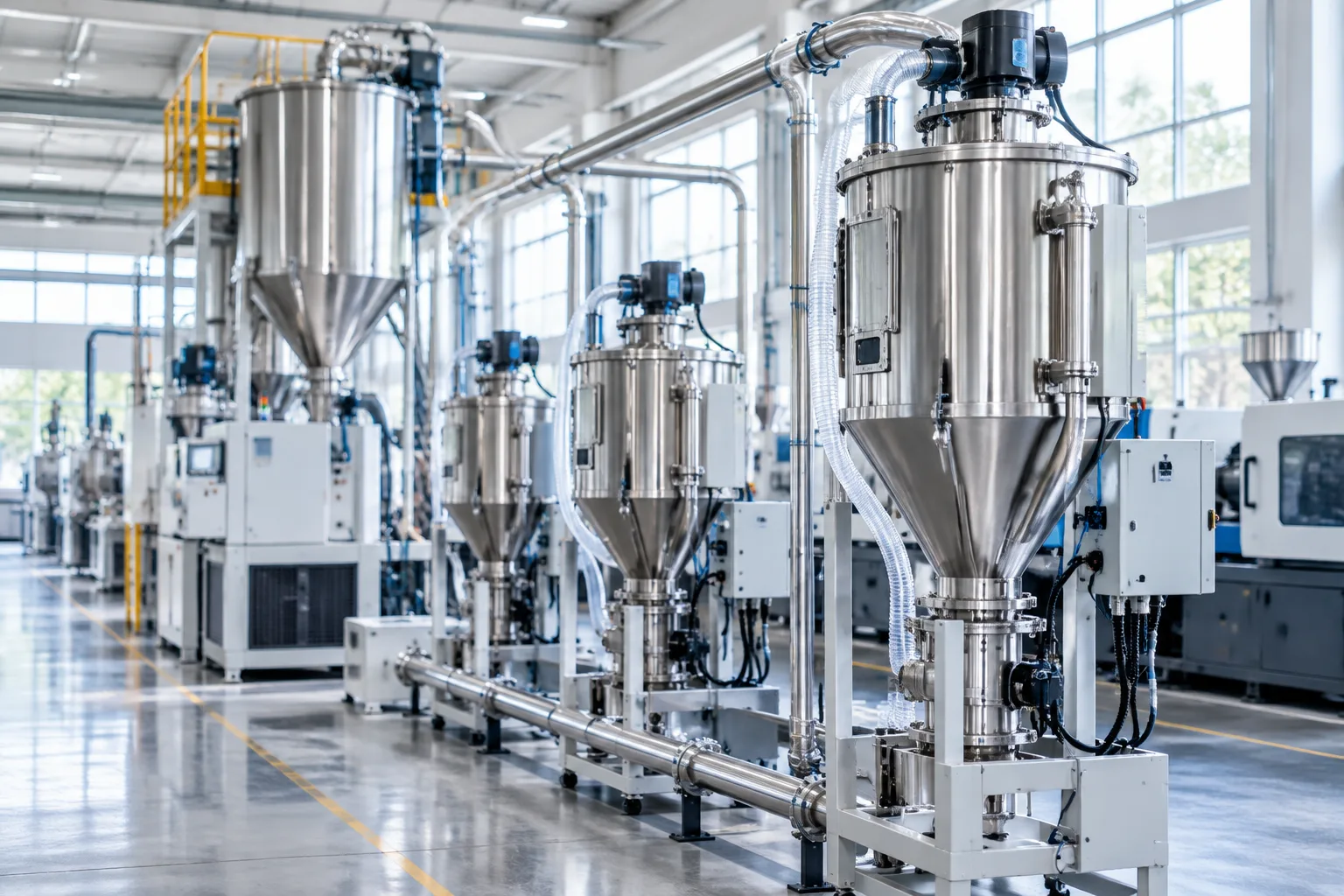
Choosing the right central feeding system manufacturer is one of the most consequential decisions in planning or upgrading a plastics processing plant. A central feeding system is not a standalone machine — it is the backbone that links dryers, loaders, and production floors into one coordinated material flow. When it is engineered well, your operators spend less time handling raw material and more time producing. When it is engineered poorly, the consequences show up as cross-contamination, moisture-regain in resins, unplanned downtime, and inflated labor costs. This article is written for procurement managers and plant engineers evaluating suppliers for a new facility, an expansion, or a retrofit of an existing central conveying setup.
What a Central Feeding System Actually Delivers
Before comparing manufacturers, it helps to be clear about what the system must accomplish. A well-designed central feeding system typically includes:
- Central vacuum loading units sized for simultaneous multi-station conveying
- Piping networks with proper routing, bends, and diameter selection to prevent material degradation or blockage
- Separation stations and distributors serving individual machines
- Drying integration, where dehumidifying dryers feed resin into the conveying loop under sealed conditions
- Centralized controls for monitoring loaders, alarms, and throughput per machine
The value is not in any single component but in how the whole loop is designed around your materials, machine layout, and production plan. That is why the manufacturer’s engineering capability matters as much as the hardware itself.
How to Evaluate a Central Feeding System Manufacturer
Overseas buyers should assess suppliers against criteria that go beyond catalog specifications.
1. Engineering and Application Support
A capable manufacturer will ask for your plant layout, machine list, resin types, and throughput targets before quoting. Be cautious of suppliers who send a price list without asking how far material must travel, how many machines share a loop, or whether hygroscopic resins like PET, PA, or PC are in the mix. The design of conveying velocity, pipe diameter, and station allocation should be derived from your data — not copied from a template.
2. Integration with Upstream and Downstream Equipment
Central feeding rarely operates alone. In most injection molding and extrusion plants, it works alongside dehumidifying dryers, mold temperature controllers, chillers, and granulators. A manufacturer that produces and integrates these auxiliary machines can deliver a matched system with consistent controls, rather than forcing you to coordinate several vendors. Suzhou Tongyi Automation Machinery, for example, supplies central conveying systems together with dehumidifying dryers, mold temperature controllers, chillers, and granulators, which simplifies interface responsibility and after-sales coordination.
3. Build Quality and Compliance
Look for documented quality management — ISO9001 certification is a reasonable baseline for a Chinese industrial equipment manufacturer — and confirm that machines destined for your market carry the CE marking where applicable. Ask to see welding quality on hoppers and piping, the brand of motors and vacuum pumps used, and the electrical cabinet standards (wiring, breakers, contactors). These details reveal more about long-term reliability than a datasheet ever will.
4. After-Sales and Spare Parts Strategy
For overseas buyers, the critical questions are practical: What is the warranty coverage? Which wear parts — filters, seals, hoses, gaskets — are consumable, and how quickly can they ship? Is remote commissioning or on-site installation support available? Can the PLC interface be documented in English? A manufacturer with export experience will have structured answers to all of these.
5. Scalability
Your plant will likely grow. A good system design leaves capacity headroom in the central vacuum units, control I/O, and distribution stations, so adding machines later does not require replacing the whole loop.
Matching the System to Your Application
Different processing contexts demand different system configurations:
- Injection molding plants with many small machines benefit from a multi-station distribution design with individual load cycle control to prevent station starvation.
- Extrusion lines need stable, continuous feeding, so surge hoppers and precise conveying control become priorities.
- PET and engineering resin processing requires tight integration between dehumidifying dryers and the conveying loop to protect dried material from moisture regain between dryer and hopper.
- Recycling and regrind operations call for granulator integration and handling of irregular, dusty materials that demand appropriate filtration and wear-resistant components.
Share your material range honestly during specification — including regrind percentages and dusty or abrasive resins — because underspecified systems are the most common cause of performance complaints.
Practical Sourcing Guidance for Overseas Buyers
- Request a layout-based proposal. Ask the manufacturer to produce a conveying schematic showing pipe routing, station counts, and equipment sizing specific to your floor plan.
- Verify certifications and documentation. Confirm ISO9001 quality management and CE conformity for the equipment scope you are purchasing, and request English manuals and drawings.
- Clarify the commercial structure. Understand what is included — piping, fittings, installation supervision, commissioning, training — versus what will be billed separately, so quotes are genuinely comparable.
- Plan for commissioning. Agree in advance whether start-up support will be remote-guided or on-site, and who provides the compressed air and power infrastructure on your side.
- Check references honestly. A manufacturer with real export experience can describe typical projects and application ranges without necessarily naming clients; vague answers on project history are worth probing.
Working with Suzhou Tongyi Automation Machinery
Suzhou Tongyi Automation Machinery is an industrial auxiliary equipment manufacturer operating under an ISO9001-certified quality management system, with CE-marked equipment for applicable markets. Our product scope covers the full plastics plant auxiliaries chain: central conveying and feeding systems, dehumidifying dryers, mold temperature controllers, chillers, and granulators. Because we manufacture and integrate these products, we can design the feeding loop, drying, and temperature control as one coordinated package, with a single point of contact for installation support, spare parts, and service.
Next Steps
If you are specifying a central feeding system for a new plant or retrofit, the fastest route to an accurate proposal is a short technical exchange: send your machine list, layout sketch, resin types, and target output. Our engineering team will respond with a preliminary system design, equipment selection, and a structured quotation. Contact Suzhou Tongyi Automation Machinery today to start the conversation and move your auxiliary equipment project from planning to installation.