Central Feeding System Manufacturer for Factories
How procurement managers and plant engineers should evaluate a central feeding system manufacturer: engineering support, system integration, certifications, and

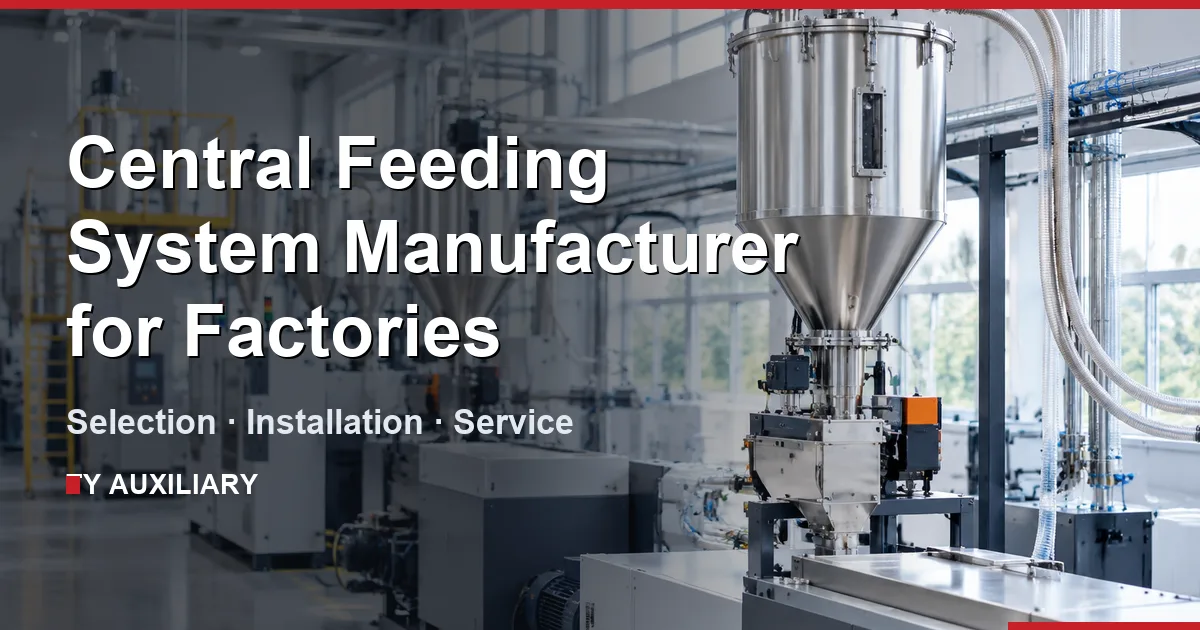
Choosing the right central feeding system manufacturer is one of the most consequential decisions a plastics plant manager makes when scaling up production. A central conveying system sits at the heart of material logistics — moving raw resin, regrind, and additives from storage to every processing machine — and its reliability directly shapes uptime, scrap rates, and labor costs. For procurement managers sourcing equipment from overseas suppliers, the question is not just who can build a system, but who can engineer, deliver, and support one that fits your specific plant layout and material mix.
What a Central Feeding System Must Do in a Modern Plastics Plant
A well-designed central feeding system replaces individual machine-mounted loaders with a centralized network of vacuum conveyors, piping, and distribution stations. Material is drawn from silos, big bags, or drying hoppers and delivered to injection molding machines, extruders, or blow molding equipment on demand. The practical benefits buyers typically evaluate include:
- Reduced manual handling of raw materials, freeing operators for higher-value tasks
- Consistent, moisture-protected material delivery when paired with dehumidifying dryers
- Cleaner production floors and lower contamination risk between material changes
- Centralized monitoring of material consumption across the entire plant
When comparing suppliers, insist on application-level engineering rather than catalog equipment. Resin type, throughput, conveying distance, and the number of processing points all determine pipe sizing, vacuum pump capacity, and station configuration.
How to Evaluate a Central Feeding System Manufacturer Before You Buy
Overseas procurement adds distance and complexity, so your vetting process needs to be systematic. Based on common buying criteria in this industry, focus on the following areas:
Engineering and Application Support
A capable manufacturer should review your plant layout, machine list, and material specifications before quoting. Ask whether they provide piping route drawings, vacuum station layouts, and load calculations as part of the sales process. Suppliers who quote purely from a price list often leave integration problems for you to solve after delivery.
System Integration with Auxiliary Equipment
Central conveying rarely operates alone. It typically works alongside dehumidifying dryers, mold temperature controllers, chillers, and granulators in a complete auxiliary equipment package. Sourcing these from a single supplier simplifies compatibility, spare parts management, and after-sales accountability. Verify that the manufacturer can deliver and match these units, not just the conveyor network itself.
Quality Systems and Compliance
For international buyers, documented quality management is a baseline requirement. An ISO9001-certified manufacturer with CE-marked equipment signals that production and electrical safety practices follow recognized standards. Request certificates directly and confirm they apply to the specific equipment scope you are purchasing.
Installation, Commissioning, and Remote Support
Clarify what happens after shipment. Does the supplier offer on-site installation supervision or commissioning? Are remote diagnostics available? What is the documented process for spare parts ordering? These answers often differentiate suppliers more than product brochures do.
Key Selection Questions to Put on Your RFQ
To make supplier quotes genuinely comparable, standardize your requests. Include these points in your inquiry:
- Conveying capacity calculations based on your resin types and consumption rates
- Pipe and station layout drawings for your specific floor plan
- Compatibility with existing dryers, granulators, and temperature control units
- Electrical specifications suited to your local supply (voltage and frequency)
- Delivery terms, packaging, and installation support scope
- Spare parts availability and response commitments for after-sales service
A manufacturer willing to answer these in writing, with engineering documents rather than generic claims, is generally a safer long-term partner.
Why Buyers Work with Suzhou Tongyi Automation Machinery
Suzhou Tongyi Automation Machinery is an industrial auxiliary equipment manufacturer based in Suzhou, China, serving plastics processing plants with a product range that covers central conveying systems, dehumidifying dryers, mold temperature controllers, chillers, and granulators. The company operates under an ISO9001 quality management system, and its equipment is CE certified for export markets.
For overseas buyers, this integrated product scope matters. Rather than coordinating five vendors for one production line, procurement teams can align conveying, drying, and temperature control under one engineering conversation — reducing interface risks and simplifying service. The company’s approach emphasizes application-based system design: reviewing customer requirements before specifying equipment, and configuring central feeding systems around each plant’s actual material flow rather than forcing standard configurations onto unique layouts.
Buyers should, of course, perform their own due diligence — request references relevant to your industry segment, review detailed technical proposals, and confirm certification documents. A transparent manufacturer will welcome this process.
Next Steps: Getting a System Design and Quotation
If you are evaluating suppliers for a new plant, a line expansion, or an upgrade from machine-mounted loaders, prepare a short brief covering your machine list, resin types, hourly material consumption, and plant dimensions. Share it with shortlisted manufacturers and compare the quality of their engineering responses, not just their pricing.
To start that conversation with a central feeding system manufacturer that also supplies the full range of auxiliary equipment around it, contact Suzhou Tongyi Automation Machinery with your project requirements. A structured technical proposal — including layout recommendations and equipment configuration — is the most reliable first deliverable, and it will tell you a great deal about how the supplier will perform throughout the project lifecycle.