
CE Marking for Plastic Processing Equipment: What Buyers Must Verify
A CE mark is a claim, not a certificate. What documents to request, which directive applies, and the five checks that expose a weak declaration.

A CE mark on a machine is the manufacturer’s declaration that the equipment meets the applicable European directives. It is not issued by a notified body for most machinery, and it is not a certificate — which is why two suppliers can both display CE and provide very different levels of evidence.
For a buyer, the mark itself proves nothing. The documentation behind it does.
Which directive applies to plastic processing equipment?
Usually the Machinery Directive 2006/42/EC, supported by the EMC Directive 2014/30/EU for electrical equipment and, where relevant, the Low Voltage Directive 2014/35/EU. Machinery incorporating a pressure vessel or lasers brings additional directives into scope.
Since the 2023 revision replaced the Machinery Directive with the Machinery Regulation (EU) 2023/1230, declarations issued after the transition period should reference the regulation rather than the directive. A declaration citing only an obsolete standard is a warning sign, not automatically a failure — but it should prompt questions.
What documents should a buyer request?
Five items, in order of usefulness:
- Declaration of Conformity — naming the machine, the directives applied, the harmonised standards used and the authorised signatory.
- Technical file summary — risk assessment, drawings, electrical diagrams and component declarations.
- Test evidence — EMC test report and, where applicable, noise and safety function test results.
- Component certificates — for safety-related parts such as guards, interlocks and safety relays.
- Instructions in the target language — a legal requirement under the directive and a practical indicator of seriousness.
What are the warning signs in a declaration?
| Warning sign | Why it matters |
|---|---|
| No harmonised standards named | conformity cannot be traced to a test basis |
| Declaration copied between models | suggests no model-specific risk assessment |
| No authorised signatory or address | invalid declaration |
| Noise or safety values absent | required content missing |
| Instructions only in another language | non-compliance with the directive |
What about integrated systems rather than single machines?
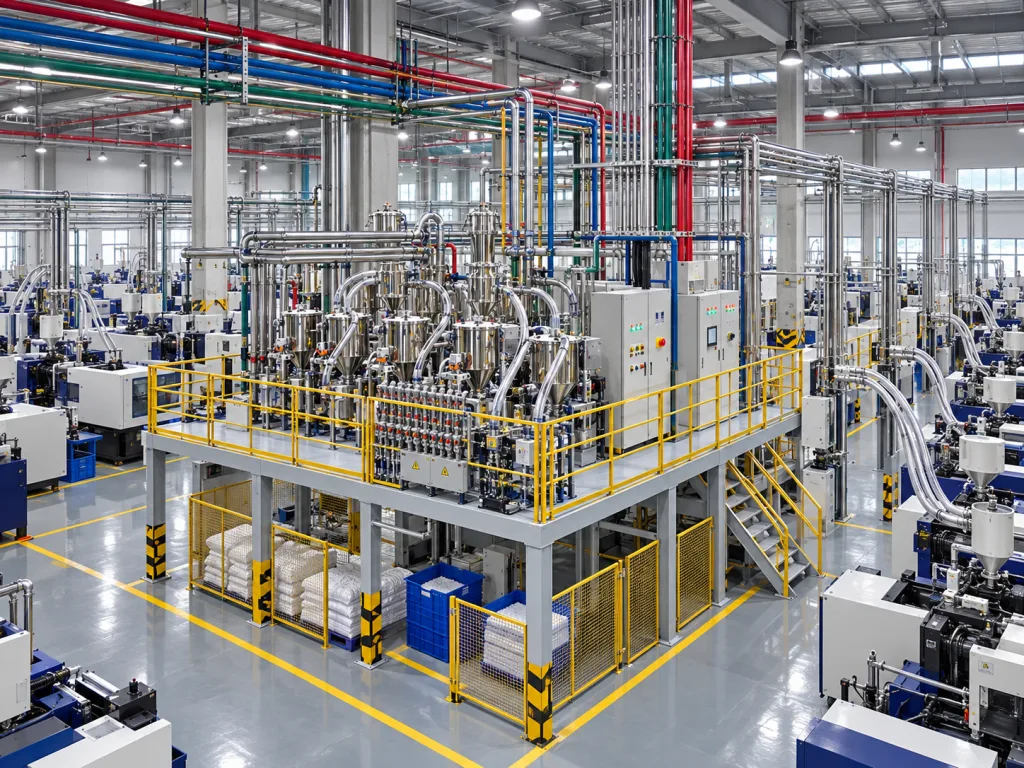
A central feeding system or a complete production line is itself machinery under the directive when it performs a function beyond the sum of its parts. That means the system integrator carries responsibility for the whole assembly, not only for the individual components.
Buyers frequently discover this gap at the point of installation: individual machines each carry a declaration, but nobody has declared the assembled line. Establishing who holds that responsibility before the order is placed avoids a difficult conversation later.
How does this affect a non-EU buyer?
Even where CE marking is not legally required, the documentation is a useful proxy for engineering discipline. A supplier able to produce a coherent technical file, consistent standards references and component certificates is usually also able to support spare parts and warranty claims.
For equipment that will later be re-exported into the EU, the file matters directly: without it, the importer becomes responsible for conformity assessment.
Where to go next
Our equipment is supplied with CE declarations under the Machinery Directive together with the technical documentation needed for import and commissioning. Details are summarised on the company page, and the centralized feeding system page describes how a multi-machine installation is handled as a single assembly.
Tell us the destination market and the equipment scope and our engineers will confirm which declarations and documents accompany the shipment.