Central Feeding System Manufacturer & Supplier
Learn how to evaluate a central feeding system manufacturer for your plastics plant, from line sizing and component integration to certifications.

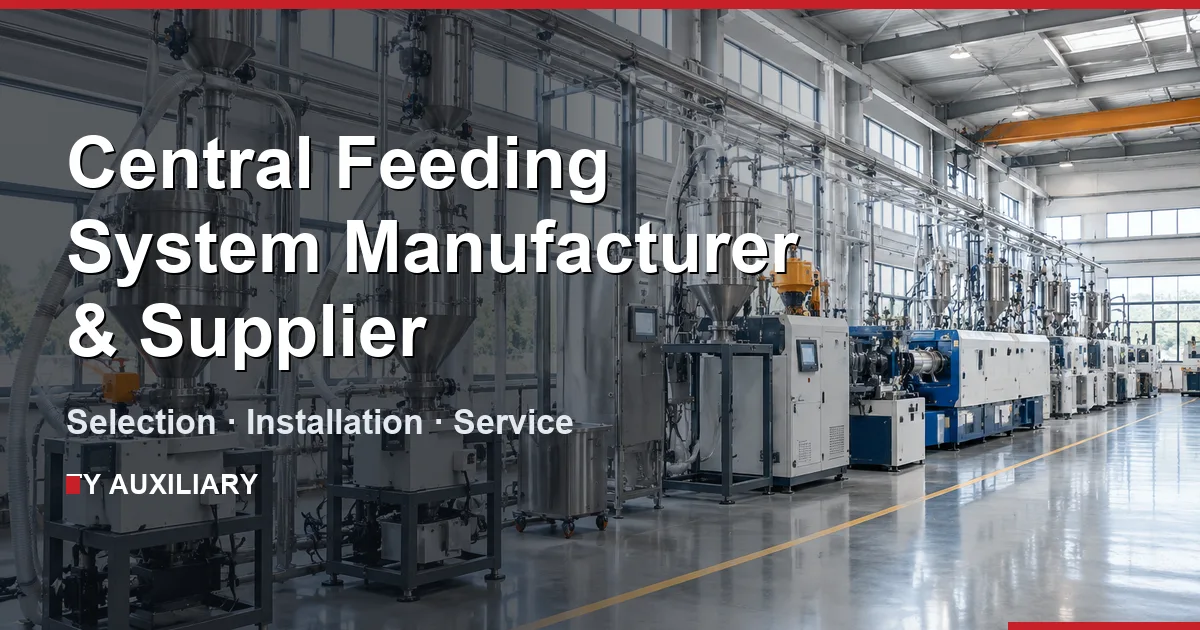
Choosing the right central feeding system manufacturer is one of the most consequential decisions in planning or upgrading a plastics processing plant. A well-engineered central conveying system quietly determines material purity, changeover speed, and labor efficiency across every production line it serves. This guide explains what procurement managers and plant engineers should evaluate before committing to a supplier.
What Does a Central Feeding System Actually Do in a Plastics Plant?
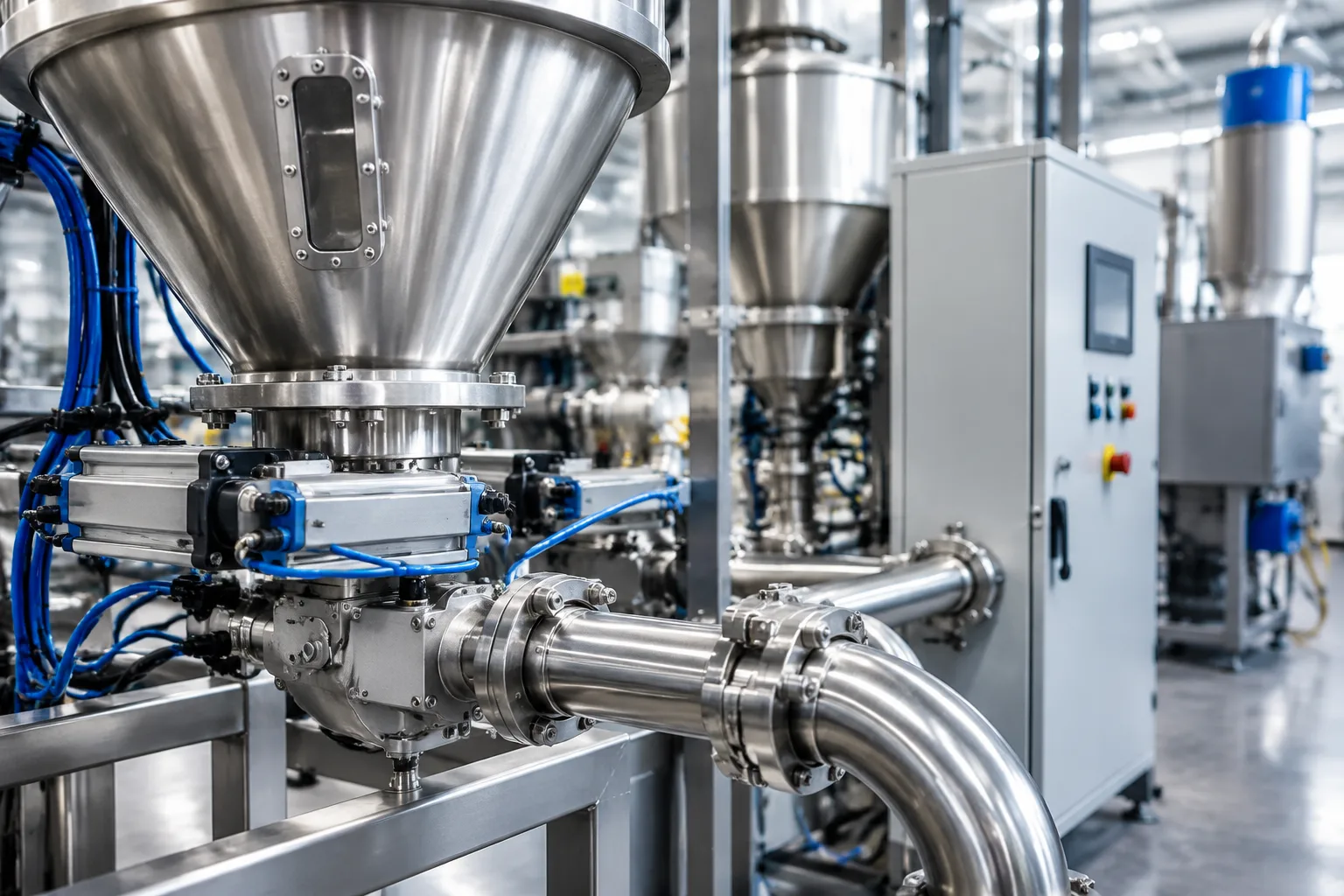
A central feeding system replaces individual single-machine loaders with a networked arrangement: a central vacuum station draws raw material from bulk storage or silos, conveys it through shared or dedicated piping, and distributes it to dryers, blenders, and machine hoppers as needed. Control software sequences loading requests, filters, and valves automatically.
For plants running multiple injection molding machines or extrusion lines, the benefits are practical rather than theoretical:
- One operator manages material supply for the entire floor instead of walking machine to machine
- Material arrives closed-loop from silo to hopper, reducing moisture pickup and contamination
- Changeovers between colors or resins become faster with purge sequencing and shared line routing
- Floor space around each machine is freed from individual loaders and material drums
Which System Configuration Fits Your Plant Layout?
Before contacting any manufacturer, document your baseline. Procurement teams that arrive prepared get sharper quotations and avoid over- or under-specification. Key inputs include:
- Number of processing machines and their hopper capacities
- Materials handled — throughputs, pellet size, whether regrind or masterbatch is involved
- Distances and elevation changes from storage to machines, which determine vacuum pump sizing
- Whether dehumidifying dryers will be integrated, since hygroscopic resins like PET, PA, and PC demand dried-air conveying
From there, a supplier should propose either a dedicated-line or shared-line architecture. Dedicated lines suit high-volume single resins; shared lines with proper valve and filter design suit frequent changeovers. Ask candidates to justify the trade-off for your mix, not just quote the cheaper option.
How Do You Evaluate a Central Feeding System Manufacturer?
Not all suppliers engineer systems to the same depth. When comparing manufacturers, use these criteria:
- Engineering capability: Can the supplier perform line sizing, vacuum calculations, and layout drawings for your specific floor plan, or do they only sell standardized kits?
- Component integration: A credible manufacturer can pair the conveying system with dehumidifying dryers, granulators, mold temperature controllers, and chillers so the whole auxiliary chain works as one coordinated package.
- Quality systems: Look for documented manufacturing standards — for example, ISO9001-certified production and CE-marked equipment — and ask which specific components carry which certification.
- Control and monitoring: Modern systems should offer central touch-screen control with fault diagnostics, and ideally remote monitoring so your team can see loading status without a floor walk.
- After-sales support: Clarify spare parts availability, remote commissioning, documentation in your working language, and typical response times before you sign.
What Should You Confirm Before Finalizing an Order?
Commercial-investigation buyers often focus on unit price and miss integration risk. Before awarding the contract, confirm in writing:
- Pipe routing drawings matched to your plant, with material-contact surfaces specified (stainless steel where required)
- Filter and separator types per material station, especially for regrind or dusty powders
- Acceptance criteria: conveying rate per line, leak tightness, and control sequence tests at commissioning
- Training scope for your operators and maintenance staff
- Warranty terms and the list of wear parts you should stock locally
A manufacturer who answers these points precisely during the quotation stage is far more likely to deliver a system that runs as promised than one who treats them as post-sale details.
Why Do Buyers Source Central Feeding Systems from China?
Overseas buyers increasingly source auxiliary equipment from Chinese manufacturers because the engineering-to-price balance has improved substantially. Established suppliers now export complete auxiliary packages — conveying, drying, temperature control, cooling, and size reduction — as integrated solutions rather than standalone machines. Suzhou Tongyi Automation Machinery, an ISO9001-certified manufacturer with CE-marked equipment, works with international plastics processors on exactly this basis: system-level engineering, factory-direct pricing, and support structured for export projects.
The practical advantage is coordination. When one supplier is responsible for the dryer, the conveying lines, and the temperature control loop, interface problems between machines become that supplier’s problem to solve — not yours to mediate.
What Is the Next Step for Your Project?
If you are shortlisting a central feeding system manufacturer, start by sending potential suppliers a simple brief: machine list, materials, plant layout sketch, and expansion plans. A competent manufacturer will respond with a preliminary line diagram, sizing rationale, and a transparent quotation — the quality of that first response tells you most of what you need to know.
Suzhou Tongyi Automation Machinery welcomes these project discussions. Share your plant requirements with our engineering team, and we will propose a central feeding configuration sized to your production — with drying, cooling, and granulation equipment integrated where your process needs it.