
How Much Does an Industrial Mold Temperature Controller Cost from the Factory?
Compare documented product features and process requirements before selecting a mold temperature controller.
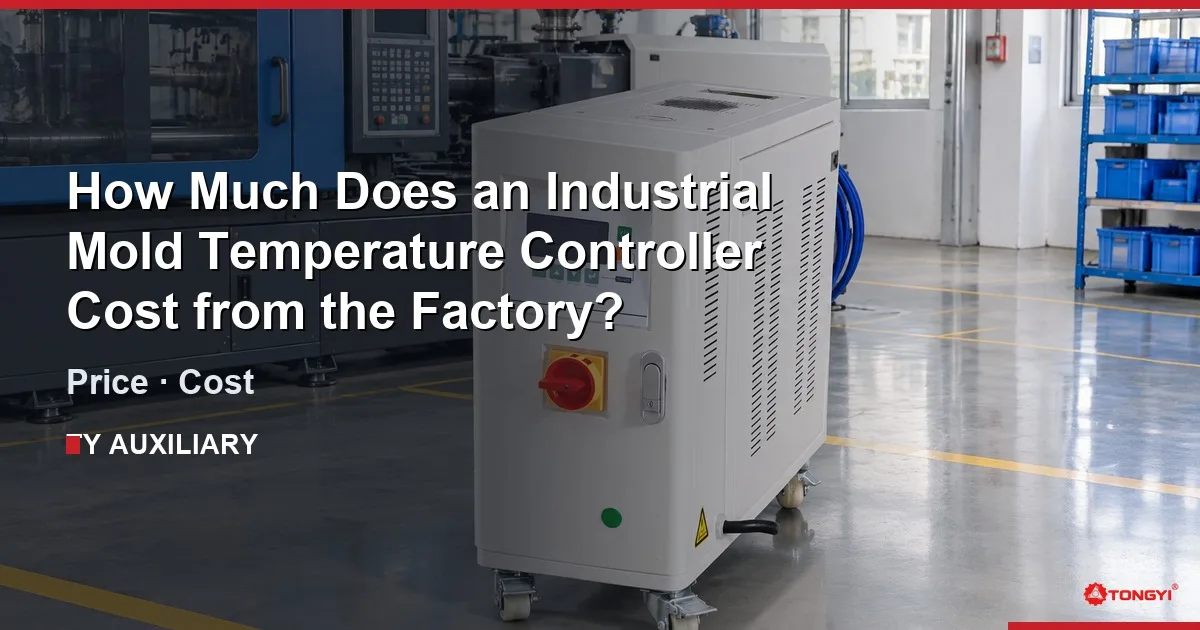
What Determines the Price of a Mold Temperature Controller?
Water-type mold temperature controllers in the same product family are usually built around a shared platform, so the biggest cost variables within a series are the heating and circulating components. Using our single-zone water-type series as a reference, the verified range runs from a 6 KW heating / 0.37 KW pump unit up to a 36 KW heating / 2.2 KW pump unit — a six-fold difference in heater power that naturally separates the entry-level and high-capacity price points.
The main cost drivers are:
- Heater power (KW). Larger heaters cost more and may require higher-amperage supply wiring on your side. If your mold only needs to hold 120 °C, paying for excess heater capacity is wasted budget.
- Pump power and flow (L/MIN). Flow determines how much heat the unit can deliver to the mold. Higher-flow pumps are more expensive and, in this series, trade off against maximum pressure (see below).
- Plumbing configuration. The number and size of media inlet/outlet ports affect manifold complexity. A 2-in/2-out splitter with 3/8-inch ports is simpler to build than a 1-in/1-out circuit with 1-inch or 1.2-inch ports.
- Maximum pressure rating (MPA). A higher-pressure pump and vessel add cost; you only need this if your circuit requires it.
- Control components. The thermocouple type (all models in this series use a K-type probe thermocouple), controller features, and safety interlocks all influence the factory price.
- Order quantity, freight, and destination requirements. Factory pricing typically improves with volume, and US-bound shipments must account for ocean/air freight and any local electrical or installation requirements you specify.
How the Model Range Maps to Price Tiers
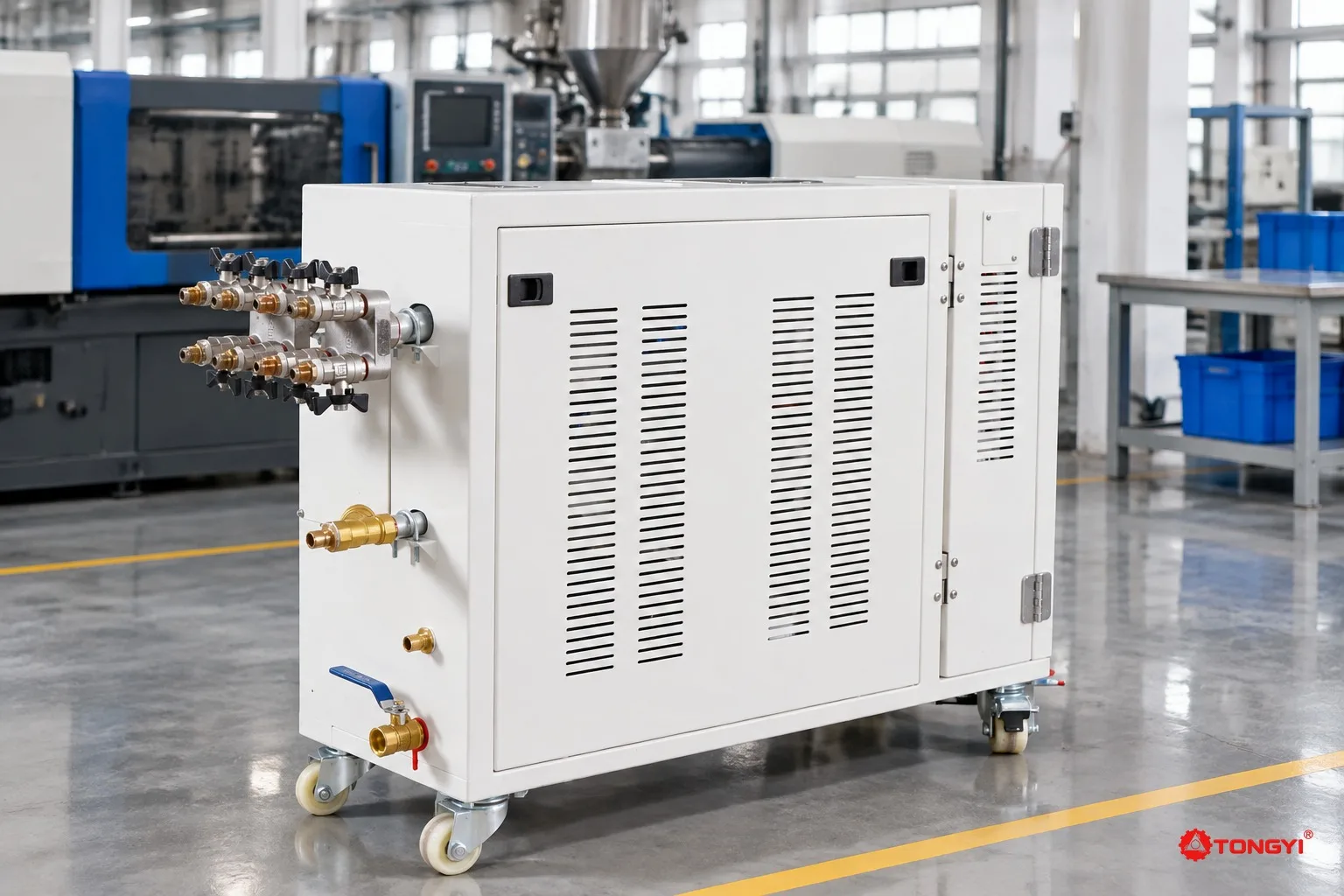
Because the price scales with capacity, it helps to see the verified single-zone water-type models side by side. All models share the same heat transfer medium (clean water), the same maximum temperature of 120 °C, direct cooling, and K-type probe thermocouples — so the differences below are essentially the price-driving differences:
| Model | Heater Power | Pump Power | Max Flow | Max Pressure | Media Ports | Splitter |
|---|---|---|---|---|---|---|
| TMC 60W | 6 KW | 0.37 KW | 42 L/MIN | 0.35 MPA | 3/8 inch | 2 in / 2 out |
| TMC 90W | 9 KW | 0.75 KW | 60 L/MIN | 0.4 MPA | 3/8 inch | 2 in / 2 out |
| TMC 120W | 12 KW | 0.75 KW | 60 L/MIN | 0.4 MPA | 3/8 inch | 4 in / 4 out |
| TMC 180W | 18 KW | 1.5 KW | 165 L/MIN | 0.25 MPA | 1 inch | 1 in / 1 out |
| TMC 240W | 24 KW | 1.5 KW | 165 L/MIN | 0.25 MPA | 1 inch | 1 in / 1 out |
| TMC 360W | 36 KW | 2.2 KW | 310 L/MIN | 0.3 MPA | 1.2 inch | 1 in / 1 out |
Two documented trade-offs in this table are worth understanding before you compare quotes. First, flow and pressure do not rise together: the TMC 60W delivers 42 L/MIN at up to 0.35 MPA, while the much larger TMC 180W moves 165 L/MIN but at a maximum pressure of only 0.25 MPA. A higher-flow pump in this series operates at a lower maximum pressure, so a buyer who needs both high flow and high circuit pressure should confirm the duty point with the factory rather than assume one rating implies the other. Second, port plumbing changes character across the range: the smaller TMC 90W uses a 2-in/2-out splitter with 3/8-inch media ports, the TMC 120W expands that to 4-in/4-out on the same 3/8-inch ports for multi-circuit molds, and the TMC 180W and TMC 240W switch to a single 1-in/1-out circuit with 1-inch ports. Your mold’s channel layout, not just heater size, should determine which configuration you quote.
Note that every model in this series tops out at 120 °C and uses clean water as the medium. If your process requires higher mold temperatures, that is a different product class (typically oil-type or pressurized water units) with a different price structure — flag it in your inquiry so the factory quotes the right category.
Why Factory Direct Pricing Differs from Distributor Pricing
Buying from the factory (manufacturer direct) usually removes one or more layers of markup, and it gives you direct access to engineering staff who can confirm sizing. The trade-off is that you take on more responsibility for specification, logistics, and after-sales coordination. When comparing a factory quote against a local distributor quote, make sure you are comparing the same scope: freight terms, voltage/frequency configuration, spare parts, warranty terms, and installation support all affect the landed cost, not just the unit price.
What to Include in a Factory Quote Request
A precise inquiry gets you an accurate price faster and prevents change-order costs later. Include:
- Mold heat load estimate or heater power target — this is the single biggest price variable.
- Required mold temperature — confirm whether 120 °C maximum (water-type) is sufficient for your resin and cycle.
- Required flow rate — based on your mold’s cooling channel diameter, length, and number of circuits; this determines whether a 60 L/MIN unit like the TMC 90W is enough or you need a 165 or 310 L/MIN machine.
- Number of mold circuits — dictates the splitter configuration (2-in/2-out, 4-in/4-out, or 1-in/1-out) and port size.
- Available power supply — voltage, phase, and frequency at your US facility, since heaters from 6 KW to 36 KW have very different electrical demands.
- Cooling water conditions — all models in this series set their minimum operating temperature at cooling water temperature plus 5–30 °C, so your plant water temperature sets the floor of the control range.
- Quantity and delivery destination — for freight terms and volume pricing.
How to Compare Factory Quotes on a Like-for-Like Basis
Once quotes arrive, normalize them before comparing numbers:
- Confirm every quote references the same heater power, pump flow, and pressure ratings — a “similar” 12 KW unit with a lower flow pump is not equivalent to the TMC 120W.
- Check that maximum temperature, medium (clean water), and cooling method (direct) match across quotes.
- Verify the temperature sensing method — this series uses K-type probe thermocouples; a cheaper unit with a different sensor type may not hold the same control behavior.
- Ask what is excluded: freight, spare heater elements, gaskets, controller calibration certificates, and commissioning support are common add-ons.
- Ask the factory to confirm in writing that the published specifications still apply — the series carries a standard notice that specifications may change without prior notice, so your order confirmation should lock the values.
Getting a Firm Price from the Factory
If you can state your mold temperature, required flow, number of circuits, and facility power supply, a factory can typically quote a specific model — for example, whether a TMC 90W or a TMC 240W fits your application — along with freight and lead time. If you are unsure which capacity you need, send your mold drawings or cooling channel layout; the manufacturer’s engineers can recommend a model and quote accordingly. For related temperature control equipment, see our mold temperature controller lineup and water-type temperature control units.
Get a specification-matched quote
Send the mold size, required working temperature, cooling channels per circuit and your electrical supply. We reply with a like-for-like configuration and the documented specifications for each model in the offer.
Every figure in this guide comes from our published specification sheets. Confirm model scope and test conditions before ordering.