
How Much Does an Industrial Mold Temperature Controller Cost? Getting a Price Quote
Learn which specifications and project details determine an industrial mold temperature controller price and what to include in a comparable quote request.

What Determines an Industrial Mold Temperature Controller Price?
A mold temperature controller combines heating, circulation, and temperature control in a package used to condition mold heating and cooling circuits. Its commercial value depends heavily on the duty expected from those functions. A unit selected only by nominal model number may be unsuitable if its circulation capacity, pressure rating, or connections do not match the mold.
The electrical heater capacity is one of the most visible specifications in a quotation. In the verified TMC series, electric heating capacity ranges from 6 KW for the TMC 60W to 36 KW for the TMC 360W. Higher heater capacity generally corresponds to greater equipment capability, but it should not be treated as a stand-alone selection criterion. The supplier should assess the proposed unit against the intended circuit and application.
Pump performance also affects selection and commercial positioning. The verified models provide maximum flows from 42 L/MIN to 310 L/MIN, depending on the model. Maximum flow describes the pump’s rated maximum delivery under the stated product conditions; it does not establish that every mold will receive that flow. Actual circuit demand, fluid path restrictions, and heat transfer requirements must be confirmed with the supplier.
Pressure is a separate rating from maximum flow. The available maximum pressures are 0.25 MPA to 0.4 MPA, depending on the exact model. Neither rating should be substituted for the other. Buyers should provide the expected system resistance and circuit design so the supplier can verify whether the selected pump and connections are suitable.
Temperature requirements, fluid type, controls, connection sizes, and shipping scope can also affect the quote. Because the available database information does not include pricing, control configuration, optional accessories, warranty terms, or freight terms, a responsible quote cannot be inferred from the model name alone.
How to Compare the TMC Series Before Requesting a Quote
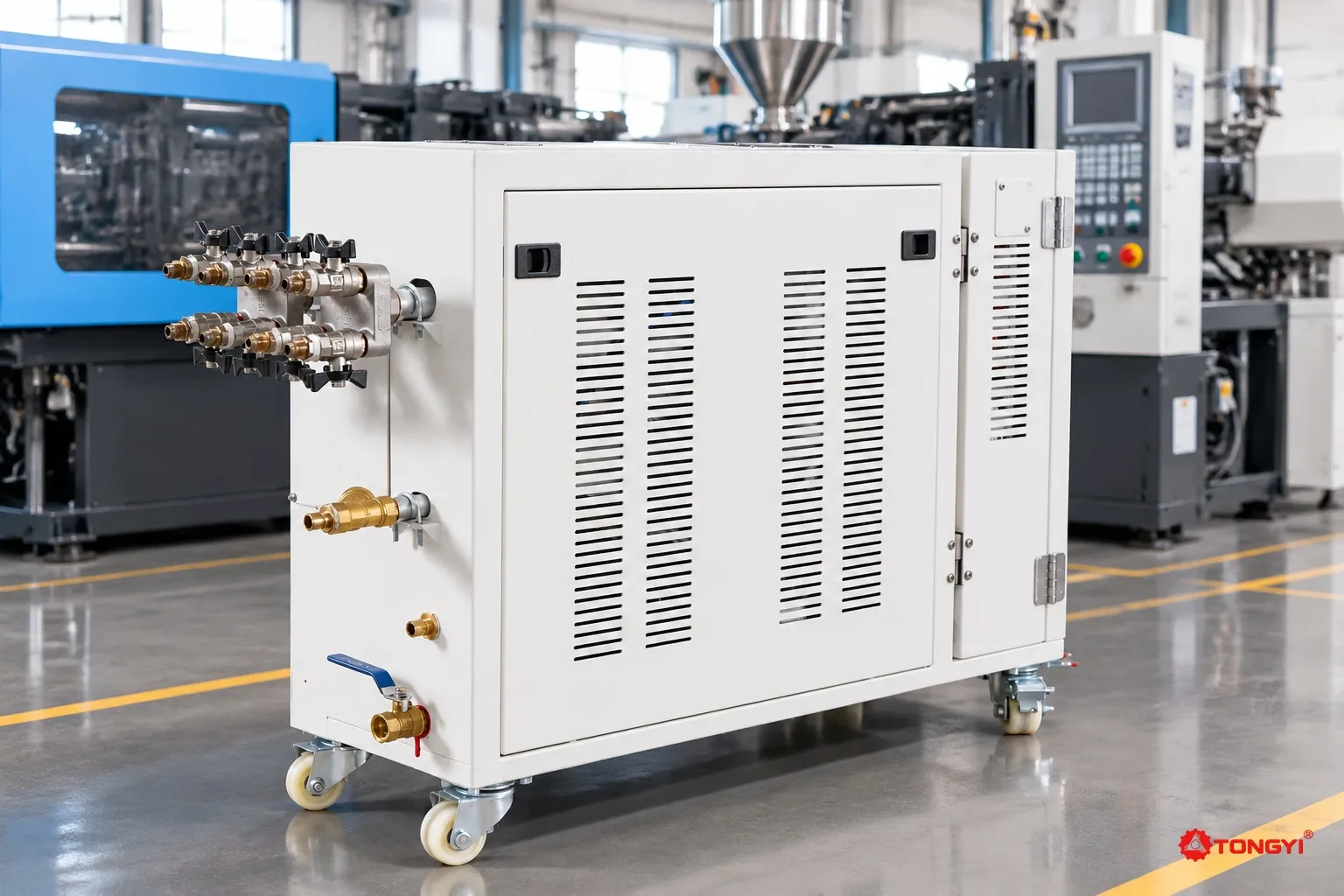
The following comparison uses verified specifications for single-temperature models using clean water as the heat-transfer medium. It is intended to help buyers organize model information; it is not a statement that every model is appropriate for a particular mold.
| Model | Maximum temperature | Electric heating capacity | Pump power | Maximum flow | Maximum pressure | Media connections |
|---|---|---|---|---|---|---|
| TMC 60W | 120 °C | 6 KW | 0.37 KW | 42 L/MIN | 0.35 MPA | 3/8 INCH |
| TMC 90W | 120 °C | 9 KW | 0.75 KW | 60 L/MIN | 0.4 MPA | 3/8 INCH |
| TMC 120W | 120 °C | 12 KW | 0.75 KW | 60 L/MIN | 0.4 MPA | 3/8 INCH |
| TMC 180W | 120 °C | 18 KW | 1.5 KW | 165 L/MIN | 0.25 MPA | 1 INCH |
| TMC 240W | 120 °C | 24 KW | 1.5 KW | 165 L/MIN | 0.25 MPA | 1 INCH |
| TMC 360W | 120 °C | 36 KW | 2.2 KW | 310 L/MIN | 0.3 MPA | 1.2 INCH |
For example, the TMC 90W and TMC 120W both use clean water, provide direct cooling, and are specified for a maximum temperature of 120 °C. Their documented maximum flow is 60 L/MIN, and their maximum pressure is 0.4 MPA. The TMC 120W has a 12 KW electric heater compared with 9 KW for the TMC 90W, while both list 0.75 KW pump power. This comparison is useful for quote structuring, but the supplier still needs the mold’s heating and cooling load to determine which capacity is justified.
Another documented trade-off appears in the TMC 180W and TMC 240W. Both have a maximum flow of 165 L/MIN, a maximum pressure of 0.25 MPA, and 1 INCH media connections. Their electric heating capacities are 18 KW and 24 KW, respectively, and both list 1.5 KW pump power. The lower pressure rating relative to the TMC 90W and TMC 120W makes circuit details especially important when comparing all four models for one application.
The TMC 360W lists the highest verified maximum flow in this series at 310 L/MIN and the highest electric heater capacity at 36 KW. Its maximum pressure is 0.3 MPA, its pump power is 2.2 KW, and its media connections are 1.2 INCH. These are maximum ratings and should be checked against the actual hydraulic circuit rather than treated as guaranteed operating values.
What Information Should Be Included in a Price Request?
A complete quote request allows a supplier to evaluate the equipment and establish a technically comparable offer. Buyers should include the following core information:
- Exact model or model range: Name the TMC model under consideration, or explain the application so the supplier can propose the closest verified option. This avoids receiving a price for equipment with the wrong capacity or connections.
- Maximum operating temperature: State the required process temperature and how long it must be maintained. All listed TMC models have a documented maximum temperature of 120 °C, so the quote should also confirm whether the requested duty falls within the supplier’s intended operating envelope.
- Minimum operating requirement: The listed models specify a minimum temperature of cooling water temperature +5~30°C. Confirm the site cooling-water conditions, available temperature margin, and expected operating mode with the supplier.
- Heat-transfer medium: The verified TMC configurations use clean water. State the proposed medium, contamination concerns, and any material compatibility requirements so the supplier can confirm suitability.
- Heating and cooling demand: Provide the available electrical supply, estimated heating requirement, start-up conditions, and expected duty cycle. The heater capacity in the quotation should be compared with those requirements.
- Flow and pressure requirements: Provide the required flow, circuit restrictions, and expected operating pressure. Ask the supplier to check the pump ratings against the complete circuit rather than comparing maximum flow alone.
- Connection arrangement: Specify the number of supply and return branches and the required media connection size. The verified series includes 2In2Out, 4In4Out, and 1In1Out configurations with 3/8 INCH, 1 INCH, or 1.2 INCH media connections, depending on model.
- Controls and accessories: List any required temperature-control functions, sensors, interfaces, valves, or other accessories. The supplied specifications identify a K-type probe thermocouple for the media inlet and outlet, but the full control scope must be confirmed in the quotation.
Which Cost Drivers Should Buyers Compare Across Suppliers?
When evaluating how much an industrial mold temperature controller will cost, compare the complete offer rather than only the equipment entry. The scope of included components can change the commercial terms significantly, particularly when accessories, special connections, controls, documentation, and delivery are treated differently by each supplier.
Start with the base machine and confirmed model. Then review the heater capacity and pump specifications as the main equipment cost indicators within the verified series. For example, comparing a 6 KW TMC 60W with a 36 KW TMC 360W is not meaningful without evaluating the intended heating load, circulation demand, and circuit design.
Next, establish what the price includes. Ask whether the quotation covers the complete temperature controller assembly, specified probe, manifold arrangement, connection fittings, electrical components, operating documentation, packaging, and freight. Also request the terms for any accessories or modifications that may be needed after technical review.
Commercial terms also need to be stated clearly. The quote should identify taxes or duties, payment terms, production lead time, delivery terms, warranty coverage, spare-parts availability, and technical support. These inputs affect the total procurement cost even when the quoted equipment configuration is the same.
Because the available product information contains no currency values, this article does not state a price range or estimate. The defensible approach is to request a model-specific quotation based on a complete application and then compare quotes using the same scope and commercial basis.
How to Avoid a Mismatched Mold Temperature Controller Quotation
The most common sourcing risk is quoting a unit without defining the mold circuit. Before accepting a price, ask the supplier to confirm the model against the application in writing. The confirmation should address temperature, medium, flow, pressure, connection arrangement, heater capacity, and electrical requirements.
Do not ask the supplier to guarantee mold temperature uniformity based only on controller specifications. The verified data identifies the temperature probe type and equipment temperature range, but it does not provide a temperature-accuracy value, uniformity guarantee, test condition, or application result. Those claims would require separate, model-specific verification under defined conditions.
Also review how minimum-temperature operation is described. The models use direct cooling and specify a minimum temperature as cooling water temperature +5~30°C. The buyer should clarify how this boundary applies to the intended cooling-water supply and operating sequence, especially when the process requires stable low-temperature conditions.
A revised request should include any missing application information and ask for an updated, itemized quotation. This is more useful than comparing headline prices from quotes that cover different duties, accessories, or delivery scopes.
Next Step for Procurement Teams
To obtain a useful industrial mold temperature controller price quote, prepare one application sheet for each mold or process line. Include the target model, operating temperatures, heat-transfer medium, heating load, flow and pressure needs, connection layout, control requirements, available electrical supply, and delivery destination.
Then ask each supplier to confirm the proposed model and list the commercial scope. This approach produces quotations that technical engineers can evaluate and procurement teams can compare without relying on unsupported price estimates.
Get a specification-matched quote
Send the mold size, required working temperature, cooling channels per circuit and your electrical supply. We reply with a like-for-like configuration and the documented specifications for each model in the offer.
Every figure in this guide comes from our published specification sheets. Confirm model scope and test conditions before ordering.