
How Much Do Industrial Mold Temperature Controllers Cost, and Where Are They for Sale?
Industrial mold temperature controller price depends on heating capacity, pump specs, and customization, so request a formal supplier quotation.
What Determines the Price of a Mold Temperature Controller?
Buyers searching for pricing information usually find a wide spread between offers, and the difference almost always comes down to configuration rather than markup alone. The main cost drivers are:
- Heating capacity. Heater power is one of the largest single cost items. A controller sized for a small mold needs far less heating element and electrical infrastructure than one serving a high-throughput line.
- Pump power and flow rate. Larger pumps cost more to buy and to run. Flow capacity determines how much heat the unit can actually deliver to the mold, so undersizing here to save money is a false economy.
- Temperature control range and cooling method. Higher maximum temperatures and more sophisticated cooling circuits add components and cost.
- Control system and safety features. Thermocouple type, controller quality, alarms, and pressure protection all affect the quoted figure.
- Customization and compliance. Voltage/frequency matching for your facility, special plumbing, and documentation requirements change engineering effort and therefore price.
Because of these variables, a responsible supplier will ask for application details before quoting. If a seller offers a single flat price without asking about your mold, press size, and process temperature, treat that quote with caution.
Which Specifications Should You Include in a Quote Request?
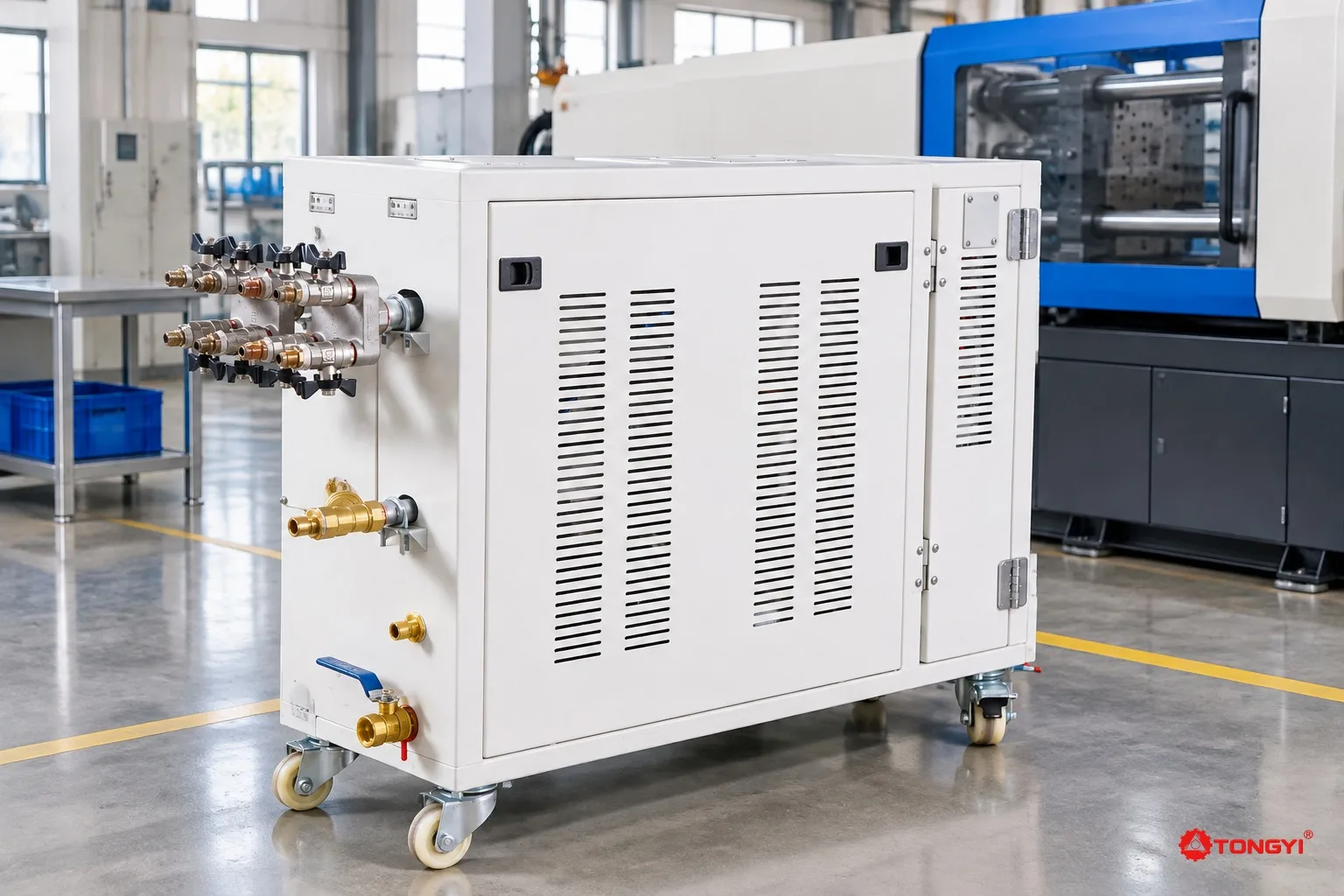
To receive comparable pricing from multiple suppliers, your request should state the parameters that define the machine. The following verified specifications from a standard water-type single-temperature series illustrate exactly what buyers compare — these are the values worth putting in writing for any controller you are considering.
Verified model comparison: water-type single-temperature series
| Model | Heat medium | Max temp | Heating power | Pump power | Max flow | Max pressure | Cooling | Media ports |
|---|---|---|---|---|---|---|---|---|
| TMC 60W | Clean water | 120 °C | 6 kW | 0.37 kW | 42 L/min | 0.35 MPa | Direct | 3/8 inch, 2-in/2-out |
| TMC 90W | Clean water | 120 °C | 9 kW | 0.75 kW | 60 L/min | 0.4 MPa | Direct | 3/8 inch, 2-in/2-out |
| TMC 120W | Clean water | 120 °C | 12 kW | 0.75 kW | 60 L/min | 0.4 MPa | Direct | 3/8 inch, 4-in/4-out |
| TMC 180W | Clean water | 120 °C | 18 kW | 1.5 kW | 165 L/min | 0.25 MPa | Direct | 1 inch, 1-in/1-out |
| TMC 240W | Clean water | 120 °C | 24 kW | 1.5 kW | 165 L/min | 0.25 MPa | Direct | 1 inch, 1-in/1-out |
| TMC 360W | Clean water | 120 °C | 36 kW | 2.2 kW | 310 L/min | 0.3 MPa | Direct | 1.2 inch, 1-in/1-out |
Reading the numbers: two values that most affect cost and fit
First, look at heating power. Within this series it spans 6 kW on the TMC 60W up to 36 kW on the TMC 360W, and heater capacity is a primary price driver because it determines element size, contactor rating, and the electrical supply your plant must provide. Choosing between, say, the 12 kW TMC 120W and the 24 kW TMC 240W is a genuine cost decision — the larger unit heats faster and holds temperature under heavy load, but it also demands more from your facility’s power infrastructure.
Second, examine maximum pump flow, which ranges from 42 L/min on the TMC 60W to 165 L/min on the TMC 180W and 240W, and 310 L/min on the TMC 360W. Flow is what actually carries heat into the mold channels; two controllers with similar heating power can behave very differently in the tool if flow differs. Note the documented trade-off in this series: the larger-flow models (TMC 180W, 240W) carry a maximum pressure of 0.25 MPa, lower than the 0.4 MPa of the TMC 90W and 120W, so if your mold circuit has high resistance, confirm with the supplier that the duty point meets your needs — maximum flow and maximum pressure are separate ratings, not a guarantee of both simultaneously.
Other series-level specifications worth noting: every model in this group uses clean water as the heat medium with direct cooling, a maximum temperature of 120 °C, a minimum operating temperature of cooling water temperature plus 5–30 °C, and K-type probe thermocouples for media temperature sensing. Return porting is 15 mm across the series. If your process requires temperatures above what a water unit provides, ask the supplier about oil-type alternatives rather than assuming the same pricing structure applies.
Where Are Industrial Mold Temperature Controllers for Sale?
These units are sold through three main channels, each with pricing implications:
- Direct from manufacturers. Buying factory-direct, typically from manufacturers exporting to the US market, usually gives the best unit pricing and access to engineering support for sizing. This is the channel where customization requests (voltage, plumbing, control features) are handled most easily.
- Distributors and agents. Local stocking distributors charge a premium but offer faster delivery, local warranty handling, and in-person service. For plants that cannot tolerate downtime, this premium is often justified.
- Online marketplaces. B2B platforms list many controllers for sale, but listings frequently omit the exact specifications that matter. Use them to identify suppliers, then verify specifications directly before purchasing.
Whichever channel you use, the price you are quoted is only meaningful if the specification behind it is explicit. A lower price for an undersized pump or an undocumented controller is not a saving.
How to Compare Quotes on a Like-for-Like Basis
When two or more quotations arrive, normalize them before comparing numbers:
- Confirm every quote specifies heating power, pump power, maximum flow, maximum pressure, and maximum temperature — using the table above as your checklist.
- Verify the heat medium and cooling method match your process (water with direct cooling in the case of this series).
- Check whether the quoted unit matches your facility voltage and frequency, and whether conversion is included in the price.
- Ask what documentation ships with the unit — wiring diagrams, operating manuals, and parts lists — and whether spares are available.
- Clarify warranty terms, shipping terms (Incoterms), and lead time, since these can shift the effective landed cost significantly.
A quote that lists the full specification set — model, kW heating, pump kW, L/min flow, MPa pressure, and port configuration — can be compared directly against competitors. One that says only “6 kW mold temperature controller” cannot.
Practical Sizing Guidance Before You Buy
Sizing errors are the most common reason a “cheap” controller ends up costing more. Before requesting pricing:
- Estimate the heat load of your mold based on shot weight, cycle time, and target mold temperature, and share this with the supplier rather than guessing a kW figure yourself.
- Match the media port configuration to your mold’s channel layout — the difference between a 2-in/2-out splitter (TMC 60W/90W), a 4-in/4-out splitter (TMC 120W), and a single 1-inch circuit (TMC 180W/240W) affects plumbing cost and flow distribution.
- Confirm your cooling water supply temperature, since the minimum operating temperature of these units is defined as cooling water temperature plus 5–30 °C.
- Check the 3/8-inch ports on smaller models versus the 1-inch and 1.2-inch ports on larger units against your existing hose and manifold sizes.
The logical next step is to shortlist two or three models from the supplier’s series that bracket your estimated load, then request itemized quotations for each. Comparing one size up and one size down is often cheaper than discovering after installation that the unit is marginal.
Get a specification-matched quote
Send the mold size, required working temperature, cooling channels per circuit and your electrical supply. We reply with a like-for-like configuration and the documented specifications for each model in the offer.
Every figure in this guide comes from our published specification sheets. Confirm model scope and test conditions before ordering.