
How Do I Choose and Customize an Industrial Mold Temperature Controller, and What Does One Cost?
Learn how heating capacity, pump performance, connections, controls, and customization affect industrial mold temperature controller price and quote.
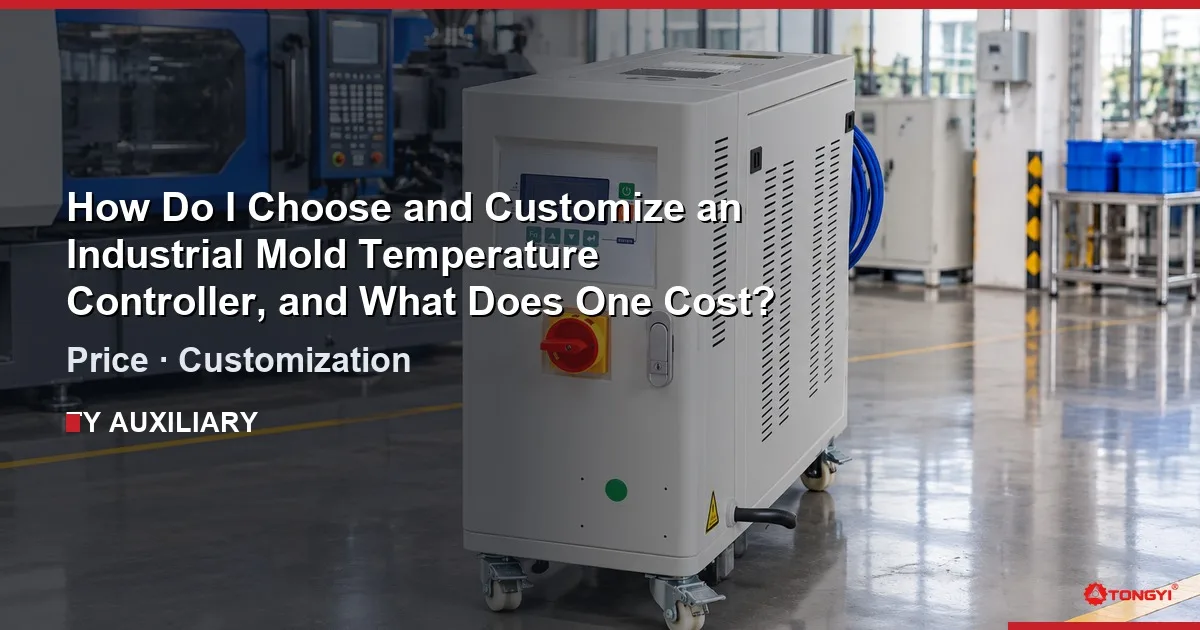
What determines the cost of an industrial mold temperature controller?
There is no responsible way to quote a mold temperature controller without defining the process. A unit that is suitable for one mold, facility, or operating schedule may not meet another application’s flow, pressure, heating, or connection requirements. For that reason, a meaningful price comparison should use the same model, accessories, control scope, and commercial terms.
Heating and temperature capability
Heating capacity affects the equipment cost because it determines the amount of electrical power the unit requires. Buyers should compare the heater rating with the thermal demand of the mold and the intended heating medium. The controller’s ability to reach the required temperature does not, by itself, describe temperature uniformity throughout the mold. If uniformity is critical, its test method, measurement location, and acceptance criteria should be confirmed separately.
Pump performance and system hydraulics
Maximum flow and maximum pressure are separate pump ratings. Maximum flow describes the maximum circulated volume, while maximum pressure describes the maximum pressure rating. Neither value establishes the pump’s delivered duty point at a specific flow and pressure combination. Buyers therefore need to evaluate both figures against the mold’s internal passages, circuit arrangement, heat-transfer requirements, and pressure losses.
Connections and installation scope
The number and size of media connections can influence both compatibility and cost. A unit with a different manifold arrangement or connection size may require additional adapters, hoses, piping, or installation work. Buyers should confirm whether the supplied equipment includes valves, fittings, electrical components, temperature sensors, and the required connection accessories.
Controls, options, and customization
Customization may involve the control interface, sensor configuration, pump or heater arrangement, electrical requirements, manifold configuration, connection sizes, and documentation. These options should be defined before quotation so that suppliers compare equivalent configurations. Undefined customization increases the risk of receiving a proposal that cannot be evaluated consistently.
Delivery, service, and commercial terms
Freight, insurance, installation, commissioning, training, warranty terms, spare parts, and technical support may affect the total acquisition cost. The extent of these services must be stated in the quote. Import duties and taxes may also apply, but they should be handled separately from the equipment quotation so the buyer can distinguish supplier scope from destination costs.
How do I select the right mold temperature controller model?
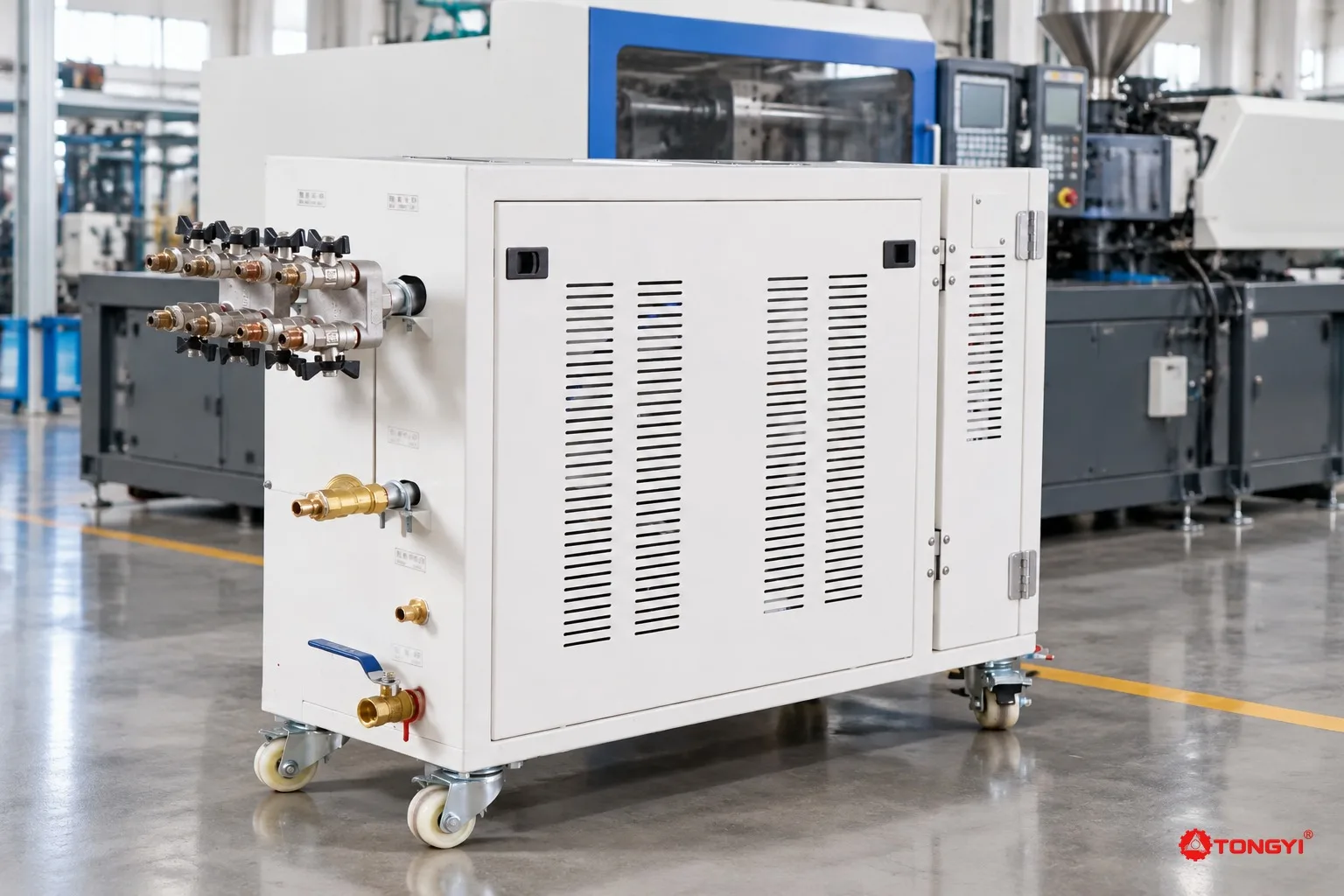
Start with the process requirements rather than the available model range. Identify the heat-transfer medium, required operating temperatures, expected heat load, mold connection method, circulation demand, available electrical supply, and control functions. After those requirements are documented, compare models on a like-for-like basis.
The following table covers the supplied TMC single-temperature models. All use clean water as the heat-transfer medium, provide direct cooling, have a maximum temperature of 120 °C, and use a K-type probe thermocouple at the media inlet and outlet. The stated minimum temperature depends on the cooling water temperature plus 5 to 30 °C, so the actual lower operating limit must be checked against site conditions.
| Model | Heating Capacity | Pump Power | Maximum Flow | Maximum Pressure | Manifold | Media Connection Size |
|---|---|---|---|---|---|---|
| TMC 60W | 6 kW | 0.37 kW | 42 L/min | 0.35 MPa | 2-in, 2-out | 3/8 inch |
| TMC 90W | 9 kW | 0.75 kW | 60 L/min | 0.4 MPa | 2-in, 2-out | 3/8 inch |
| TMC 120W | 12 kW | 0.75 kW | 60 L/min | 0.4 MPa | 4-in, 4-out | 3/8 inch |
| TMC 180W | 18 kW | 1.5 kW | 165 L/min | 0.25 MPa | 1-in, 1-out | 1 inch |
| TMC 240W | 24 kW | 1.5 kW | 165 L/min | 0.25 MPa | 1-in, 1-out | 1 inch |
| TMC 360W | 36 kW | 2.2 kW | 310 L/min | 0.3 MPa | 1-in, 1-out | 1.2 inch |
Compare heating and flow together
For example, the TMC 120W has 12 kW of heating capacity, 60 L/min maximum flow, and a maximum pressure rating of 0.4 MPa. The 12 kW heater capacity identifies the unit’s heating output, while the 60 L/min rating helps a buyer assess whether the circulating volume fits the mold circuit. The 0.4 MPa rating indicates a separate pressure characteristic, not an operating point of 60 L/min at 0.4 MPa.
The TMC 180W provides a documented step up in flow, with 165 L/min maximum flow, but its maximum pressure rating is 0.25 MPa. Its 18 kW heater also supports a greater heating output than the TMC 120W. This difference illustrates why a larger model should not be selected from flow alone: the buyer must also verify that the available heating capacity, electrical supply, mold circuit, and pressure requirements work together.
Compare connections and manifold arrangements
The TMC 90W and TMC 120W share a 60 L/min maximum flow and a 0.4 MPa maximum pressure rating, but their manifold configurations differ. The TMC 90W has a 2-in, 2-out arrangement, while the TMC 120W has a 4-in, 4-out arrangement. Both use 3/8-inch media connections. This makes them useful examples of how similar hydraulic ratings do not necessarily mean identical installation requirements.
At the other end of the supplied range, the TMC 360W has 36 kW of heating capacity, 310 L/min maximum flow, and a 0.3 MPa maximum pressure rating. Its 1.2-inch media connection and 1-in, 1-out manifold should be compared with the mold’s available piping and intended circuit layout. These verified figures help establish compatibility, but they do not by themselves prove that a model can meet the required mold temperature or uniformity.
How should custom configurations be specified?
A customization request should translate the molding process into measurable requirements. Instead of asking for a customized unit without further detail, provide a written specification that suppliers can quote against. The request should identify the baseline model and list every required difference from it.
- Thermal requirements: Specify the heat-transfer medium, minimum and maximum operating temperatures, expected heating load, startup conditions, and the required control sequence.
- Mold and circuit data: Include the mold weight, number of heating and cooling circuits, passage dimensions, connection locations, and the expected flow arrangement.
- Water supply conditions: State the available cooling-water temperature and supply pressure because the published lower temperature limit is tied to the cooling-water condition.
- Electrical requirements: Provide the available voltage, phase arrangement, breaker capacity, cable routing, and applicable site electrical standards.
- Control requirements: Define the required control mode, sensor arrangement, alarms, interfaces, operating language, and any data-recording needs.
- Connection requirements: Specify manifold count, connection size, valve requirements, material compatibility, and whether hoses, fittings, or adapters must be supplied.
- Scope of supply: List required accessories, installation materials, commissioning support, operating documents, spare parts, warranty coverage, and delivery terms.
What information should be included in a supplier quote request?
A quote becomes easier to evaluate when every supplier receives the same technical and commercial information. Ask each supplier to identify the proposed model and configuration clearly rather than referring to it only as a mold temperature controller.
The request should include:
- The selected model or model range, with every proposed option identified by description.
- The verified operating values relevant to the application, stated for the exact proposed model.
- Heating capacity, maximum flow, and maximum pressure as separate ratings, with no assumption that they represent a simultaneous duty point.
- The medium, maximum temperature, minimum-temperature condition, and temperature-sensing arrangement.
- Manifold configuration, media connection size, return-water connection size, and required valves or fittings.
- Electrical supply, control scope, accessories, documentation, testing, commissioning, delivery, warranty, and support terms.
- A clear statement of exclusions, so the buyer knows which site preparation, freight, installation, or consumables are not included.
How can buyers compare quotes without comparing unlike configurations?
Use a line-by-line comparison sheet and normalize the commercial scope. Start with the technical configuration, then separate equipment, optional accessories, freight, installation, and other services. If two quotations use different models or connection arrangements, compare the differences rather than treating the model names as equivalent.
Also clarify the basis of the price. The request should state whether the quotation covers a standard configured unit or a customized build, and whether any third-party components are included. Document lead-time assumptions, packing requirements, shipping terms, payment terms, and after-sales support. This approach supports procurement review while leaving the final commercial decision based on the supplier’s complete response.
What should be confirmed before ordering?
The supplied model data supports an initial comparison, but site-specific suitability still requires confirmation. Before placing an order, buyers should confirm the following items with the selected supplier:
- Required temperature range: Verify that the requested operating temperatures remain within the model’s maximum temperature of 120 °C and the stated minimum-temperature condition. Check how cooling-water temperature affects the available lower limit.
- Heating capacity: Provide the calculated or measured heat demand and ask the supplier to confirm suitability for the intended model. Heater capacity should not be treated as proof of mold temperature uniformity.
- Flow and pressure duty: Give the mold’s circuit arrangement and pressure-loss information. Confirm actual operating requirements against the model’s maximum flow and maximum pressure ratings, which are separate limits.
- Temperature measurement scope: Confirm where the K-type probe thermocouples are installed, what accuracy or uniformity claims are offered, and what test conditions and measurement points support them.
- Connection compatibility: Check the manifold arrangement, media connection size, and 15 mm return-water connection against the mold and facility piping before approval.
- Water quality and materials: Confirm that clean water is appropriate for the process and review wetted-material compatibility, filtration needs, and corrosion considerations.
- Electrical and installation scope: Confirm voltage, phase, power, breaker requirements, cable size, protective devices, accessories, and responsibilities at the installation boundary.
- Customization and delivery terms: Obtain written confirmation of every modified item, proposed option, supply exclusion, packing requirement, delivery term, and warranty provision.
What is the most practical next step for a buyer?
The most useful next step is to prepare a structured application sheet and request model-specific quotations. Include the process temperatures, mold and circuit information, available water and electrical conditions, connection details, control requirements, and required supplier services. This gives the supplier enough information to propose an industrial mold temperature controller configuration and gives procurement teams a consistent basis for comparing the resulting quotations.
When evaluating a proposal, verify that every technical figure belongs to the exact quoted model. Pay particular attention to heater capacity, pump ratings, temperature conditions, and connection details, and request written clarification wherever the scope is incomplete.
Get a specification-matched quote
Send the mold size, required working temperature, cooling channels per circuit and your electrical supply. We reply with a like-for-like configuration and the documented specifications for each model in the offer.
Every figure in this guide comes from our published specification sheets. Confirm model scope and test conditions before ordering.