
How Does an Energy-Saving Mold Temperature Controller Work, and How Much Does One Cost?
Learn how a water-type mold temperature controller heats, circulates and cools your mold, and which verified specifications most affect its price.
Quick answer
How a water-type mold temperature controller actually works
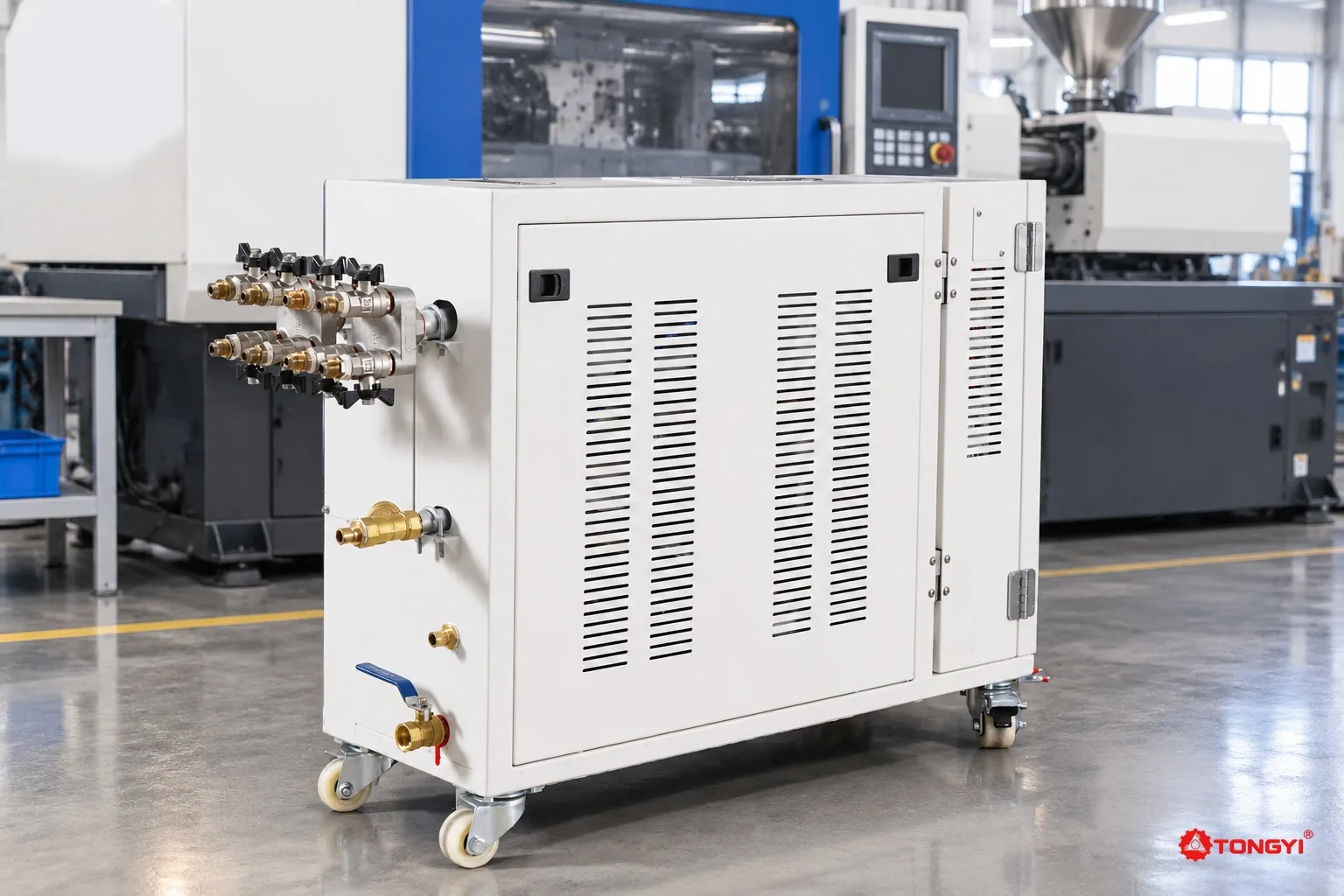
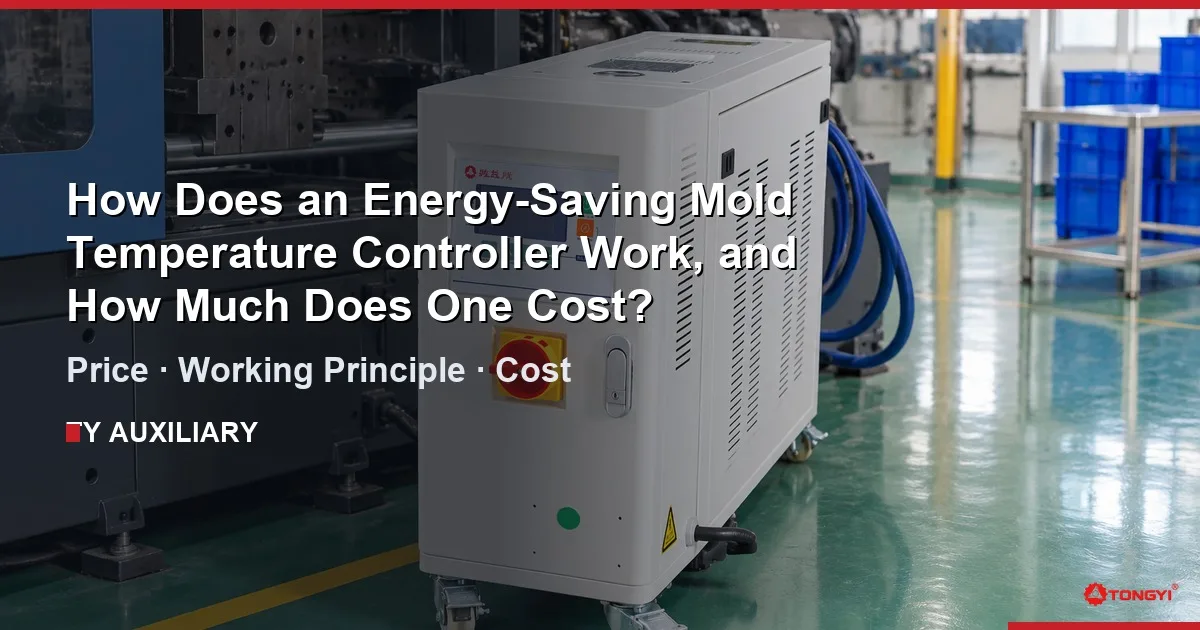
A mold temperature controller — often called a temperature control unit or TCUs in North American plants — sits between your plant’s water supply and the cooling channels inside an injection mold or die. Its job is to hold the mold surface within a narrow band, because mold temperature directly affects cycle time, part shrinkage, warp, and surface finish.
The loop runs like this:
- Heating: An electric immersion heater warms the circulating water. The heater is not sized to run continuously; it tops up heat lost to the mold and the surrounding air.
- Circulation: A centrifugal pump pushes the heated water through the mold’s channels and back to the unit. Flow rate matters as much as temperature — slow-moving water carries less heat per minute, even when it is hot.
- Temperature sensing: Probe-type thermocouples at the medium’s inlet and outlet tell the controller what is actually happening in the loop, not just what the heater is doing.
- Direct cooling: When the return water runs hotter than set point, a cooling valve opens and fresh plant water mixes in directly to pull the loop temperature back down.
Because the controller measures real loop temperature and modulates both the heater and the cooling valve, the heater only fires when needed. That closed-loop, on-demand behavior is the practical meaning of “energy saving” in this equipment category — the machine is not consuming rated power around the clock.
Why water as the heat-transfer medium matters for both performance and price
The units described here all use clean water as the heat-transfer medium, with a maximum working temperature of 120 °C. That boundary matters when you specify a machine. Water-type controllers are the standard choice for common thermoplastics molding where mold surfaces stay well below 120 °C, and they are generally simpler and less expensive than oil-type units, which exist to serve applications above water’s usable range. If your process requires mold temperatures above 120 °C, a water unit of this type is not the right tool, and you should say so explicitly in your inquiry.
Direct cooling is the other design choice worth understanding. Instead of a separate heat exchanger, the controller cools the loop by blending in cooling water directly. That keeps the internal design compact, but it also means your plant cooling water quality and pressure influence long-term reliability, so it is worth confirming both with the supplier.
What the verified model specifications tell you before you ask for a price
This equipment line covers six water-type models, from the TMC 60W through the TMC 360W, all capped at the same 120 °C maximum temperature and all using direct cooling. What separates them is heating power, pump capacity, and plumbing configuration — and those differences are exactly what drive price differences between units.
Two specifications deserve close attention. First, heating power: the TMC 60W carries a 6 KW electric heater, while the TMC 360W steps up to 36 KW. Heating power determines how quickly the unit can bring a cold mold up to set point and how well it holds temperature on large, heat-hungry tooling — under-sizing it is the most common cause of a machine that “can’t hold temperature” on a bigger mold. Second, pump capacity: the TMC 60W’s pump delivers up to 42 L/min at a maximum pressure of 0.35 MPa, whereas the TMC 360W moves up to 310 L/min at 0.3 MPa. Note that maximum flow and maximum pressure are separate ratings; a high-flow pump does not automatically mean a high-pressure pump, and the right balance depends on how many mold circuits your tooling has and how restrictive they are.
The plumbing configuration also changes between models. The TMC 120W uses a 4-in/4-out manifold at 3/8-inch ports, while the TMC 180W and TMC 240W switch to a 1-in/1-out configuration with 1-inch connections — a design aimed at serving fewer, larger-diameter circuits rather than many small ones. Matching the manifold style to your mold’s channel layout avoids adapters, reducers, and the pressure losses they introduce.
| Model | Heater power | Pump power | Max flow | Max pressure | Manifold | Port size |
|---|---|---|---|---|---|---|
| TMC 60W | 6 KW | 0.37 KW | 42 L/min | 0.35 MPa | 2-in/2-out | 3/8 inch |
| TMC 90W | 9 KW | 0.75 KW | 60 L/min | 0.4 MPa | 2-in/2-out | 3/8 inch |
| TMC 120W | 12 KW | 0.75 KW | 60 L/min | 0.4 MPa | 4-in/4-out | 3/8 inch |
| TMC 180W | 18 KW | 1.5 KW | 165 L/min | 0.25 MPa | 1-in/1-out | 1 inch |
| TMC 240W | 24 KW | 1.5 KW | 165 L/min | 0.25 MPa | 1-in/1-out | 1 inch |
| TMC 360W | 36 KW | 2.2 KW | 310 L/min | 0.3 MPa | 1-in/1-out | 1.2 inch |
All models share the same return-water connection of 15 mm and use a K-type probe thermocouple for medium inlet and outlet temperature sensing. Manufacturers reserve the right to change specifications without prior notice, so treat this table as a selection baseline and confirm the current datasheet when you inquire.
What actually drives the price of a mold temperature controller
Because pricing depends on configuration rather than a fixed catalog number, focus on these cost drivers when comparing quotes:
- Heater power. Higher-rated heating elements cost more and often require heavier electrical supply. The jump from a 6 KW unit like the TMC 60W to a 36 KW unit like the TMC 360W changes not just the machine but possibly your facility wiring.
- Pump specification. Pump power and flow capacity scale with price. A 2.2 KW pump moving 310 L/min is a larger, costlier component than a 0.37 KW pump moving 42 L/min.
- Manifold and connection complexity. More circuits (like the 4-in/4-out arrangement on the TMC 120W) mean more valves, fittings, and fabrication labor.
- Control features. Controller brand and display type, safety devices such as over-temperature protection and low-level protection, and whether the unit communicates with your plant’s monitoring system all affect cost.
- Compliance and export scope. For US buyers, confirm the electrical standard (voltage, phase, frequency) and any documentation the machine ships with, since meeting your local requirements adds configuration work the supplier must account for.
- Freight and logistics. Larger models weigh more and occupy more container volume; ask whether the quoted price includes export packing and what the shipping terms are.
What to include in a quote request so the price you get is comparable
A quote built on vague inputs invites vague numbers. Before requesting pricing, prepare the following and ask each supplier to confirm against their datasheet:
- Your target mold temperature and the material you run — this confirms whether a 120 °C water-type unit is sufficient or whether you need an oil-type machine.
- The number and size of your mold’s cooling circuits, so the supplier can match the manifold configuration (2-in/2-out, 4-in/4-out, or 1-in/1-out) and port sizes.
- Estimated mold weight and shot size, which help the supplier size heating power and pump flow sensibly rather than defaulting to the smallest unit.
- Your plant’s cooling water temperature and pressure, because the minimum usable loop temperature on these units is defined as cooling water temperature plus 5–30 °C, and direct cooling depends on a healthy supply.
- Facility electrical details — voltage, phase, and frequency — so the heater and pump can be configured correctly for your US installation.
- Required documentation, packing, and shipping terms, so total landed cost — not just unit price — can be compared like for like.
With those details in hand, ask each supplier to state the exact model recommended, its heater and pump ratings, its maximum temperature, and what is excluded from the quote. A short, well-specified RFQ almost always produces faster answers and fewer surprises than a request for “a price list.”
The practical next step for US buyers
If you are evaluating a water-type mold temperature controller for the first time, start by measuring what you have: your mold’s channel layout, your target set point, and your available cooling water. Compare those against the 120 °C ceiling and the flow and pressure ratings of each model above, and shortlist the smallest unit that meets the duty with margin. Then send two or three suppliers the same specification sheet and judge the responses on how precisely they address your application, not on which quote arrives first or cheapest.
Get a specification-matched quote
Send the mold size, required working temperature, cooling channels per circuit and your electrical supply. We reply with a like-for-like configuration and the documented specifications for each model in the offer.
Every figure in this guide comes from our published specification sheets. Confirm model scope and test conditions before ordering.