
Where Can I Buy a Custom Water-Type Mold Temperature Controller at Factory Price?
Learn what drives the factory price of a custom water-type mold temperature controller and which mold circuit data to send for an accurate.
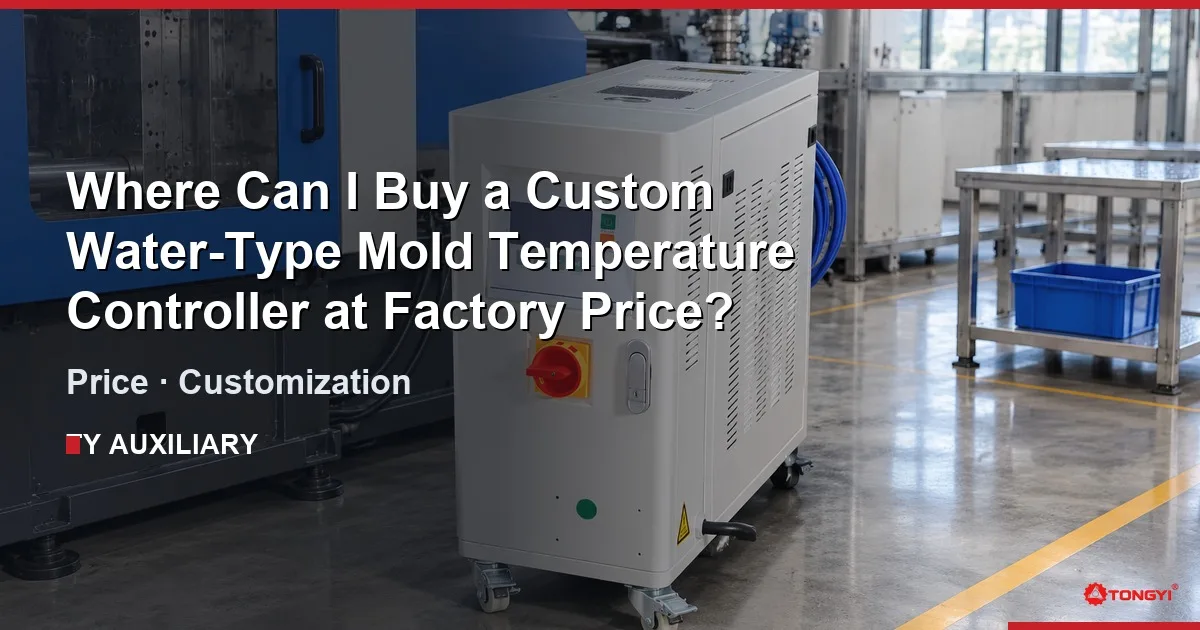
What does factory price actually cover on a custom mold temperature controller?
Factory price is not a discount code. It is the cost of the components you select plus the labor to assemble, wire, and test them. When a supplier quotes a custom unit, four things are driving most of the number:
- Heater capacity — rated in kW and set by mold mass, shot weight, and the heat your process actually has to add per hour.
- Pump power and flow — sized so the circulating loop can move heat out of the mold fast enough, not just so it can fill the circuit.
- Manifold configuration — how many mold circuits the unit feeds and returns simultaneously, which drives both manifold cost and internal piping.
- Electrical supply and control package — single vs. three-phase, voltage, controller features, alarms, and the enclosure rating for your plant.
Anything outside those four — a non-standard port size, a different medium connection layout, a special paint color, or a customer-specific controller — is what turns a catalog model into a custom order, and it is also where a factory quote can move most. If you want an apples-to-apples comparison, send every supplier the same mold data and the same required configuration, then compare what they list as standard versus optional.
Start with the mold circuit, not the price sheet
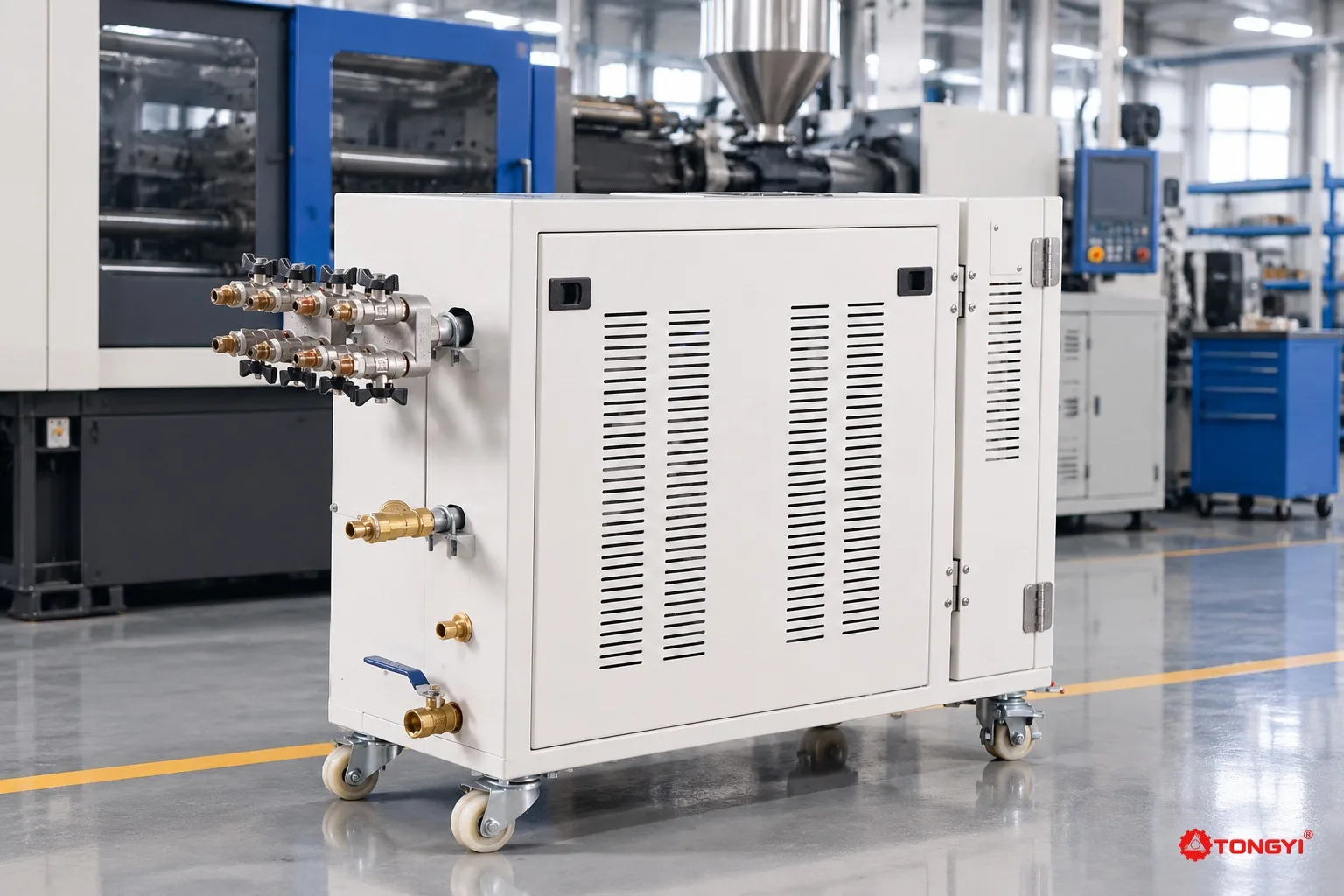
The single most common sourcing mistake is shopping by price before the mold loop is defined. A water-type controller is a closed circulation loop: it heats clean water, pumps it through the mold, and dumps excess heat through direct cooling when the return water is warmer than the setpoint. If the loop is undersized, no amount of controller tuning fixes it — the mold will still run hot, cycle times will drift, and part quality will vary from shot to shot.
Before you request a quote, have these answers ready:
- Number of independent mold circuits that must be fed at the same time
- Target mold surface temperature and the maximum temperature the process needs
- Available cooling water temperature in your plant and its seasonal swing
- Mold weight and the material being run
- Distance and height between the controller and the press, plus hose diameter
- Plant voltage, phase, and available breaker capacity
Suppliers who ask for this list before quoting are usually the ones who will size the unit correctly. A quote that arrives without any of it is a catalog price, not an engineering quote.
Comparing water-type models on a like-for-like basis
The clean-water series in our catalog gives a clear picture of how a single family scales across press sizes. All models in the series share the same heating medium, the same 120 °C maximum temperature, and the same K-type probe thermocouple for media in/out temperature sensing. What changes across the range is heating power, pump power, flow, pressure, and manifold layout. The table below lists the supplied specifications side by side so you can see where the steps occur.
| Model | Heating medium | Max. temperature | Min. temperature | Cooling method | Heater power | Pump power | Pump max. flow | Max. pressure | Manifold | Media port size |
|---|---|---|---|---|---|---|---|---|---|---|
| TMC 60W | Clean water | 120 °C | Cooling water temperature +5~30 °C | Direct | 6 kW | 0.37 kW | 42 L/min | 0.35 MPa | 2-in 2-out | 3/8 inch |
| TMC 90W | Clean water | 120 °C | Cooling water temperature +5~30 °C | Direct | 9 kW | 0.75 kW | 60 L/min | 0.4 MPa | 2-in 2-out | 3/8 inch |
| TMC 120W | Clean water | 120 °C | Cooling water temperature +5~30 °C | Direct | 12 kW | 0.75 kW | 60 L/min | 0.4 MPa | 4-in 4-out | 3/8 inch |
| TMC 180W | Clean water | 120 °C | Cooling water temperature +5~30 °C | Direct | 18 kW | 1.5 kW | 165 L/min | 0.25 MPa | 1-in 1-out | 1 inch |
| TMC 240W | Clean water | 120 °C | Cooling water temperature +5~30 °C | Direct | 24 kW | 1.5 kW | 165 L/min | 0.25 MPa | 1-in 1-out | 1 inch |
| TMC 360W | Clean water | 120 °C | Cooling water temperature +5~30 °C | Direct | 36 kW | 2.2 kW | 310 L/min | 0.3 MPa | 1-in 1-out | 1.2 inch |
Series note: specifications are subject to change without prior notice. Confirm the current datasheet with the supplier before you build your procurement specification around it.
Reading the specification values that move the price
Heater power is the clearest cost driver in the series, and it is also the value buyers most often oversize. The supplied range starts at 6 kW on the TMC 60W and rises to 36 kW on the TMC 360W. Heater power sets how quickly the loop can bring the mold up to temperature and how much heat it can replace during the cycle; a mold with large mass or a high melt-temperature material needs more of it, while a small mold on a short cycle can be badly overcooled by a heater that is far too large. From a quoting standpoint, heater power is a direct contributor to the electrical panel, contactor, and safety circuit in the unit, so an oversized selection raises the factory price without improving the process.
Pump maximum flow is the second value worth pinning down, and it tells a different story. The supplied figures run from 42 L/min on the TMC 60W to 310 L/min on the TMC 360W. Flow determines how much heat the loop can carry away from the mold per minute; a mold with long, narrow cooling channels restricts flow, and the pump has to overcome that resistance. This is why the maximum pressure rating must be read separately from the maximum flow rating: the TMC 180W and TMC 240W are listed at 165 L/min with a maximum pressure of 0.25 MPa, while the smaller TMC 90W and TMC 120W move only 60 L/min but carry a higher maximum pressure of 0.4 MPa. Neither number proves a duty point on its own — the pump curve shows what flow you actually get at the pressure your mold circuit creates. Ask the supplier for the pump curve at your required flow, not just the headline flow figure.
The manifold configuration is the specification that most often forces a custom build. The TMC 60W and TMC 90W are supplied as 2-in 2-out units with a 3/8 inch media port, the TMC 120W steps up to 4-in 4-out on the same 3/8 inch port, and the larger TMC 180W, 240W, and 360W move to a single 1-in 1-out manifold with a 1 inch port (1.2 inch on the TMC 360W). If your mold needs, say, four circuits on a press large enough to need the flow of a 240W, the standard single-circuit manifold does not match, and that mismatch is a legitimate reason to order a customized manifold rather than paying for a larger pump you do not need.
Where the word “custom” earns its cost
Custom work is worth paying for in three situations, and rarely in others.
- Circuit count mismatch. Your mold has more independent cooling circuits than the standard manifold provides, or the ports are in the wrong position for your hose routing. A custom manifold solves a real production problem.
- Medium and material compatibility. If the process requires a different circulation medium or a different wetted-material specification than clean water, the unit must be built for it.
- Plant integration. Non-standard voltage, a specific control interface, plant-standard alarms, or a footprint that has to fit an existing installation envelope are all genuine custom requirements.
Custom work is usually not worth paying for when the only goal is a slightly different number on the spec sheet. A short conversation about the actual mold circuit often lands on a standard model that performs the same job, and the saved cost can go toward a second unit for a second press.
What to write in a quote request so suppliers can price accurately
Vague inquiries get vague prices. To get a comparable factory quote, include the following. This is also the right place to state a US delivery point, a required lead time, and whether you are buying a single unit or a repeat quantity — volume expectations genuinely change factory pricing, and it is fair to say so up front.
- Number of mold circuits and required manifold layout (for example, 4-in 4-out)
- Target and maximum process temperature required by the material
- Available cooling water temperature and its seasonal range
- Mold weight and approximate shot weight
- Hose run length, height difference, and hose diameter between unit and press
- Plant electrical supply: voltage, phase, frequency, and breaker size
- Required control features: setpoint accuracy expectations, alarms, remote start/stop, data output
- Enclosure rating, footprint, and any plant-standard interface requirement
- Quantity, delivery destination, and required delivery date
How to verify quality before you commit to a factory order
Buying direct from a factory saves the middle layer, but it also means you own more of the verification work. The product page for the water-type series publishes a temperature accuracy of ±0.1 °C, and the page states that figure at the series level. Read it carefully: it is a controller accuracy statement for the series, not a guarantee for any individual model, and it is not a claim about temperature uniformity across a mold cavity. Actual mold surface uniformity depends on cooling channel design, flow balance between circuits, and how the mold is plumbed — none of which the controller can fix on its own. If you need a tighter number for your process, ask the supplier to confirm the accuracy specification, the measurement point it refers to, and the test conditions it was established under, rather than assuming the series figure applies directly to your application.
Beyond the datasheet, ask for the test record from the unit’s factory run, a wiring and piping diagram, a parts list with the controller and pump make and model, and the recommended spare parts list. A factory that will not provide these documents is a factory that will be difficult to work with after the sale.
Next steps
Fix the mold circuit data first, match it against a standard model in the water-type series, and only then scope the custom work. That sequence is what turns a factory price into a real cost advantage instead of a purchase you have to re-engineer later. Review the water-type mold temperature controller specifications for the full model range, look at the wider mold temperature controller lineup if your process needs a different heating medium, or send your mold circuit data through the contact form for a configuration-matched quote.
Get a specification-matched quote
Send the mold size, required working temperature, cooling channels per circuit and your electrical supply. We reply with a like-for-like configuration and the documented specifications for each model in the offer.
Every figure in this guide comes from our published specification sheets. Confirm model scope and test conditions before ordering.