
How Much Does an Injection Molding Mold Temperature Controller Cost When You Buy Direct?
Compare documented product features and process requirements before selecting a mold temperature controller.
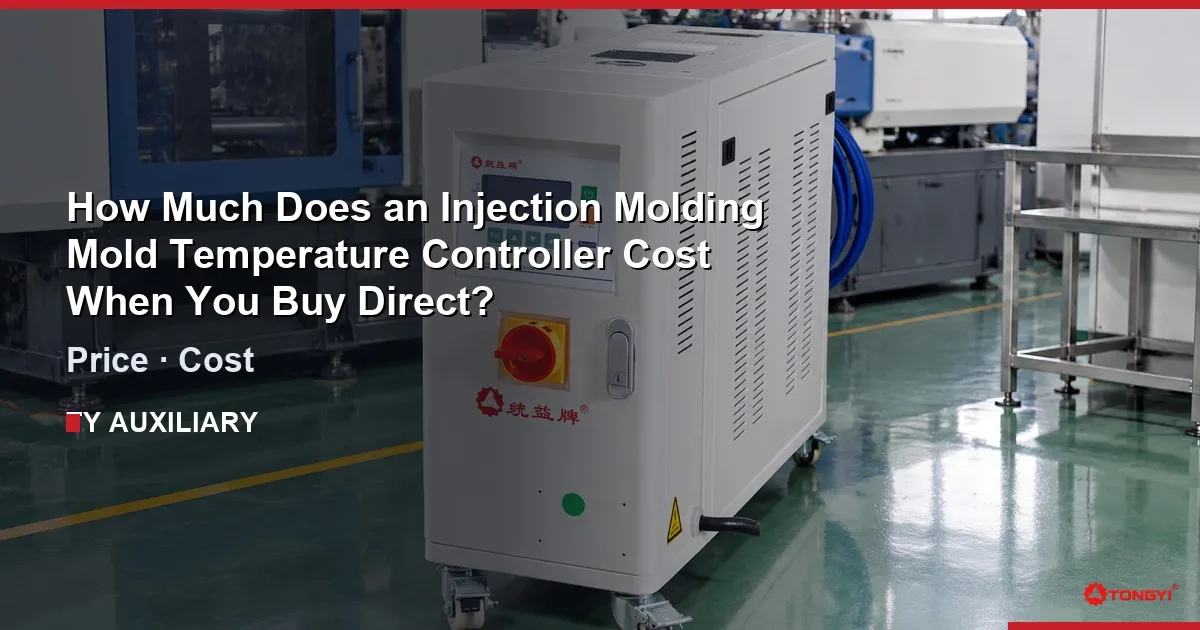
What actually drives the price of a mold temperature controller
Cost follows the two components that do the physical work — the heater and the pump — plus the plumbing and control hardware that distribute the medium.
Heating power sets the electrical infrastructure the buyer must provide. A 6 KW heater on the TMC 60W is a single-phase-friendly load in many plant layouts, while the 36 KW heater on the TMC 360W typically forces a wiring, breaker and panel review before installation. Higher heating power also means larger contactors, heavier internal wiring and more thermal mass in the tank, all of which carry material cost.
Pump power and flow determine how many circuits the unit can feed and how much pressure loss it can overcome. Pump power moves from 0.37 KW to 2.2 KW across the series, and maximum flow moves from 42 L/MIN to 310 L/MIN. Those two figures are related but not interchangeable — the flow rating is measured at the pump, and it does not guarantee the same flow at the mold once hose length, manifold restrictions and circuit count are applied. A buyer paying for 310 L/MIN of pump output should confirm the delivered flow at the mold, not just at the outlet.
Maximum pressure is a separate rating from maximum flow and should be quoted as such. The TMC 60W is rated 0.35 MPA, the TMC 90W and TMC 120W are rated 0.4 MPA, the TMC 180W and TMC 240W are rated 0.25 MPA, and the TMC 360W is rated 0.3 MPA. Note that the highest-flow models are not the highest-pressure models — the 180W and 240W move 165 L/MIN at 0.25 MPA, while the smaller 90W and 120W move 60 L/MIN at 0.4 MPA. If your mold has narrow channels or long hose runs, the pressure rating matters more than the flow headline, and the two must be evaluated against the same circuit.
Distribution hardware scales with circuit count. The TMC 60W, TMC 90W, TMC 120W and TMC 180W use 15 MM return ports, while the TMC 240W and TMC 360W are also listed at 15 MM. The manifold configuration, however, changes: 2In2Out on the TMC 60W and TMC 90W, 4In4Out on the TMC 120W, and 1In1Out on the TMC 180W, TMC 240W and TMC 360W. Media inlet/outlet port size steps from 3/8 INCH on the 60W through 120W, to 1 INCH on the 180W and 240W, and 1.2 INCH on the 360W. Manifold type directly affects hose, fitting and labor cost on the buyer’s side, and it is one of the most commonly omitted line items in a price comparison.
Comparing verified models on a like-for-like basis
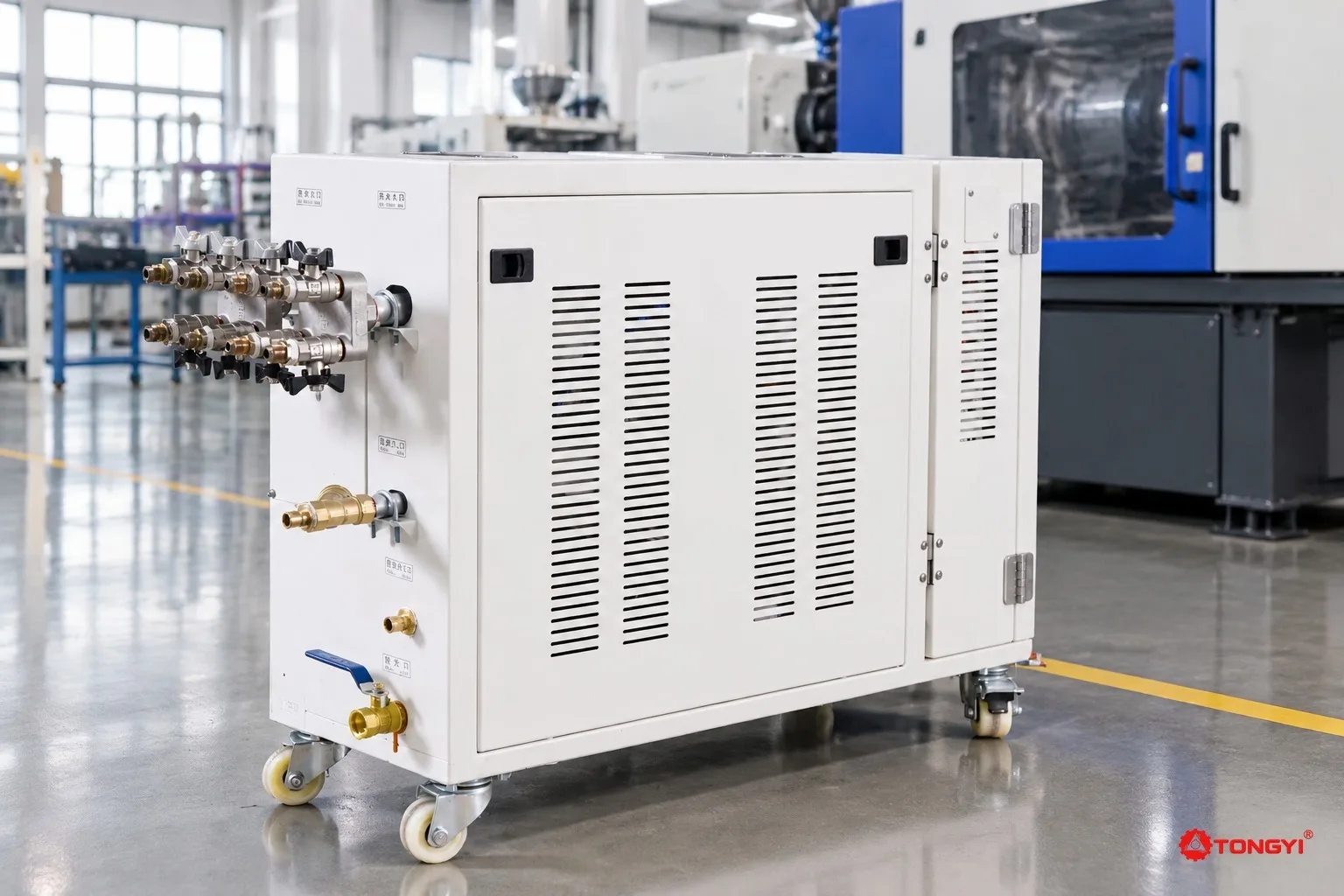
The table below shows the supplied TMC clean-water series as published. Every model shares the same medium, temperature ceiling and cooling method, so the meaningful differences for a quote are heating power, pump power, flow, pressure, manifold configuration and port size.
| Model | Heating power | Pump power | Max flow | Max pressure | Manifold | Port size |
|---|---|---|---|---|---|---|
| TMC 60W | 6 KW | 0.37 KW | 42 L/MIN | 0.35 MPA | 2In2Out | 3/8 INCH |
| TMC 90W | 9 KW | 0.75 KW | 60 L/MIN | 0.4 MPA | 2In2Out | 3/8 INCH |
| TMC 120W | 12 KW | 0.75 KW | 60 L/MIN | 0.4 MPA | 4In4Out | 3/8 INCH |
| TMC 180W | 18 KW | 1.5 KW | 165 L/MIN | 0.25 MPA | 1In1Out | 1 INCH |
| TMC 240W | 24 KW | 1.5 KW | 165 L/MIN | 0.25 MPA | 1In1Out | 1 INCH |
| TMC 360W | 36 KW | 2.2 KW | 310 L/MIN | 0.3 MPA | 1In1Out | 1.2 INCH |
All six models use clean water as the heat transfer medium and are rated to a maximum temperature of 120 °C, with a minimum temperature of cooling water temperature +5~30°C. They use direct cooling and a K Type probe thermocouple for media inlet/outlet temperature sensing, and all list a 15 MM return port. The published note on the specification sheet states that specifications may change without prior notice, so any quotation should reference the model and revision you actually intend to receive.
The 180W versus the 240W — same flow, different heater
This is the clearest trade-off in the series. The TMC 180W and TMC 240W share identical pump power (1.5 KW), maximum flow (165 L/MIN), maximum pressure (0.25 MPA), manifold (1In1Out), port size (1 INCH) and 15 MM return port. The only published difference is heating power: 18 KW versus 24 KW. For a buyer, that means the circulation side of the specification is the same, and the extra cost of the 240W buys heat-up speed and the ability to hold temperature against a larger heat load — a heavier mold, a faster cycle, or more injected mass per hour. If your process is already stable at temperature and the limiting factor is heat-up time on startup, the 240W is the relevant step. If your mold simply has more circuits to feed than one unit can handle, the extra 6 KW buys nothing and the money belongs in a second unit or a larger manifold instead. Ask the supplier which of the two they would recommend for your shot weight and cycle time, and ask them to state the assumption in writing.
What a direct-buy quotation should itemize
Buying direct is not only about the price on the unit. It changes what is included and what the buyer is responsible for after arrival. A quotation that does not separate these items is not yet comparable to a competitor’s.
- Model and configuration: the exact model number, heating power, pump power and manifold type, plus any non-standard voltage or frequency requirement for the destination plant.
- Electrical supply requirement: the voltage, phase and amperage the unit needs. This is where a 36 KW heater differs materially from a 6 KW heater in installation cost.
- Temperature control hardware: the controller type and the sensor type supplied. The published series uses a K Type probe thermocouple at the media inlet/outlet; confirm whether the quoted unit matches and where the sensor is located in the circuit.
- Plumbing interface: manifold configuration, media inlet/outlet port size and return port size, so hose and adapter cost can be added before the order is placed rather than after.
- Scope of supply: hoses, fittings, filters, spare seals and any mold-side connection hardware — each item either included, quoted separately, or explicitly excluded.
- Documentation: the manual, wiring diagram, and whether it is supplied in English for the operators who will run the machine.
- Packaging and shipping terms: export packing standard, Incoterm, and who handles the freight and import clearance.
- Spare parts and service: availability of pumps, heaters, seals and controllers, plus the response route if a unit fails during a production run.
- Warranty terms: duration and what is covered, stated in the quotation rather than referenced verbally.
Cost drivers beyond the machine itself
Three factors routinely change the total cost of ownership more than the unit price does.
Installation and utilities. A high-heating-power unit needs adequate breaker capacity, correct cable sizing and, in many plants, a dedicated circuit. A buyer comparing a small and a large controller should price the electrical work alongside the machine, because the installation delta can be significant.
Water quality and cooling loop. All TMC models in this series use clean water and direct cooling, with a minimum operating temperature tied to the incoming cooling water temperature plus 5~30°C. If the plant’s cooling water is warm, or the loop is prone to scale, the achievable minimum temperature is affected and additional water treatment or a chiller may be needed. That is a cost the machine quotation will not show.
Number of units and circuits. The series spans 2In2Out, 4In4Out and 1In1Out manifold configurations. A mold that needs more circuits than one manifold provides may be better served by two smaller units than by one large unit, or by a different manifold arrangement. This decision changes the price comparison entirely and should be made before requesting quotations.
How to keep quotes from different suppliers comparable
Send the same duty sheet to every supplier. At minimum, state the mold or part, the required mold surface temperature range, the ambient and cooling water temperature available on site, the number of circuits and their approximate length and diameter, and the available electrical supply. Then ask each supplier to respond in the same format: model, heating power, pump power, maximum flow, maximum pressure, manifold, port size, included accessories, documentation language, packaging and shipping terms, warranty and spare parts availability.
Watch for three common mismatches. First, flow quoted at the pump versus flow at the mold — confirm which figure is being offered. Second, pressure and flow quoted from different models, which produces a rating that no single unit actually has. Third, an accessory package that is included by one supplier and excluded by another, which makes the net price comparison meaningless until it is normalized.
If your application is a small-tonnage press running a single low-cavitation mold, the smaller end of the range may be sufficient and the quotation should reflect that. If you are running a high-cavitation tool or several molds in sequence, the higher-heating-power models are the relevant starting point. A supplier who asks about your shot weight, cycle time and mold layout before quoting is doing the work that makes the price meaningful.
A practical next step
Write down the model you believe fits, the heating power and pump power you need, and the manifold configuration your mold requires, then request a configured quotation with the itemized list above. If you are unsure which model fits, ask for a recommendation against your duty sheet and request the reasoning in writing — including which of the 120 °C maximum temperature or the cooling-water-linked minimum temperature is the binding constraint for your process. Compare the returned quotes line by line, and treat any quotation that omits the manifold, port size or accessory scope as incomplete rather than cheaper.
Get a specification-matched quote
Send the mold size, required working temperature, cooling channels per circuit and your electrical supply. We reply with a like-for-like configuration and the documented specifications for each model in the offer.
Every figure in this guide comes from our published specification sheets. Confirm model scope and test conditions before ordering.