
How Much Does an Injection Mold Temperature Controller Cost, and How Does It Work?
Compare documented product features and process requirements before selecting a mold temperature controller.
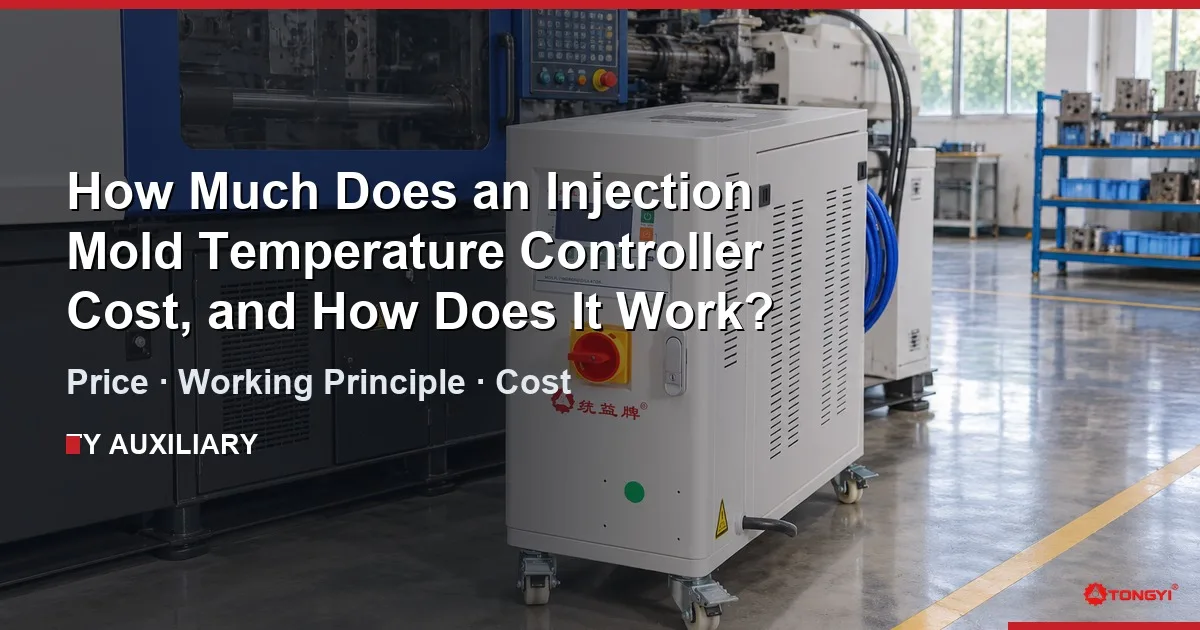
How a mold temperature controller actually works
A mold temperature controller is a closed-loop heat transfer unit. It circulates a heat transfer medium — clean water on the models described here — from a reservoir through the mold’s cooling channels and back to the unit. Depending on whether the mold needs to be warmed or cooled, the controller either adds heat with an electric heating element or removes heat through a cooling circuit, and it does this continuously to hold the mold surface near a set temperature.
The loop has four functional blocks:
- Circulation. A pump moves the medium through the mold and back. Pump power and maximum flow determine how much channel volume the unit can serve and how much pressure drop it can overcome.
- Heating. Electric heating elements raise the medium to the set point on startup and compensate for heat lost to the mold and the environment.
- Cooling. On the models described here, cooling is direct: plant cooling water is admitted into the loop when the controller senses the medium is above set point, and shut off when it drops back.
- Control and sensing. A temperature probe at the medium inlet/outlet reads the circulating medium, and the controller cycles heating and cooling to hold the set value.
The practical consequence of this design is that the controller regulates the temperature of the medium, not of the mold steel. Mold temperature uniformity is a function of channel layout, flow rate, and the part and tooling design. If you need a guaranteed mold-surface temperature distribution, that has to be established by the tool builder and confirmed with the supplier — it is not something a controller specification alone can promise.
What determines the price of an injection mold temperature controller
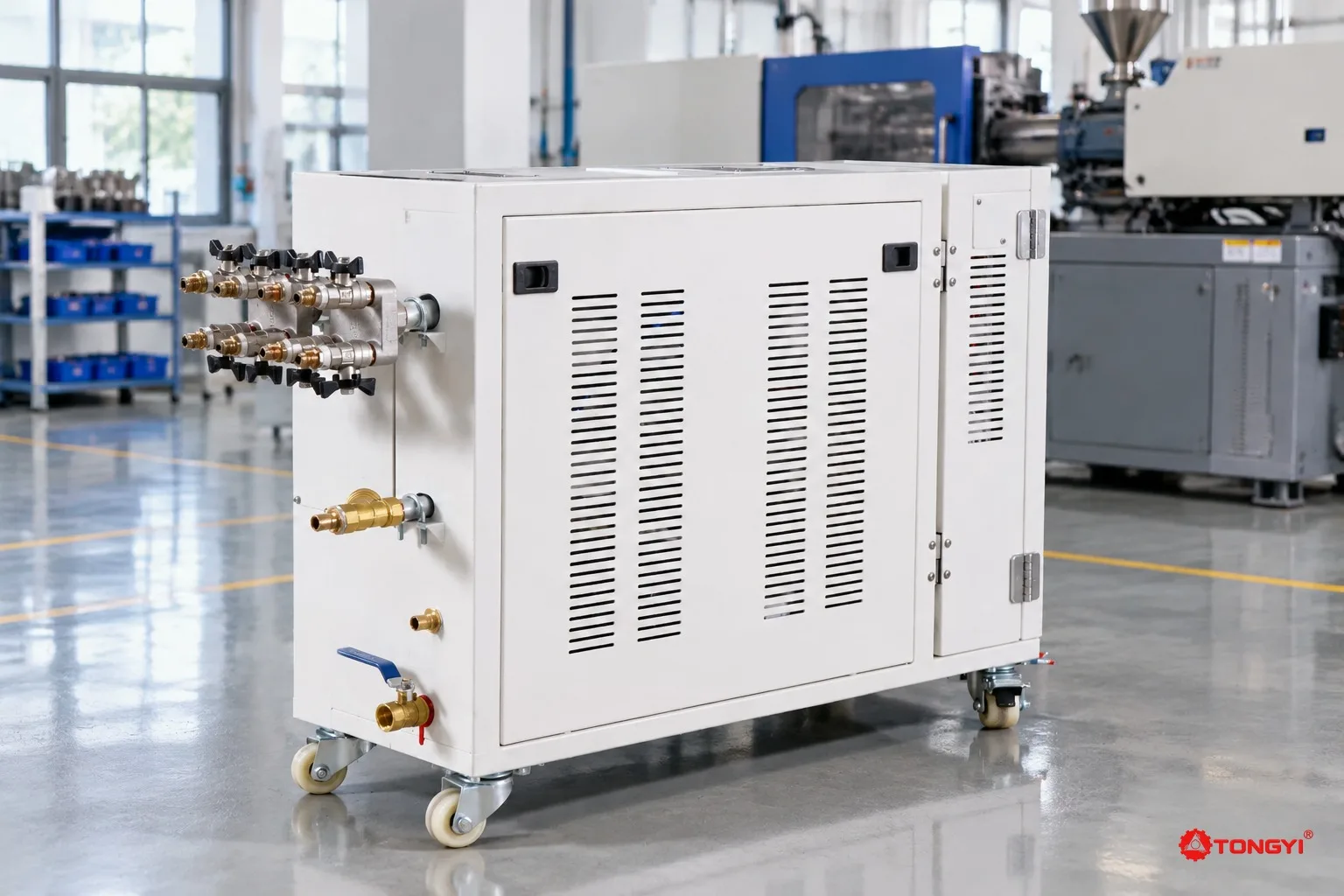
Cost tracks the physical work the unit has to do. Four variables dominate.
1. Heating capacity
Electric heating power is usually the single largest cost driver. More kilowatts means more heating elements, heavier contactors, larger wiring, and a bigger electrical enclosure. Heating capacity sets how quickly the unit can bring a cold mold up to temperature and how well it holds set point against heat loss. The series described here spans 6 kW to 36 kW of electric heating power, and that spread alone usually separates an entry-level unit from a large one.
2. Pump power and flow
The pump determines whether the medium can actually push through the mold’s channels at the flow rate the process needs. A larger pump costs more, and it also forces a larger reservoir, larger piping, and a higher-capacity cooling valve. Units in this series run from a 0.37 kW pump with 42 L/min maximum flow up to a 2.2 kW pump with 310 L/min maximum flow.
3. Cooling method and cooling capacity
Direct cooling — the method used across this series — uses plant cooling water and a control valve rather than a separate refrigeration circuit, which keeps cost and complexity down. Indirect or refrigerated cooling adds a compressor and a refrigerant circuit and moves the unit into a different price category entirely. If your plant has no reliable cooling water supply at the required temperature, that change alone can double what you need to budget.
4. Control package, manifolds, and connections
Instrumentation, manifold configuration, and port sizing add cost at the margins. A unit plumbed with a 2-in/2-out manifold and 3/8 inch media ports is a smaller assembly than one with 1 inch ports, and the number of circuits a manifold serves affects both the bill of materials and the installation labor on your side.
How the working principle maps onto specifications you can compare
Every number on a mold temperature controller data sheet is a priced design decision. Two specifications in this series make the connection clear, and both are worth checking before you ask for a quotation.
Maximum flow rate. The TMC 90W is rated for a maximum flow of 60 L/min with a 0.75 kW pump, while the TMC 180W is rated for a maximum flow of 165 L/min with a 1.5 kW pump. Flow matters because heat transfer between the medium and the mold depends on how much medium moves past the channel wall per unit of time. A mold with many small-diameter channels presents high resistance and needs more pressure to reach a given flow, whereas a large single circuit may reach the required flow easily. What this means for a quotation is that the pump rating should be matched to your specific tool, not selected on price alone: an undersized pump leaves you with slow heat-up and unstable control, and an oversized one is money spent on capacity your mold cannot use.
Maximum pressure. Maximum pressure is a separate rating from maximum flow, and the two should not be read as one duty point. The TMC 90W is rated at a maximum pressure of 0.4 MPa, while the TMC 360W reaches a maximum flow of 310 L/min but is rated at a maximum pressure of 0.3 MPa. This is a useful reminder that a higher-flow machine is not automatically a higher-pressure machine. Pressure is what overcomes the resistance of narrow channels and long hose runs in your press; the pressure your loop actually sees depends on the tool, the hoses, and the manifold, not on the controller rating alone. When you request a quote, give the supplier your expected flow requirement and the pressure drop your mold presents so the pump and relief settings can be confirmed against a real duty point.
One more value worth building into the quote request is the maximum temperature and the media type, because they define the whole class of machine. The models described here circulate clean water and reach a maximum temperature of 120 °C, with a minimum temperature of cooling water temperature +5 to 30 °C. If your process demands a higher set point, you are no longer buying a water unit, and the supplier needs to know that before quoting.
Comparing models in one series: what changes and what stays the same
The table below reflects only the models listed here; it is not the complete series. Read it as a like-for-like comparison of the models supplied, with every value attached to its exact model.
| Model | Electric heating power | Pump power | Max flow | Max pressure | Manifold | Media ports |
|---|---|---|---|---|---|---|
| TMC 60W | 6 kW | 0.37 kW | 42 L/min | 0.35 MPa | 2 in / 2 out | 3/8 inch |
| TMC 90W | 9 kW | 0.75 kW | 60 L/min | 0.4 MPa | 2 in / 2 out | 3/8 inch |
| TMC 120W | 12 kW | 0.75 kW | 60 L/min | 0.4 MPa | 4 in / 4 out | 3/8 inch |
| TMC 180W | 18 kW | 1.5 kW | 165 L/min | 0.25 MPa | 1 in / 1 out | 1 inch |
| TMC 240W | 24 kW | 1.5 kW | 165 L/min | 0.25 MPa | 1 in / 1 out | 1 inch |
| TMC 360W | 36 kW | 2.2 kW | 310 L/min | 0.3 MPa | 1 in / 1 out | 1.2 inch |
All six models circulate clean water, share a maximum temperature of 120 °C, a minimum temperature of cooling water temperature +5 to 30 °C, direct cooling, and a K type probe thermocouple at the medium inlet/outlet.
The documented trade-off worth understanding is between the 120W and 180W models. Both are legitimate choices, but they are built for different molds. The TMC 120W has 12 kW of heating and a 0.75 kW pump rated for 60 L/min maximum flow, with a 4-in/4-out manifold and 3/8 inch ports. The TMC 180W has 18 kW of heating and a 1.5 kW pump rated for 165 L/min, but it uses a 1-in/1-out manifold with 1 inch ports. You trade multi-circuit convenience for single-circuit flow capacity. If your press runs four small circuits that need separate control, the 120W’s manifold layout is the more practical match. If you run one large circuit and need volume, the 180W’s flow rating and larger ports serve that better — but you lose the ability to split the loop across four manifolds. Neither machine is the better buy in the abstract; the tool decides.
What to include in a quotation request
A quote built on a vague requirement is a quote you will have to rebuild later, and rework costs time in both directions. Suppliers cannot price a unit accurately without knowing the duty it has to handle.
- Mold and channel data. Number of circuits, channel diameter, and total water volume in the tool. This drives the flow and pressure requirement.
- Required set point and medium. State the target mold temperature and whether water is acceptable, or whether the process requires a higher-temperature medium.
- Available cooling water. Supply temperature, pressure, and flow at the press. Direct-cooling units depend on it.
- Electrical supply at the press. Voltage, phase, and frequency available, plus the amperage your panel can spare for the heating load.
- Manifold and connection preference. How many circuits you want to control from one unit, and what hose or pipe size your press uses.
- Ambient and installation conditions. Where the unit sits, how far it is from the mold, and whether hoses must be long enough to affect pressure drop.
- Control and monitoring needs. Whether you need alarms, communications, or data logging, and what your quality system requires.
- Documentation and spares. What manuals, wiring diagrams, and spare parts you need included, and whether the quote covers commissioning support.
Before you place an order, confirm with any supplier that cooling is direct water cooling and that the maximum temperature is 120 °C — these two facts together tell you whether the unit fits a water-based process at all, and they are the fastest way to compare two quotations that otherwise look similar.
Next step
If you are sizing a unit now, review the mold temperature controller range and compare the TMC water-type models against your mold data before you request a price.
Frequently asked questions
Why is there no single price for an injection mold temperature controller?
Because the machine is priced from the work it has to do. Heating capacity, pump power, cooling method, manifold configuration, and port sizing all vary with the mold you are running, and each one changes the bill of materials. Two units with the same footprint can differ substantially in cost if one has 6 kW of heating and the other has 36 kW.
Does a higher maximum flow rating always mean a better controller?
No. Maximum flow and maximum pressure are separate ratings, and neither is a duty point by itself. A high-flow machine rated at 310 L/min maximum flow may be rated at a lower maximum pressure than a smaller unit, because the two ratings describe different aspects of pump performance. Match the pump to the pressure drop your mold and hoses actually present.
What is the difference between heating power and pump power in the price?
Electric heating power sets how fast the unit brings the mold up to temperature and how well it holds set point against heat loss. Pump power sets how much medium it can circulate through the mold. Both are priced components, and they scale independently: a unit can have modest heating and a large pump, or the reverse, depending on the process it was designed to serve.
What temperature can a water-type mold temperature controller reach?
The clean-water models described here have a maximum temperature of 120 °C, with a minimum temperature of cooling water temperature +5 to 30 °C. If your process requires a set point above that, you need a different class of unit, and the supplier should be told before any quote is prepared.
How does the controller’s temperature reading relate to mold temperature?
The controller reads the circulating medium at the inlet/outlet using a K type probe thermocouple. That is the medium temperature, not the mold steel temperature. Uniformity across the mold depends on channel layout, flow rate, and tooling design. If you need a specific mold-surface temperature distribution, that must be established with the tool builder and confirmed by the supplier.
What should I send a supplier to get an accurate quotation?
Send the number of circuits, channel diameter, total water volume in the mold, your target set point, available cooling water temperature and pressure, electrical supply at the press, preferred manifold and connection size, and your documentation and spare parts requirements. A supplier who can price against that data gives you a quote you can compare directly with another.
Get a specification-matched quote
Send the mold size, required working temperature, cooling channels per circuit and your electrical supply. We reply with a like-for-like configuration and the documented specifications for each model in the offer.
Every figure in this guide comes from our published specification sheets. Confirm model scope and test conditions before ordering.