
How Much Do Injection Molding Mold Temperature Controllers Cost, and Which Factory Builds Them?
There is no list price for an injection molding mold temperature controller.
What drives the price of an injection molding mold temperature controller
Every cost driver below maps to a physical component or a labor step, which is why a factory can quote a specific number instead of a range. When you compare quotes, compare them line by line against these drivers.
Heating capacity and voltage supply
Heating capacity is the largest single cost element because it sets the number and rating of heating elements, the contactor or solid-state switching, the wire gauge, and the terminal block. It also drives the electrical enclosure size. In the TMC clean water series, electric heating power steps from 6 kW on the TMC 60W through 9 kW, 12 kW, 18 kW, 24 kW to 36 kW on the TMC 360W. A jump from 6 kW to 36 kW is not a small option — it changes the enclosure, the incoming supply requirement and the shipping weight, and the quote should reflect that.
Pump power, flow and pressure
The pump is the second-largest cost line and the one buyers most often under-specify. Pump power and maximum flow move together in the supplied data: the TMC 60W uses a 0.37 kW pump rated at 42 L/min, the TMC 90W and TMC 120W share a 0.75 kW pump at 60 L/min, the TMC 180W and TMC 240W share a 1.5 kW pump at 165 L/min, and the TMC 360W uses a 2.2 kW pump at 310 L/min. Maximum pressure is a separate rating — 0.35 MPa, 0.4 MPa, 0.25 MPa and 0.3 MPa respectively — so do not assume the biggest flow automatically means the highest pressure. Higher flow costs more because it requires a larger motor, larger impeller and larger-bore piping.
Mold circuit count and manifold configuration
The number of media inlets and outlets determines how much manifold, hose connection and valving the factory must build. The TMC 60W and TMC 90W use a 2-in 2-out splitter, the TMC 120W uses 4-in 4-out, and the TMC 180W, TMC 240W and TMC 360W use a single 1-in 1-out arrangement. Media inlet/outlet diameters also widen across the series, from 3/8 inch on the smaller units to 1 inch and 1.2 inch on the larger ones, with a 15 mm return water port common across the range. More circuits and larger bores mean more machining and more fittings, and that shows up in the quote.
Control scope, instrumentation and documentation
A unit ordered with a K-type probe thermocouple and a basic temperature controller sits at a different price point than one ordered with dual thermocouples, alarms, communications and a factory test report. Calibration records, wiring diagrams, spare-part lists and an English manual are labor hours, and factories price them accordingly. If your US plant needs UL-listed components or specific supply voltages, say so at the RFQ stage — retrofitting later costs more than building it in.
Build quality, testing and after-sales structure
A factory that pressure-tests every unit, runs a heat-up cycle, records the result and ships with a warranty commitment carries more cost than one that does not. That is not padding; it is the difference between a unit that holds setpoint on arrival and one that leaks at the pump seal in the first month. Ask what the standard test procedure is and whether the record ships with the machine.
Logistics, duty and landed cost
Ocean freight, crating, US import duty, port handling and inland delivery can add a meaningful share on top of the ex-works price, and larger units weigh more and crate larger. Buyers who only compare ex-works quotes are comparing an incomplete number. Ask each supplier to quote on a consistent Incoterm — FOB and CIF on the same port — so the comparison is like for like.
How the TMC clean water series is positioned along those cost drivers
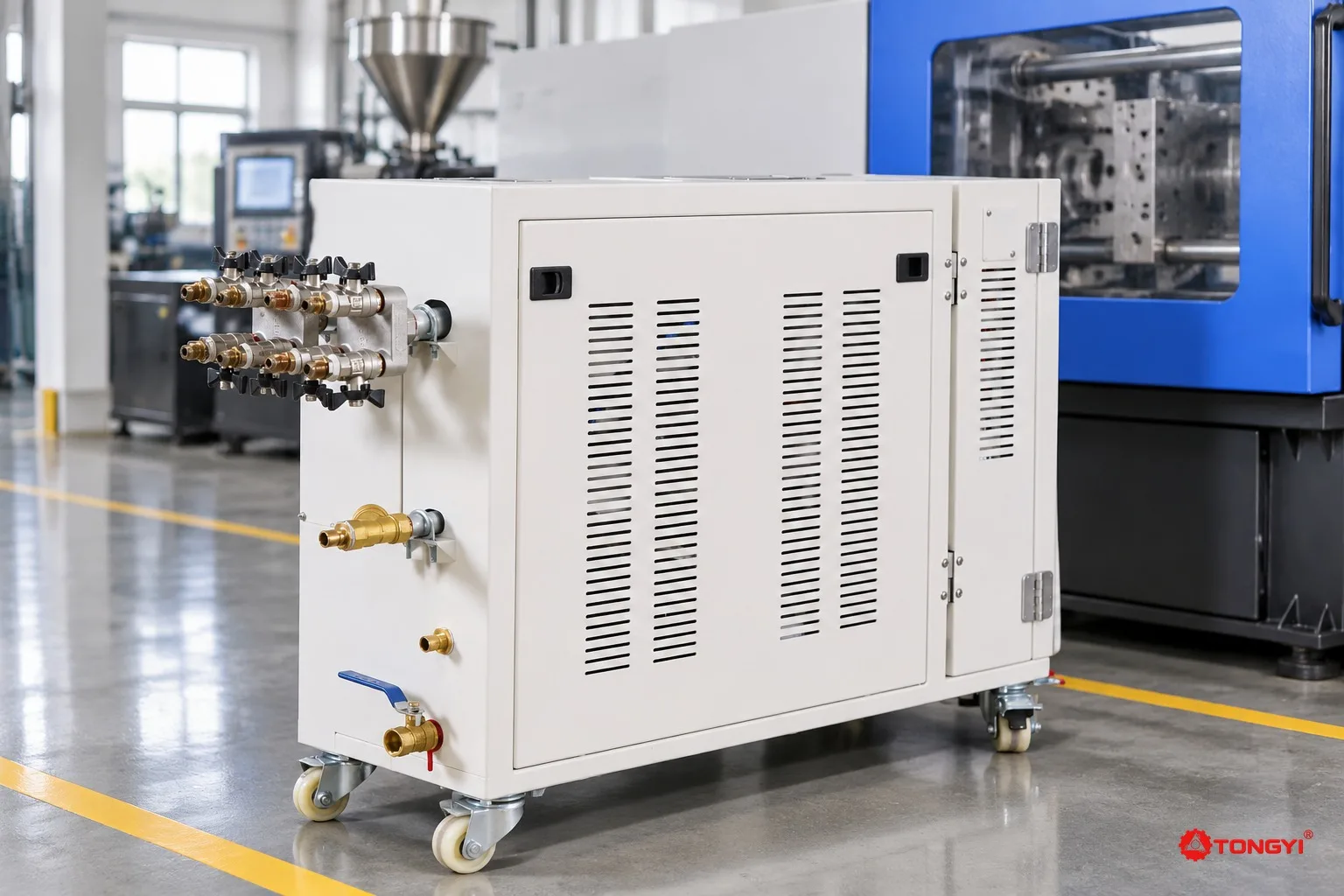
The supplied TMC series is a single-temperature clean water line with a 120 °C maximum temperature and a minimum temperature of cooling water temperature plus 5 to 30 °C, using direct cooling. Because every model shares the same heat-transfer medium, the same temperature ceiling and the same controller family, the price steps between models are almost entirely explained by heating capacity, pump size and manifold configuration. That makes the series a clean example of how a factory builds cost into a catalog.
Two values are worth explaining because they are the ones buyers most often misread. First, heating capacity: the TMC 120W carries 12 kW of electric heating power, while the TMC 180W carries 18 kW. The extra 6 kW on the larger model buys faster heat-up and faster recovery when cold plastic or a cold mold pulls heat out of the circuit, which matters on thicker walls and faster cycles. If your cycle does not actually demand that recovery rate, the higher-capacity unit is money spent on capability you will not use. Second, maximum flow: the TMC 180W is rated at 165 L/min with a 1.5 kW pump and a maximum pressure of 0.25 MPa, whereas the TMC 120W moves 60 L/min at 0.4 MPa with a 0.75 kW pump. Higher flow helps when you are circulating through long, narrow cooling channels or feeding multiple circuits from one unit, but the lower-pressure rating of the 165 L/min configuration means you should confirm the pressure drop across your mold and hoses before assuming the higher-flow unit will deliver more pressure at the tool. Flow and pressure are separate ratings here — the supplied data does not establish a single duty point for either unit.
The series tops out at the TMC 360W with 36 kW of heating, a 2.2 kW pump, 310 L/min and a 0.3 MPa maximum pressure through a 1-in 1-out manifold with a 1.2-inch media connection. Below it, the TMC 60W is the entry point at 6 kW and 0.37 kW, with the TMC 90W and TMC 120W sharing a 0.75 kW pump and the TMC 120W alone offering a 4-in 4-out splitter for multi-circuit work.
| Model | Heating power | Pump power | Max flow | Max pressure | Manifold | Media connection |
|---|---|---|---|---|---|---|
| TMC 60W | 6 kW | 0.37 kW | 42 L/min | 0.35 MPa | 2-in 2-out | 3/8 inch |
| TMC 90W | 9 kW | 0.75 kW | 60 L/min | 0.4 MPa | 2-in 2-out | 3/8 inch |
| TMC 120W | 12 kW | 0.75 kW | 60 L/min | 0.4 MPa | 4-in 4-out | 3/8 inch |
| TMC 180W | 18 kW | 1.5 kW | 165 L/min | 0.25 MPa | 1-in 1-out | 1 inch |
| TMC 240W | 24 kW | 1.5 kW | 165 L/min | 0.25 MPa | 1-in 1-out | 1 inch |
| TMC 360W | 36 kW | 2.2 kW | 310 L/min | 0.3 MPa | 1-in 1-out | 1.2 inch |
All models in the supplied table use clean water as the heat-transfer medium, a K-type probe thermocouple for media inlet/outlet temperature sensing, direct cooling, a 120 °C maximum temperature and a 15 mm return water port. Specifications are subject to change without prior notice, so confirm the current datasheet at the time of order.
If you are still mapping the machine into your plant, the mold temperature controller range and the injection molding temperature control solutions pages give the wider context on how these units are configured into a molding cell.
Which factory should build your mold temperature controller?
The “which factory” question matters more than the last few percent of unit price. A mold temperature controller is a long-service machine that sits in a production cell, and the real cost of a bad supplier is downtime, not the invoice.
Start with manufacturing scope. A factory that builds its own heat exchangers, brazes its own manifolds and winds or sources its own pumps has more control over quality and lead time than an assembler buying complete sub-units. Ask directly: which parts are made in-house, and which are bought in? A clear answer tells you where quality responsibility sits.
Then look at the test routine. Ask for the standard factory test: leak test pressure and duration, heat-up verification, setpoint stability check, and whether a record ships with each unit. A factory that can describe this in specific terms is usually the one that builds consistently.
Ask about documentation in English. Wiring diagrams, a parts list with supplier part numbers, a maintenance schedule and an operating manual are what your maintenance team will rely on for the next decade. If the factory treats documentation as an afterthought, assume the same attitude applies to the build.
Check spare-part continuity. Heating elements, pumps, seals and controllers wear or fail. Confirm that the factory stocks or can promptly supply these for the specific model you buy, and ask for the expected lead time on a spare pump and a spare thermocouple.
Finally, evaluate the quoting process itself. A supplier who asks about your material, mold weight, cycle time, cooling channel layout, plant water temperature and supply voltage before quoting is doing selection work, not just pricing. That is the behavior that produces a unit that holds setpoint from day one.
What to put in your quote request
A complete RFQ shortens the quoting cycle and prevents the expensive surprise of a machine that arrives under-specified. Include the following.
- Required heating capacity in kW, or the mold and material data the supplier needs to calculate it.
- Required flow in L/min and the pressure available at the mold inlet, with your cooling channel layout and hose lengths.
- Number of mold circuits and the manifold configuration you need — for example 2-in 2-out, 4-in 4-out or 1-in 1-out.
- Media connection size and the type of fittings on your existing mold and plant piping.
- Plant cooling water temperature range, since the minimum operating temperature follows cooling water temperature plus 5 to 30 °C on this series.
- Supply voltage, phase and frequency at your US facility, plus any component approval requirements.
- Ambient conditions in the molding area and whether the unit will be moved between presses.
- Documentation and test-record requirements, and your preferred Incoterm and destination port.
If you would rather match a model to the application first, the request a mold temperature controller quote page is the fastest route — send the mold and cycle data and let the supplier come back with a specific configuration and price.
Frequently asked questions
Why don’t mold temperature controllers have a published list price?
Because the price is built from the configuration, not from a catalog position. Heating capacity, pump power and flow, manifold circuit count and control scope all change the bill of materials, so a factory quotes the unit you specify rather than a generic model. That is also why two quotes for what sounds like the same machine can differ substantially.
Is a higher heating capacity always worth the extra cost?
No. Higher kW means faster heat-up and better recovery when the mold pulls heat away, which helps on thick walls and short cycles. If your process does not demand that recovery rate, the extra capacity adds purchase cost and electrical demand without improving part quality. Size to the actual cycle, not to a round number.
Does higher flow mean higher pressure on a mold temperature controller?
Not necessarily. In the supplied TMC series, the 165 L/min models are rated at 0.25 MPa maximum pressure while the 60 L/min models are rated at 0.4 MPa. Flow and pressure are separate ratings, and the pressure you actually see at the mold depends on the pressure drop through your channels, hoses and fittings. Confirm the duty point with the supplier against your mold.
What does 2-in 2-out versus 1-in 1-out mean for my mold?
It describes how many media inlet and outlet connections the unit provides. A 2-in 2-out splitter lets you feed two separate circuit groups from one unit, while a 1-in 1-out arrangement feeds a single loop through a larger connection. Your choice depends on how many independent temperature zones your mold has and how you want to route hoses.
What temperature can a clean water mold temperature controller reach?
The supplied TMC clean water series lists a maximum temperature of 120 °C. The minimum operating temperature is cooling water temperature plus 5 to 30 °C, which means the plant’s cooling water temperature sets the lower end of the working range. If your process needs to run colder or hotter than that window, discuss it with the supplier before ordering.
How do I compare quotes from two different factories fairly?
Put the same specification in front of both, including kW, flow, pressure at the mold, circuit count, connection sizes, supply voltage, documentation and Incoterm. Then compare what is actually included: test records, spare parts, manual language, warranty terms and lead time. A lower unit price that excludes testing or documentation is not a lower cost.
Get a specification-matched quote
Send the mold size, required working temperature, cooling channels per circuit and your electrical supply. We reply with a like-for-like configuration and the documented specifications for each model in the offer.
Every figure in this guide comes from our published specification sheets. Confirm model scope and test conditions before ordering.