
How Much Does an Injection Molding Mold Temperature Controller Cost, and How Do I Request a Price Quote?
Learn what drives injection molding mold temperature controller cost, which specifications set the price, and how to request a quote that suppliers can.
What determines the price of a mold temperature controller
Buyers searching for a mold temperature controller price usually receive a wide spread of figures, and the spread is real rather than a negotiating tactic. The unit is assembled from a heater bank, a circulation pump, a cooling valve or solenoid, a heat exchanger or direct-injection cooling path, a controller and a set of temperature and safety sensors. Each of those has a cost ladder, and the specification choices you make decide which rung you land on.
Heater capacity
Heating power is the largest single contributor. In a single-temperature water series, heater ratings run from 6 kW up to 36 kW, and the heater bank, contactors, wiring gauge and branch-circuit protection all scale with it. A higher heater rating is not simply “more expensive for the same machine” — it is a bigger electrical assembly, and it usually requires a dedicated supply circuit that your plant may or may not already have.
Pump power and flow
The pump determines how much heat-transfer fluid you can move through the mold per minute, which in turn determines how quickly the mold reaches setpoint after startup and how evenly it holds temperature across a large or multi-cavity tool. Pump ratings in a single-temperature water series range from 0.37 kW to 2.2 kW, with maximum flow spanning roughly 42 to 310 L/min across the line. Pump and motor cost rises with both power and flow, and the motor enclosure (standard versus washdown or higher protection) is a further line item.
Cooling method and piping configuration
Direct cooling uses the plant cooling water to pull the mold back down to setpoint, which keeps the bill of materials simpler than an indirect or oil-based circuit. What does change the price is the manifold arrangement — how many mold circuits the unit feeds and returns. A 2-in/2-out splitter and a 4-in/4-out splitter are different fabrications, and a 1-in/1-out configuration with a large single media connection uses larger fittings and hoses priced by diameter.
Temperature range and control hardware
A unit rated to 120 °C with clean water as the heat-transfer medium needs a different pressure vessel and sealing specification than a higher-temperature machine. Sensor type, controller brand, alarm and communication options, and whether the cabinet is a standard panel or a washdown enclosure each add cost. None of these are visible in a headline price, which is exactly why quote comparisons fail when the specification sheets differ.
Order volume, shipping and compliance
Freight class, cabinet dimensions, weight, crating and the electrical standard of the destination country all affect the delivered cost. A unit built for one supply voltage and certification regime is not interchangeable with another, so a quote that ignores your plant voltage is not comparable.
How the specifications scale across a single-temperature water series
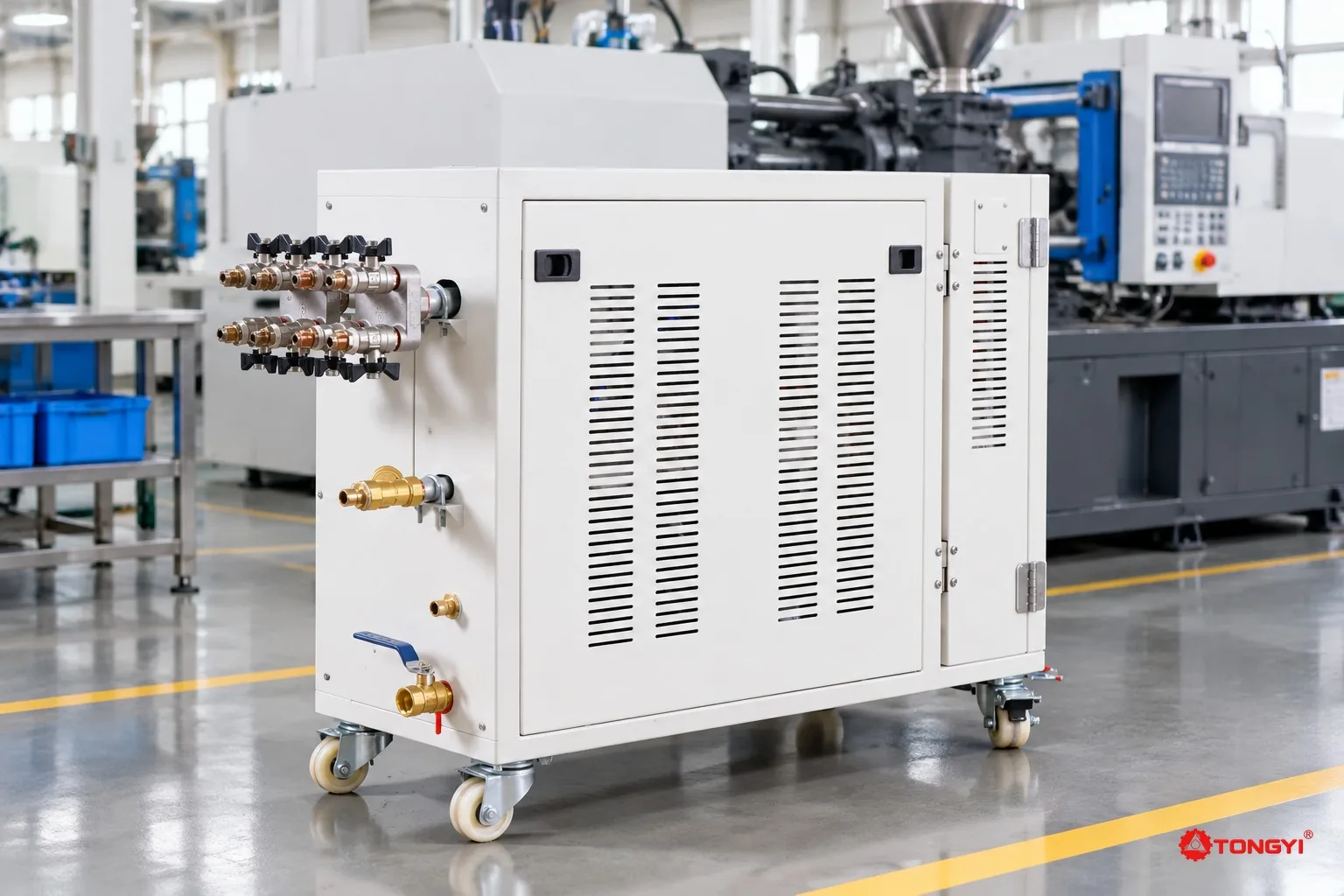
The table below shows verified specifications for one series of single-temperature water mold temperature controllers. It is useful for seeing how the electrical and hydraulic requirements step up as you move through the line, but it is not a price list — it is the input a supplier needs to quote you. Every value is tied to its exact model.
| Model | Heat transfer medium | Max. temperature | Min. temperature | Cooling method | Heater power | Pump power | Max. flow | Max. pressure | Temperature sensor | Return port | Manifold | Media ports |
|---|---|---|---|---|---|---|---|---|---|---|---|---|
| TMC 60W | Clean water | 120 °C | Cooling water temperature +5~30 °C | Direct | 6 kW | 0.37 kW | 42 L/min | 0.35 MPa | K type probe thermocouple | 15 mm | 2 in / 2 out | 3/8 inch |
| TMC 90W | Clean water | 120 °C | Cooling water temperature +5~30 °C | Direct | 9 kW | 0.75 kW | 60 L/min | 0.4 MPa | K type probe thermocouple | 15 mm | 2 in / 2 out | 3/8 inch |
| TMC 120W | Clean water | 120 °C | Cooling water temperature +5~30 °C | Direct | 12 kW | 0.75 kW | 60 L/min | 0.4 MPa | K type probe thermocouple | 15 mm | 4 in / 4 out | 3/8 inch |
| TMC 180W | Clean water | 120 °C | Cooling water temperature +5~30 °C | Direct | 18 kW | 1.5 kW | 165 L/min | 0.25 MPa | K type probe thermocouple | 15 mm | 1 in / 1 out | 1 inch |
| TMC 240W | Clean water | 120 °C | Cooling water temperature +5~30 °C | Direct | 24 kW | 1.5 kW | 165 L/min | 0.25 MPa | K type probe thermocouple | 15 mm | 1 in / 1 out | 1 inch |
| TMC 360W | Clean water | 120 °C | Cooling water temperature +5~30 °C | Direct | 36 kW | 2.2 kW | 310 L/min | 0.3 MPa | K type probe thermocouple | 15 mm | 1 in / 1 out | 1.2 inch |
Specifications are subject to change without prior notice. Confirm current data with the supplier at the time of quotation.
Comparing two models in the series: what the numbers actually buy you
A like-for-like comparison between two models in the same series shows where the price steps come from. Take the TMC 60W and the TMC 120W. Both use clean water as the heat-transfer medium, both have a maximum temperature of 120 °C, both use direct cooling, and both share the same lower temperature limit of cooling water temperature +5~30 °C. The differences are entirely in capacity and distribution: the TMC 60W carries a 6 kW heater with a 0.37 kW pump and a 42 L/min maximum flow, feeding a 2-in/2-out manifold through 3/8 inch media ports, while the TMC 120W carries a 12 kW heater with a 0.75 kW pump and a 60 L/min maximum flow, feeding a 4-in/4-out manifold through the same 3/8 inch ports.
The trade-off is not simply “bigger is better.” The TMC 120W’s doubled heater rating and higher flow shorten recovery time on a heavier mold and let you feed four circuits instead of two — but it draws roughly twice the connected electrical load and costs more to buy and to run. If your tool is small, has two cooling circuits, and your cycle time is not heat-limited, the TMC 60W is the correct unit and the additional capacity of the TMC 120W is money spent on capability you will not use. The TMC 120W earns its price when the mold has enough thermal mass or enough separate circuits that a 6 kW bank cannot hold setpoint during the injection and holding phases.
One more comparison worth noting: maximum flow and maximum pressure are separate ratings, and they do not always move together. The TMC 60W is rated at 42 L/min and 0.35 MPa; the TMC 90W is rated at 60 L/min and 0.4 MPa. Move further up the series to the TMC 180W and 240W and the maximum flow rises to 165 L/min while the maximum pressure rating falls to 0.25 MPa; the TMC 360W reaches 310 L/min at 0.3 MPa. These are separate ratings for the pump and circuit, not a single guaranteed duty point. If your mold has narrow internal channels that create high restriction, do not assume the highest-flow model will deliver both the highest flow and the highest pressure at your mold — ask the supplier to confirm the flow at the pressure your circuit actually develops.
The media port diameter also changes purchasing decisions. The TMC 60W, 90W and 120W use 3/8 inch media connections, while the TMC 180W and 240W step up to 1 inch and the TMC 360W to 1.2 inch. You will need matching hoses, fittings and quick-disconnects, and those are priced by diameter — a factor that is easy to leave out of a budget when comparing two quotes on the controller alone.
What to include in a request for a price quote
A quote request that produces a usable number contains the following. If you send all of it, suppliers can price the actual unit rather than a placeholder.
- Mold weight and material. Heavier tools and higher-melt-temperature resins need more heater capacity to reach setpoint and recover between shots.
- Required mold temperature and tolerance. State both the setpoint and how tightly it must be held. If you have a validated tolerance, say so explicitly.
- Cooling water supply temperature. The lowest achievable mold temperature is defined relative to your cooling water, so the supplier needs the actual plant supply temperature and its seasonal swing.
- Number of mold circuits. This determines the manifold configuration — a two-circuit tool and a four-circuit tool are different builds.
- Plant voltage, phase and frequency. Heater banks and motors are wound and wired for a specific supply. A unit built for the wrong supply cannot simply be re-plugged.
- Required flow and allowable pressure drop. Give the mold’s internal channel restriction or the flow you need through it, not just a model number.
- Ambient and environmental conditions. Washdown areas, high ambient temperature or corrosive atmosphere change the enclosure and sealing specification.
- Quantity, delivery location and required documentation. Volume, destination port or plant, and the electrical standard or documentation package required for import.
When you send these, ask for the quote to be broken out by heater capacity, pump, cooling configuration, manifold type, controls and freight. A breakdown makes two suppliers comparable; a single lump sum does not.
Questions to ask before you compare two quotes
Two prices that look different are often two different machines. Before you decide on cost, confirm that both quotes cover the same scope.
- Is the quoted temperature range the same, and is the lower limit stated relative to a specified cooling water temperature or left open?
- Is the heater power rating identical, and is it the connected load or the usable heat input?
- Is the manifold configuration — number of inlets and outlets — the same on both quotes?
- Are the media connection sizes the same, and are hoses and fittings included or excluded?
- Is the pump rating given as maximum flow or as flow at a stated pressure? These are not the same claim.
- Is the temperature sensor type specified, and where is it located in the circuit?
- Does the quote include the electrical panel, safety interlocks and any documentation or compliance package you need?
If a supplier cannot answer these from the quote, the figure is not yet a price — it is an indication.
A note on temperature accuracy and uniformity
Control precision and mold temperature uniformity are different things, and mixing them up leads to disappointment. The controller’s own accuracy describes how well the unit holds the fluid temperature at its sensing point. Temperature uniformity across the mold cavity is a property of the mold cooling layout, flow balance, and the number of circuits — not something a controller can guarantee on its own. If a supplier claims a specific accuracy figure or uniformity figure, ask which point was measured, under what conditions, and on which model. Without that information, treat the claim as unconfirmed.
Where to go next
Start by writing down the eight inputs listed above for your specific mold and plant. Then request quotes against that fixed specification so every supplier is quoting the same machine. If you need to compare configurations first, review the single-temperature water mold temperature controller series and the higher-temperature mold temperature controller options to confirm which media temperature range your process actually requires, then price the model that fits. Buyers who also run auxiliary material handling can review the injection molding auxiliary equipment lineup to coordinate the temperature controller with the rest of the line.
Get a specification-matched quote
Send the mold size, required working temperature, cooling channels per circuit and your electrical supply. We reply with a like-for-like configuration and the documented specifications for each model in the offer.
Every figure in this guide comes from our published specification sheets. Confirm model scope and test conditions before ordering.