
How Much Does an Injection Molding Mold Temperature Controller Cost, and Where Can I Buy One?
Learn what actually drives the cost of an injection molding mold temperature controller and where to buy one, so you can compare supplier quotes fairly.
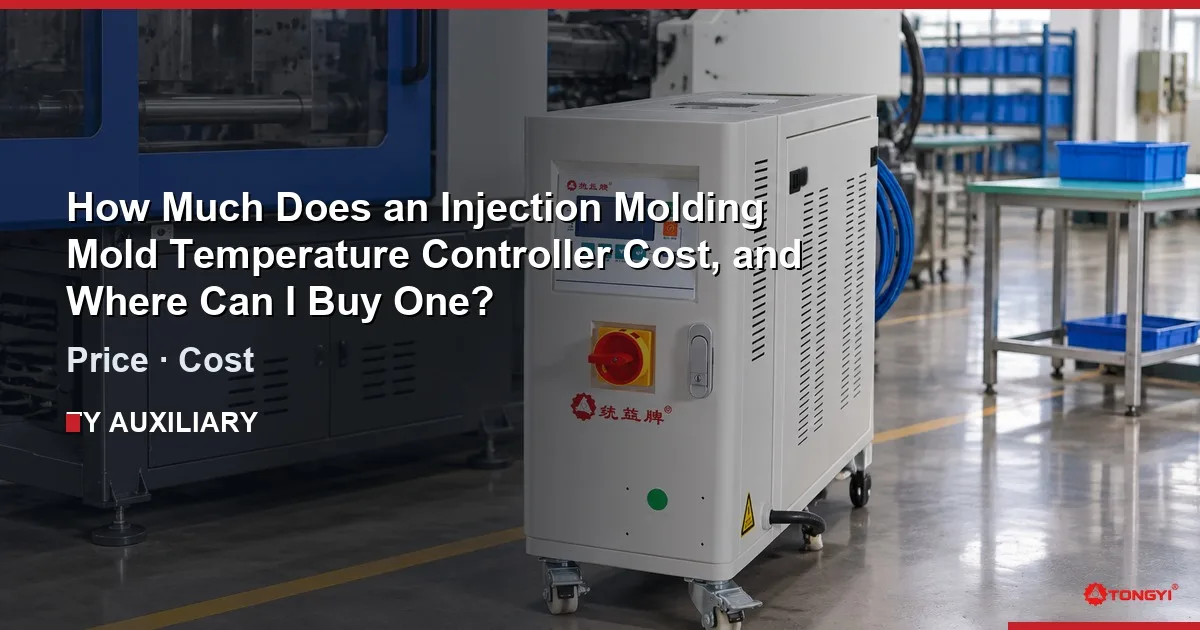
What drives the price of a mold temperature controller
Two buyers can request the same nominal “water heater” and receive quotes that differ substantially, because the internal components are not the same. The cost drivers below are the ones worth separating on any quotation.
Heating capacity and pump power
Heating wattage and pump motor size move together, and both scale with the amount of heat the mold must gain and shed per cycle. In a single-temperature water series such as the TMC-W range, the smaller units are intended for compact molds and short manifolds, while larger units serve multi-cavity tools and long cooling lines. Electrical service requirements follow the heating power, so a higher-wattage unit may also add cost at the panel and in the plant wiring, not only on the equipment invoice.
Pump flow, pressure, and piping size
Circuit count and line diameter are quoted differently by different suppliers and can shift the price noticeably. A unit with a single-in, single-out manifold and a one-inch connection is a different assembly than a unit with a four-in, four-out manifold and 3/8-inch connections, even when the heating power is identical. Confirm manifold configuration and connection size before comparing quotes.
Control, instrumentation, and safety package
Controller type, sensor type, alarms, dual-circuit switching, interlocks, and enclosure rating are specification items, not accessories. Each one adds cost and each one can be omitted from a low quote. Ask for the sensor type and the alarm set to be written into the offer.
Documentation, testing, and after-sales terms
Wiring diagrams, spare parts lists, factory test records, warranty length, and the availability of replacement pumps and controllers all carry cost. A quote that excludes them is not cheaper; it is incomplete.
Freight, duty, and payment terms
Shipping method, Incoterm, insurance, customs clearance, and payment terms (deposit versus letter of credit) change the landed figure without changing the machine. Always compare quotations at the same Incoterm and the same destination.
Why the series rating matters more than the headline wattage
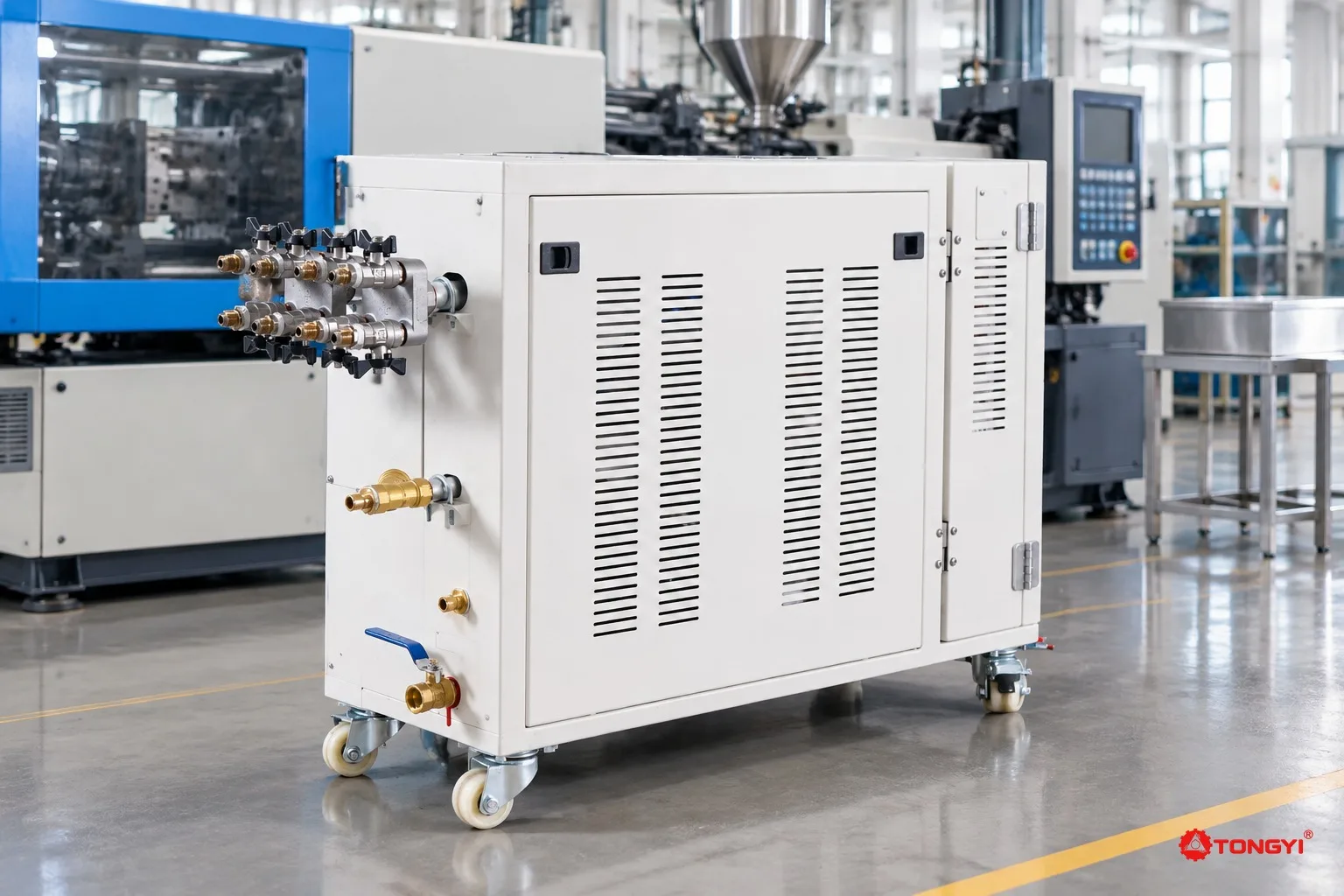
A common mistake is to compare units only by heating power. The TMC-W single-temperature water series illustrates why that is insufficient. Every model in the series uses clean water as the heat-transfer medium and shares a maximum temperature of 120 °C, with a minimum temperature expressed as the cooling water temperature plus 5 to 30 °C. The cooling method is direct cooling across the series, and the temperature sensor is a K-type probe thermocouple on every model. Those series-level values tell you the operating envelope: the unit is a pressurized hot-water machine, it cannot exceed 120 °C, and its achievable low end depends on the temperature of the cooling water you supply to it.
The model-to-model differences sit in electrical heating power, pump power, maximum flow, maximum pressure, manifold configuration, and process connection. Two adjacent models can share a pump and flow rating while differing in heating power, which changes heat-up speed and recovery on a heavy tool but not the circulating volume. Conversely, a larger unit may carry a higher flow with a lower maximum pressure than a smaller one, because flow and pressure are separate ratings; do not assume that a higher-flow pump delivers higher pressure at the mold.
Single-temperature water models compared like for like
The table below reproduces the supplied specifications for the TMC-W series exactly as documented. All models share the same medium, temperature limit, cooling method, and sensor type, so only the differing values are shown alongside those shared conditions.
| Model | Heating power | Pump power | Max. flow | Max. pressure | Manifold | Process connection |
|---|---|---|---|---|---|---|
| TMC 60W | 6 KW | 0.37 KW | 42 L/MIN | 0.35 MPA | 2 in 2 out | 3/8 inch |
| TMC 90W | 9 KW | 0.75 KW | 60 L/MIN | 0.4 MPA | 2 in 2 out | 3/8 inch |
| TMC 120W | 12 KW | 0.75 KW | 60 L/MIN | 0.4 MPA | 4 in 4 out | 3/8 inch |
| TMC 180W | 18 KW | 1.5 KW | 165 L/MIN | 0.25 MPA | 1 in 1 out | 1 inch |
| TMC 240W | 24 KW | 1.5 KW | 165 L/MIN | 0.25 MPA | 1 in 1 out | 1 inch |
| TMC 360W | 36 KW | 2.2 KW | 310 L/MIN | 0.3 MPA | 1 in 1 out | 1.2 inch |
Shared conditions for every model above: clean water medium, maximum temperature 120 °C, minimum temperature cooling water temperature +5 to 30 °C, direct cooling, K-type probe thermocouple, and 15 mm return water connection. Specifications are subject to change without prior notice; confirm the final configuration on the order acknowledgment.
The trade-off worth noting in prose is the one between TMC 120W and TMC 180W. Raising heating power from 12 KW to 18 KW also raises pump power from 0.75 KW to 1.5 KW and maximum flow from 60 to 165 L/MIN, but maximum pressure falls from 0.4 MPA to 0.25 MPA, and the manifold changes from 4 in 4 out to 1 in 1 out. That is not an upgrade or a downgrade; it is a different circuit architecture. The higher-flow unit circulates more water through fewer, larger connections, which suits a single large circuit, while the lower-flow unit distributes through four smaller circuits. Selecting on wattage alone can therefore produce a machine that cannot be plumbed to the mold as intended.
How to specify before you ask for a price
Suppliers price what they can define. Sending the following information with your inquiry shortens the quoting cycle and makes competing offers comparable.
- Mold weight, number of cooling circuits, and circuit diameters.
- Required mold surface temperature and the tolerance you actually need to hold.
- Resin being processed and expected cycle time.
- Press tonnage and available electrical service at the machine.
- Cooling water supply temperature and pressure at your plant.
- Ambient conditions and whether the unit will be installed beside the press or in a utility room.
- Control interface expectations, alarm requirements, and any plant safety standard the unit must meet.
- Destination port, Incoterm, and preferred payment structure.
Temperature control accuracy and temperature uniformity across the mold are two different things, and neither should be assumed from a general claim. If a supplier states an accuracy figure for the controller, ask for the measurement point and the test conditions behind it. Where that information is not supplied, treat the figure as requiring confirmation rather than as a guarantee.
What to put in a price request line by line
A quotation you can audit breaks the total into at least these lines: base unit with model designation, control package, manifold and connection configuration, spare parts kit, factory test and documentation, crating, freight to the named destination, insurance, and payment terms. Ask for the warranty period and what it covers, the recommended spare parts list with part numbers, and the lead time from deposit to shipment. If a supplier cannot itemize, ask them to restate the offer in that format before you compare it against others.
Where to buy a mold temperature controller
There are three practical routes, and each carries different cost and risk.
Buying direct from the manufacturer
Direct purchase usually gives the widest configuration range, access to the original spare parts, and a single point of responsibility for warranty. It also means you carry the import process, the electrical conformity check, and any commissioning work. Ask for the factory test record and confirm which voltage and frequency the unit is built for, since that is fixed at manufacture.
Buying through a regional distributor
A distributor holds stock, can often support installation, and shortens the response time on a breakdown. You pay for that inventory and service in the unit price. Ask whether the distributor stocks the pump and controller for your specific model, because that determines your real downtime exposure.
Buying used or refurbished
Used units can lower the entry cost but rarely come with a documented heating-element history or a verified pump curve. Before buying used, verify the heating power, pump condition, sensor calibration, and the integrity of the manifold, because those are the parts that fail.
Verification checklist before you place an order
Use this list with any supplier, direct or through a distributor, before committing to a purchase.
- Model designation and full specification sheet in writing, so the delivered unit can be matched against the offer.
- Electrical heating power and pump power at the voltage and frequency you will actually supply, because these are fixed at build.
- Maximum flow and maximum pressure listed as separate ratings, since one does not imply the other.
- Manifold configuration and connection size, to confirm the unit will plumb to your mold without adapters that restrict flow.
- Sensor type and controller accuracy statement, with the measurement point identified.
- Minimum achievable temperature relative to your cooling water supply temperature, since the series minimum is stated as an offset from it.
- Spare parts availability and lead time for pumps, controllers, and heating elements.
- Warranty terms, factory test documentation, and the Incoterm quoted, so landed cost comparisons are valid.
For buyers who want to move from specification to quotation, the TMC-W single-temperature water series is described on our mold temperature controller product page, and units can be matched to press and mold data through the injection molding temperature control solution overview. If your process runs above the water series envelope or needs a different circuit arrangement, the full equipment range shows the other configurations available for quoting.
Frequently asked questions
Is the price of a mold temperature controller fixed by model number?
No. The model sets heating power, pump power, flow, pressure, and connections, but the final price also depends on the control and safety package, documentation, spare parts, freight, duty, and payment terms. A quotation without those lines itemized is not directly comparable to one that has them.
Why do two suppliers quote very different amounts for a similar mold temperature controller?
Usually because the offers are not the same scope. Differences in manifold configuration, connection size, sensor type, alarm package, factory testing, and Incoterm all change the total. Ask both suppliers to restate their offer line by line at the same destination and the same delivery terms before you compare.
Does a higher maximum flow mean higher pressure at the mold?
Not necessarily. Flow and pressure are separate ratings. In the TMC-W series, the model with 165 L/MIN maximum flow is rated at 0.25 MPA maximum pressure, while a lower-flow model is rated at 0.4 MPA. Match the rating to the pressure drop of your actual mold circuits rather than assuming the higher number wins.
What cooling water conditions does the unit need?
Across the TMC-W series the minimum temperature is stated as the cooling water temperature plus 5 to 30 °C, and the maximum is 120 °C. Your achievable low temperature therefore depends on the temperature of the water you supply, so confirm your plant cooling water conditions before selecting a model for a low-temperature process.
Where can I buy a mold temperature controller for an overseas plant?
Direct from the manufacturer, through a regional distributor, or on the used market. Direct purchase brings the widest configuration range and original spare parts but leaves import and commissioning to you; a distributor shortens response time at a higher unit price. In all three cases, confirm voltage and frequency in writing before ordering.
What information should I send with a request for quotation?
Mold weight, number of cooling circuits and their diameters, required mold temperature and tolerance, resin and cycle time, press tonnage, available electrical service, cooling water temperature and pressure, destination port, Incoterm, and payment preference. Suppliers price what they can define, so this list typically shortens the quoting cycle.
Get a specification-matched quote
Send the mold size, required working temperature, cooling channels per circuit and your electrical supply. We reply with a like-for-like configuration and the documented specifications for each model in the offer.
Every figure in this guide comes from our published specification sheets. Confirm model scope and test conditions before ordering.