
What’s the Price of an Injection Mold Temperature Controller, and How Much Does Repair Cost?
Heating capacity, pump size and quote structure set the price of a mold temperature controller, while repair cost depends on which component failed.
Why the quoted price varies so much for the same duty
Two buyers can describe the same molding cell and receive quotes that differ by a wide margin. In most cases the gap comes from what was assumed rather than what was written:
- Electrical service assumed. A larger heater changes the supply, the breaker, the cable size and sometimes the transformer capacity. If one supplier quoted a 6 kW machine and the other quoted a 36 kW machine for the same cell, the price difference is mostly copper and switchgear, not margin.
- Pump curve assumed. A higher-flow pump raises cost and changes the piping and manifold sizing. Flow and pressure are separate ratings, so a supplier who quotes only “max pressure” has not told you what the circuit will actually deliver.
- Circuit count assumed. A 2-in / 2-out manifold and a 4-in / 4-out manifold serve different mold layouts and are priced differently.
- Scope of supply. Hoses, quick couplers, manifold, spare thermocouple, spare pump seal, documentation package and operator training are frequently excluded from the headline number.
- Delivery terms. FOB, CIF and DDP place very different cost on the buyer. Duty classification and destination charges belong in the comparison.
- Documentation and inspection. A third-party pre-shipment inspection, a full material certificate package, or a witnessed factory acceptance test all add cost and are usually optional line items.
The practical rule: never compare two mold temperature controller quotes until both are broken down into unit, options, documentation, freight, duty, and commissioning. Ask for the same FOB or DDP basis on both.
What the specification tells you about the price you should expect
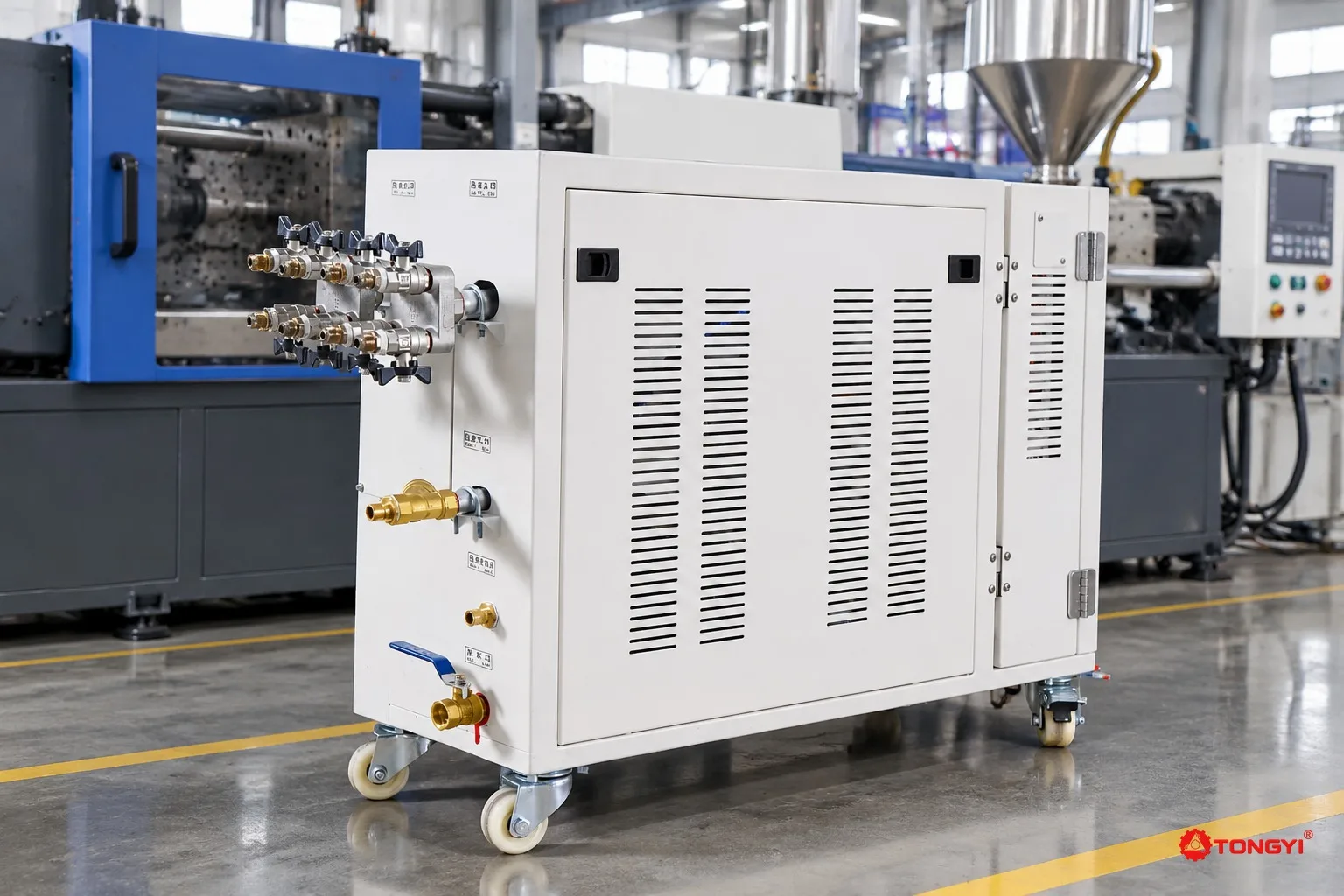
The supplied single-temperature clean-water series gives a clear picture of how cost scales because every model differs in measurable hardware, not in marketing tier. Two values matter most at the quoting stage.
First, heating capacity. The series starts at 6 kW on the TMC 60W and rises through 9 kW, 12 kW, 18 kW and 24 kW to 36 kW on the TMC 360W. That number sets how fast the unit can bring a mold up to temperature and how much heat it can replace once the press is cycling. It also sets the electrical supply class, which is where a large part of the installed cost sits. A buyer who oversizes heating pays twice: once for the machine and again for the service upgrade. A buyer who undersizes pays daily in longer heat-up and longer cycle time.
Second, pump power and flow. The same series runs from a 0.37 kW pump moving up to 42 L/min on the TMC 60W, up to 1.5 kW at 165 L/min on the TMC 180W and 240W, and to 2.2 kW at 310 L/min on the TMC 360W. Flow is what carries heat into and out of the mold; if the circuit is long, the mold has many channels, or the manifold splits flow across several loops, a small pump simply cannot move enough medium and the controller will chase temperature it can never reach. Pump size, not heater size, is the usual reason a correctly rated unit still performs badly.
Both series values sit under the same operating window: clean water as the heat-transfer medium, a maximum temperature of 120 °C, and a minimum temperature of cooling water temperature plus 5 to 30 °C. That last figure matters for cost planning — the unit cannot go below your plant cooling water temperature by more than the stated margin, so if your process needs colder mold temperature, a different machine class is required and the quote will reflect it.
Like-for-like comparison across the supplied single-temperature models
The table below keeps every value attached to its exact model and supplied condition. It is meant for comparison, not as a price list — no currency figures are given or implied anywhere in this article.
| Model | Heat-transfer medium | Max temperature | Min temperature | Heating power | Pump power | Max flow | Max pressure | Manifold | Inlet/outlet size |
|---|---|---|---|---|---|---|---|---|---|
| TMC 60W | Clean water | 120 °C | Cooling water temperature +5 to 30 °C | 6 kW | 0.37 kW | 42 L/min | 0.35 MPa | 2 in / 2 out | 3/8 inch |
| TMC 90W | Clean water | 120 °C | Cooling water temperature +5 to 30 °C | 9 kW | 0.75 kW | 60 L/min | 0.4 MPa | 2 in / 2 out | 3/8 inch |
| TMC 120W | Clean water | 120 °C | Cooling water temperature +5 to 30 °C | 12 kW | 0.75 kW | 60 L/min | 0.4 MPa | 4 in / 4 out | 3/8 inch |
| TMC 180W | Clean water | 120 °C | Cooling water temperature +5 to 30 °C | 18 kW | 1.5 kW | 165 L/min | 0.25 MPa | 1 in / 1 out | 1 inch |
| TMC 240W | Clean water | 120 °C | Cooling water temperature +5 to 30 °C | 24 kW | 1.5 kW | 165 L/min | 0.25 MPa | 1 in / 1 out | 1 inch |
| TMC 360W | Clean water | 120 °C | Cooling water temperature +5 to 30 °C | 36 kW | 2.2 kW | 310 L/min | 0.3 MPa | 1 in / 1 out | 1.2 inch |
All models use a K-type probe thermocouple for medium inlet/outlet temperature sensing, a 15 mm return-water port, and direct cooling. Specifications are subject to change without prior notice; confirm current ratings with the supplier before releasing a purchase order.
One documented trade-off is worth calling out because it is easy to misread. The TMC 180W and TMC 240W share the same 1.5 kW pump and the same 165 L/min maximum flow, and both are rated at a maximum pressure of 0.25 MPa — lower than the 0.4 MPa maximum of the smaller TMC 90W and TMC 120W. The TMC 360W moves more volume again at 310 L/min but its maximum pressure is 0.3 MPa. Flow and pressure are separate ratings here, not two views of the same number: a high-flow circuit handling a large mold and a single-circuit arrangement tolerates lower pressure, while a small-bore mold with restrictive channels needs the higher pressure the smaller frames offer. Never merge values from different models into an assumed range, and never assume the largest machine has the highest pressure.
What actually drives repair cost
Repair bills are not random. They track the failed component, and each component has a different cost profile:
Heating elements and contactors
Heater failure is the most common repair on any water-based controller and usually the cheapest to resolve in parts terms. The real cost is downtime, not the element. Ask whether the supplier stocks the element for your exact model — a 6 kW element and a 36 kW element are different parts and are not interchangeable between frames.
Pumps and seals
Pump replacement is a mid-tier repair and its cost scales with pump power, from 0.37 kW up to 2.2 kW across the supplied series. Mechanical seal wear is the usual root cause and is aggravated by dirty or hard water. This is the strongest argument for treating water quality as a maintenance item rather than a nuisance: clean medium protects the seal, the pump and the heat exchanger at the same time.
Sensors and controllers
The series uses a K-type probe thermocouple at the medium inlet/outlet. Thermocouple drift or failure causes temperature swings that look like a process problem and are often misdiagnosed as a heater fault. Control board or display failure is more expensive than a sensor but far less common. When you request a repair quote, state the model, the symptom, and the measured temperature deviation so the supplier can separate a sensor fault from a control fault.
Heat exchanger and piping
Scaling and corrosion in a direct-cooling circuit lead to the most expensive class of repair because they can require the exchanger to be replaced rather than cleaned. This cost is largely preventable and is the reason a documented water-treatment and flush schedule pays for itself.
The cost nobody quotes: downtime and freight
On an overseas installation, the true repair cost usually exceeds the parts cost. Air freight for a pump, customs clearance for a warranty shipment, an engineer’s travel, and the hours of idle press time all belong in the number. Two identical repairs can differ by an order of magnitude depending on whether spare parts are held locally. This is the single most useful question to ask before you buy, not after: which spare parts does the supplier recommend stocking on site for this model?
How to structure a quote request so the numbers are comparable
A quote request that returns comparable numbers includes the following, every time:
- Model or duty. Name the model you are evaluating or state the mold weight, number of circuits and target temperature.
- Heat-transfer medium and maximum temperature. Confirm the process stays inside clean water at up to 120 °C. If it does not, say so — the answer changes the machine class, not just the price.
- Cooling water temperature at your plant. This sets the achievable minimum temperature and therefore whether the standard unit will work at all.
- Electrical supply. Voltage, phase, frequency and available breaker capacity. This determines the largest heater you can install without a service upgrade.
- Circuit layout. How many inlets and outlets the mold needs, and the hose and coupler sizes you intend to use.
- Scope of supply. Manifold, hoses, couplers, spare thermocouple, spare seal kit, documentation, and whether commissioning support is included.
- Delivery term. Request FOB and DDP side by side so the landed comparison is visible on one page.
- Warranty and spare parts. Warranty duration, what it covers, and which spares the supplier recommends holding on site.
If you are still comparing machine classes or need to match a controller to a specific mold or press, review the mold temperature controller range and, where the cell also needs material handling, the auxiliary equipment selection guide before you send the request. Buyers sourcing a complete cell rather than a single unit often get better pricing and better-matched accessories by starting from the molding cell solutions overview.
Frequently asked questions
How much does an injection mold temperature controller cost?
Pricing is quoted per project rather than published as a list, and it is driven mainly by heating capacity and pump size — the supplied single-temperature series spans 6 kW to 36 kW of heating power, which places the units in different electrical installation classes. Ask for the unit price, options, documentation, freight and duty to be broken out separately so offers can be compared on the same basis.
What does a repair on a mold temperature controller typically involve?
Most repairs fall into four groups: heating elements and contactors, pump and mechanical seal replacement, thermocouple or control board faults, and heat exchanger cleaning or replacement caused by scale and corrosion. The parts cost is usually the smaller part of the bill once freight and press downtime are counted, which is why on-site spare parts matter more than the repair price itself.
Which spare parts should I keep on site for a water-type controller?
At minimum, plan for a spare K-type thermocouple, a pump mechanical seal kit, and a heating element matched to your exact model. Because heating power ranges from 6 kW to 36 kW across the series, elements are model-specific and cannot be shared between frames. Confirm with your supplier which parts are recommended for the model you operate.
Can a 6 kW unit and a 36 kW unit be compared on price alone?
No. The TMC 60W runs a 6 kW heater with a 0.37 kW pump at up to 42 L/min, while the TMC 360W runs a 36 kW heater with a 2.2 kW pump at up to 310 L/min. They differ in heating rate, flow capability, cabinet size, electrical service and manifold configuration, so each should be priced against the duty it actually has to serve.
Does a bigger pump always mean better performance?
Not necessarily. The TMC 360W delivers the highest maximum flow at 310 L/min but is rated at a maximum pressure of 0.3 MPa, while the smaller TMC 90W and TMC 120W are rated at 0.4 MPa. Flow and pressure are separate ratings, so the correct choice depends on circuit length, channel size and how many loops the manifold splits the medium across.
What information should I include when requesting a price or a repair quote?
Include the model or the required duty, the heat-transfer medium and maximum process temperature, your plant cooling water temperature, the electrical supply available, the number of mold circuits, the intended scope of supply and the delivery term. For a repair quote, add the symptom, the measured temperature deviation and the part you believe has failed, so the supplier can distinguish a sensor fault from a control or pump fault.
Bottom line
The price of an injection mold temperature controller is set by heating capacity, pump capability, circuit configuration and the commercial terms around the machine — not by a single list figure. Repair cost is set by which component failed and how quickly parts can reach your plant. Specify the duty first, compare offers on identical terms, and settle the spare-parts question before the purchase order, and both numbers stop being unpredictable.
Get a specification-matched quote
Send the mold size, required working temperature, cooling channels per circuit and your electrical supply. We reply with a like-for-like configuration and the documented specifications for each model in the offer.
Every figure in this guide comes from our published specification sheets. Confirm model scope and test conditions before ordering.