
How Much Does a Custom Industrial Mold Temperature Controller Cost from a Manufacturer?
Learn which specifications drive a custom industrial mold temperature controller price and what to include in a quote request to compare suppliers fairly.
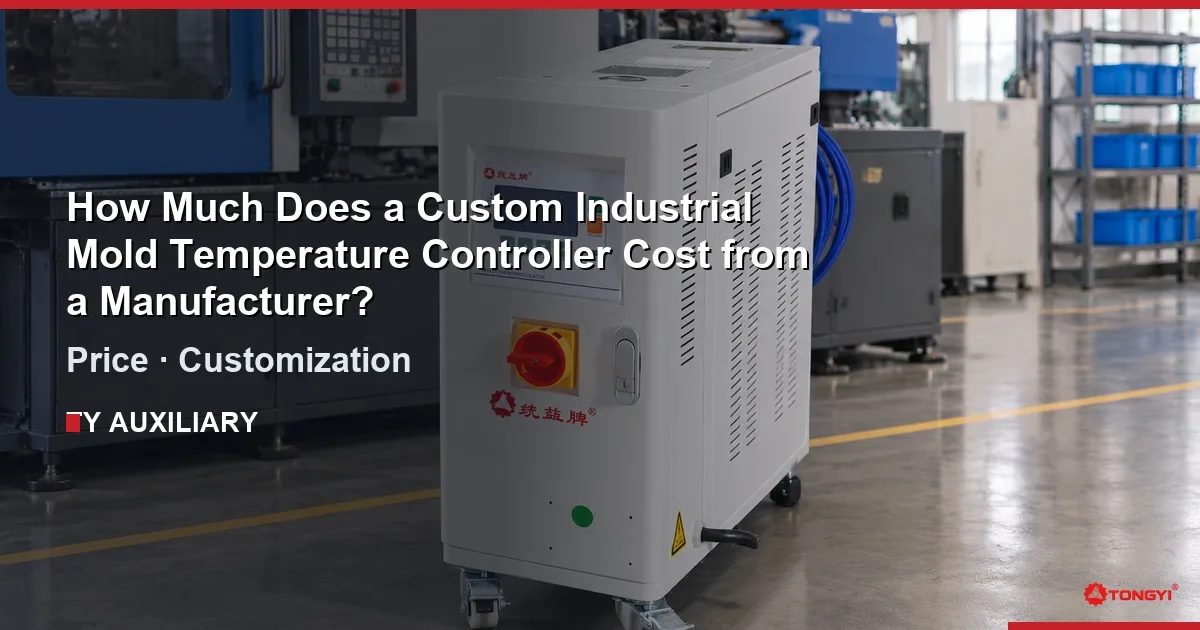
What actually drives a custom industrial mold temperature controller price
Four specification blocks account for most of the variation between one quote and the next. Heating power, stated in KW, sizes the heater bundle, the contactor, the wiring gauge, and the electrical protection. The pump package — pump power, maximum flow in L/MIN, and maximum pressure in MPA — decides pump size, shaft seal type, and piping bore. The cooling and heat transfer arrangement sets valve sizing and how quickly the unit can pull temperature down; direct cooling on clean water is a simpler circuit than an indirect design. Distribution and connections come last: the manifold configuration, the return port diameter, and the process connection size all change how much fabrication each machine carries.
Layered on top of those are the control package, sensor type, safety interlocks, the electrical standard for the destination country, and the factory test scope. Customization and manufacturing method both move the number because they change how much work is completed in the factory rather than at the installation site. A unit assembled from a standard bill of materials and tested to a fixed routine is quoted differently from one built to a plant standard with documented component brands and a witnessed functional test.
Reading the TMC clean-water data sheet before you request cost
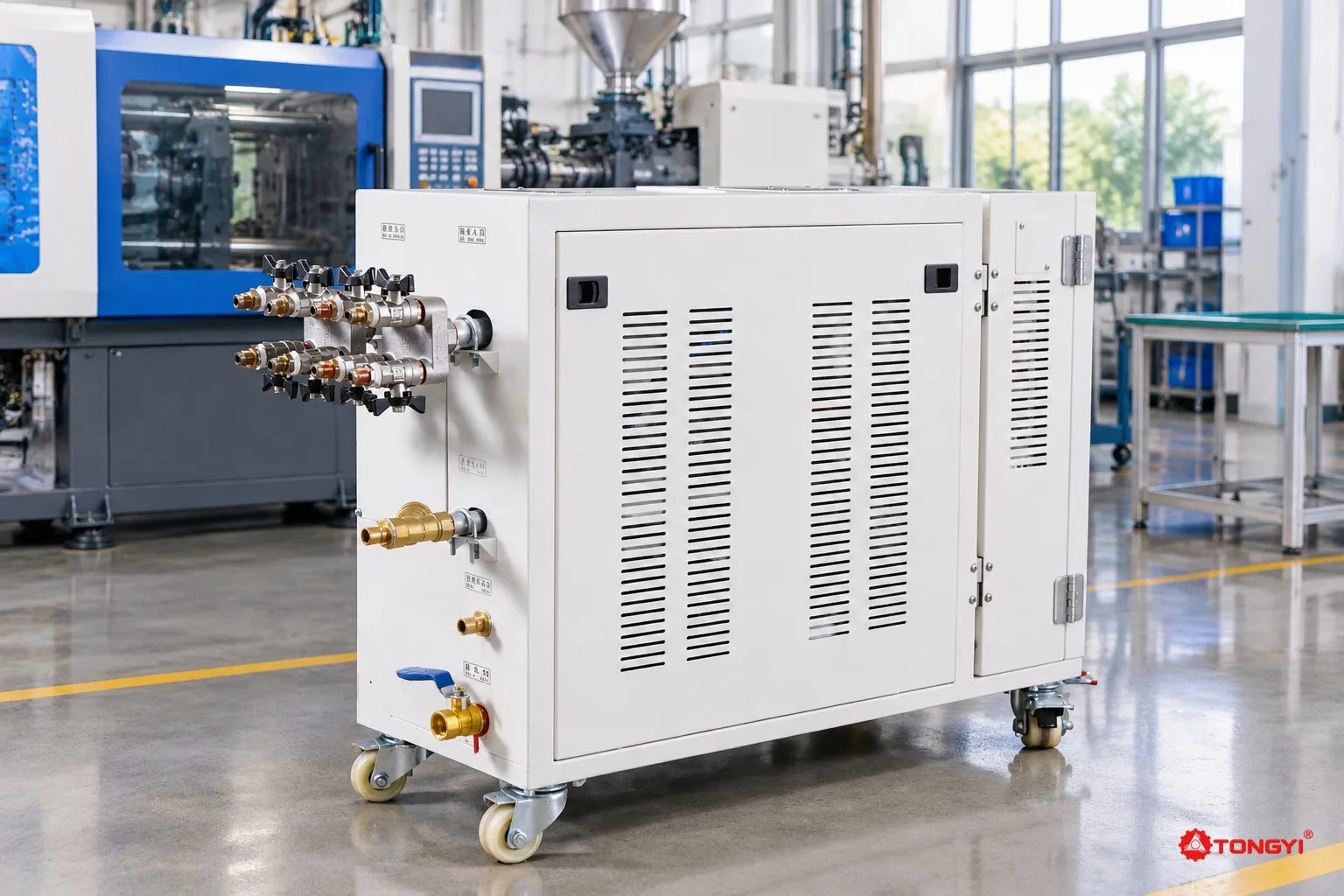
The TMC series is a clean-water, directly cooled line. Every model in it shares the same maximum temperature of 120 °C and the same K type probe thermocouple as the sensing element, so the differences you pay for sit in heating power, pump output, and manifold layout.
Heating power sets the recovery rate you are buying
Heating power runs from 6 KW on the TMC 60W to 36 KW on the TMC 360W. That value tells you how much heat the unit can push into the mold circuit per unit of time, which in practice governs how quickly a cold mold reaches setpoint and how well the unit holds temperature when cold plastic or metal starts absorbing heat. A small platen with a light shot can be served by the 6 KW unit; a large die with heavy sections and a short cycle needs the higher end of the range. Because the heater bundle, contactors, and supply wiring scale with this number, heating power is usually the single largest cost driver on the sheet.
Flow and pressure are two separate ratings
The TMC 60W is rated at 42 L/MIN maximum flow and 0.35 MPA maximum pressure. The TMC 180W is rated at 165 L/MIN at a lower maximum pressure of 0.25 MPA. Flow and pressure are not two ways of describing the same performance figure — they are separate ratings, and the series is documented as delivering higher flow at a lower pressure ceiling as the models get larger. If your mold circuit is long, narrow, or heavily restricted, a high-flow rating at a lower pressure ceiling may not translate into the same result as a lower-flow unit with more head. Ask the supplier for expected flow at your actual circuit pressure drop instead of comparing the headline numbers alone.
The temperature floor depends on your cooling water
The minimum temperature across the series is stated as cooling water temperature +5~30 °C. That is a relative figure, not a fixed number: the unit can hold a setpoint only a short distance above whatever your plant cooling water is at that moment. In summer, when supply water is warm, the achievable floor rises with it. When you request pricing, give the supplier your measured cooling water supply temperature rather than a nominal room temperature, because it determines whether a water unit can hold the setpoint your process needs at all.
Like-for-like comparison of the TMC clean-water series
The table below compares the six supplied models on the values that most often change the quoted cost.
| Model | Heating power | Pump power | Maximum flow | Maximum pressure | Manifold | Process connection |
|---|---|---|---|---|---|---|
| TMC 60W | 6 KW | 0.37 KW | 42 L/MIN | 0.35 MPA | 2 in 2 out | 3/8 INCH |
| TMC 90W | 9 KW | 0.75 KW | 60 L/MIN | 0.4 MPA | 2 in 2 out | 3/8 INCH |
| TMC 120W | 12 KW | 0.75 KW | 60 L/MIN | 0.4 MPA | 4 in 4 out | 3/8 INCH |
| TMC 180W | 18 KW | 1.5 KW | 165 L/MIN | 0.25 MPA | 1 in 1 out | 1 INCH |
| TMC 240W | 24 KW | 1.5 KW | 165 L/MIN | 0.25 MPA | 1 in 1 out | 1 INCH |
| TMC 360W | 36 KW | 2.2 KW | 310 L/MIN | 0.3 MPA | 1 in 1 out | 1.2 INCH |
All six models share the same heat transfer medium (clean water), the same 120 °C maximum temperature, the same direct cooling method, the same K type probe thermocouple, the same cooling water temperature +5~30 °C minimum, and the same 15 MM return connection. Specifications are subject to change without prior notice, so confirm the current data sheet with the supplier at the time of order.
Trade-offs worth knowing before you choose a size
Two patterns in this series matter when you compare offers. First, the TMC 60W moves 42 L/MIN at 0.35 MPA while the TMC 180W moves 165 L/MIN at 0.25 MPA — roughly four times the flow, but at a lower maximum pressure. Higher flow helps when the mold has many parallel channels or a large platen to sweep; lower pressure matters when the circuit is restrictive. Second, the manifold changes with size. The TMC 60W and TMC 90W use a 2 in 2 out splitter and the TMC 120W uses 4 in 4 out, all with 3/8 INCH process connections, while the TMC 180W and above step to a 1 in 1 out arrangement with 1 INCH or 1.2 INCH connections. Smaller units are built to distribute to several small circuits directly; larger units are set up for one large circuit or an external manifold. If your quote includes an external manifold, make sure it is listed in both offers, because otherwise you are not comparing the same scope.
What “custom” changes on a mold temperature controller
A custom order usually modifies one or more of the following, and each one adds engineering and fabrication scope that should appear as a separate line in the quote:
- Manifold configuration and the number of circuits the unit feeds, including splitter layout and connection sizes.
- Electrical standard for the destination plant — voltage, phase, frequency, and panel arrangement.
- Control package, including how setpoints are entered and what alarms are provided.
- Sensor placement and probe length, since the supplied element in the TMC series is a K type probe thermocouple but its mounting position is a build decision.
- Documentation set — datasheets, wiring diagrams, and test records in your language.
- Factory testing scope, including whether the buyer witnesses the functional test.
A custom build should still be quoted against a fixed data sheet, so you can see exactly what was changed from the standard model and confirm that what arrives matches what was quoted.
How the manufacturer’s build scope affects the quote
Two suppliers can offer the same headline heating power and still differ in cost, because the amount of manufacturing done in-house is different. Ask whether the tank and piping are fabricated in the supplier’s own shop, which brand of pump and contactor is used, and how the finished unit is tested before shipment. A quote that includes a pressure test and a functional run with a written record is not the same offer as one that includes a visual check only. Component brand, assembly hours, and test depth are legitimate cost drivers, and they are the first items to normalize if you want to understand why two numbers differ.
What to include in your quote request
- Required heating power or the condition it must satisfy. State either the KW you need or the mold mass and cycle you are running, so the supplier can size it. Without this, quotes come back against different assumptions.
- Required flow at the mold, with your circuit’s pressure drop. A flow rating on its own says little; the useful input is the flow you need at the restriction your circuit presents.
- Setpoint and measured cooling water supply temperature. Because the minimum temperature is cooling water temperature +5~30 °C, this pair of numbers tells the supplier whether a water unit is viable and how much cooling capacity to fit.
- Number of mold circuits and their connection sizes. This determines whether a 2 in 2 out, 4 in 4 out, or 1 in 1 out manifold is appropriate, and whether the 3/8 INCH or the 1 INCH process connection matches your hoses.
- Electrical supply at the destination plant. Voltage, phase, and frequency determine the heater wiring, contactor rating, and panel build, and they are a common source of rework when they are left out.
- Control and sensor requirements. State the control features you need, note that the supplied sensing element in this series is a K type probe thermocouple, and ask where the probe will sit. Controller accuracy and temperature uniformity across the mold face are separate questions — confirm both with the supplier rather than assuming they follow from the thermocouple type.
- Testing, documentation, and acceptance criteria. Ask what test is run, what record is provided, and whether you can witness it. This is the item that most often explains a difference between two quotes.
- Spare parts, warranty terms, and lead time. Pumps, seals, and heaters are wear items; asking for their part numbers with the quote makes later sourcing straightforward.
How to compare quotes from two manufacturers fairly
Send the same specification sheet to every supplier and require each of them to state the model or the exact custom variant being offered. Then check three things: whether the heating power, flow, and pressure values match the duty you described; whether the manifold, connection sizes, and return port are the same in both offers; and whether testing, documentation, spare parts, and warranty are included or quoted separately. A quote that looks different is usually a scope difference rather than a price difference, and the only way to see which is to compare the sheets side by side.
A practical next step is to complete one specification sheet covering the eight items above, mark your required heating power and cooling water temperature clearly, and ask each manufacturer to quote against that sheet with the data sheet revision number attached. That gives you offers you can compare on equal terms and a written record of the configuration you are buying.
Get a specification-matched quote
Send the mold size, required working temperature, cooling channels per circuit and your electrical supply. We reply with a like-for-like configuration and the documented specifications for each model in the offer.
Every figure in this guide comes from our published specification sheets. Confirm model scope and test conditions before ordering.