
How Much Does a Custom Industrial Mold Temperature Controller Cost, and How Do I Select the Right Unit?
Compare documented product features and process requirements before selecting a mold temperature controller.
What determines the price of a custom industrial mold temperature controller?
For that reason, suppliers quote from a specification, not from a catalog. The most reliable way to get a comparable price is to send the same set of inputs to every supplier you approach: mold weight, number of circuits, required mold surface temperature, achievable cooling water temperature, available power supply, and how far the unit will sit from the press. Buyers who supply those details get firm quotes faster and have something meaningful to compare.
Which cost drivers matter most in a custom quote
Heating capacity
Heating capacity is the single largest cost driver, because it determines the electric heating elements and the contactors that switch them. It also sets the power supply requirement at the plant. In the TMC 60W water-type series, for example, heating capacity runs from 6 kW on the smallest model up to 36 kW on the largest, and that spread alone moves a unit between cost classes.
Pump flow and pressure
The pump is the second major driver. Higher flow means a physically larger pump, larger internal piping, and a heavier frame. It is a common mistake to size the pump on temperature alone. Flow determines how quickly the unit can move heat out of the mold, and pressure determines whether that flow can actually be pushed through a restricted circuit such as a long, small-diameter channel or a multi-cavity manifold.
Media outlets and manifold configuration
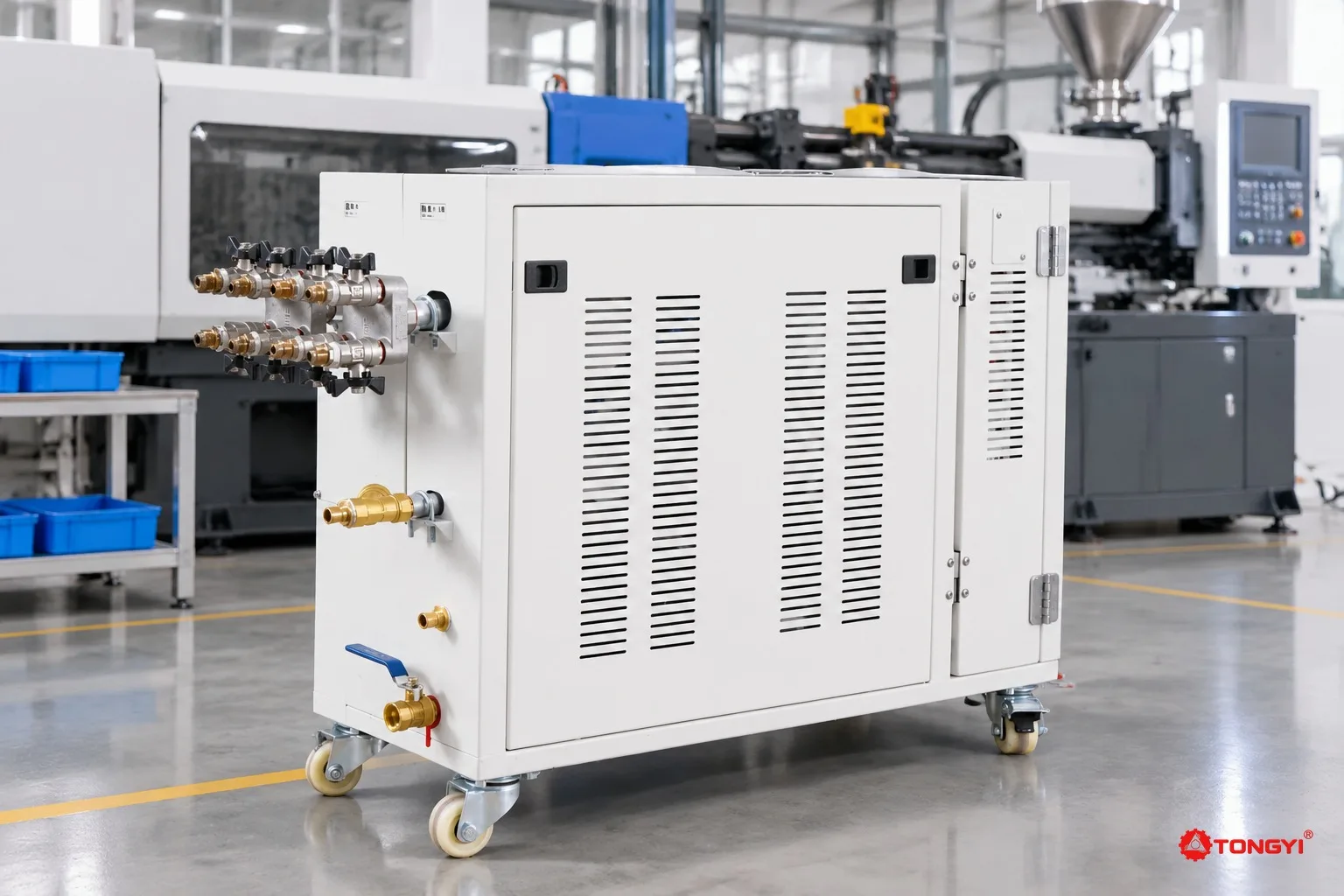
The number of inlets and outlets determines the manifold block, valves and fittings. A 2-in-2-out configuration on a small unit is straightforward. A 4-in-4-out configuration on the TMC 120W requires more hardware and more assembly time, and that is reflected in the quote. Ask the supplier to state the manifold configuration explicitly, because a unit quoted as “4 circuits” may not include the flow balancing hardware you expect.
Control package, instrumentation and materials
Standard control versus closed-loop mold-surface control, the type and placement of the temperature sensor, data logging and plant-network communication, and stainless versus standard wetted parts all change the price. Custom units frequently add non-standard fittings, voltage or frequency variants, and documentation packages for the buyer’s own compliance file.
Engineering, testing and freight
Custom engineering effort, factory testing, packaging for ocean freight, and destination charges are real line items. Buyers comparing only the ex-works figure are comparing incomplete numbers. Ask for a quote broken down by equipment, engineering and logistics so you can see where the money is going.
Comparing models like for like: TMC 60W through TMC 360W
The table below uses only verified specifications from the TMC water-type single-temperature series. It is intended to show how the specification climbs across the range, not to rank the models. Every figure belongs to the exact model in its row.
| Model | Heating power | Pump power | Max. flow | Max. pressure | Media outlets | Media connection | Max. temperature |
|---|---|---|---|---|---|---|---|
| TMC 60W | 6 kW | 0.37 kW | 42 L/min | 0.35 MPa | 2 in 2 out | 3/8 inch | 120 °C |
| TMC 90W | 9 kW | 0.75 kW | 60 L/min | 0.4 MPa | 2 in 2 out | 3/8 inch | 120 °C |
| TMC 120W | 12 kW | 0.75 kW | 60 L/min | 0.4 MPa | 4 in 4 out | 3/8 inch | 120 °C |
| TMC 180W | 18 kW | 1.5 kW | 165 L/min | 0.25 MPa | 1 in 1 out | 1 inch | 120 °C |
| TMC 240W | 24 kW | 1.5 kW | 165 L/min | 0.25 MPa | 1 in 1 out | 1 inch | 120 °C |
| TMC 360W | 36 kW | 2.2 kW | 310 L/min | 0.3 MPa | 1 in 1 out | 1.2 inch | 120 °C |
All models in this series use clean water as the heat transfer medium and direct cooling, with a minimum working temperature defined as cooling water temperature plus 5 to 30 °C. Temperature sensing is by K type probe thermocouple, and the return water port on every model is 15 mm. Specifications are subject to change without prior notice.
What the TMC 60W and TMC 90W figures tell a buyer
Take the TMC 60W. Its 6 kW heating power and 0.37 kW pump with 42 L/min maximum flow define a small cell: a single small-to-medium mold where the circuit is short and unrestricted. The same unit’s 0.35 MPa maximum pressure matters more than the flow figure in practice, because a narrow or long mold channel can consume most of that pressure before the water ever reaches the far end of the circuit; if the circuit is restrictive, flow drops and temperature recovery slows. Note also that maximum flow and maximum pressure are separate ratings, not a single duty point; the pump will not deliver both at once, and the supplier should confirm the expected duty point for your specific mold.
Now compare the TMC 60W with the TMC 90W. Heating power rises from 6 kW to 9 kW and pump power from 0.37 kW to 0.75 kW, while maximum flow climbs from 42 L/min to 60 L/min. The manifold configuration stays at 2 in 2 out and the media connection stays at 3/8 inch. For a buyer, this is a useful decision boundary: the TMC 90W buys faster heat-up and recovery without changing the plumbing layout of the mold, which keeps installation simple. If your mold already runs 2 in 2 out at 3/8 inch and the limiting factor is cycle time rather than circuit count, the step up in pump and heating power is the cheaper change than reworking the mold manifold.
Where the configuration changes character
The TMC 120W holds the same 0.75 kW pump and 60 L/min maximum flow as the TMC 90W but adds heating power to 12 kW and moves the manifold to 4 in 4 out. That extra capacity is aimed at molds with more circuits, not at molds needing more flow. Above that, the TMC 180W and TMC 240W step to a 1.5 kW pump at 165 L/min and a 1 inch media connection with a single inlet and outlet, which suits a larger, lower-restriction circuit where a single high-flow loop is preferable to four small ones. The TMC 360W goes to 2.2 kW and 310 L/min at 1.2 inch. This series-wide progression is the reason a custom quote changes so much between a 6 kW and a 36 kW build: heating elements, pump, piping and manifold all scale together.
How to select the right unit for your mold
Selection is a sequence, not a single calculation. Work through it in this order.
- Start with mold and process data. Record mold weight, number of cooling/heating circuits, required mold surface temperature, and target cycle time. These set the minimum heating and flow requirement.
- Establish the cooling water temperature available in your plant. The minimum achievable temperature for this series is cooling water temperature plus 5 to 30 °C, so a plant with warmer cooling water cannot reach the same low-end temperature as a plant with chiller-fed water.
- Match the pump to circuit resistance, not just to mold size. Check the circuit length, diameter and number of restrictions against the unit’s maximum flow and maximum pressure ratings separately.
- Choose the manifold configuration to match the mold. Confirm inlet/outlet count and connection size against your existing hoses and manifolds before ordering.
- Confirm power supply and electrical protection. Heating power drives the amperage; verify the available voltage, phase and breaker capacity at the installation point.
- Decide the control and instrumentation scope. Specify whether you need closed-loop mold surface control, remote setpoint, data logging or plant network connection, since these change both the price and the lead time.
- Confirm the temperature measurement point. This series uses a K type probe thermocouple, and the return water port is 15 mm. Make sure the sensing location matches how you intend to control the process.
If you are replacing an existing unit rather than specifying for a new mold, the fastest route is to photograph the nameplate, measure the hoses and manifold, and send the old specification with your inquiry.
What to send in a custom quote request
A complete inquiry shortens the quoting cycle and makes responses comparable. Include each of the following.
- Required heating power and working temperature range — state the maximum temperature you actually run, not the maximum the unit can reach.
- Required flow and pressure at the mold, plus circuit length, diameter and number of circuits.
- Number of media inlets and outlets, and the connection size you already use.
- Available cooling water temperature range at the installation point.
- Power supply: voltage, phase, frequency and available breaker capacity.
- Control and instrumentation requirements, including any plant network protocol.
- Environment: ambient temperature, humidity and any washdown or corrosive atmosphere.
- Site constraints: press clearance, footprint, and delivery and installation schedule.
Ask the supplier to confirm the temperature sensing type, the return port size, and whether the manifold hardware is included, so the quoted scope is unambiguous.
Customization options and how they affect cost and lead time
Custom work on this type of equipment usually falls into five categories: non-standard voltage or frequency for the destination market; modified manifold layouts and connection sizes to match existing plant plumbing; upgraded wetted materials for corrosion resistance; extended control and communication features; and documentation packages. Each adds engineering time, and engineering time is what makes custom units slower and more expensive than standard builds. The practical advice is to customize only what the process requires. A standard model with one modified fitting is faster and cheaper than a fully bespoke unit, and it is easier to support with spare parts later. When you must customize, ask the supplier which changes can be made at the factory before shipment rather than in the field after installation.
Next step
Assemble the mold and plant data listed above, state your required temperature, flow, pressure, manifold configuration and power supply in one document, and send that identical specification to each supplier you are considering. If your requirement is standard water-type heating, review the mold temperature controller range first, since the TMC 60W through TMC 360W cover a wide span of heating power and flow within one series. If your process needs a different configuration, compare the water-type mold temperature controller options and then submit the customization details for a firm quotation.
Frequently asked questions
What is the price of a custom industrial mold temperature controller?
There is no fixed price, because cost depends on heating power, pump flow and pressure, manifold configuration, control package and customization scope. The most reliable approach is to submit a specification with your required temperature, flow, pressure, connection size and power supply, then compare fixed written quotations from several suppliers on a like-for-like basis.
Which TMC model suits a small mold?
The TMC 60W, with 6 kW heating power, a 0.37 kW pump, 42 L/min maximum flow, 0.35 MPa maximum pressure and a 2 in 2 out manifold at 3/8 inch, is the smallest unit in the series and suits a short, low-restriction circuit. Confirm the circuit resistance and required heat-up time with the supplier before ordering.
What is the maximum temperature of this water-type series?
Every model in the TMC water-type single-temperature series has a maximum temperature of 120 °C using clean water as the heat transfer medium. The minimum working temperature is defined as the cooling water temperature plus 5 to 30 °C, so the achievable low end depends on your plant’s cooling water supply.
Should I choose a higher flow or a higher heating capacity?
They solve different problems. Higher heating capacity reduces heat-up time and improves temperature recovery after the mold loses heat; higher flow moves heat out of the mold faster and helps hold a stable temperature across the mold. In this series the two rise together — the TMC 60W has 6 kW and 42 L/min, while the TMC 360W has 36 kW and 310 L/min — so the decision is really about the size of the cell and the resistance of the circuit.
How do I know whether I need a 2 in 2 out or a 1 in 1 out manifold?
It depends on the number of circuits in your mold and how you want to balance flow between them. The TMC 60W and TMC 90W use 2 in 2 out, the TMC 120W uses 4 in 4 out, and the TMC 180W and above use 1 in 1 out at a 1 inch or larger connection. Match the manifold configuration to the mold, and confirm the hardware included in the quote.
What information should I include in a customization request?
Include required heating power and working temperature range, flow and pressure at the mold, circuit count and dimensions, number of media inlets and outlets with connection size, available cooling water temperature, power supply details, control and instrumentation requirements, and any site constraints. Providing these in one document lets suppliers quote a fixed scope instead of an estimate.
Get a specification-matched quote
Send the mold size, required working temperature, cooling channels per circuit and your electrical supply. We reply with a like-for-like configuration and the documented specifications for each model in the offer.
Every figure in this guide comes from our published specification sheets. Confirm model scope and test conditions before ordering.