
How Much Does a Custom Industrial Mold Temperature Controller Cost for My Application?
Learn how heating capacity, pump flow and pressure, media, and control scope drive the cost of a custom industrial mold temperature controller.
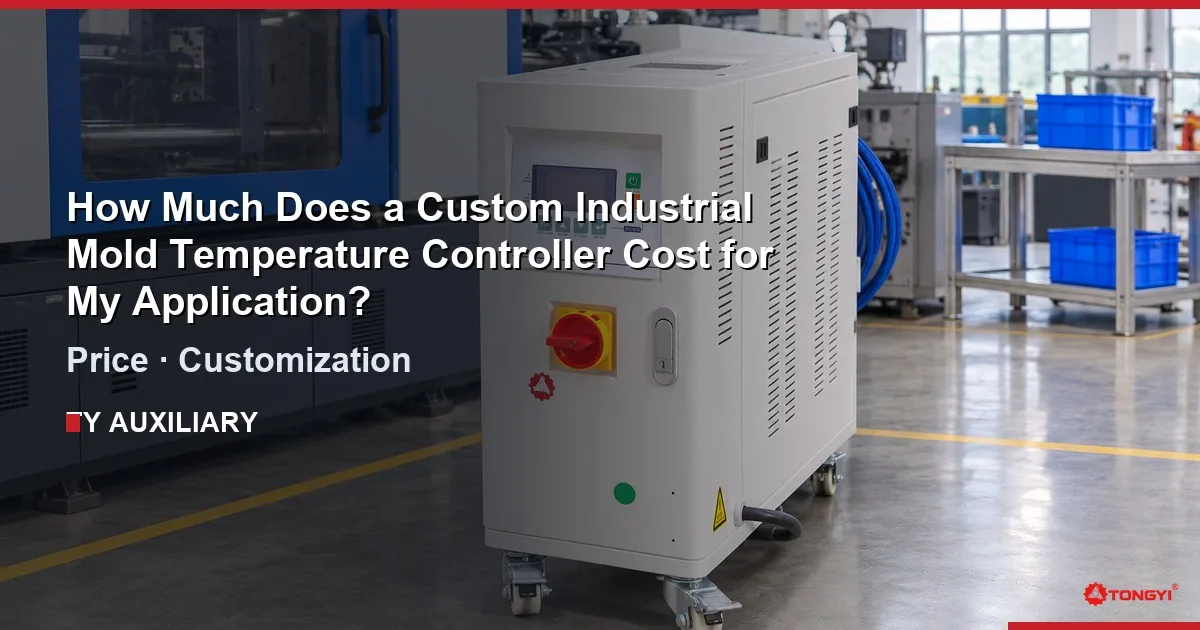
What actually drives the cost of a custom mold temperature controller
Every mold temperature controller is essentially a pump, a heater, a cooling valve and a controller assembled around a specific heat load. Customization changes the size and grade of each of those parts, and that is where cost accumulates.
Heat transfer medium and maximum temperature
The medium sets the temperature ceiling of the whole machine. A clean water unit is limited by the boiling point of water under pressure, while a heat transfer oil unit requires a different pump seal, expansion tank and piping class to reach higher temperatures. Moving from water to oil is one of the largest single cost steps in a custom build, because it changes materials throughout the circuit, not just the setpoint on the display.
Heating capacity and pump sizing
Heating capacity is sized against the mass of the mold, the shot rate and the allowable heat-up time. Pump selection is driven by circuit pressure drop: longer hoses, narrower channels and manifold splits raise resistance and require either a higher-head pump or a different circuit configuration. In our single-temperature water series, for example, the TMC 60W uses a 0.37 KW pump rated at a maximum flow of 42 L/MIN and a maximum pressure of 0.35 MPA, while the TMC 90W and TMC 120W both move to a 0.75 KW pump rated at 60 L/MIN and 0.4 MPA. Both figures are separate ratings — maximum flow and maximum pressure are not produced at the same operating point, so a buyer should never size a circuit from the flow number alone.
Control scope, instrumentation and safety devices
Customization often lives in the control cabinet: additional temperature sensing points, alarm and interlock logic, communication protocols for plant-level monitoring, and non-standard electrical voltages for the destination market. Each added function carries engineering time, components and testing, and each one should be listed separately in a quote so the buyer can see what is being paid for.
Compliance, documentation and destination requirements
Electrical supply voltage, frequency, plug and wiring standards differ by destination. Documentation language, nameplate format and inspection requirements also vary. These items do not change the thermal performance of the machine, but they change the engineering and paperwork content of the order, and reputable suppliers quote them explicitly rather than burying them.
How to define your application before requesting a price
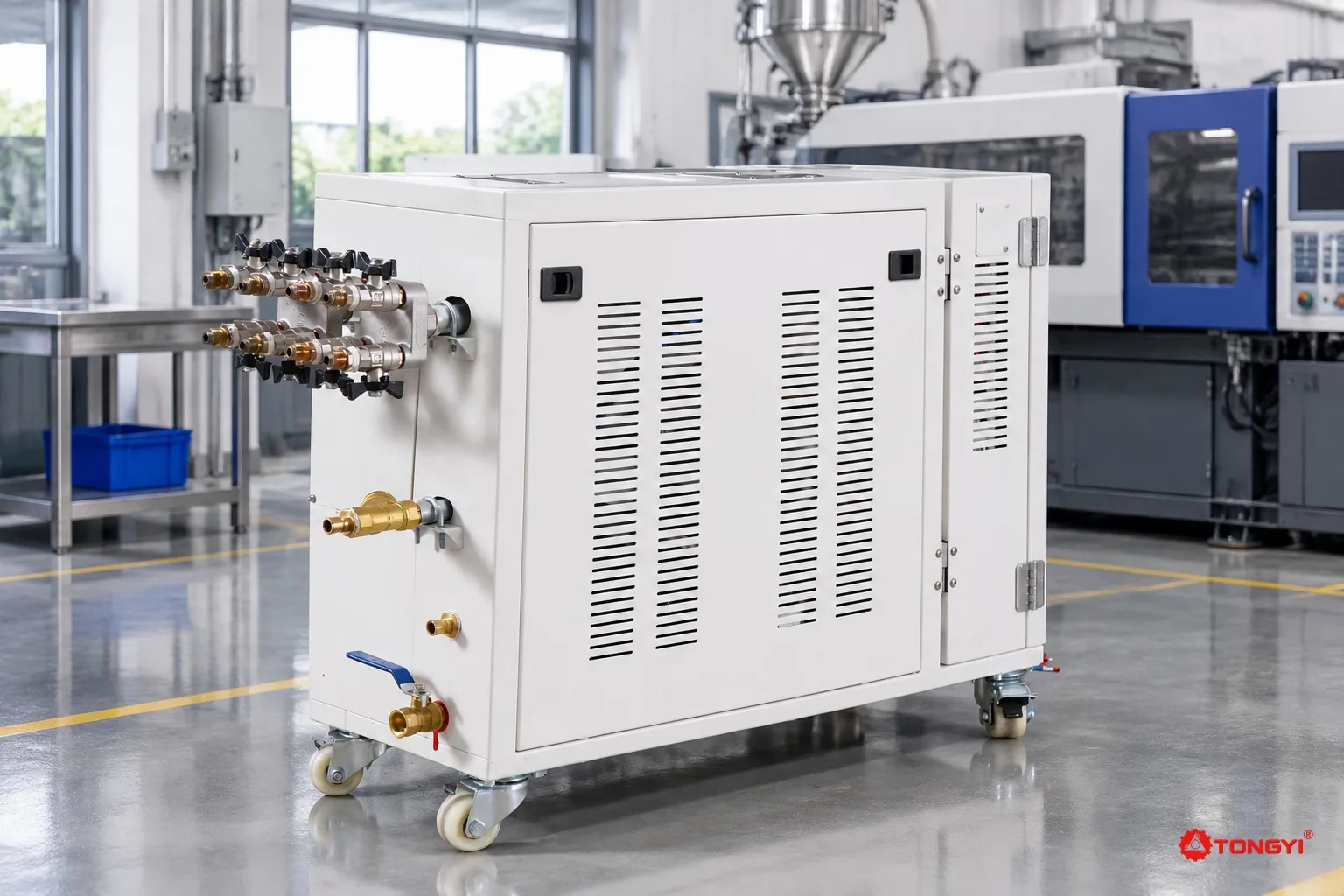
The fastest route to a meaningful quotation is a short, complete process description. Suppliers can price a defined duty point; they can only guess at a vague one, and guesses lead to either an oversized machine or a change order later.
- Process and polymer: what material is being molded, and what mold surface temperature the process requires.
- Mold mass and circuit layout: approximate mold weight, number of cooling channels, channel diameter, and how many circuits will be connected.
- Required heat-up time: how quickly the mold must reach temperature from cold at the start of a shift or after a stoppage.
- Cooling water supply: available water temperature and pressure at the plant, since the minimum achievable temperature is tied to the incoming cooling water.
- Ambient and electrical conditions: plant voltage, frequency, phase configuration and available space around the machine.
- Control and integration needs: local control only, or connection to a plant monitoring system.
Minimum temperature deserves particular attention because it is often misunderstood. Across the supplied water-heated models, the stated minimum is cooling water temperature plus 5 to 30 °C — meaning the achievable low setpoint depends on the plant’s cooling water, not on the controller alone. A buyer planning a low-temperature process should confirm the actual incoming water temperature before accepting a quotation, because a machine that meets the specification on paper may not reach the target setpoint on a warm cooling loop.
Comparing models in the single-temperature water series
The table below compares verified specifications within one series so that the step changes in capacity are visible. Values are model-specific and are not interchangeable between rows.
| Model | Heat transfer medium | Max. temperature | Min. temperature | Heating power | Pump power | Max. flow | Max. pressure | Manifold | Media port size |
|---|---|---|---|---|---|---|---|---|---|
| TMC 60W | Clean water | 120 °C | Cooling water temperature +5~30 °C | 6 KW | 0.37 KW | 42 L/MIN | 0.35 MPA | 2 in 2 out | 3/8 inch |
| TMC 90W | Clean water | 120 °C | Cooling water temperature +5~30 °C | 9 KW | 0.75 KW | 60 L/MIN | 0.4 MPA | 2 in 2 out | 3/8 inch |
| TMC 120W | Clean water | 120 °C | Cooling water temperature +5~30 °C | 12 KW | 0.75 KW | 60 L/MIN | 0.4 MPA | 4 in 4 out | 3/8 inch |
| TMC 180W | Clean water | 120 °C | Cooling water temperature +5~30 °C | 18 KW | 1.5 KW | 165 L/MIN | 0.25 MPA | 1 in 1 out | 1 inch |
| TMC 240W | Clean water | 120 °C | Cooling water temperature +5~30 °C | 24 KW | 1.5 KW | 165 L/MIN | 0.25 MPA | 1 in 1 out | 1 inch |
| TMC 360W | Clean water | 120 °C | Cooling water temperature +5~30 °C | 36 KW | 2.2 KW | 310 L/MIN | 0.3 MPA | 1 in 1 out | 1.2 inch |
Specifications are subject to change without prior notice. All models listed use direct cooling and a K type probe thermocouple for media in/out temperature sensing, with a 15 mm return water port.
The most useful trade-off to understand in this series is between the mid-range models and the high-capacity models. The TMC 120W and the TMC 180W differ by only 6 KW of heating power — 12 KW versus 18 KW — yet the pump package is completely different: 60 L/MIN at 0.4 MPA against 165 L/MIN at 0.25 MPA. That is not a simple upgrade. The larger pump moves far more volume but at lower maximum pressure, so it suits a machine with several parallel circuits or large-diameter channels, while the smaller, higher-pressure pump suits a tighter circuit with greater resistance. Choosing between them is an engineering decision about circuit geometry, not about which number is bigger, and it directly affects cost because pump and piping class change together.
How customization changes the specification and the price
Custom work on a mold temperature controller usually falls into five categories. Understanding which ones you need keeps the quotation comparable between suppliers.
- Media and temperature range: water versus oil, and the maximum setpoint the process requires.
- Capacity and circuit configuration: heating power, pump curve, number of inlets and outlets, and port sizes to match existing hoses and manifolds.
- Control and instrumentation: additional sensors, alarm outputs, data logging, or communication interfaces.
- Electrical configuration: voltage, frequency and phase to match the plant supply, which varies by destination.
- Mechanical arrangement: footprint, casters, hose routing and access for maintenance in a tight cell.
When a supplier quotes a custom unit, ask for the specification sheet to be attached to the quotation. A price without a locked specification cannot be compared against a competitor’s price, because the two offers may describe machines with different heater grades, pump curves or control packages.
What to compare when you receive quotations
Quotations for custom equipment are rarely formatted the same way. Normalizing them onto a common basis takes a little effort but prevents expensive surprises.
- Locked specification sheet: every model, capacity, temperature limit and port size stated in writing.
- Scope boundaries: whether hoses, manifolds, fittings, installation and commissioning are included or excluded.
- Electrical supply: confirmed voltage, frequency and phase for the destination, not a regional default.
- Spare parts and wear items: availability and lead time for seals, pumps and heater elements.
- Documentation and testing: what test report, wiring diagram and manual are delivered with the unit.
- Warranty terms and support: coverage period and how service requests are handled across time zones.
- Lead time and shipping terms: production lead time and the Incoterms basis of the price.
Two quotes can differ substantially while describing a similar machine, and the difference is usually found in one of these line items rather than in the heating capacity itself.
Where to start
Write down the mold weight, the required mold temperature, the number of circuits and the plant cooling water conditions, then send that description with your expected heat-up time and electrical supply. Suppliers can then propose a specific model — for example, choosing between the 12 KW TMC 120W with its 4 in 4 out manifold and the 18 KW TMC 180W with its higher-flow 1 in 1 out configuration depends on your circuit layout as much as on your heat load. A defined duty point produces a firm quotation and a machine that performs as expected.
Get a specification-matched quote
Send the mold size, required working temperature, cooling channels per circuit and your electrical supply. We reply with a like-for-like configuration and the documented specifications for each model in the offer.
Every figure in this guide comes from our published specification sheets. Confirm model scope and test conditions before ordering.