
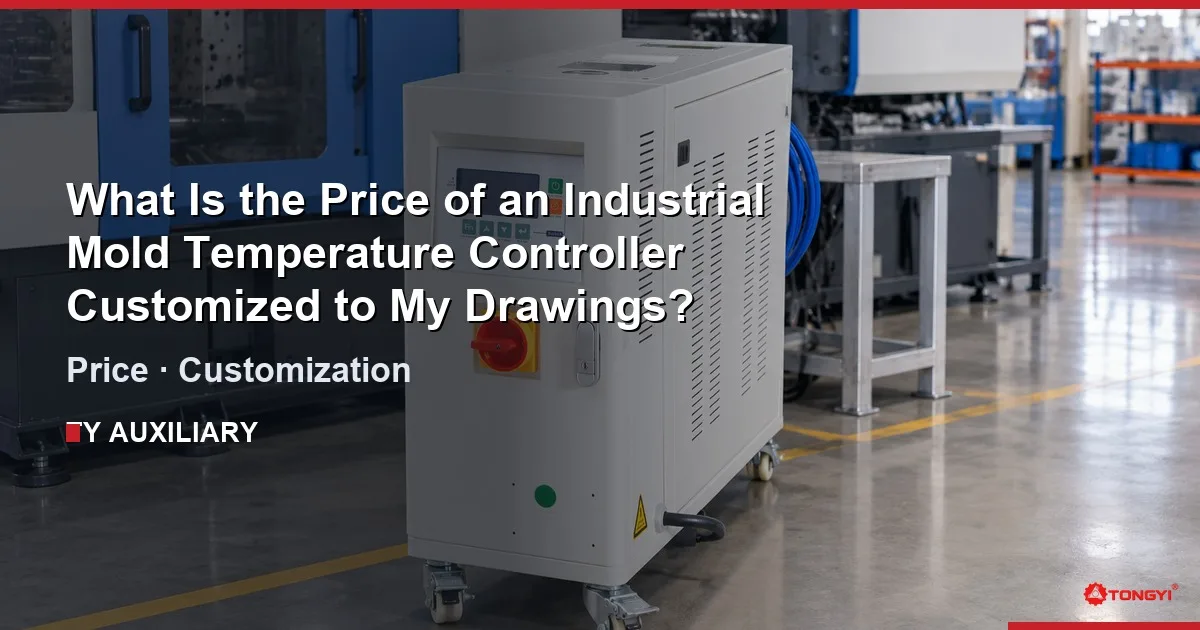
What Is the Price of an Industrial Mold Temperature Controller Customized to My Drawings?
Custom industrial mold temperature controller price depends on heating capacity, pump duty, manifold layout and controls.
Why a Machine Built to Drawings Cannot Be Priced From a List
Standard units are priced from a list because thousands of them are identical: fixed manifold, fixed connection size, fixed cabinet, fixed control panel. A machine customized to your drawings breaks all four at once. Moving a media connection, adding a manifold branch, changing the electrical supply to your plant standard, or specifying a communication protocol on the controller each creates engineering, machining and testing work that did not exist on the standard build.
That is why the price of a customized unit tracks the drawing, not the model number. The model number tells you the size class; the drawing tells the factory what to build.
The Specifications That Move the Custom Mold Temperature Controller Price Most
Electric heating power sets the size of the electrical build
Electric heating power is the first cost step. In the supplied single-temperature water series it starts at 6 KW on the TMC 60W and climbs through 9 KW on the TMC 90W, 12 KW on the TMC 120W, 18 KW on the TMC 180W, 24 KW on the TMC 240W and 36 KW on the TMC 360W. Heating power tells a buyer how much mold mass the unit can bring to temperature in the time available and how much heat loss it can replace during the cycle; it also fixes the rating of the contactors, the cross-section of the internal wiring and the airflow needed in the cabinet. That is why a step from 6 KW to 18 KW is a structural change in the quote rather than a component swap, because the electrical bill of materials changes with it.
Pump power, maximum flow and maximum pressure are three separate figures
The hydraulic side is the second cost step, and it does not move in lockstep with heat. The TMC 60W is listed with a 0.37 KW pump producing a maximum flow of 42 L/MIN at a maximum pressure of 0.35 MPA. The TMC 90W and TMC 120W share a 0.75 KW pump with a maximum flow of 60 L/MIN and a maximum pressure of 0.4 MPA. The TMC 180W and TMC 240W step up to a 1.5 KW pump with a maximum flow of 165 L/MIN but a maximum pressure of 0.25 MPA, and the TMC 360W is listed with a 2.2 KW pump at 310 L/MIN and 0.3 MPA.
Maximum flow and maximum pressure are separate ratings, not a single duty point, and this series shows why the distinction matters commercially. A mold with many narrow, restrictive channels is limited by pressure, while a mold with long parallel circuits is limited by flow, and the two pull the pump choice, and the price, in different directions. State which figure limits your mold and the supplier can size the pump against the real constraint instead of the largest number on the page.
Manifold configuration and connection size come straight off the drawing
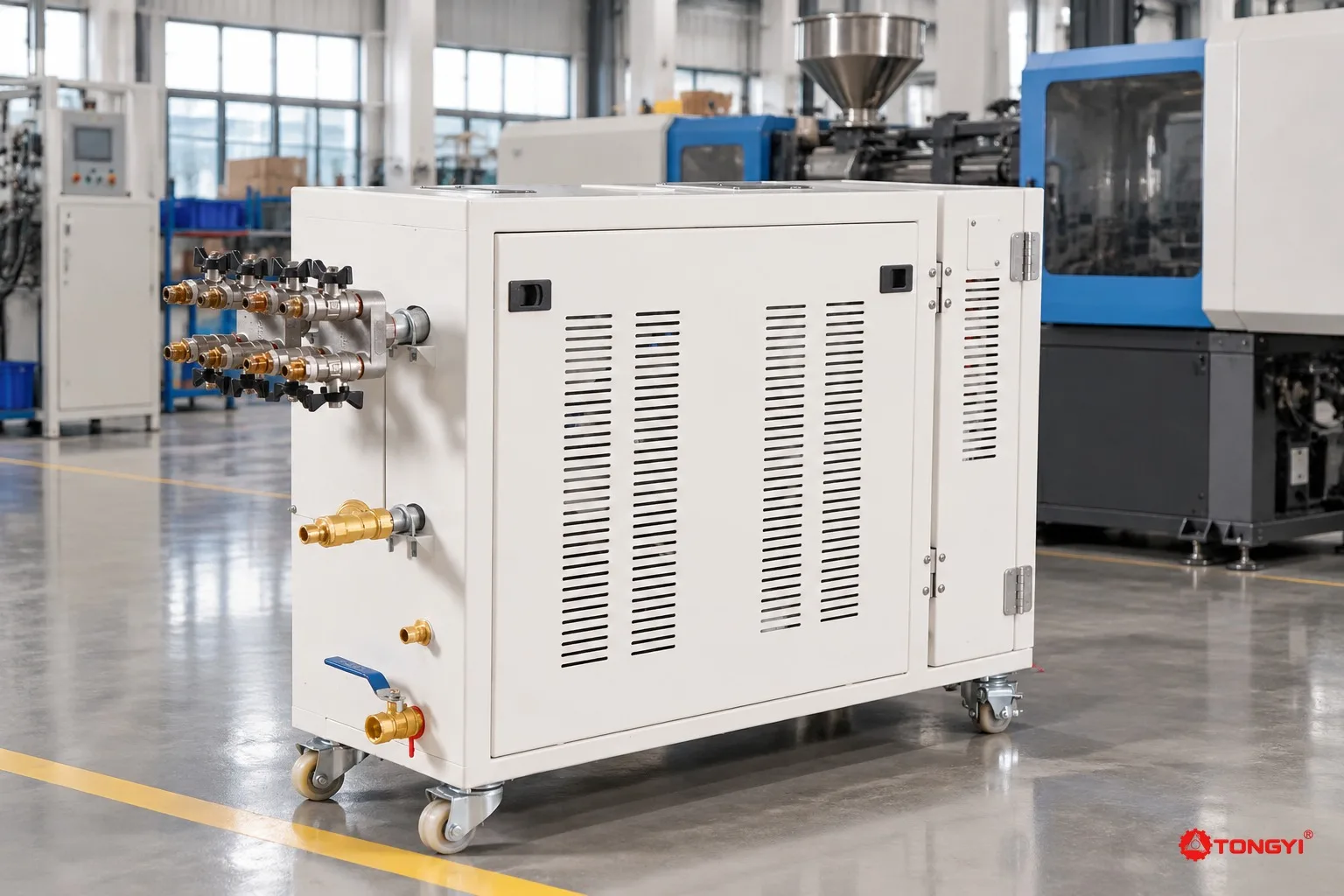
Manifold layout is the part of a custom build that is almost entirely drawing-driven. The TMC 60W and TMC 90W are listed with a 2-in-2-out manifold and 3/8 inch media connections; the TMC 120W uses a 4-in-4-out manifold at the same 3/8 inch connection size; the TMC 180W, TMC 240W and TMC 360W use a single 1-in-1-out manifold at 1 inch, 1 inch and 1.2 inch respectively. Return water connection is listed at 15 MM across all six models.
Every manifold branch has to be machined, joined, fitted and pressure-tested, so a 4-in-4-out manifold costs more than a 1-in-1-out manifold on the same heater rating. When your drawing calls for a branch count and spacing that matches no standard manifold, that is a real and explainable line in the price, not padding.
Temperature range is a boundary condition, not a feature
All six models are listed with a maximum temperature of 120 °C, and the minimum temperature is expressed as cooling water temperature +5 to +30 °C. That second figure is the one buyers misread most often: it is not an absolute floor, it is an offset relative to the cooling water you supply, so the cold end of the machine is a function of your plant water temperature, flow and load. Cooling water conditions therefore belong in the quote request rather than in a later conversation. The series is also listed with clean water as the heat transfer medium and a K type probe thermocouple for media temperature sensing, so if your drawings assume a different fluid or a sealed high-temperature circuit, this family is not the correct frame and the supplier should confirm the right one before quoting.
Like-for-Like Model Comparison: Single-Temperature Water Series
| Model | Electric heating power | Pump power | Max flow | Max pressure | Max temperature | Manifold | Media connection size |
|---|---|---|---|---|---|---|---|
| TMC 60W | 6 KW | 0.37 KW | 42 L/MIN | 0.35 MPA | 120 °C | 2-in-2-out | 3/8 inch |
| TMC 90W | 9 KW | 0.75 KW | 60 L/MIN | 0.4 MPA | 120 °C | 2-in-2-out | 3/8 inch |
| TMC 120W | 12 KW | 0.75 KW | 60 L/MIN | 0.4 MPA | 120 °C | 4-in-4-out | 3/8 inch |
| TMC 180W | 18 KW | 1.5 KW | 165 L/MIN | 0.25 MPA | 120 °C | 1-in-1-out | 1 inch |
| TMC 240W | 24 KW | 1.5 KW | 165 L/MIN | 0.25 MPA | 120 °C | 1-in-1-out | 1 inch |
| TMC 360W | 36 KW | 2.2 KW | 310 L/MIN | 0.3 MPA | 120 °C | 1-in-1-out | 1.2 inch |
All models in this table: heat transfer medium clean water; cooling method direct; minimum temperature cooling water temperature +5 to +30 °C; K type probe thermocouple; return water connection 15 MM. Specifications are supplied by the manufacturer and are subject to change without prior notice.
Read the table as a cost map rather than a ranking. The TMC 120W and TMC 180W sit close together in heating power, 12 KW against 18 KW, but the hydraulic and manifold picture is completely different: 60 L/MIN at 0.4 MPA through a 4-in-4-out manifold at 3/8 inch, against 165 L/MIN at 0.25 MPA through a 1-in-1-out manifold at 1 inch. A drawing that needs four separate circuits plumbed at the mold points toward the smaller manifold machine; a drawing that needs volume through one large circuit points toward the larger one.
The TMC 180W and TMC 240W are the clearest case of heat being the only variable. Pump power, maximum flow, maximum pressure, manifold configuration and connection size are identical on both, with 18 KW against 24 KW of electric heating. If the drawing already fixes the hydraulic requirement, that pair isolates the heater bank as the single line that changes in the quote, which is exactly the kind of comparison a buyer should ask a supplier to explain in writing.
What to Include With Your Drawings for a Firm Quote
- Mold or plate layout showing circuit count, channel diameter and the position of every inlet and outlet.
- Required flow and required pressure at the mold, and which of the two is the limiting factor.
- Target mold temperature and cycle time, plus the heat-up time the process allows.
- Cooling water available on site: temperature, pressure, flow and water quality or filtration.
- Heat transfer medium, confirmed as clean water or otherwise specified.
- Electrical supply: voltage, phase, frequency and connection arrangement.
- Control requirements: setpoint range, alarms, sensor type and placement, and any communication protocol.
- Physical constraints: footprint, height, mobility, hose run from the unit to the mold, and ambient conditions.
- Documentation and marking: the drawing revision the quote is based on, nameplate details and manual language.
- Quantity required, plus any spare parts you want included.
The drawing revision is the item most often left out. A quotation is only firm against a stated revision, so number your drawings and ask the supplier to reference that number on the quote. It protects both sides when the design changes later.
What Actually Adds Cost in a Custom Build
When two quotes for the same drawing differ, the gap usually sits in one of these places: heater bank rating and the contactors, cable and cabinet hardware that scale with it; pump and motor selection against the required flow and pressure; manifold fabrication, branch count, connection size and pressure testing; controller and instrumentation features; enclosure and frame changes needed for a non-standard footprint; factory test time, which grows with custom circuits; crating and freight class; and documentation work such as dimensional drawings and manuals.
None of those lines should be a mystery. A transparent quote shows the model class it is based on, the ratings it commits to, and any assumption it made about your drawing.
How to Compare Quotes From Different Suppliers
Offers only compare when they describe the same machine. Before you line them up, normalize every quote to one basis: the same heating power, the same pump duty stated at the required flow and pressure, the same manifold branch count and connection size, the same electrical supply, the same control features, and the same scope for testing, documentation, warranty and spare parts. Where a supplier quotes a model class instead of your drawing, ask for the specific ratings in writing.
Because manufacturers reserve the right to change specifications without prior notice, the binding document is the datasheet and approval drawing attached to your purchase order, not a webpage or a brochure. Request that attachment at the quotation stage and check that heating power, pump power, maximum flow, maximum pressure, manifold configuration and connection size on it match what you specified.
How to Move From Drawing to Price
The fastest route to an accurate figure is a single package: your numbered drawing revision, the process data listed above, and a clear statement of which hydraulic figure, flow or pressure, limits the mold. Review the water-type mold temperature controllers in the single-temperature series to see the model classes the quote will be built on, check the wider industrial temperature control equipment range if your application falls outside the 120 °C clean-water frame described here, then send your drawings with the specification list so the factory can price a defined machine and state the drawing revision its number is based on.
Get a specification-matched quote
Send the mold size, required working temperature, cooling channels per circuit and your electrical supply. We reply with a like-for-like configuration and the documented specifications for each model in the offer.
Every figure in this guide comes from our published specification sheets. Confirm model scope and test conditions before ordering.