
How Much Does a Custom Industrial Mold Temperature Controller Cost, and What Is Its Working Principle?
See what drives the cost of a custom industrial mold temperature controller, how its heating and cooling loop works, and which specifications to send.
Why a custom industrial mold temperature controller price is quote-based
A standard catalog unit is priced from a fixed bill of materials. A custom unit is priced from the requirements you send: how many circuits the manifold must feed, how far the mold sits from the machine, what coolant quality is available on the plant floor, and how much heater capacity the part weight and cycle time demand. Every one of those decisions changes the heater, the pump, the piping, and the electrical panel, and each of them moves the final figure. That is why two buyers asking for the same “custom mold temperature controller” can receive quotes that differ substantially — they are not quoting the same machine.
For budgeting, treat the quote as a function of four variables rather than a single number: heating power rating, pump flow and pressure, valving and circuit count, and controls. In the TMC water series, the smallest listed configuration heats at 6 KW and the largest at 36 KW, which is a six-fold difference in electrical and thermal hardware alone. Nothing about that spread suggests a single market price.
How a mold temperature controller works
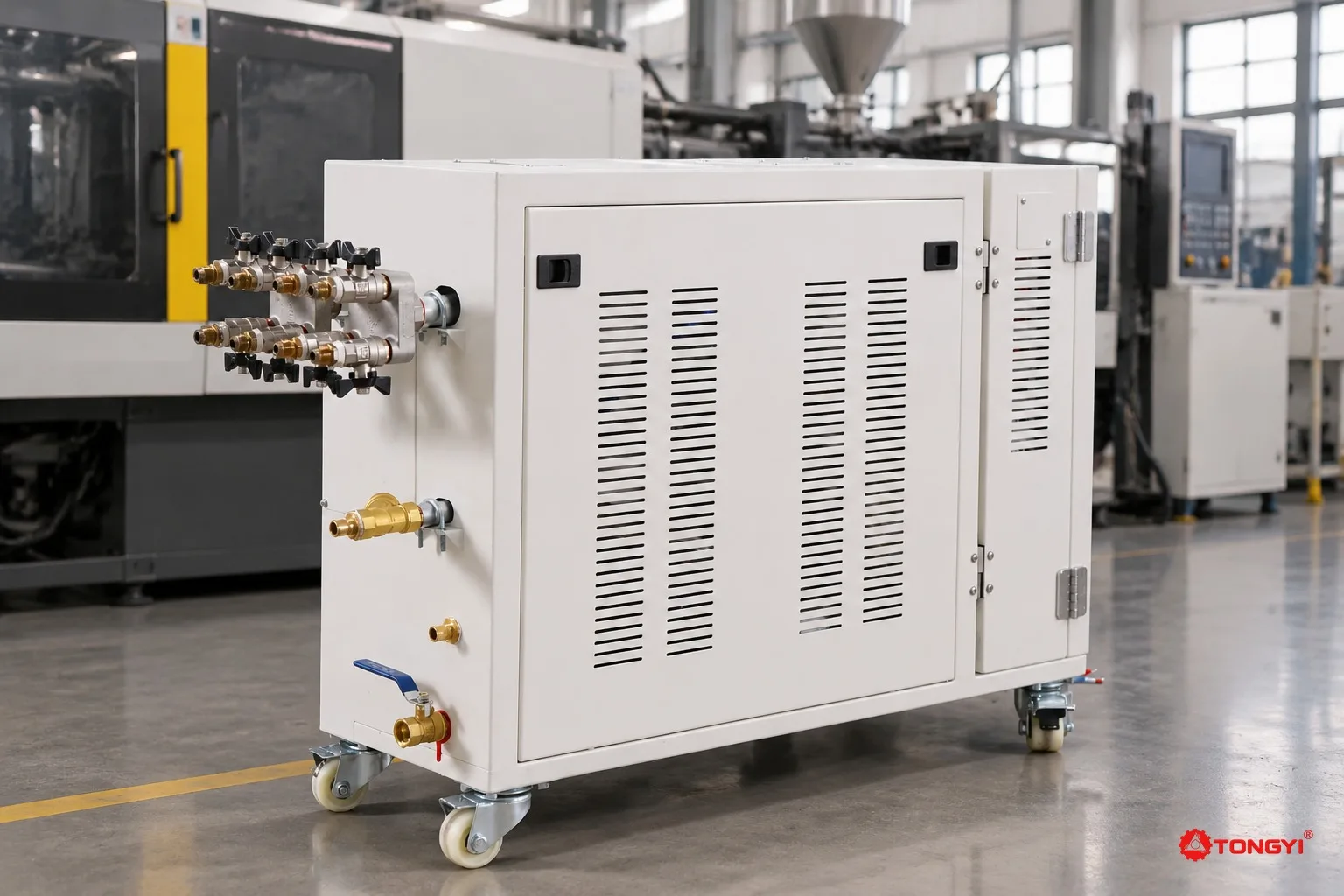
The working principle is a closed circulation loop with two opposing actuators under one controller. A pump pushes heat-transfer fluid from the unit’s tank through the mold channels and back. A heater switches on to raise fluid temperature; a cooling valve admits plant cooling water to lower it. The controller reads the return temperature with a thermocouple, compares it to setpoint, and modulates heat and cooling to hold the mold at the target condition.
The heating and cooling cycle
On the heating side, the electric heater warms the circulating fluid before it enters the mold. On the cooling side, the unit diverts a portion of the flow through a water-to-water exchanger and dumps excess heat to cooling water. Because both actuators act on the same fluid stream, response is fast and the mold sees a narrow temperature band rather than a slow ramp-and-overshoot pattern. This is the reason a dedicated mold temperature controller outperforms running hot water from a central plant header.
Sensing and control
All TMC water models use a K Type Probe Thermocouple for media inlet and outlet temperature. A probe thermocouple inserted into the fluid path responds to the actual circulating medium rather than to the heater surface, which is what makes the setpoint meaningful for the process. Two things are worth separating when you read a specification: controller accuracy, meaning how precisely the control loop holds the reading it sees, and mold temperature uniformity, meaning how evenly that heat distributes across the cavity. The first is a controller property; the second depends on channel layout, flow distribution, and manifold design. A specification sheet does not resolve mold uniformity — only flow and circuit design do.
Direct cooling and the low-temperature limit
Every TMC water unit in this series uses direct cooling, meaning cooling water contacts the closed loop through a heat exchanger without a long intermediate circuit. The listed minimum temperature follows plant cooling water: cooling water temperature +5 to 30 °C. In practical terms, the unit can hold the mold somewhat above whatever your plant supplies to the cooling header, not below it. If your process needs a mold temperature far below your available cooling water, this class of unit is not the answer, and the quote should reflect a different cooling architecture.
Comparing TMC water models on the specifications that drive cost
The table below compares six clean-water units from the same series so the relationships are visible: as heating power rises, pump power and maximum flow rise with it, and the manifold configuration and connection size change to match. All values are as listed for each model, and every model in this series carries the same 120 °C maximum temperature and the same cooling-water-relative minimum.
| Model | Heating power | Pump power | Max flow | Max pressure | Manifold | Port size |
|---|---|---|---|---|---|---|
| TMC 60W | 6 KW | 0.37 KW | 42 L/MIN | 0.35 MPA | 2 in 2 out | 3/8 inch |
| TMC 90W | 9 KW | 0.75 KW | 60 L/MIN | 0.4 MPA | 2 in 2 out | 3/8 inch |
| TMC 120W | 12 KW | 0.75 KW | 60 L/MIN | 0.4 MPA | 4 in 4 out | 3/8 inch |
| TMC 180W | 18 KW | 1.5 KW | 165 L/MIN | 0.25 MPA | 1 in 1 out | 1 inch |
| TMC 240W | 24 KW | 1.5 KW | 165 L/MIN | 0.25 MPA | 1 in 1 out | 1 inch |
| TMC 360W | 36 KW | 2.2 KW | 310 L/MIN | 0.3 MPA | 1 in 1 out | 1.2 inch |
The trade-off worth noting sits between the high-flow and high-pressure ends of this series, and it is the single most common source of mismatched expectations. TMC 180W and TMC 240W both deliver a maximum flow of 165 L/MIN at a maximum pressure of 0.25 MPA, while TMC 90W and TMC 120W deliver less flow — 60 L/MIN — but at a higher maximum pressure of 0.4 MPA. Maximum flow and maximum pressure are separate ratings on separate duty points, not two readings of the same operating condition. A mold with narrow, restrictive channels needs pressure to push fluid through it, and a unit selected purely on the biggest flow number may not develop enough pressure to fill those channels. Conversely, a large mold with generous channels benefits more from volume than from head. Send your channel geometry with the quote request and both ratings can be matched to it deliberately.
Reading heating power and pump flow as selection inputs
Heating power sets how quickly the unit can recover temperature after the mold absorbs heat from each shot. The 6 KW rating on TMC 60W suits small molds and short cycles; the 36 KW rating on TMC 360W is intended for much larger thermal loads. When you quote, state the shot weight, the resin, the target mold temperature, and the cycle time — those four items let a supplier calculate whether a given heater rating can hold setpoint rather than merely reach it.
Pump flow at 42 L/MIN on TMC 60W and 310 L/MIN on TMC 360W is what determines temperature uniformity across the mold, not the heater. Uneven flow means uneven cooling and warped parts, which is why flow belongs in the quote request alongside the mold’s circuit count. Note too that the manifold configuration changes at the 120W step: 2 in 2 out on TMC 60W and TMC 90W, 4 in 4 out on TMC 120W, and 1 in 1 out on TMC 180W through TMC 360W, with port size stepping from 3/8 inch on the smaller units to 1 inch and 1.2 inch on the largest. A 4-circuit manifold and a single large port serve different mold plumbing, and the selection should follow your mold, not the other way around.
What to include in a custom build request
Customization is where most of the cost and most of the lead-time variation lives. A useful request lets the supplier price the real machine instead of a generic one:
- Heating capacity and voltage. Confirm the heater rating you need and the plant supply available at the press. For reference, this series spans 6 KW through 36 KW.
- Pump flow and pressure. State the flow and pressure your mold channels require, not just the maximum the unit can produce.
- Circuit count and port size. Match the manifold configuration (2 in 2 out, 4 in 4 out, or 1 in 1 out) and connection size to your mold plumbing.
- Medium. These models are listed for clean water. If your process needs oil or a different medium, say so — it changes the entire unit.
- Cooling water conditions. Supply temperature and pressure at your plant, because the achievable minimum is defined relative to it.
- Controls and integration. Whether the unit must interface with the press, a plant network, or an existing control scheme.
- Footprint and placement. Available floor space, distance to the mold, and hose or pipe routing.
For buyers evaluating the wider temperature-control lineup, the mold temperature controller product range shows how water and oil units differ, and the water-cooled mold temperature controller page covers the clean-water configuration described here in more detail. If your process runs above the temperature this series can reach, the oil-type mold temperature controller option is the appropriate comparison point.
How suppliers structure a quote
Because no list price exists, the quote structure itself tells you something about the supplier. A transparent quote separates the base unit, the heater rating, the pump, the manifold and valving, the control package, and any special materials or finishes. It also states what is excluded: freight, duties, installation, spare parts, and whether startup support is included. Ask for the technical datasheet to accompany the commercial quote so you can verify that the model named matches the specifications you requested — particularly the heating power, maximum flow, and maximum pressure, since those are the three values most often confused between adjacent models in a series.
Product specifications are subject to change without prior notice, so confirm the final configuration in writing before the order is placed.
This article explains cost drivers and selection logic only. It does not state or estimate prices, and no monetary figures should be inferred from the model comparisons above.
Frequently asked questions
Why is there no fixed price for a custom industrial mold temperature controller?
A custom unit is built around your heating capacity, pump flow, pressure, circuit count, and control requirements, so the bill of materials changes with every order. The heater rating alone ranges from 6 KW to 36 KW across the TMC water series, and that difference changes the pump, panel, and piping with it. The only accurate figure comes from a quote built on your process data.
What is the working principle of a mold temperature controller?
A pump circulates heat-transfer fluid through the mold in a closed loop while a controller holds the return temperature at setpoint. A heater raises the fluid temperature and a cooling valve lowers it by rejecting heat to plant cooling water. A thermocouple reads the returning fluid so the controller can switch between heating and cooling to keep the mold stable.
What is the maximum temperature of these TMC water units?
Every model listed in this clean-water series has a maximum temperature of 120 °C. The minimum is defined relative to your cooling water supply, at cooling water temperature plus 5 to 30 °C. If your process requires higher mold temperature, a water unit in this series is not the correct choice.
How do I choose between a high-flow and a high-pressure model?
Match the rating to your mold channels. TMC 90W and TMC 120W deliver 60 L/MIN at a maximum pressure of 0.4 MPA, while TMC 180W and TMC 240W deliver 165 L/MIN at 0.25 MPA. Restrictive channels need pressure to fill; large, open channels benefit more from flow volume.
What information should I send to get an accurate quote?
Send shot weight, resin, target mold temperature, cycle time, mold channel geometry and circuit count, required flow and pressure, plant voltage and frequency, and your cooling water temperature and pressure. Also state whether the unit must connect to the press controller or a plant network. These details let the supplier price the specific machine you need.
Does the temperature controller guarantee uniform mold temperature?
No. The controller holds the temperature of the fluid it measures, but uniformity across the mold depends on channel layout, flow distribution, and manifold design. That is why pump flow and circuit configuration belong in the selection process alongside the controller specification, and why supplier confirmation of your specific mold setup is required.
Get a specification-matched quote
Send the mold size, required working temperature, cooling channels per circuit and your electrical supply. We reply with a like-for-like configuration and the documented specifications for each model in the offer.
Every figure in this guide comes from our published specification sheets. Confirm model scope and test conditions before ordering.