
How Much Does a Custom Industrial Mold Temperature Controller Cost?
Compare documented product features and process requirements before selecting a mold temperature controller.
What buyers should understand before asking for an industrial mold temperature controller price
Mold temperature control units are built around a heater, a pump, a cooling circuit, and a controller. In a custom configuration, the supplier adjusts these and the plumbing to match the mold, so price follows the duty the unit must perform. TMC 60W, TMC 90W, TMC 120W, TMC 180W, TMC 240W, and TMC 360W show how far one series can spread. All six are built for clean water as the heat transfer medium, reach a maximum temperature of 120 °C, and provide a minimum temperature of cooling water temperature +5~30 °C through direct cooling. Across that family the electric heating power ranges from 6 KW to 36 KW and pump ratings range from 0.37 KW to 2.2 KW, so two units that look similar on a quotation sheet can differ substantially in what they deliver at the press.
Cost drivers you are actually paying for
Heating capacity and the heat load it must overcome
Electric heating power sets how quickly the loop recovers after a cold mold is loaded or after heat is lost during a shutdown. The TMC 60W is rated at 6 KW of heating power, while the TMC 360W is rated at 36 KW. Buyers should match heating power to the mass of the mold, the shot weight, and the cycle time; an oversized heater adds cost without improving cycle stability, and an undersized one slows startup and recovery.
Pump power, flow, and pressure
Pump performance determines whether the loop can move enough water through long hoses and restricted mold channels. In this series, pump power moves from 0.37 KW on the TMC 60W to 2.2 KW on the TMC 360W, with maximum flow from 42 L/MIN to 310 L/MIN and maximum pressure from 0.25 MPA to 0.4 MPA. Maximum flow and maximum pressure are separate ratings, not a single duty point, so state both in the quote request and describe the actual circuit. The TMC 180W, TMC 240W, and TMC 360W, for example, are all rated at 1.5 to 2.2 KW of pump power but differ in maximum flow and pressure, which matters when the mold has narrow channels or the unit sits far from the press.
Cooling method and coolant
Direct cooling with clean water keeps construction simpler and avoids the additional equipment and maintenance that oil circuits require. Because the minimum achievable temperature is stated as cooling water temperature +5~30 °C, the plant cooling water supply directly limits how cold the loop can run. If the process needs a lower set point, that requirement changes the cooling design and should be stated up front, since it affects both cost and feasibility.
Number of circuits and connection sizing
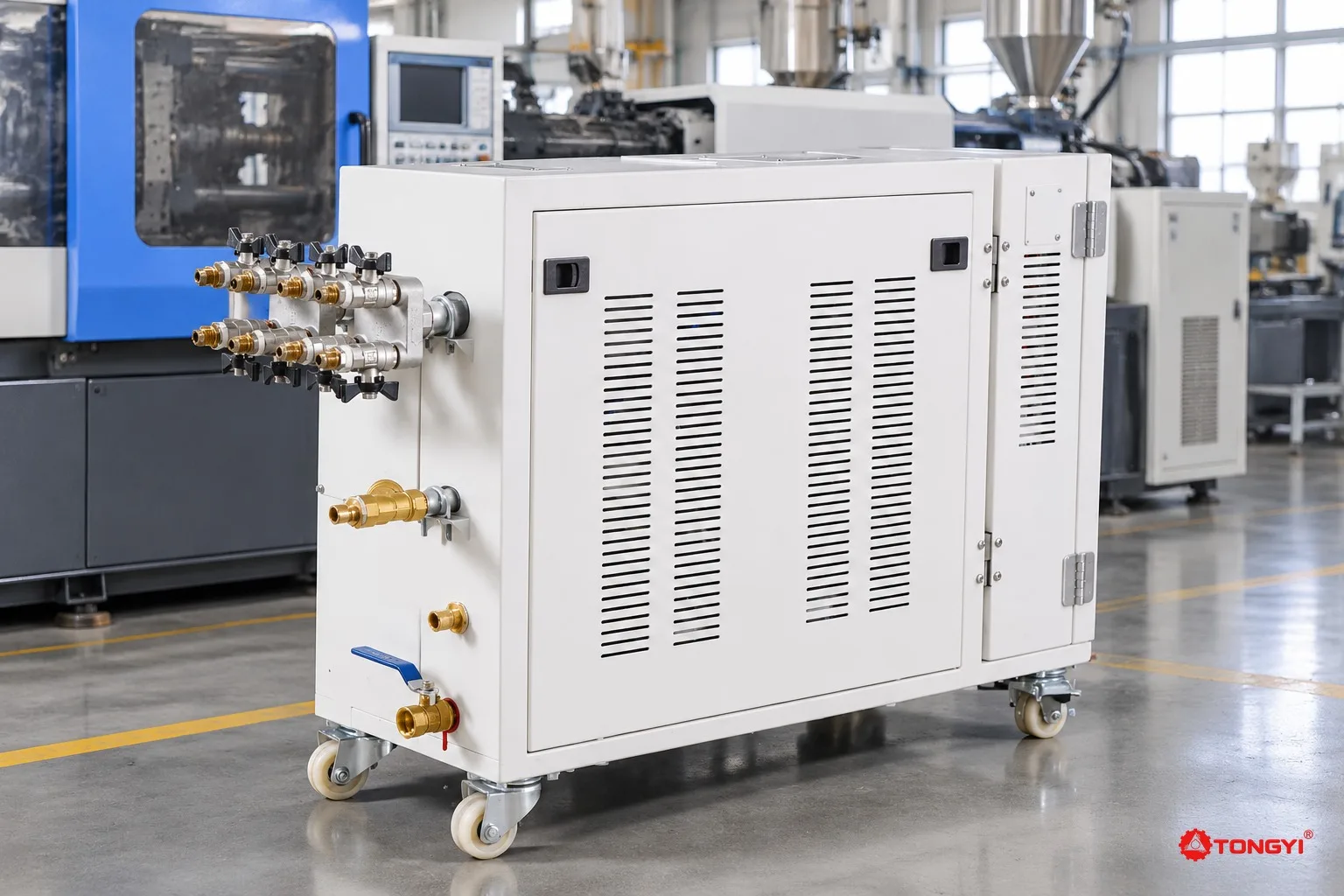
The media inlet/outlet manifold and connection size scale with the mold. The TMC 60W and TMC 90W are supplied as 2 in 2 out with 3/8 inch ports, the TMC 120W is 4 in 4 out with 3/8 inch ports, and the TMC 180W, TMC 240W, and TMC 360W use a single 1 in 1 out circuit with a larger connection — 1 inch for the 180W and 240W and 1.2 inch for the 360W. Every model in the series uses a 15 mm return water connection and a K type probe thermocouple for media inlet/outlet temperature sensing. A multiport manifold costs more than a single circuit but can serve a large mold without an external splitter.
Like-for-like comparison of selected models
The table below compares three models from the same series so buyers can see how configuration scales. Values are exactly as supplied for each model and are not interchangeable between rows.
| Parameter | TMC 60W | TMC 120W | TMC 360W |
|---|---|---|---|
| Heat transfer medium | Clean water | Clean water | Clean water |
| Maximum temperature | 120 °C | 120 °C | 120 °C |
| Minimum temperature | Cooling water temperature +5~30 °C | Cooling water temperature +5~30 °C | Cooling water temperature +5~30 °C |
| Cooling method | Direct | Direct | Direct |
| Electric heating power | 6 KW | 12 KW | 36 KW |
| Pump power | 0.37 KW | 0.75 KW | 2.2 KW |
| Maximum flow | 42 L/MIN | 60 L/MIN | 310 L/MIN |
| Maximum pressure | 0.35 MPA | 0.4 MPA | 0.3 MPA |
| Temperature sensor | K type probe thermocouple | K type probe thermocouple | K type probe thermocouple |
| Return water connection | 15 MM | 15 MM | 15 MM |
| Manifold configuration | 2 in 2 out | 4 in 4 out | 1 in 1 out |
| Media inlet/outlet size | 3/8 inch | 3/8 inch | 1.2 inch |
One trade-off is visible in the table itself: the TMC 120W and the TMC 360W are both rated at 0.4 MPA maximum pressure and 0.3 MPA maximum pressure respectively, while the TMC 120W offers four smaller circuits rather than one large circuit. A mold that needs multiple parallel channels may suit the TMC 120W, while a mold that needs a single high-flow loop fits the TMC 360W better. Choosing between them is a matter of circuit layout, not of one model simply being better.
Controller temperature accuracy and temperature uniformity across the mold are different questions. The supplied series data identifies the sensor type and the achievable temperature range, but it does not state a controller accuracy class, measurement point, or test condition. Ask the supplier to confirm accuracy and uniformity expectations for your specific mold and process rather than assuming a guarantee.
How customization changes the quotation
Custom work usually means adapting a standard platform to a specific mold or press rather than designing from scratch. Typical adjustments include manifolds that match the mold’s cooling circuits, larger or smaller media connections, different pump selections to suit hose length and pressure drop, additional instrumentation, and control or communication options required by the plant. Each adjustment is a line item on the quotation. Suppliers reserve the right to change specifications without prior notice, so the configuration written into the purchase order is the configuration that counts — not an earlier datasheet.
What to include in a quote request
A complete request shortens the quotation cycle and reduces the risk of a mismatched unit.
- Mold description: number of cooling circuits, channel size, and material being molded.
- Required mold temperature and the required minimum achievable temperature.
- Available plant cooling water temperature and pressure at the installation point.
- Distance and hose run between the unit and the mold or press.
- Heating power and pump flow expected at the working condition, not only at maximum rating.
- Connection sizes and whether a multi-circuit manifold is required.
- Ambient conditions, electrical supply, and any control or communication requirements.
- Cleaning, filtration, and water treatment expectations for the cooling loop.
Supplying these items lets a supplier size heating power, pump performance, and the manifold to the application and return a quotation that reflects the real duty instead of a placeholder figure.
Verification checklist before ordering
If a quotation arrives without a full specification, confirm the following with the supplier. Each item affects whether the unit will perform as expected at the press.
- Exact model and configuration: confirm the model code and every deviation from the standard configuration in writing, because custom changes are not visible in a model name alone.
- Heating power and supply: check the heating power rating against the electrical supply available and the heat load of the mold.
- Pump curve at working conditions: ask for flow and pressure at the anticipated system resistance, not maximum flow and maximum pressure as separate headline figures.
- Cooling water requirements: verify the required inlet temperature, pressure, and flow for the cooling circuit and confirm the plant can supply them continuously.
- Sensor type and placement: confirm the sensor type and where it measures, since the reading location affects how the controller responds.
- Connection and manifold sizes: verify thread standards, connection sizes, and manifold layout against the mold’s actual ports.
- Control and safety features: confirm over-temperature protection, alarms, and any interlocks required by plant standards.
- Documentation and service: confirm what manuals, spare parts, and technical support are included and what response time is offered.
Next step
The most useful first move is to write the process requirement down before contacting suppliers. Once the mold, temperature target, cooling water conditions, and hose run are documented, a supplier can size heating power, pump performance, and manifold configuration to the duty — and quote a custom industrial mold temperature controller against a specification you can compare directly with competing offers. Review the mold temperature controller range for available configurations, and if the molds themselves are part of the project, see the injection mold options and the mold temperature control solutions overview before finalizing the specification.
Get a specification-matched quote
Send the mold size, required working temperature, cooling channels per circuit and your electrical supply. We reply with a like-for-like configuration and the documented specifications for each model in the offer.
Every figure in this guide comes from our published specification sheets. Confirm model scope and test conditions before ordering.