
How Do I Choose a Water-Type Mold Temperature Controller, and What Price or Quote Should I Expect?
Learn how heating power, pump capacity, and circuit configuration drive water-type mold temperature controller pricing, and how to build a like-for-like.
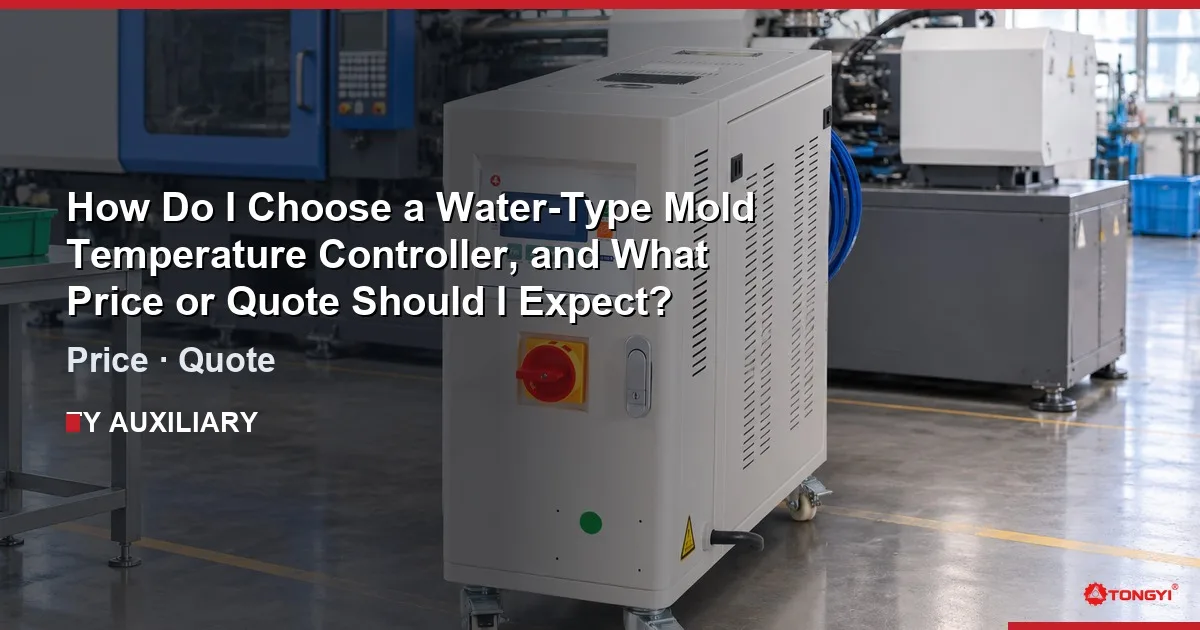
A water-type mold temperature controller quote is driven primarily by heating capacity, pump size, and flow configuration — not by the mold itself. For most injection molding applications running up to 120 °C with clean water as the heat transfer medium, the right unit is the smallest model whose heater and pump match your mold’s heat load and coolant flow demand, and the price you should expect will scale roughly with that heater and pump capacity. This guide explains how to size a unit correctly, what specifications belong in a quote request, and how to compare supplier quotations on a like-for-like basis.
What actually drives the price of a water-type mold temperature controller
When buyers search for water-type mold temperature controller pricing, they often expect a simple catalog number. In practice, three engineering variables determine what a supplier quotes:
- Electric heating power. Heater capacity is usually the single largest cost driver. It must cover the heat your mold absorbs during startup and steady operation, plus losses in the piping loop.
- Pump power and maximum flow. A larger pump moves more heat transfer medium through the mold channels, which improves temperature response on bigger or multi-cavity molds — but it adds cost.
- Circuit configuration. The number of media inlet/outlet connections (the manifold split, such as 2-in/2-out versus 1-in/1-out) and the connection size affect plumbing design and, with it, unit cost.
Because these variables differ from model to model, a responsible supplier will ask for your mold size, target process temperature, and available cooling water conditions before quoting — not just “send me your price list.”
Which models fall in the 120 °C water-type range
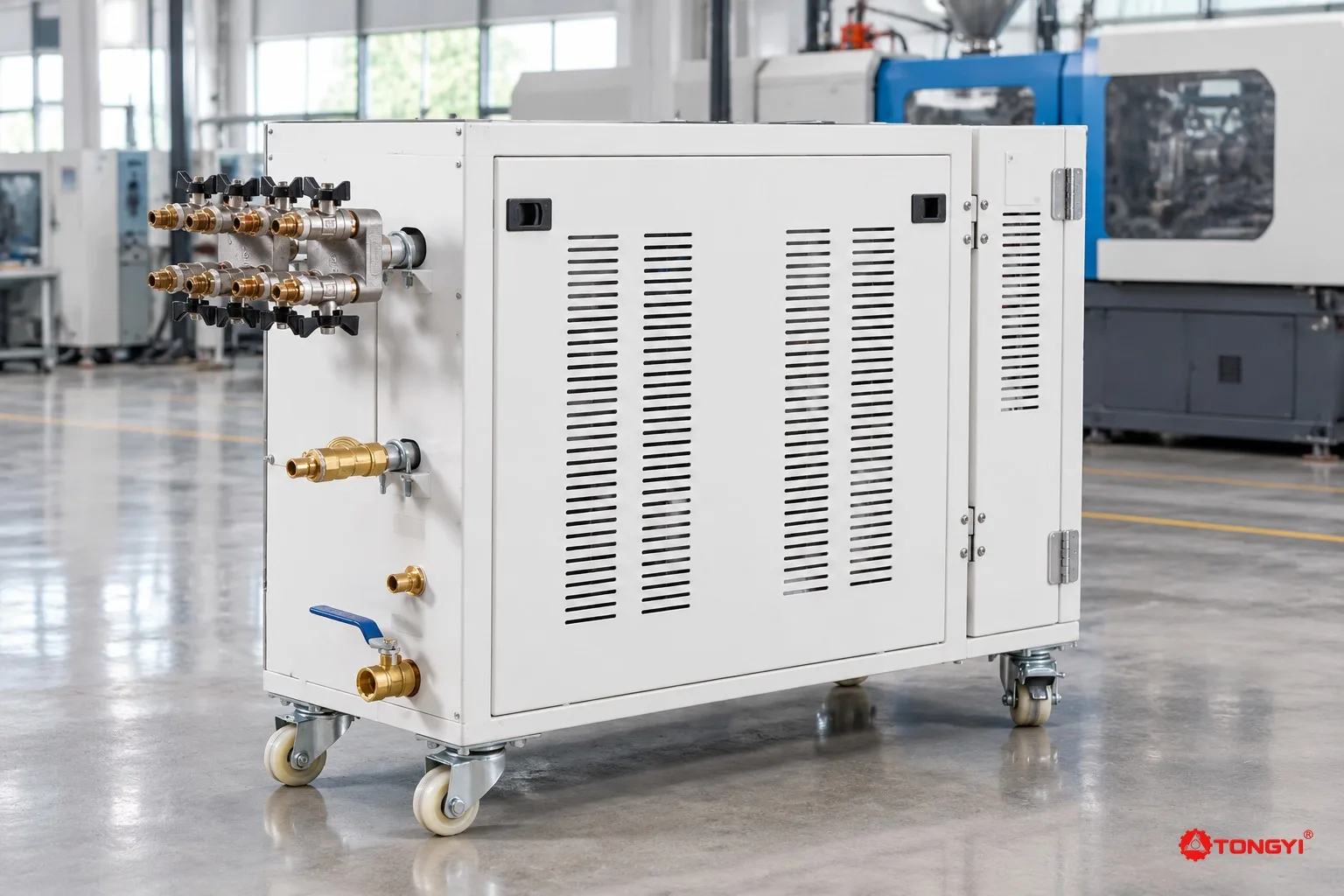
Water-type units are the economical choice when your process temperature stays at or below 120 °C, which covers a large share of conventional thermoplastic molding. Oil-type units are the alternative above that range. Our water-type series uses clean water as the heat transfer medium with direct cooling, and is available in six heater sizes. The table below compares them like for like:
| Model | Heating power | Pump power | Max pump flow | Max pressure | Manifold | Media connection |
|---|---|---|---|---|---|---|
| TMC 60W | 6 kW | 0.37 kW | 42 L/min | 0.35 MPa | 2 in / 2 out | 3/8 inch |
| TMC 90W | 9 kW | 0.75 kW | 60 L/min | 0.4 MPa | 2 in / 2 out | 3/8 inch |
| TMC 120W | 12 kW | 0.75 kW | 60 L/min | 0.4 MPa | 4 in / 4 out | 3/8 inch |
| TMC 180W | 18 kW | 1.5 kW | 165 L/min | 0.25 MPa | 1 in / 1 out | 1 inch |
| TMC 240W | 24 kW | 1.5 kW | 165 L/min | 0.25 MPa | 1 in / 1 out | 1 inch |
| TMC 360W | 36 kW | 2.2 kW | 310 L/min | 0.3 MPa | 1 in / 1 out | 1.2 inch |
All six models share the same operating envelope: a maximum temperature of 120 °C, a minimum usable temperature of cooling water temperature +5 to +30 °C, clean water as the medium, direct cooling, and a K-type probe thermocouple for media inlet and outlet temperature sensing. The return water connection is 15 mm across the series.
Two specifications that matter most when you compare quotes
Pump flow, not just pump power. Compare the TMC 90W and TMC 120W: both use a 0.75 kW pump with a maximum flow of 60 L/min, yet the 120W carries a 12 kW heater and a 4-in/4-out manifold. If your mold has four independent cooling circuits, the 120W’s manifold lets you feed all four from one unit — something the 90W’s 2-in/2-out split cannot do without external plumbing. Conversely, if you only need heat and modest circulation, paying for the larger manifold is wasted cost. This is exactly the kind of trade-off to make explicit in your quote request.
Maximum flow against maximum pressure as separate ratings. The TMC 360W delivers a maximum pump flow of 310 L/min at a maximum pressure of 0.3 MPa, while the smaller TMC 60W moves 42 L/min at up to 0.35 MPa. Note that the high-flow models actually operate at lower maximum pressure — flow and pressure are independent ratings, and a duty point that combines both must be confirmed with the supplier rather than assumed. If your mold circuits are long or restrictive, low pressure capability can limit effective flow even on a large unit, which is why a supplier should review your circuit layout before finalizing the quote.
A note on temperature accuracy
The published specification for this water-type series lists a temperature control accuracy of ±0.1 °C. This is a series-level figure describing how tightly the controller regulates the heat transfer medium; it is not a per-model guarantee, and it does not by itself describe temperature uniformity across the mold cavity, which also depends on mold design and channel layout. Confirm the applicable measurement point and test conditions with your supplier.
How to choose the right model for your molding operation
Use this sequence to match a unit to your application before requesting a quote:
- Confirm your process temperature. If your setpoint is at or below 120 °C, a water-type unit is appropriate. The minimum controllable temperature is bounded by your plant cooling water temperature plus 5 to 30 °C, so very low setpoints need sufficiently cold incoming water.
- Estimate heat load. Mold mass, shot weight, cycle rate, and material determine the heating power you need. Undersized heaters extend startup time and destabilize cycle-to-cycle temperature; oversized heaters inflate the quote and can cause short-cycling of the heater contactor.
- Count and size your mold circuits. Match the manifold split and media connection size to your mold. The 3/8 inch connections on the TMC 60W–120W group suit smaller circuit sets; the 1 inch connections on the 180W and 240W, and 1.2 inch on the 360W, support the higher flows larger molds demand.
- Check your plant water supply. Direct cooling means the unit draws on your facility’s cooling water. Its temperature and pressure determine the achievable minimum temperature and affect cooling response.
For a closer look at the full specification set, see the water-type mold temperature controller product page.
What to include in a quote request
To get an accurate, comparable price rather than a vague ballpark, give every supplier the same inputs:
- Process temperature setpoint and material being molded
- Mold weight and number of cooling circuits, with circuit connection sizes
- Available cooling water temperature and pressure at the machine
- Required heating power estimate, if your process engineer has calculated one
- Local electrical supply (voltage, phase, frequency) and any regional compliance requirements
- Expected order quantity and delivery terms (FOB, CIF, or DDP destination)
When quotes come back, normalize them: confirm each supplier has quoted the same heater size, pump rating, and manifold configuration, and ask what is included — shipping, spare thermocouples, control documentation, and commissioning support all affect landed cost.
How to compare supplier quotes on a like-for-like basis
- Match the spec line by line. A 9 kW unit and a 12 kW unit are not substitutes. Insist that each quote states heating power, pump power, maximum flow, and maximum pressure exactly.
- Ask how temperature accuracy is measured. A ±0.1 °C claim means little without knowing the measurement point and conditions. Ask for the test basis in writing.
- Confirm the change-notice policy. Published specifications can be revised without notice, so the quote itself should list the exact values the delivered unit will meet.
- Weight total cost of ownership. Pump efficiency, heater control method, and serviceability affect running cost over years, not just the purchase price.
Next step
Gather your mold circuit count, target temperature, and plant water conditions, then request a quote for the specific model that fits — for example, if you have four cooling circuits and a moderate heat load, ask for pricing on a 12 kW unit with a 4-in/4-out manifold and 60 L/min pump. A supplier who asks clarifying questions before quoting is generally a better partner than one who sends a number immediately. You can also explore complementary auxiliary equipment for injection molding if you are building out a complete production cell.