
Water-Type Mold Temperature Controller: What Is the Difference Between Price and Quote, and How Do They Compare?
An indicative price covers a base unit, while a quotation matches cost to your exact model, heating power, pump flow and delivery terms for a water-type.
A price is an indicative figure for a base configuration, while a quotation is a formal, project-specific offer that ties cost to your exact requirements — heating power, pump flow, manifold layout, port size, voltage, delivery terms and lead time. For a water-type mold temperature controller, the quotation is the number you compare across suppliers, because two units with very different heating and pumping capability can look almost identical in a catalog and carry misleadingly similar price tags.
Price vs. Quote: What the Difference Means at the Purchasing Stage
Buyers researching a water-type mold temperature controller price usually run into one of two documents:
- An indicative or list price. This is a ballpark figure for a base unit. It typically excludes freight, duty, start-up support and any options your process needs. It answers “roughly what does this class of equipment cost?” but it is not an offer you can place a purchase order against.
- A formal quotation. This is a written offer naming the exact model, its verified technical parameters, commercial terms (Incoterms, payment, delivery) and a validity period. It is the document your procurement team can act on.
The distinction matters because water-type mold temperature controller pricing is configuration-driven. Heating capacity, pump size, manifold splits and port diameter all change what is built into the machine, and therefore what it costs to produce and ship. A quote forces those variables onto the table; an indicative price hides them. If you compare quotes, make sure each one states the same specifications — otherwise you are not comparing like for like.
What Actually Drives the Cost of a Water-Type Mold Temperature Controller
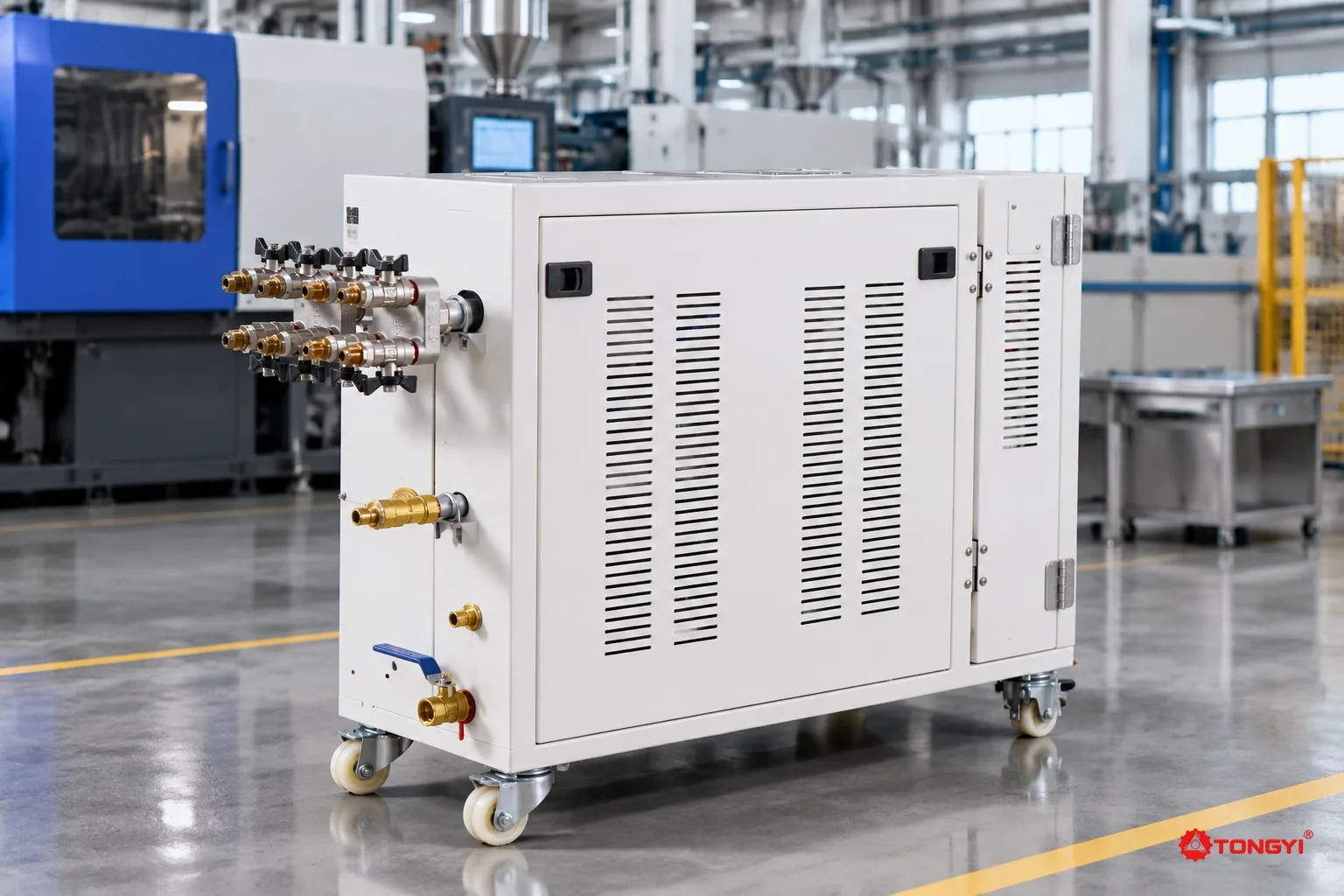
Within one water-type series, a handful of published specification differences separate a higher-cost model from a lower-cost one. Knowing them helps you judge whether a quotation is proportionate to what you asked for.
- Electric heating power. A larger heater costs more and may require more supply capacity at your plant.
- Pump power and maximum flow. A bigger circulating pump moves more water through the mold circuit — essential for large molds with long, restrictive channels — and it adds cost.
- Maximum pressure rating. Some models carry a lower pressure limit than others even with higher flow, and hydraulic components rated for different duties are not priced the same.
- Manifold and connection configuration. The number of media inlet/outlet splits and the port diameter change plumbing complexity on both the controller and your mold.
- Commercial scope. Freight, duty, spares, documentation and start-up support are commercial line items rather than machine specifications, but they belong in the quotation so the landed cost is complete.
Comparing Water-Type Models Like for Like
The TMC water-type series below uses clean water as the heat-transfer medium and direct cooling. Every model in the series reaches a maximum temperature of 120 °C, has a minimum operating temperature of cooling water temperature +5~30 °C, and uses a K-type probe thermocouple for media inlet/outlet temperature measurement. Because published specifications can change without notice, confirm current values with the supplier before ordering.
| Model | Heating Power | Pump Power | Max Flow | Max Pressure | Manifold | Port Size |
|---|---|---|---|---|---|---|
| TMC 60W | 6 kW | 0.37 kW | 42 L/min | 0.35 MPa | 2-in/2-out | 3/8 inch |
| TMC 90W | 9 kW | 0.75 kW | 60 L/min | 0.4 MPa | 2-in/2-out | 3/8 inch |
| TMC 120W | 12 kW | 0.75 kW | 60 L/min | 0.4 MPa | 4-in/4-out | 3/8 inch |
| TMC 180W | 18 kW | 1.5 kW | 165 L/min | 0.25 MPa | 1-in/1-out | 1 inch |
| TMC 240W | 24 kW | 1.5 kW | 165 L/min | 0.25 MPa | 1-in/1-out | 1 inch |
| TMC 360W | 36 kW | 2.2 kW | 310 L/min | 0.3 MPa | 1-in/1-out | 1.2 inch |
Two published values deserve explanation in purchasing terms, because they are the ones buyers most often get wrong when comparing quotations.
Heating power — 6 kW on the TMC 60W compared with 9 kW on the TMC 90W. Electric heating power determines how fast the controller can bring the water loop up to setpoint and how well it recovers heat after each shot or mold-open period. The TMC 60W offers 6 kW; the TMC 90W raises this to 9 kW. For a small mold running a light cycle, 6 kW can be entirely sufficient. For a larger mold, a thick-walled part, or a high-throughput cell with short cycle times, the 9 kW unit gives faster heat recovery. Undersizing on heater power is one of the most common and most expensive selection errors, because the smaller unit will quote lower and then fail to hold temperature in production.
Maximum flow — 60 L/min on the TMC 90W compared with 310 L/min on the TMC 360W. Flow rate governs how much water you can circulate through the mold’s cooling channels each minute, which directly affects heat removal from the mold. The TMC 90W is rated at 60 L/min; the TMC 360W reaches 310 L/min. Note that maximum flow and maximum pressure are separate ratings, not one curve: the TMC 180W moves 165 L/min through 1-inch ports but has a lower maximum pressure of 0.25 MPa than the TMC 90W’s 0.4 MPa. Higher-flow models trade pressure capability for volume, so the right choice depends on whether your circuit needs volume through large channels or pressure through longer, more restrictive runs. Ask the supplier to confirm the duty point you intend to operate at rather than treating either figure as a guaranteed simultaneous condition.
Temperature Accuracy: What the Published Claim Actually Covers
The manufacturer publishes a temperature accuracy of ±0.1 °C for the TMC water-type series as a whole. Because this is a series-level figure, it is not presented here as a per-model guarantee, and the published page does not specify the measurement point or the test conditions behind it. It also helps to separate two different ideas: controller accuracy is how closely the unit holds the water temperature at its sensor, while temperature uniformity throughout the mold is a property of mold design, channel layout and flow distribution. Treat the ±0.1 °C figure as a series-level statement and ask the supplier to confirm the model scope, measurement point and test conditions before relying on it in a process validation.
What to Include in a Quote Request
To receive quotations you can genuinely compare, put the following in every request:
- Target mold temperature and material. Confirm that the 120 °C maximum of a water-type unit covers your process; above that you would need an oil-type controller, which is a different category with different cost drivers.
- Mold size, number of cooling zones and required channel flow. This lets the supplier match heating power and pump flow instead of defaulting to the smallest unit in the series.
- Required manifold configuration and port size. The series spans 2-in/2-out and 4-in/4-out manifolds on 3/8-inch ports, and 1-in/1-out on 1-inch and 1.2-inch ports. Mismatched connections are a frequent hidden cost item.
- Facility supply voltage and frequency. Electrical supply is a configuration choice, so it must be stated rather than assumed.
- Cooling water conditions. The minimum operating temperature is defined relative to your cooling water temperature, so tell the supplier what you have available at the plant.
- Delivery terms, Incoterms and lead time. For US buyers importing machinery, freight and duty are meaningful components of landed cost and should be explicit in the quotation.
- Scope of the accuracy specification. Ask the supplier to state the measurement point and conditions the ±0.1 °C series-level figure applies to.
How to Compare Quotations Fairly
Once quotations arrive, normalize them against a single specification checklist — the one above works. Flag any quote that quietly substitutes a different model, a lower heating power, or a lower flow rating than you requested. A lower number on a smaller heater or pump is not a discount; it is a different machine with less capability. Confirm the quotation validity period, and check whether start-up support, spare parts and documentation are included, since these are commonly omitted from an indicative price but may or may not appear in a formal quotation.
When you are ready to move from general price research to an offer you can act on, review the full water-type mold temperature controller specifications, and if your process runs above 120 °C, compare it with the oil-type mold temperature controller range before you send your request.
Frequently asked questions
Why is a water-type mold temperature controller quote higher than the price I saw online?
An online price is normally an indicative figure for a base configuration and often excludes freight, duty, start-up support and options. A quotation prices the exact model and its heating power, pump size, manifold configuration, port size and delivery terms. When the configurations differ, the two numbers describe different machines rather than a markup.
Are all models in a water-type mold temperature controller series priced the same?
No. Within the TMC water-type series, electric heating power ranges from 6 kW to 36 kW, pump power from 0.37 kW to 2.2 kW, and maximum flow from 42 L/min to 310 L/min, with manifold and port configurations changing as well. Those component differences are what separate one model’s cost from another’s, so a single series price is not meaningful.
What should I put in a quote request to get comparable offers?
State the target mold temperature and material, mold size and number of cooling zones, required channel flow, the manifold configuration and port size you need, facility supply voltage and frequency, your cooling water conditions, and the delivery terms and Incoterms. With those items fixed, competing quotations describe the same machine and can be compared directly.
Can a water-type controller handle any mold temperature?
The TMC water-type series is rated to a maximum temperature of 120 °C, with a minimum operating temperature of cooling water temperature +5~30 °C. If your process requires higher temperatures, you would need an oil-type controller instead, which is a different product category with its own cost drivers.
Does a higher maximum flow rating always mean better mold temperature control?
Not always. Maximum flow and maximum pressure are separate ratings. The TMC 180W delivers up to 165 L/min but at a maximum pressure of 0.25 MPa, while the TMC 90W delivers up to 60 L/min at 0.4 MPa. High flow suits large channels and volume-driven circuits; higher pressure suits longer, more restrictive runs. Choose on the duty your mold circuit actually presents.
Is the published temperature accuracy of ±0.1 °C valid for every model?
The ±0.1 °C figure is published for the TMC water-type series as a whole, and the published page does not state the measurement point or test conditions. Treat it as a series-level claim, not a per-model guarantee, and ask the supplier to confirm the applicable scope for your specific model before you rely on it in process validation.