
Water-Type Mold Temperature Controller Price, Quote and Selection Guide: What Should an US Buyer Expect to Pay?
Learn what drives water-type mold temperature controller price and how heating power, flow, pressure, and scope of supply shape the quote you should.
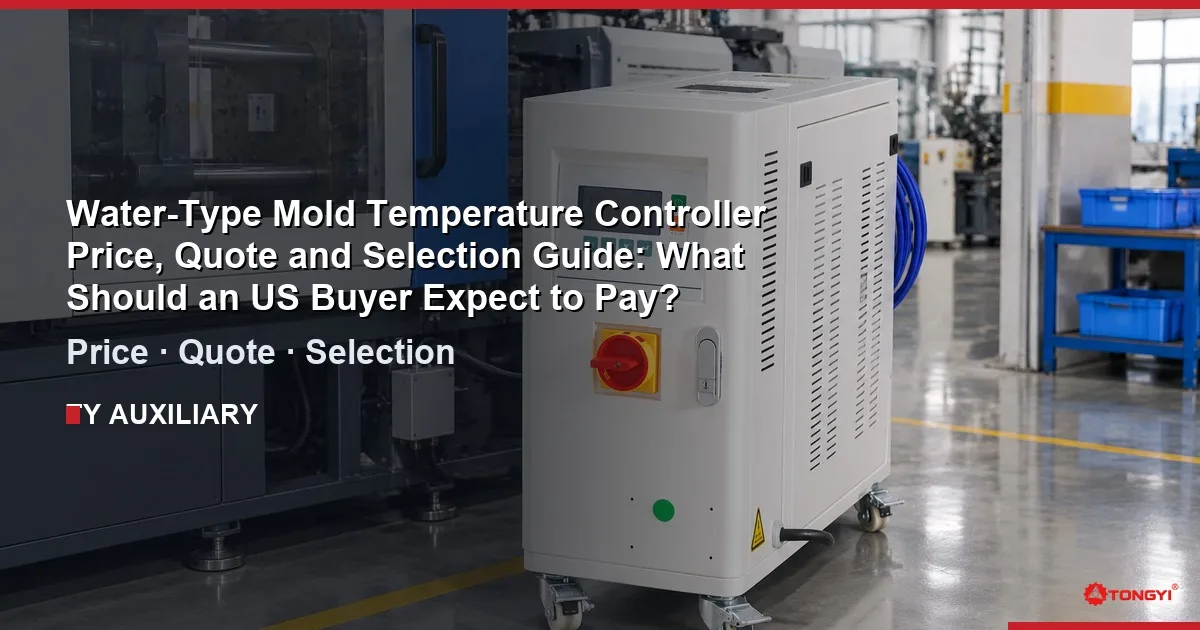
What drives the price of a water-type mold temperature controller?
There is no single list price for a water-type mold temperature controller because the unit is built around the process it has to hold. On a clean-water TMC machine, the two specifications that move cost the most are electric heating power and pump power, because together they determine the size of the heater bundle, the pump, the piping, the electrical panel, and the breaker and feed your plant has to provide. Model numbers follow that logic directly: the TMC series runs from the TMC 60W at 6 KW of heating with a 0.37 KW pump up to the TMC 360W at 36 KW of heating with a 2.2 KW pump. A buyer requesting a mold temperature controller price quote should therefore start from the required heating capacity and flow, not from a catalog tier. Two machines that both read “120 °C maximum” can differ substantially in cost because one is a 9 KW unit and the other is a 36 KW unit.
The rest of the price is set by configuration rather than size: manifold arrangement, media connection size, control and communication options, and how the unit is tested before shipment. Those items are cheap to specify correctly at the quotation stage and expensive to correct after the machine is built.
What should an US buyer expect to pay for?
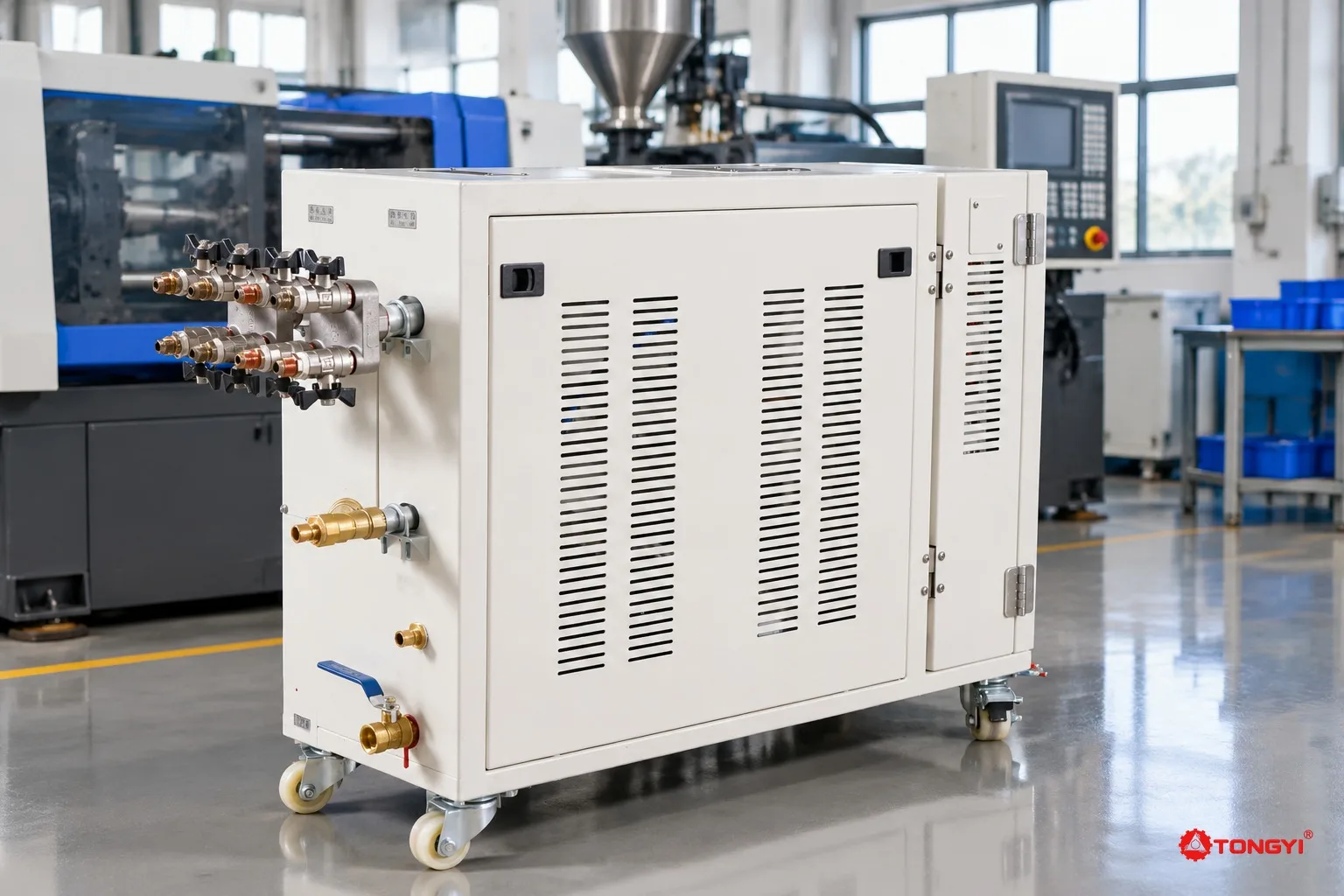
The honest answer for a pricing search is that you pay for capacity, control, and compliance work, plus freight, duty, and commissioning. Because suppliers quote against different scopes, the same nominal model can arrive at very different totals. The practical approach is to compare quotes on a like-for-like basis. That means every request for quotation should state the following inputs so the supplier prices the same machine you are actually comparing:
- Heating power required (KW) — driven by mold mass, cycle time, and start-up time.
- Pump power and maximum flow (KW, L/MIN) — driven by the number of circuits and total pressure drop.
- Maximum pressure (MPA) — must suit the manifold and hose rating, not just the pump.
- Manifold type and connection size — 2In2Out, 4In4Out, or 1In1Out, and 3/8 inch, 1 inch, or 1.2 inch media ports.
- Return water port size — 15 mm across the TMC water series.
- Temperature sensor and controller type — the TMC water series uses a K type probe thermocouple.
- Electrical supply — voltage, phase, and available amperage at the installation point.
- Cooling water conditions — the water series is rated from cooling water temperature +5 to +30 °C.
- Scope of delivery — hoses, fittings, spare parts, documentation, warranty terms, and whether factory acceptance testing is included.
- Commercial terms — Incoterms, installation support, and training.
When two suppliers quote the same model name but different scopes, the difference in total is usually scope, not margin. Ask each supplier to price the identical input list above; the comparison then becomes meaningful.
How heating power and pump power change both capability and cost
Heating power sets how fast the mold reaches setpoint and how much heat the unit can replace during a fast cycle. In the TMC water series the heating steps are 6, 9, 12, 18, 24, and 36 KW, and the pump steps are 0.37, 0.75, 1.5, and 2.2 KW. These are not interchangeable: a 6 KW unit with a 0.37 KW pump is a small single-cavity or pilot machine, while a 36 KW unit with a 2.2 KW pump is a large tool or a multi-circuit manifold. The cost difference between those two ends is substantial because the heater, pump, contactors, wiring, and enclosure all change together, and so does the electrical service you must bring to the machine.
One verified value that buyers ask about repeatedly is maximum flow. On the TMC 180W the pump is rated at 1.5 KW with a maximum flow of 165 L/MIN and a maximum pressure of 0.25 MPA. That flow figure matters because it tells you how much water the unit can circulate across all connected circuits, and it is one of the main drivers of how many mold circuits you can feed from a single controller. The matching pressure rating of 0.25 MPA tells you the other half of the story: if your manifold, hoses, and internal mold channels create more pressure drop than that, you will not achieve the rated flow regardless of pump size. Flow and pressure are separate ratings on these units, and the supplied data gives them as independent maximums, not as a single verified duty point. Always confirm your actual circuit pressure drop rather than assuming design flow at whatever pressure your system happens to run.
A second value worth explaining is media connection size. The TMC 60W, TMC 90W, and TMC 120W use 3/8 inch media ports with a 15 mm return water port, while the TMC 180W and TMC 240W use 1 inch media ports and the TMC 360W uses 1.2 inch ports, all with the same 15 mm return. Connection size determines how much flow you can physically push into the mold without excessive velocity and pressure loss, so a large unit fitted with small ports will be throttled by its own plumbing. When you compare quotes, confirm that the quoted manifold connection size matches the unit’s rated flow, not just the model number.
Water-type TMC model comparison
The table below compares verified specifications across the TMC water series. Every row reflects the supplier’s published data for that model. Specifications are subject to change without prior notice, so confirm the exact configuration in writing at the quotation stage.
| Model | Heating power | Pump power | Max flow | Max pressure | Manifold | Media port | Max temperature |
|---|---|---|---|---|---|---|---|
| TMC 60W | 6 KW | 0.37 KW | 42 L/MIN | 0.35 MPA | 2In2Out | 3/8 inch | 120 °C |
| TMC 90W | 9 KW | 0.75 KW | 60 L/MIN | 0.4 MPA | 2In2Out | 3/8 inch | 120 °C |
| TMC 120W | 12 KW | 0.75 KW | 60 L/MIN | 0.4 MPA | 4In4Out | 3/8 inch | 120 °C |
| TMC 180W | 18 KW | 1.5 KW | 165 L/MIN | 0.25 MPA | 1In1Out | 1 inch | 120 °C |
| TMC 240W | 24 KW | 1.5 KW | 165 L/MIN | 0.25 MPA | 1In1Out | 1 inch | 120 °C |
| TMC 360W | 36 KW | 2.2 KW | 310 L/MIN | 0.3 MPA | 1In1Out | 1.2 inch | 120 °C |
All water-series models use clean water as the heat transfer medium, direct cooling, and a K type probe thermocouple for media in/out temperature sensing. The lower temperature limit across the series is cooling water temperature +5 to +30 °C, and the return water port is 15 mm on every model.
How to compare two models on the same job
Take a mid-range example: the TMC 120W and the TMC 180W. The TMC 120W provides 12 KW of heating with a 0.75 KW pump, 60 L/MIN maximum flow, 0.4 MPA maximum pressure, a 4In4Out manifold, and 3/8 inch media ports. The TMC 180W provides 18 KW of heating with a 1.5 KW pump, 165 L/MIN maximum flow, 0.25 MPA maximum pressure, a 1In1Out manifold, and 1 inch media ports. The trade-off documented in these figures is straightforward and worth understanding before you request a quote. The TMC 120W has higher available pressure (0.4 MPA against 0.25 MPA) and a four-circuit manifold, which suits a tool with several smaller cooling circuits that each need pressure to push through narrow channels. The TMC 180W delivers much more heating power and roughly 2.75 times the flow, which suits a large mold where the priority is moving water volume to remove heat quickly rather than driving pressure through restrictive channels.
Choosing between them is not a matter of “bigger is better.” If your circuits are narrow and numerous, the TMC 120W’s pressure and 4In4Out manifold may serve you better than a larger unit that cannot develop the same pressure. If your mold has fewer, larger passages and a high heat load, the TMC 180W is the more appropriate selection. This is the kind of trade-off that should appear explicitly in your selection notes and in the quote request, because it changes which model a supplier prices.
Temperature accuracy: what the published figure does and does not cover
The published product page for the water-type series states a temperature accuracy of ±0.1 °C. Buyers frequently read that number as a guarantee of how evenly the mold will run, which it is not. The claim is published at series level, and the page does not specify which models it applies to, where the measurement is taken, or under what test conditions it was established. Treat it as an indication of controller and sensor resolution performance rather than as a mold-cavity temperature uniformity specification. Uniformity across a mold depends on circuit layout, flow balance, manifold design, and the mold itself — all outside the controller. If the ±0.1 °C figure is important to your process validation, ask the supplier to confirm the applicable model scope, the measurement point, and the test conditions in writing before you rely on it.
What to verify with any supplier before you order
Because published specifications can change without notice, and because a quote is only as good as the scope behind it, confirm the following items with every supplier — including us — before issuing a purchase order. Each item below explains why it matters and how to check it.
- Heating power and pump power, matched to your mold. These determine cycle performance and electrical service. Check them against your calculated heat load and required flow, and ask for the calculation basis.
- Maximum flow and maximum pressure, stated separately. Required to confirm the unit will actually circulate your circuits. Check both against your manifold and internal mold pressure drop; do not accept flow quoted at an unstated pressure.
- Manifold configuration and media port size. These limit usable flow. Check that the quoted manifold (2In2Out, 4In4Out, or 1In1Out) and port size (3/8 inch, 1 inch, or 1.2 inch) match your circuit count and hose sizing.
- Temperature sensor type and controller accuracy scope. Affects control stability and any process validation. Check that the thermocouple type (K type probe on the TMC water series) and the accuracy statement’s model scope and test conditions are documented.
- Cooling water supply conditions. The lower temperature limit is cooling water temperature +5 to +30 °C. Check your plant cooling water temperature and stability across seasons, since a warmer supply raises the achievable minimum.
- Electrical supply compatibility. Voltage, phase, and amperage must match your facility. Check against your panel capacity, and confirm the unit’s nameplate values in the quote.
- Scope of delivery and commercial terms. Determines the true total cost of ownership. Check Incoterms, included hoses and fittings, spare parts, documentation language, warranty terms, and whether factory testing and commissioning support are included.
- Configuration freeze at order. Specifications may change without prior notice, so the quotation and order confirmation should state the exact model, all ratings above, and the agreed configuration.
How to write a quote request that gets a comparable price
A quote request that lists only a model name will come back with an ambiguous price. Write the request around the process instead. State the mold or tool being run, the number of circuits, the required setpoint, the required start-up time, the available cooling water temperature, the plant electrical supply, and the ambient conditions in the molding area. Add the manifold arrangement and media connection size you need, and say whether the unit will run continuously or in short batches. Then ask for the heating power, pump power, maximum flow, maximum pressure, and connection sizes that the supplier proposes for that duty, along with the accuracy statement scope. With those answers on paper, you can compare proposals from different suppliers line by line rather than guessing at what a model number contains.
If you are still narrowing the series, review the water-type mold temperature controller range first to confirm which sizes fit your tool, then check whether a larger frame or additional manifold capacity is available in the product catalog. Buyers comparing against hot-oil machines for higher setpoints should also review the oil-type mold temperature controller options, since the choice of medium changes both the achievable temperature and the supporting equipment you need.
Frequently asked questions
Why do two quotes for the same water-type mold temperature controller differ so much?
Most differences come from scope, not from the base machine. One quote may include hoses, fittings, factory testing, and commissioning support, while another prices only the unit. Electrical configuration, manifold arrangement, and media connection size also change the build. Ask both suppliers to price the same written specification list so the comparison is like-for-like.
What information do I need to give a supplier to get an accurate mold temperature controller price quote?
Provide the mold or tool details, number of circuits, required setpoint, required start-up time, available cooling water temperature, plant electrical supply, and ambient conditions. Also state the manifold arrangement and media connection size you need. With those inputs, the supplier can propose specific heating power, pump power, flow, and pressure ratings, and price the correct machine.
How do I choose between a 12 KW and an 18 KW water-type unit?
Compare heat load and circuit characteristics rather than size alone. The TMC 120W offers 12 KW of heating, a 0.75 KW pump, 60 L/MIN maximum flow, 0.4 MPA maximum pressure, a 4In4Out manifold, and 3/8 inch ports. The TMC 180W offers 18 KW of heating, a 1.5 KW pump, 165 L/MIN maximum flow, 0.25 MPA maximum pressure, a 1In1Out manifold, and 1 inch ports. Choose the 120W for several narrow, pressure-hungry circuits and the 180W for high heat load with fewer, larger passages.
Does maximum flow tell me whether the controller will work on my mold?
Only partly. Maximum flow is the highest circulation rate the pump can achieve, but your mold’s internal pressure drop determines what you actually get. If the required pressure exceeds the unit’s maximum pressure rating, flow will fall below the maximum. Confirm both maximum flow and maximum pressure against the calculated pressure drop of your manifold, hoses, and mold circuits.
Is the ±0.1 °C temperature accuracy a guarantee for my mold?
No. That figure is published at series level for the water-type TMC range, and the published scope does not specify the applicable models, measurement point, or test conditions. It reflects controller and sensor performance rather than temperature uniformity across a mold cavity. Ask the supplier to confirm the applicable model scope and test conditions in writing before relying on it for process validation.
What is the lowest temperature a water-type TMC unit can reach?
The lower limit is cooling water temperature plus 5 to 30 °C, which applies across the TMC water series. The achievable minimum therefore depends on your plant’s cooling water supply and how stable it is across the year. If your process needs temperatures below what your cooling water allows, review the oil-type alternatives before ordering.