
How Much Does a Water-Type Mold Temperature Controller Cost, and Can I Get a Quote with Drawings?
Compare documented product features and process requirements before selecting a mold temperature controller.
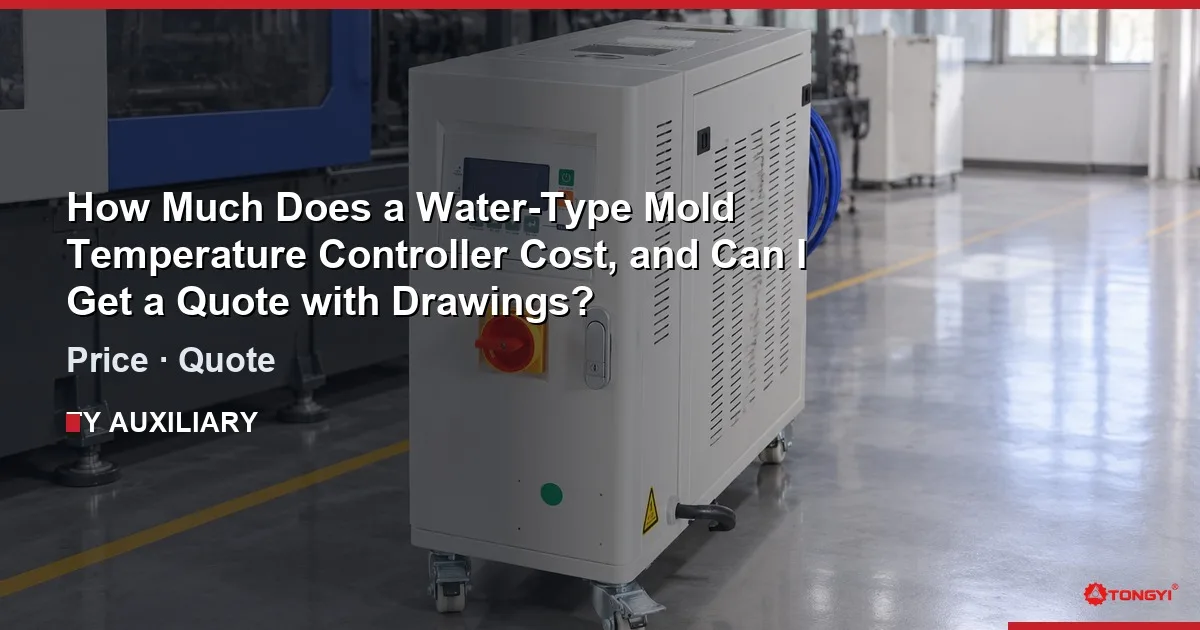
A water-type mold temperature controller does not have one published list price: the figure you are quoted depends mainly on heating capacity, pump size, connection configuration, and how much engineering documentation you require alongside the unit. For buyers sourcing from overseas, the fastest path to an accurate number is a specification-based quote request that states your mold connection points, required water temperature, plant power supply, and whether you need dimension drawings for installation planning. This guide explains what actually drives the price, how to compare quotes on a like-for-like basis, and exactly what to include when you ask a supplier for a quotation with drawings.
What Determines the Price of a Water-Type Mold Temperature Controller
Suppliers price these units primarily on the heating and circulating package inside the cabinet. For water-type units running on clean water up to 120 °C, the cost drivers break down into five areas:
- Heater power. Larger electric heating capacity means larger contactors, wiring, and often a higher-amperage supply requirement, all of which raise both equipment cost and installation cost.
- Pump power and flow. A higher-flow pump moves more heat to the mold, but larger pumps, motors, and piping add cost.
- Manifold configuration. The number of media inlet/outlet ports (2-in/2-out, 4-in/4-out, or 1-in/1-out) and the pipe diameter affect plumbing complexity.
- Control and safety features. Temperature sensing type, controller accuracy, alarms, and protective interlocks influence both price and compliance work at your facility.
- Documentation and drawings. If your project requires general-arrangement drawings, electrical schematics, or connection diagrams for facility approval, ask whether these are included or quoted as an engineering line item.
How Unit Size Affects Cost: The Capacity Ladder
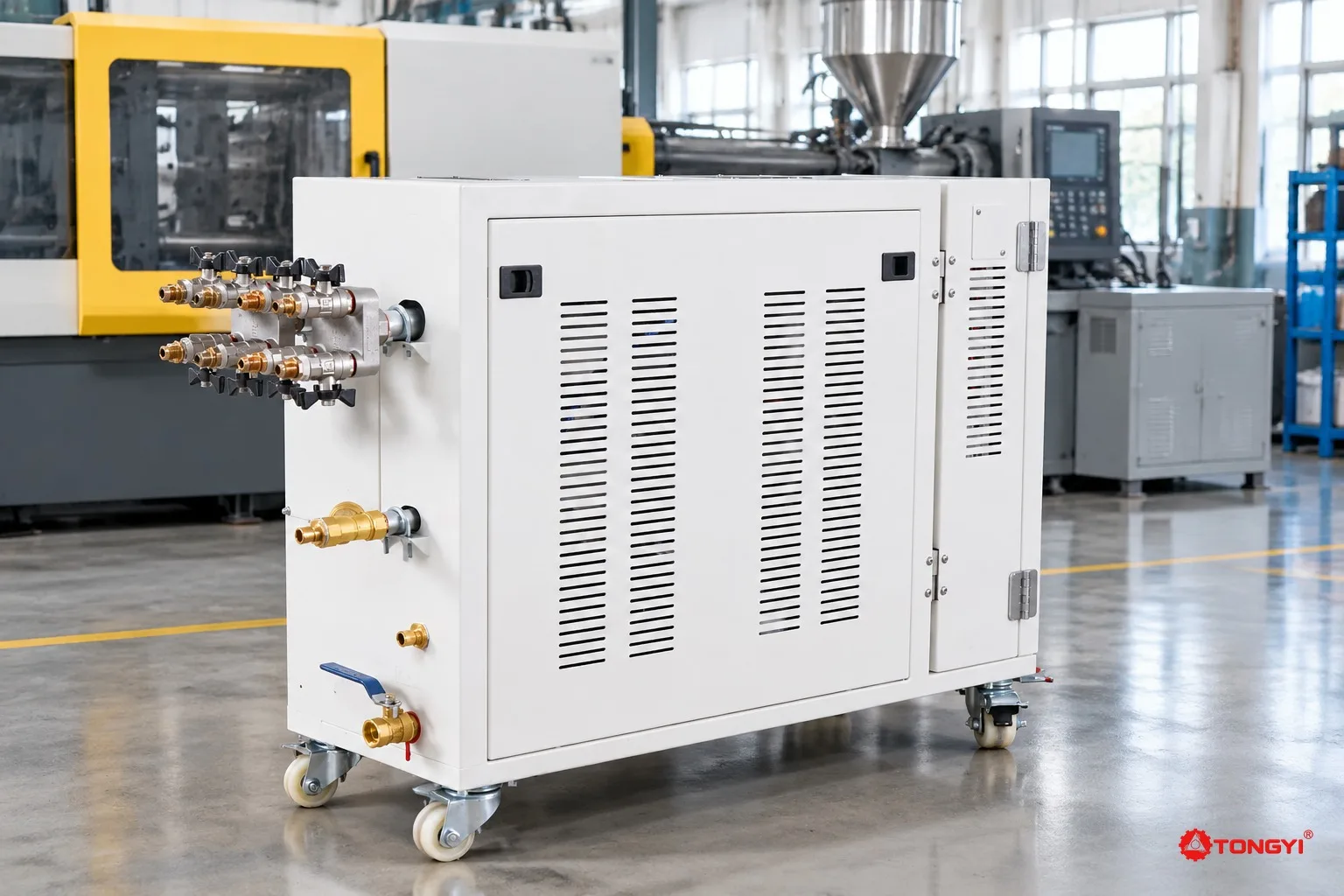
Most suppliers offer a water-type series as a ladder of heating capacities, and your position on that ladder is the single biggest price variable. The TMC water-type series, for example, spans six models from 6 KW to 36 KW heating power, all using clean water as the heat transfer medium with a 120 °C maximum temperature and direct cooling:
| Model | Heater Power | Pump Power | Max Flow | Max Pressure | Manifold | Media Port |
|---|---|---|---|---|---|---|
| TMC 60W | 6 KW | 0.37 KW | 42 L/min | 0.35 MPa | 2-in/2-out | 3/8 inch |
| TMC 90W | 9 KW | 0.75 KW | 60 L/min | 0.4 MPa | 2-in/2-out | 3/8 inch |
| TMC 120W | 12 KW | 0.75 KW | 60 L/min | 0.4 MPa | 4-in/4-out | 3/8 inch |
| TMC 180W | 18 KW | 1.5 KW | 165 L/min | 0.25 MPa | 1-in/1-out | 1 inch |
| TMC 240W | 24 KW | 1.5 KW | 165 L/min | 0.25 MPa | 1-in/1-out | 1 inch |
| TMC 360W | 36 KW | 2.2 KW | 310 L/min | 0.3 MPa | 1-in/1-out | 1.2 inch |
Two of these figures deserve a closer look because they directly affect both price and suitability. First, pump flow varies enormously across the range: the TMC 60W delivers a maximum flow of 42 L/min, while the TMC 360W reaches 310 L/min. Higher flow keeps heat transfer consistent across larger molds with long water circuits, but it also drives you toward bigger piping, larger ports, and a higher equipment price — so specify flow based on your mold’s circuit demand, not on the assumption that bigger is better. Second, note the trade-off between the small and large ends of the ladder: the TMC 180W and TMC 240W use a 1-inch media port and a 1-in/1-out manifold with a maximum pressure of 0.25 MPa, whereas the smaller 60W/90W units run 3/8-inch ports in a 2-in/2-out arrangement at up to 0.4 MPa. The larger port sizes on the higher-capacity models support greater flow volume, but the lower maximum pressure rating means you should confirm your plant’s cooling water supply pressure and the back-pressure of your mold circuits before selecting a model. Also note that all models in this series use a K-type probe thermocouple for media temperature sensing, and the published temperature accuracy for the series is ±0.1 °C — a series-level figure, so ask the supplier to confirm how it applies to the specific model and operating conditions you are buying.
Why You Should Ask for a Quote with Drawings
For overseas buyers, drawings are not a luxury — they prevent expensive surprises. A general-arrangement drawing lets your facilities team plan floor space, lifting points, and service clearance before the unit ships. Connection drawings confirm where your cooling water supply, return line, and mold circuits tie in, and whether your existing plumbing matches the unit’s port sizes and manifold configuration. Electrical drawings let your electrician verify supply amperage and breaker sizing against the heater power, which for a 36 KW unit is a meaningful load.
When you request a quotation, ask explicitly whether the price includes:
- General-arrangement and dimension drawings
- Piping and connection diagrams (media in/out, cooling water in, drain, return)
- Electrical schematic and wiring diagram
- Operation and maintenance manual in English
If drawings are quoted as an extra, get that cost stated up front rather than discovering it after the purchase order.
What to Include in Your Quote Request
A precise request gets a precise price. Include the following in your RFQ:
- Required water temperature range. Water-type units like this series operate up to 120 °C; the minimum operating temperature depends on your cooling water temperature (typically cooling water temperature plus 5–30 °C for this series). If you need above 120 °C, you need an oil-type unit instead — see our water-type mold temperature controller page and ask about oil-type options.
- Mold size and number of water circuits. This determines manifold configuration — a 4-in/4-out unit like the TMC 120W suits molds with multiple independent circuits, while a 1-in/1-out unit suits a single large circuit.
- Plant power supply. Voltage, frequency, and phase. Heater power from 6 KW to 36 KW implies very different electrical service requirements.
- Cooling water conditions. Supply temperature, available pressure, and water quality (the series runs on clean water).
- Documentation requirements. State which drawings and manuals you need and in what language.
- Shipping terms and destination port. Freight, crating, and Incoterms affect the landed cost significantly.
How to Compare Quotes on a Like-for-Like Basis
When two or three quotations arrive, normalize them before comparing numbers:
- Match the specification sheet, not the model name. One supplier’s “12 KW unit” may include a 0.75 KW pump while another’s uses a smaller pump; flow, port size, and manifold type should be compared line by line.
- Confirm what documentation is included. A lower price without drawings may cost more once you buy engineering support locally.
- Check spare parts and consumables. Ask the price of replacement heaters, pumps, thermocouples, and seals — the lifetime cost of a temperature control unit is dominated by these, not the initial purchase.
- Verify the warranty scope in writing, including whether overseas labor or only parts are covered.
Water-Type vs. Oil-Type: A Cost-Relevant Selection Point
Water-type units are generally the more economical choice when your process temperature stays within their range, because water is a cheap, clean medium and the equipment doesn’t need the high-pressure sealed circuit an oil system requires at equivalent temperatures. For this series, the 120 °C maximum temperature and clean-water medium suit most injection molding, die casting trim, and extrusion applications that operate below that ceiling. If your process requires higher mold temperatures, request pricing for an oil-type unit instead — see our mold temperature controller lineup for the full range and ask the supplier to quote both options if your temperature requirement is near the boundary.
Next Step: Request a Specification-Based Quotation
The most reliable way to get an accurate water-type mold temperature controller price is to send the supplier a completed specification sheet: required temperature, mold circuit count, power supply, cooling water conditions, and your drawing and documentation list. Suppliers who respond with a model-specific datasheet, connection drawings, and a line-item quotation are the ones worth shortlisting — vague one-number quotes usually signal specifications you’ll have to reconcile later. To start, review the water-type mold temperature controller specifications and submit your application details for a drawing-inclusive quotation.