
How Much Does a Custom Water-Type Mold Temperature Controller Cost, and Which Manufacturers Can Quote You a Price?
Compare documented product features and process requirements before selecting a mold temperature controller.
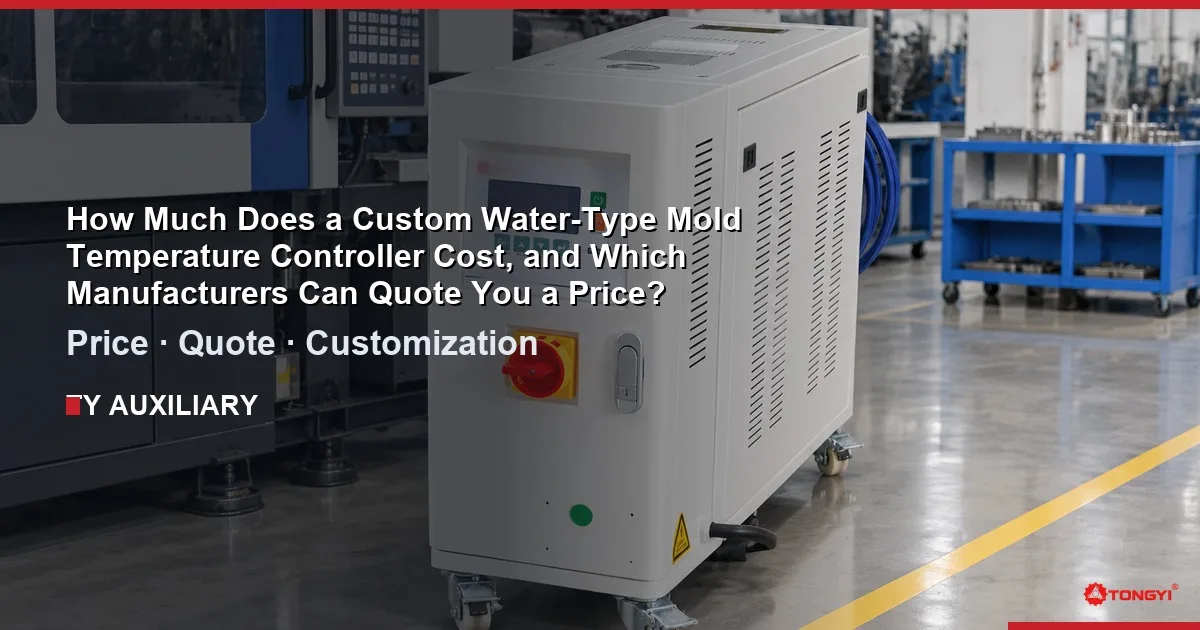
A custom water-type mold temperature controller is priced by specification, not by a fixed list number: the heating capacity, pump size, flow configuration, and any non-standard options you request all change what a manufacturer will quote. Because actual pricing varies with scope, currency, freight, and duties, the most useful thing a buyer can do is understand which specifications drive cost, build a like-for-like quote request, and shortlist manufacturers who can document their answers. This guide walks through those cost drivers, compares the standard models in a typical water-type series so you can see where customization is actually needed, and explains what to put in your request for quotation.
What Actually Drives the Price of a Water-Type Mold Temperature Controller
Water-type units use clean water as the heat transfer media and are generally the more economical class of mold temperature control compared with oil-type units, because water offers excellent heat transfer and the equipment can be built more simply. Within the water-type category, the main cost drivers a manufacturer will ask about are:
- Heating capacity. Larger heaters cost more and often pull larger pumps and bigger plumbing with them. A 6 KW unit and a 36 KW unit are different machines in terms of frame size, wiring, and pump selection.
- Pump power and flow rate. Higher flow means a bigger pump, larger motor, and heavier-duty pipework — all of which add to the quote.
- Manifold configuration. The number of media inlet/outlet circuits (for example, 2-in/2-out versus 1-in/1-out) changes the plumbing and the internal manifold fabrication.
- Connection sizes and return-water arrangements. Non-standard port sizes or return-line requirements affect fabrication effort.
- Control and safety options. Controller features, alarm configurations, and any special electrical requirements for your plant can change both cost and lead time.
- Order quantity, destination, and commercial terms. Freight, packaging, and Incoterms change the landed number even when the ex-works figure is identical.
Any reputable manufacturer will quote against a written specification sheet. If a supplier offers a number without asking for your heating capacity, required temperature, and flow configuration, treat that quote as an estimate at best.
Standard Models vs. Custom: Where Customization Actually Matters
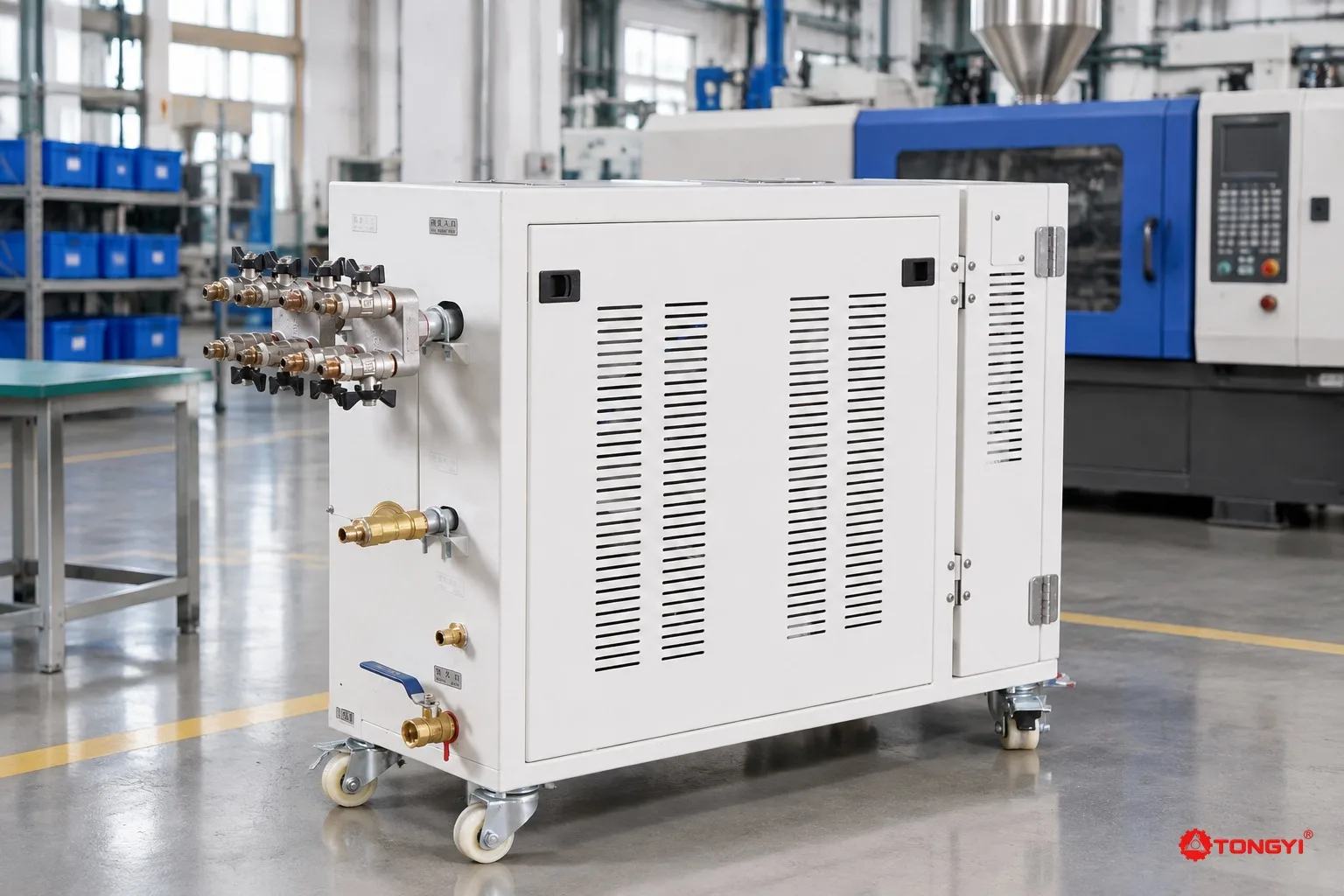
Before requesting a custom build, check whether a standard model already covers your duty point — that is usually the fastest and most economical path. The table below compares the standard models in a water-type series so you can judge which unit is closest to your process and where a custom quote is genuinely needed.
| Model | Heating Power | Pump Power | Max Pump Flow | Max Pressure | Manifold | Media Port Size |
|---|---|---|---|---|---|---|
| TMC 60W | 6 KW | 0.37 KW | 42 L/min | 0.35 MPa | 2-in/2-out | 3/8 inch |
| TMC 90W | 9 KW | 0.75 KW | 60 L/min | 0.4 MPa | 2-in/2-out | 3/8 inch |
| TMC 120W | 12 KW | 0.75 KW | 60 L/min | 0.4 MPa | 4-in/4-out | 3/8 inch |
| TMC 180W | 18 KW | 1.5 KW | 165 L/min | 0.25 MPa | 1-in/1-out | 1 inch |
| TMC 240W | 24 KW | 1.5 KW | 165 L/min | 0.25 MPa | 1-in/1-out | 1 inch |
| TMC 360W | 36 KW | 2.2 KW | 310 L/min | 0.3 MPa | 1-in/1-out | 1.2 inch |
Across the series, all models use clean water as the media, a maximum temperature of 120 °C, direct cooling, and a K-type probe thermocouple for media inlet/outlet temperature sensing, with a 15 mm return-water port.
Heating capacity and its cost implication
Heating power in this series steps from 6 KW on the TMC 60W through 9 KW (TMC 90W), 12 KW (TMC 120W), 18 KW (TMC 180W), 24 KW (TMC 240W), up to 36 KW on the TMC 360W. Heating capacity determines how quickly the unit can bring your mold and circulating water up to setpoint and how well it holds temperature under load. Sizing it correctly matters for two reasons: undersizing leaves you with slow heat-up and unstable molding, while oversizing means you are paying for heater, wiring, and frame capacity you never use. When you request a quote, state your mold weight, target water temperature, and heat-up time expectation so the manufacturer can justify the kilowatt rating they propose.
Pump flow, pressure, and manifold configuration
Pump ratings are equally quote-relevant. The TMC 60W runs a 0.37 KW pump delivering up to 42 L/min, while the TMC 120W pairs a 12 KW heater with a 0.75 KW pump at 60 L/min and a 4-in/4-out manifold — a configuration aimed at molds with multiple independent water circuits. At the top of the series, the TMC 360W uses a 2.2 KW pump moving up to 310 L/min through a 1-in/1-out circuit with a 1.2 inch port. Note that maximum flow and maximum pressure are separate ratings: for example, the TMC 180W and 240W share a 165 L/min flow rating but a lower 0.25 MPa maximum pressure than the mid-series 0.4 MPa units, because they move large volumes through larger 1 inch ports. If your mold’s cooling channels create significant back pressure, confirm the pump’s actual duty point with the manufacturer rather than assuming the maximum pressure value applies at your operating flow.
Temperature control accuracy
The product page for this water-type series publishes a temperature accuracy of ±0.1 °C at the series level. Treat this as a series-level published figure rather than a per-model guarantee: the page does not specify how it applies to individual models, at which measurement point it is taken, or under what test conditions it was verified. Also keep in mind that controller accuracy is not the same as temperature uniformity throughout the mold — uniformity depends on your water circuit design and mold construction. Ask any quoting manufacturer to state the measurement point and conditions behind their accuracy figure, and whether it applies to the specific model you are buying.
How to Compare Manufacturers on a Like-for-Like Basis
Because quotes arrive in different formats, comparison gets messy fast. Structure your request for quotation so every supplier answers the same questions:
- Required maximum water temperature (for this class of unit, 120 °C is the published series maximum) and the minimum usable temperature relative to your cooling water supply temperature — the series specifies cooling water temperature plus 5 to 30 °C.
- Heating capacity in KW, and whether the supplier calculated it or copied a standard model.
- Pump power and maximum flow, plus the manifold circuit count and media port sizes.
- Temperature sensing type and controller features, including any alarms you require.
- What is explicitly included: wiring standards, documentation, spare parts, packaging, and shipping terms.
- Lead time from order to ex-works, and lead time for any custom options.
- Specification change policy — note that some published spec sheets carry a statement reserving the right to change specifications without notice, so confirm the exact values at order time in writing.
A quote that itemizes these points is far easier to defend internally and to compare against a competing supplier than a single lump figure. If you are also evaluating equipment around the molding cell, our site’s water-type mold temperature controller product page lists the full series specification table, and buyers coordinating plant-wide material handling may find our auxiliary equipment catalog a useful next reference.
Custom Manufacturing: What Suppliers Will Ask You Before Quoting
A manufacturer quoting a custom unit will typically request more information than one quoting a catalog model. Expect questions about:
- Your mold’s water circuit layout — number of zones, series or parallel routing, and channel restriction.
- Plant cooling water temperature and quality, since the minimum usable controller temperature is tied to cooling water temperature plus 5 to 30 °C in this class of equipment.
- Target temperature and how tightly you need to hold it at the mold, not just at the controller.
- Electrical supply standards at your facility (voltage, frequency, and applicable electrical codes).
- Installation footprint constraints and port orientations.
Providing these details up front shortens the quoting cycle and reduces the chance of a costly specification mismatch after delivery. Engineers who need higher process temperatures than a water unit allows should also evaluate an oil-type mold temperature controller as the alternative, and can discuss that trade-off with the quoting supplier directly.
Practical Next Step for Buyers
The fastest path to a usable number is a one-page specification: target temperature, heating capacity, pump flow and pressure, manifold configuration, port sizes, electrical standards, destination, and required Incoterms. Send that to two or three manufacturers, ask each to state which standard model they sized from and what they would modify, and compare the responses line by line. Manufacturers who ask clarifying questions before quoting are, in practice, the ones whose final delivered units cause the fewest surprises.