
How Much Does a Water-Type Mold Temperature Controller Cost, and Where Can I Get a Quote with a Schematic?
Learn what drives the price of a water-type mold temperature controller, how heater power and pump flow shape the quote, and how to request pricing.
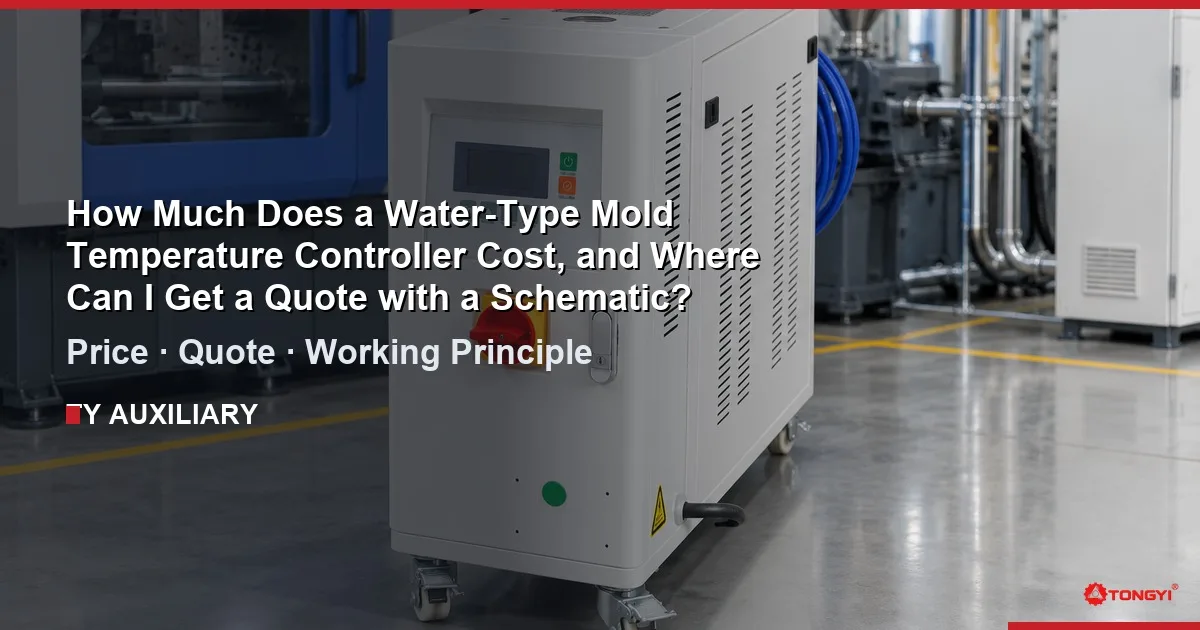
A water-type mold temperature controller typically costs anywhere from a few hundred dollars for a compact 6 kW single-zone unit to several thousand dollars for a high-flow 36 kW model, with the final figure driven by heating capacity, pump size, connection configuration, and options such as remote monitoring or special wiring. Suppliers generally do not publish fixed prices because these units are configured per application, so the practical answer is to request a formal quote. Most manufacturers, including producers of the TMC water-type series covered below, will provide a price quotation together with a wiring or piping schematic (a connection diagram showing how the unit ties into your mold and plant water loop) as part of the technical proposal.
What Determines the Price of a Water-Type Mold Temperature Controller?
Because water units circulate clean water as the heat-transfer medium up to a maximum of about 120 °C, they are the economical choice for most injection molding and die-casting trimming applications that do not require oil. Within that category, four factors move the price:
- Heating capacity. Electric heater power is one of the largest single cost components. A 6 kW entry unit is materially cheaper than a 36 kW unit, but undersizing the heater means slow heat-up and poor recovery on large molds.
- Pump power and flow. Larger pumps cost more but deliver the flow needed to push coolant through multi-cavity molds and long runner drops.
- Connection configuration. The number of inlet/outlet ports on the media splitter and the pipe diameter affect both hardware cost and installation labor on your floor.
- Options and documentation. Custom voltage, control integration, and deliverables such as a detailed wiring schematic or piping diagram can add to the quote but often pay for themselves in faster commissioning.
How to Size the Unit Before You Ask for a Quote
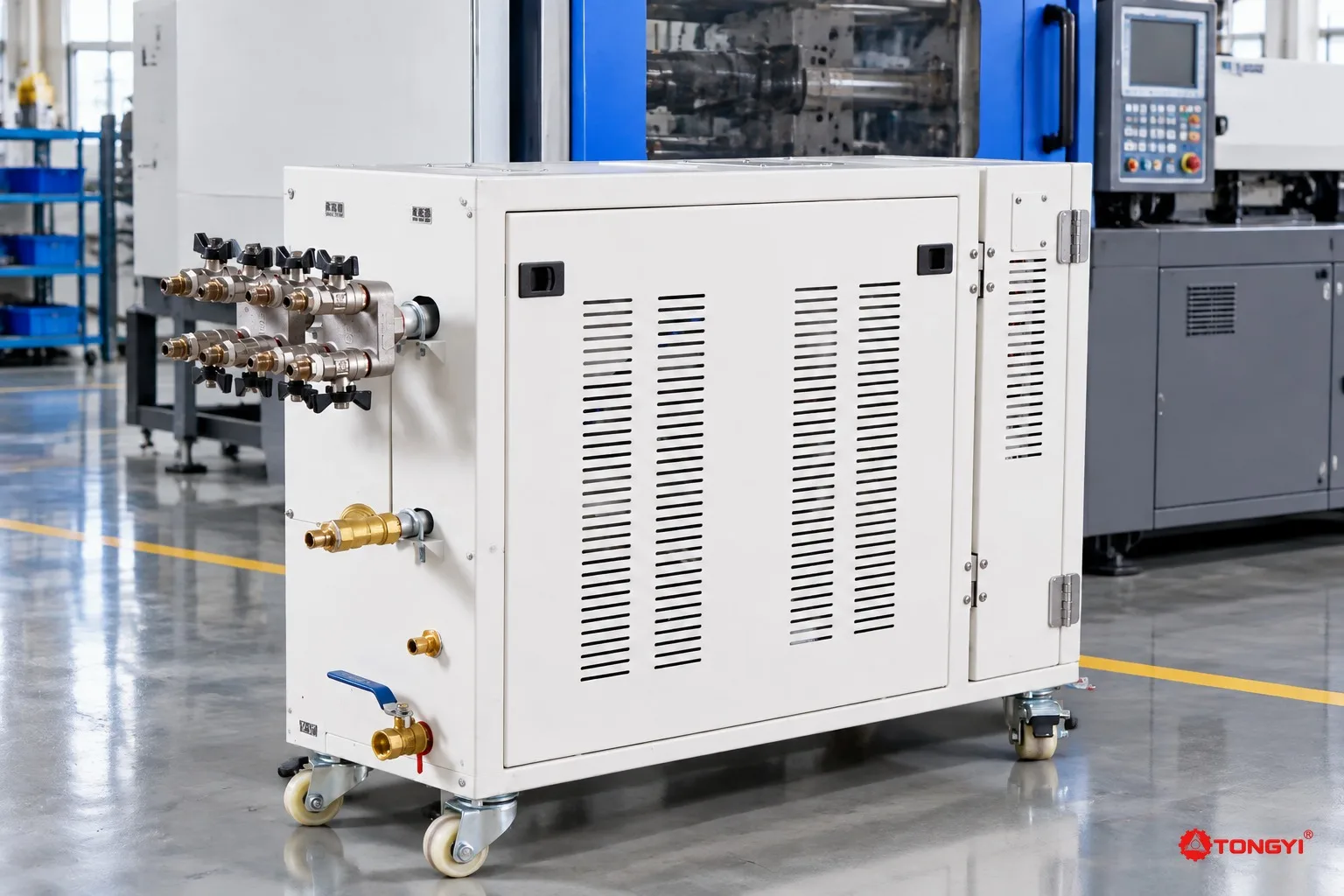
Sourcing teams that arrive at a supplier with a defined model selection get tighter, faster quotes. The TMC water-type series illustrates the range a buyer should consider:
| Model | Heater power | Pump power | Max flow | Max pressure | Splitter config | Port size |
|---|---|---|---|---|---|---|
| TMC 60W | 6 kW | 0.37 kW | 42 L/min | 0.35 MPa | 2-in/2-out | 3/8 inch |
| TMC 90W | 9 kW | 0.75 kW | 60 L/min | 0.4 MPa | 2-in/2-out | 3/8 inch |
| TMC 120W | 12 kW | 0.75 kW | 60 L/min | 0.4 MPa | 4-in/4-out | 3/8 inch |
| TMC 180W | 18 kW | 1.5 kW | 165 L/min | 0.25 MPa | 1-in/1-out | 1 inch |
| TMC 240W | 24 kW | 1.5 kW | 165 L/min | 0.25 MPa | 1-in/1-out | 1 inch |
| TMC 360W | 36 kW | 2.2 kW | 310 L/min | 0.3 MPa | 1-in/1-out | 1.2 inch |
All six models use clean water as the medium, control up to a maximum of 120 °C, cool by direct cooling, and use a K-type probe thermocouple at the media inlet and outlet, with a 15 mm return-water port.
Two specifications deserve a closer look in prose, because they drive both price and fit. First, maximum flow varies enormously across the series: the TMC 60W delivers 42 L/min on a 0.37 kW pump, while the TMC 360W delivers 310 L/min on a 2.2 kW pump. Flow determines how many mold circuits you can feed at useful velocity; a large multi-cavity mold starved by a 42 L/min unit will show uneven cooling even if the setpoint is correct. Second, maximum pressure does not scale with heater power: the 6 kW TMC 60W is rated at 0.35 MPa while the 36 kW TMC 360W is rated at only 0.3 MPa, and the 180W and 240W sit lower at 0.25 MPa. Higher-flow, larger-port units (the 180W and up use 1 inch or 1.2 inch ports on a 1-in/1-out splitter) trade delivery pressure for volume, which matters if your plant water supply is weak or your mold has high circuit resistance. Note also that the minimum operating temperature for the whole series is cooling water temperature plus 5–30 °C, so below-ambient cooling is not possible with these direct-cooling water units.
The manufacturer publishes a temperature accuracy of ±0.1 °C for the water-type series as a whole. This is a series-level figure for the controller, and the published page does not specify which models, measurement points, or test conditions it applies to — treat it as a starting point and confirm the applicable conditions with the supplier in writing. Also keep in mind that controller accuracy is not the same as temperature uniformity across the mold cavity, which depends on flow balance and mold design.
What a Schematic Should Show, and Why to Ask for One
A schematic — whether a piping diagram or a wiring diagram — is more than paperwork. It tells you, before the unit arrives:
- Where the plant water supply, drain, and return connections land, and what pipe sizes are needed (for example, 3/8 inch on the smaller 2-in/2-out units versus 1 inch or 1.2 inch on the high-flow models).
- The electrical supply requirement implied by the heater and pump power, so your electrician can plan breaker and cable sizing.
- How the K-type thermocouples and the direct-cooling valve loop into the control circuit.
Suppliers who provide a schematic with the quotation are usually easier to work with during commissioning. Ask for it explicitly when you request pricing.
What to Include in Your Quote Request
To get an apples-to-apples quotation, send the supplier:
- Mold size, number of cooling circuits, and required circuit flow.
- Required setpoint — anything up to 120 °C fits a water unit; higher temperatures would require an oil-type unit (see our oil-type mold temperature controller range).
- Plant cooling water temperature and available pressure.
- Electrical supply (voltage, phase, frequency) at the installation site.
- Preferred model or let the supplier recommend one from a range like the water-type mold temperature controller series.
- Any documentation deliverables: wiring schematic, piping diagram, and manual language.
Comparing Quotes on a Like-for-Like Basis
When two or three quotes land, normalize them before comparing price:
- Confirm heater power, pump power, max flow, and max pressure match the model quoted — a lower price on a smaller pump is not a discount.
- Confirm the temperature accuracy figure and the conditions under which it is measured.
- Confirm whether the schematic and installation drawings are included or billable.
- Clarify the specification-change policy; many manufacturers reserve the right to revise specifications without notice, so lock the agreed values into the purchase order.
For buyers equipping a full molding line, the temperature controller is usually specified together with material handling — see our auxiliary equipment overview for the related categories.