
How Much Does a Custom Industrial Mold Temperature Controller Cost, and Where Can I Get the Schematic Diagram?
Learn which specifications drive the cost of a custom industrial mold temperature controller, how verified models compare, and when the schematic diagram.
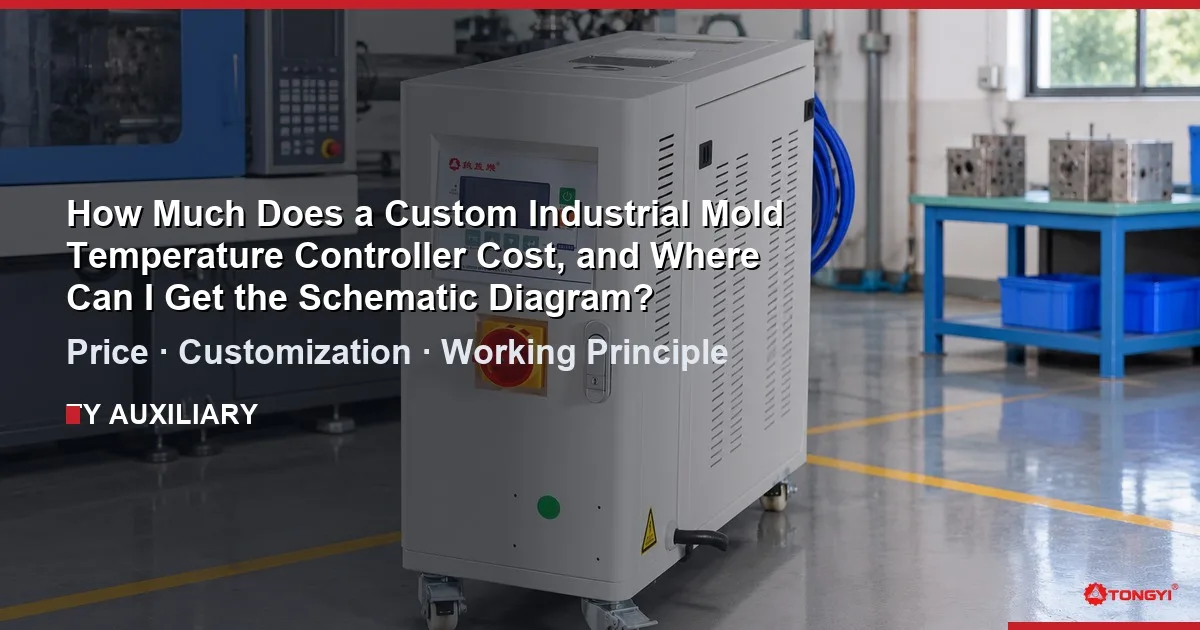
A custom industrial mold temperature controller is usually quoted as a configured unit, not a catalog item, so there is no single list price. What you actually receive is a firm quotation built from four inputs: the required heating capacity in kilowatts, the pump duty that matches your mold circuit, the control and safety scope you specify, and the electrical standard the unit must be built to. Many suppliers also release a schematic diagram — a wetted-path and electrical drawing showing pump, heater, thermocouple and valve arrangement — once an order is confirmed, because the drawing has to match the exact configuration being built.
What drives the cost of a custom mold temperature controller
Price moves with hardware, not with the word “custom.” When you compare quotes, ask each supplier to break the offer down along the same four axes below so the numbers are comparable line by line.
Heating capacity
Heater power is the largest single cost element and the first thing a supplier needs from you. In our single-temperature water series, the range runs from 6 KW on the TMC 60W up to 36 KW on the TMC 360W, which is a sixfold spread in heating hardware. If you request a quote without stating the heater power you need, suppliers will either guess or ask you to return — both slow the process down.
Pump and flow duty
Pump power and flow are quoted as separate ratings from pressure, and they scale independently of the heater. On the TMC 90W the pump is rated 0.75 KW with a maximum flow of 60 L/MIN, while the TMC 180W steps up to a 1.5 KW pump with a maximum flow of 165 L/MIN. A larger cavity, more parallel circuits, or long hose runs can justify the larger pump even when the heater size stays the same. Maximum flow and maximum pressure are separate ratings — a pump advertised at high flow is not automatically the higher-pressure unit.
Control scope and instrumentation
A basic on/off thermostat build and a unit with closed-loop control, alarms, and remote start/stop are different builds with different costs. The temperature sensor itself matters: throughout our single-temperature water series the sensing element is a K type probe thermocouple, which is the standard interface a supplier will design the controller loop around. If your plant standard requires a different sensor type or a second monitoring point, that is a configuration change and should be priced as one.
Electrical standard, documentation and testing
Voltage, phase, frequency, control voltage, terminal marking conventions, and the language of the drawing set all vary by destination. Documentation and factory acceptance testing are real cost lines, not overhead absorbed for free — ask whether the quote includes a drawing set, and in what language.
Comparing verified single-temperature water models
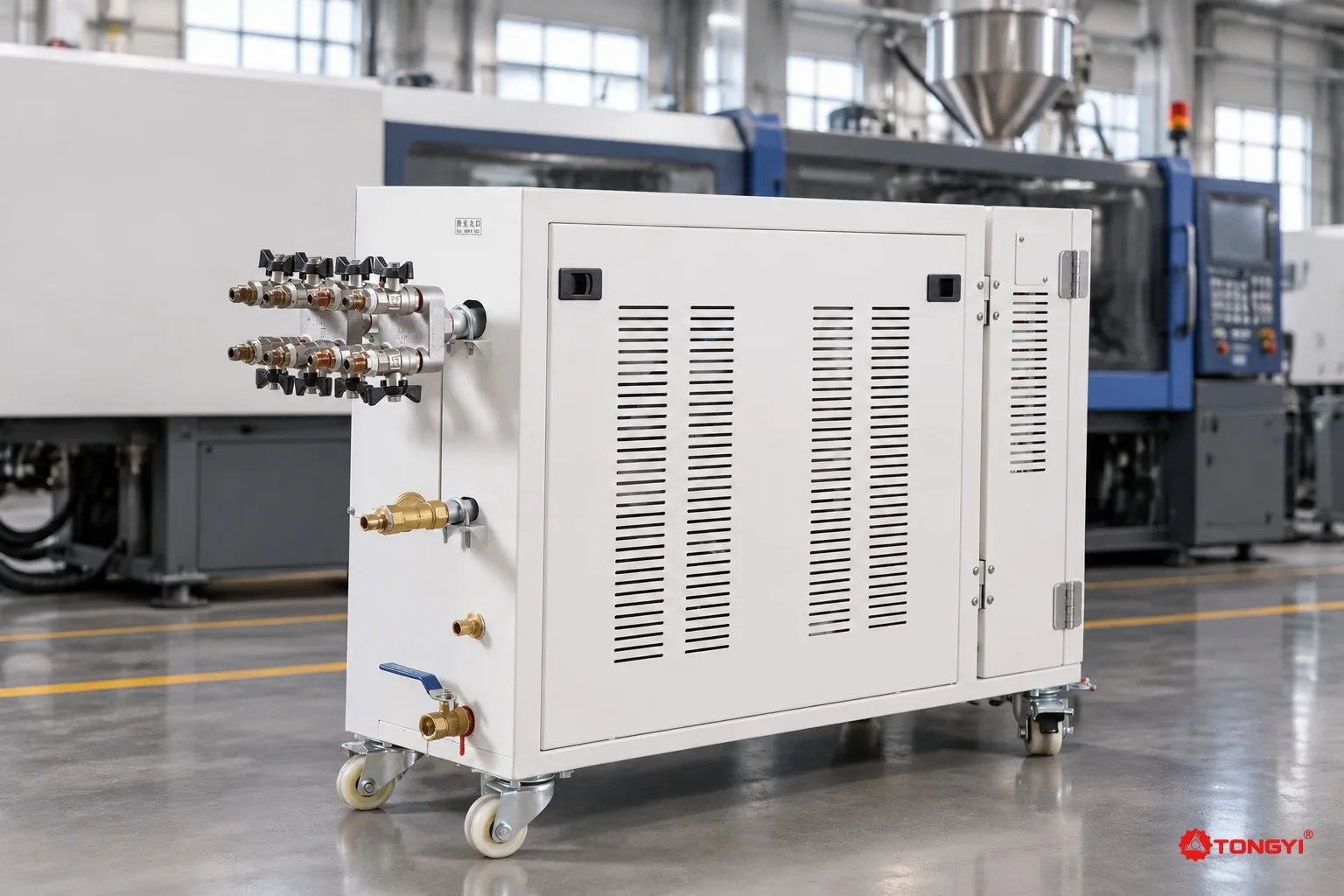
The table below compares exact published specifications for three models in our clean-water single-temperature series. It is here so you can see how the cost drivers above map onto real hardware, not to suggest that any one row is the right answer for your process.
| Model | Heating power | Pump power | Max flow | Max pressure | Max temperature | Media ports |
|---|---|---|---|---|---|---|
| TMC 60W | 6 KW | 0.37 KW | 42 L/MIN | 0.35 MPA | 120 °C | 2 in 2 out, 3/8 inch |
| TMC 90W | 9 KW | 0.75 KW | 60 L/MIN | 0.4 MPA | 120 °C | 2 in 2 out, 3/8 inch |
| TMC 120W | 12 KW | 0.75 KW | 60 L/MIN | 0.4 MPA | 120 °C | 4 in 4 out, 3/8 inch |
All three models use clean water as the heat transfer medium, direct cooling, a K type probe thermocouple for media temperature, and a 15 mm return water port. Minimum controllable temperature is stated as cooling water temperature +5~30 °C, which is a real constraint: if your plant cooling water runs warm in summer, the bottom of your usable control range moves up with it. None of these figures should be mixed across models — the TMC 120W reaches 12 KW with the same 0.75 KW pump as the TMC 90W, because the extra capacity goes into a 4-in 4-out manifold rather than into more pump.
How the piping layout changes what you pay for
Look at the manifold column in the table and then at the larger models. The TMC 60W and TMC 90W are both 2-in 2-out units on 3/8 inch ports. The TMC 120W keeps the same 0.75 KW pump and 3/8 inch ports but splits to 4-in 4-out. Further up the series the geometry changes again — the TMC 180W, 240W and 360W are 1-in 1-out units, with the TMC 360W using 1.2 inch media ports and 1 inch on the 180W and 240W.
That is a genuine trade-off worth understanding before you request pricing. A 4-in 4-out manifold lets you feed several small circuits from one unit, which can reduce the number of controllers you buy. A 1-in 1-out layout with a large port concentrates flow into a single high-volume path, which suits a large single cavity where you want maximum circulation rather than circuit count. Asking for the wrong one and then adding adapters after delivery costs more than specifying it correctly up front.
What to send with your quote request
- Required heating power in KW, or the mold mass, material, and cycle time you need to hold
- Number and size of cooling circuits in the mold, and the manifold layout you prefer
- Supply voltage, phase, and frequency at your facility
- Cooling water supply temperature at your site, since it sets the floor of your control range
- Desired control interface, alarms, and any plant-standard signal requirements
- Whether you need a drawing set, and in which language
- Any spare-parts or documentation requirements for your maintenance team
Buyers sourcing this class of equipment typically review the full mold temperature controller range and the associated temperature control solutions before finalizing a build, then confirm the drawing package as part of the order.
Custom configurations and what “custom” changes
Customization on this equipment normally means one or more of the following: a different heating capacity than any standard row, a different pump curve, a modified manifold block, non-standard media port sizes, an alternate control voltage, or an added safety interlock. Each of these is a drawing change, and drawing changes are where the schematic diagram requirement comes from.
Be specific about which of these you actually need. A supplier quoting a fully custom unit when a standard model plus one adapter would work is not doing you a favor. Note also that specifications in this product series are subject to change without prior notice, so the drawing issued with your order — not a brochure — is the document that governs what gets built.
Where to get the schematic diagram
Schematic diagrams for custom industrial mold temperature controllers are normally released by the manufacturer, not published openly, because the wetted path and electrical layout depend on the exact configuration ordered. The practical route is:
- Request a quotation with your full configuration details, as listed above
- Ask explicitly for the dimensional drawing and the electrical/wetted-path schematic as part of the offer
- Confirm the drawing language and revision-control convention your maintenance team expects
- Ask whether a factory acceptance test record is included
- Verify that the final drawing matches the quotation line items before releasing the order
If you are comparing several suppliers, ask all of them for the same drawing set at the quotation stage. A supplier who cannot produce a controlled drawing for the unit they are quoting is a risk to your maintenance and spare-parts planning years after the purchase.
Why there is no published price list
Two units with the same model number can carry different costs depending on pump selection, manifold geometry, control scope, and documentation. Publishing a single figure would either overstate the price of a simple build or understate a complex one. What you can do is make quotes comparable: insist that every supplier prices against the same specification sheet, and ask for the cost breakdown by subsystem — heater, pump, controls, enclosure, testing, documentation, freight.
Once two or three offers are broken down the same way, the comparison becomes an engineering exercise rather than a negotiation. That is usually faster and cheaper than pushing for a headline number that does not reflect the unit you will actually receive.
Frequently asked questions
Why isn’t there a published price for a custom industrial mold temperature controller?
Because the unit is configured to order. Heater power, pump curve, manifold layout, control scope and documentation vary between builds, so two units sharing a series name can have different costs. Suppliers quote from your specification sheet rather than from a list.
Can I get a schematic diagram before placing an order?
Usually you can receive a dimension drawing and a configuration summary at the quotation stage, while the full electrical and wetted-path schematic is issued with the confirmed order because it must reflect the exact build. Ask what documentation is released at each stage before you sign.
What heating power should I specify for my mold?
It depends on mold mass, material, cycle time and ambient losses. Within the clean-water single-temperature series, published heater ratings run from 6 KW on the TMC 60W to 36 KW on the TMC 360W, so give the supplier your process data and let the calculation set the size rather than picking a number from the table.
What does cooling water temperature +5~30 °C mean in practice?
It is the minimum controllable media temperature for these models, expressed relative to your incoming cooling water. If your plant cooling water is warm, the bottom of your usable control range rises with it, so confirm your site water temperature before specifying the unit.
Is a 4-in 4-out manifold better than a 1-in 1-out layout?
They solve different problems. A 4-in 4-out manifold such as the TMC 120W feeds multiple small circuits from one unit; a 1-in 1-out layout with larger ports, such as the TMC 180W and above, concentrates flow into a single high-volume path. The right choice follows your mold’s cooling circuit design.
What should I include in a quote request to get comparable offers?
Required heating power or process data, number and size of cooling circuits, preferred manifold layout, supply voltage and frequency, site cooling water temperature, control interface requirements, and whether a drawing set and test record are needed. The same list sent to each supplier makes their offers directly comparable.