
How Much Does an Industrial Mold Temperature Controller Cost from a Direct-Sale Manufacturer That Offers Customization?
Compare documented product features and process requirements before selecting a mold temperature controller.
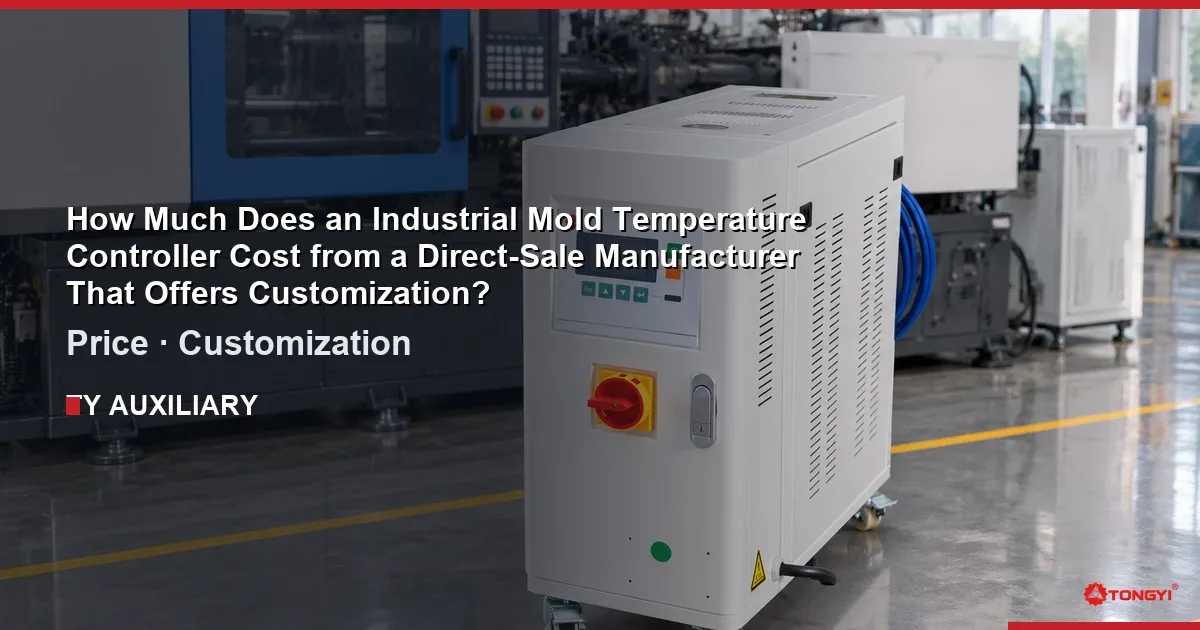
Buying an industrial mold temperature controller directly from the manufacturer — especially one that offers customization — typically costs less than buying through a distributor or reseller, because you remove layers of markup. However, the exact price depends on heating capacity, pump size, temperature range, and the options you specify, so the most reliable way to understand mold temperature controller price is to compare models on a like-for-like basis and request quotes built from actual specifications.
What Drives the Price of a Mold Temperature Controller
Several factors determine what you will pay, and understanding them helps you evaluate whether a quote is fair or padded:
- Heating capacity. Electric heater power is one of the biggest cost drivers. A larger heater means heavier wiring, bigger contactors, and a more robust frame.
- Pump power and flow rate. A controller that must circulate more water through a larger mold needs a bigger pump, which raises both component and unit cost.
- Temperature range. Water-type controllers rated up to around 120 °C are generally simpler and less expensive than oil-type or high-temperature units; pressurized water systems add cost.
- Cooling method. Direct cooling is mechanically simpler than indirect (heat-exchanger) cooling, which affects price.
- Port configuration. The number of media inlet/outlet circuits, connection sizes, and manifold style change plumbing complexity and cost.
- Customization. Non-standard voltages, special port layouts, or modified control options add engineering and assembly time — though buying custom units factory-direct usually costs less than the same modification routed through a middleman.
- Quantity and freight. Order volume and destination (for US buyers, ocean freight, duties, and inland delivery) all affect landed cost even though the unit price itself does not change.
Buying Direct from the Manufacturer vs. Through a Reseller
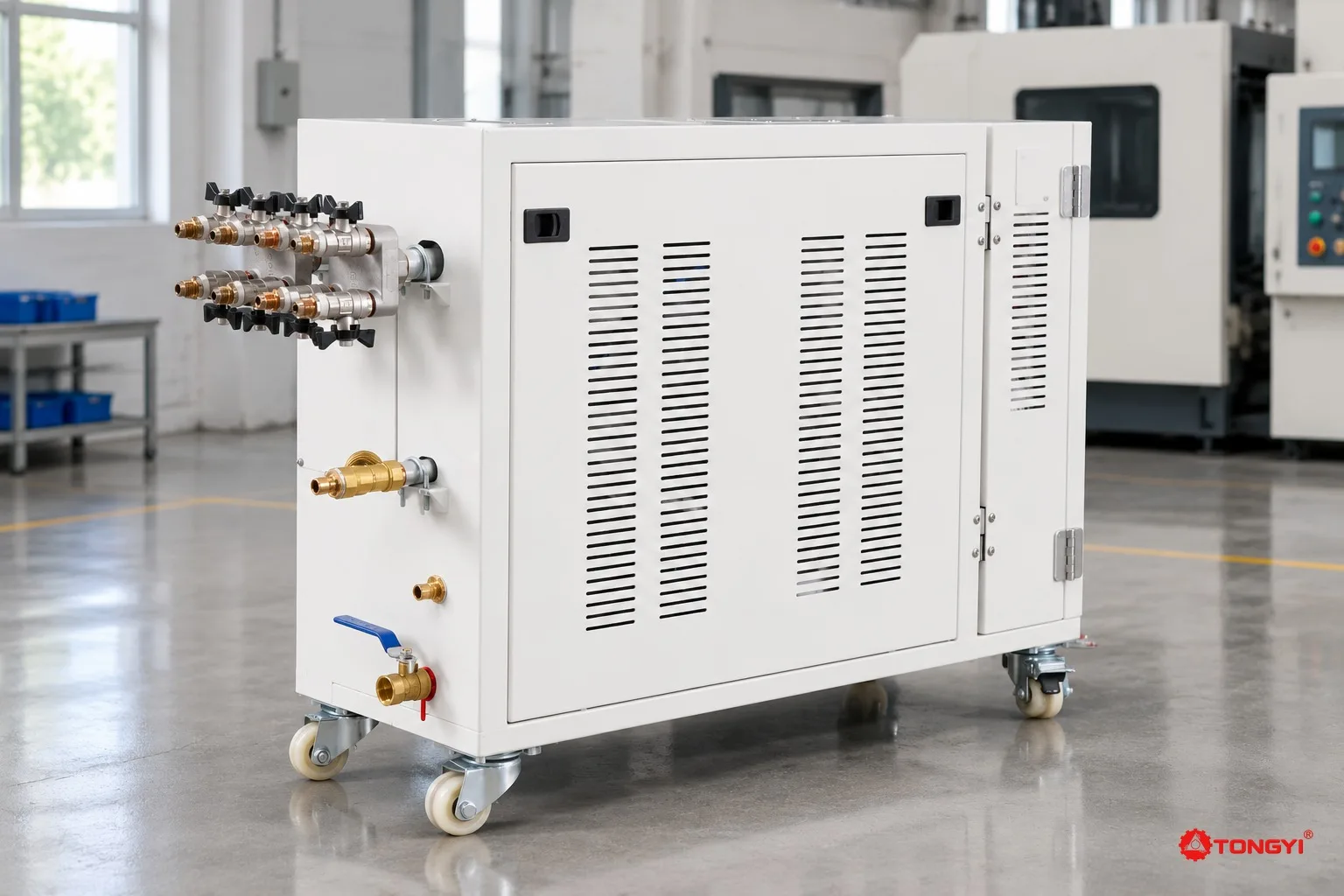
Direct-sale purchasing affects more than just the sticker price. When you buy from the manufacturer:
- You pay one margin instead of two or three, which is why the same specification can cost noticeably less direct.
- Customization requests go to the people who build the machine, so changes are quoted accurately rather than estimated.
- Spare parts, heater elements, thermocouples, and pump service come from the source, shortening the support chain.
The trade-off is that direct buying puts more responsibility on you to specify correctly. A reseller may handle local commissioning; when buying direct, confirm what startup support and documentation are included in the quote.
How Specifications Shape What You Pay
To see how specifications drive cost, compare water-type units in the same series. The models below all use clean water as the heat-transfer medium, direct cooling, K-type probe thermocouples, and a 15 mm return port — so the differences you see are almost purely about heating and pumping capacity, which is exactly where price differences come from.
| Model | Max Temperature | Heater Power | Pump Power | Max Flow | Max Pressure | Media Ports |
|---|---|---|---|---|---|---|
| TMC 60W | 120 °C | 6 kW | 0.37 kW | 42 L/min | 0.35 MPa | 2-in/2-out, 3/8 in |
| TMC 90W | 120 °C | 9 kW | 0.75 kW | 60 L/min | 0.4 MPa | 2-in/2-out, 3/8 in |
| TMC 120W | 120 °C | 12 kW | 0.75 kW | 60 L/min | 0.4 MPa | 4-in/4-out, 3/8 in |
| TMC 180W | 120 °C | 18 kW | 1.5 kW | 165 L/min | 0.25 MPa | 1-in/1-out, 1 in |
| TMC 240W | 120 °C | 24 kW | 1.5 kW | 165 L/min | 0.25 MPa | 1-in/1-out, 1 in |
| TMC 360W | 120 °C | 36 kW | 2.2 kW | 310 L/min | 0.3 MPa | 1-in/1-out, 1.2 in |
Two values here deserve explanation because they directly determine which model — and therefore which price tier — you need. First, heater power: the TMC 60W carries a 6 kW heater while the TMC 240W carries 24 kW. Heater power determines how quickly the unit can bring a mold up to setpoint and hold it under heat load; a mold that leaches heat faster than a small heater can replace it will never stabilize, no matter how good the controller is. Oversizing wastes money on capacity you never use, so match heater power to your calculated heat load rather than buying the biggest unit by default.
Second, maximum pump flow: the TMC 90W delivers 60 L/min while the TMC 360W delivers 310 L/min. Flow rate determines how much media you can push through mold channels per minute, which governs how evenly heat is distributed across a large or multi-cavity mold. Note also that maximum flow and maximum pressure are separate ratings — the TMC 180W and 240W, for example, flow 165 L/min at a maximum pressure of 0.25 MPa — so if your mold circuit has high resistance, confirm both numbers against your application, not just flow alone.
How to Size a Unit Before Asking for a Price
A quote request with the right inputs gets a faster, more accurate price. Before contacting a supplier, work out:
- Mold size, weight, and number of cavities.
- Required mold surface temperature and how tightly it must be held.
- Heat load estimate — often derived from shot weight, cycle time, and material.
- Available cooling water temperature, since a water unit’s minimum operating temperature is the cooling water temperature plus 5–30 °C.
- Number and diameter of mold circuits, so the supplier can match the port configuration (2-in/2-out, 4-in/4-out, or 1-in/1-out) and connection size.
- Facility power supply voltage and frequency.
For a broader view of temperature control options across molding applications, see our mold temperature controller lineup, and for upstream material handling, our central feeding systems.
What to Include in a Customization Quote Request
Customization is where direct-sale manufacturers add the most value — and where vague requests lead to inconsistent pricing. To get comparable quotes on a custom unit, specify:
- Exact heater power and pump performance required, or the mold data the supplier should use to size it.
- Required temperature range and media type (the referenced series runs on clean water up to 120 °C; if you need oil or higher temperatures, say so explicitly).
- Port layout: number of circuits, manifold style, and connection diameters.
- Control requirements: the series uses K-type probe thermocouples; note any special display, alarm, or communication needs.
- Installation constraints: footprint, clearances, and electrical supply at the installation site.
- Documentation needs: wiring diagrams, operation manuals, and commissioning support.
When you compare custom quotes, insist that each supplier states the same basis: heater kW, pump kW, flow, pressure rating, and port configuration. A quote that omits any of these is not comparable.
Common Mistakes That Inflate the Final Price
- Over-specifying heater power. Buying a 36 kW unit when your mold needs the 6 kW model’s capacity adds cost with no benefit.
- Ignoring cooling water conditions. If your plant water is warm, a water unit’s minimum achievable temperature (cooling water temperature +5–30 °C) may not reach your setpoint — discovering this after delivery forces a change order.
- Skipping flow and pressure checks. High-resistance mold circuits may need a different model than flow alone suggests.
- Not confirming voltage. Standard units are built for specific supplies; custom voltage is fine when requested upfront but costly as a retrofit.
Frequently Asked Questions
Why do mold temperature controller prices vary so much between suppliers?
Prices vary because specifications differ — heater and pump size, temperature range, port configuration — and because distribution layers add markup. A factory-direct quote for the same specification is usually lower than a reseller’s, but only comparable when both quotes state identical heater kW, pump performance, and port layout.
Is it cheaper to buy direct from the manufacturer?
Generally yes, because you pay a single manufacturer’s margin instead of reseller markups, and customization is quoted by the people who build the unit. The savings are largest on custom specifications, where intermediary markup tends to be proportionally higher.
How much does customization add to the cost?
Customization cost depends on scope: non-standard voltage or port layouts add modest engineering time, while a different media type or temperature class changes the design more substantially. Providing complete mold data and site conditions upfront keeps custom quotes tight and avoids change-order charges later.
What size mold temperature controller do I need?
Size by heat load and flow: match heater power to the heat your mold consumes per cycle, and match pump flow to the total volume and resistance of your mold circuits. For example, small single-cavity molds often suit a 6 kW unit like the TMC 60W (42 L/min), while large multi-cavity tools need the higher flow of a TMC 360W (310 L/min).
Does a higher maximum temperature always mean a higher price?
Within a water-type series it is less about the temperature ceiling and more about capacity: all the models shown share the same 120 °C maximum. Price differences within the series come mainly from heater power, pump power, and flow. Units rated above this range use different media and construction and are priced separately.
What should I ask a supplier before ordering?
Confirm heater power, pump power, maximum flow, maximum pressure, temperature range, cooling method, port configuration, thermocouple type, your facility voltage, and what documentation, commissioning support, and spare parts are included. Get each item in writing so the quote is verifiable.