
How Much Does an Industrial Mold Temperature Controller Cost with Custom Pricing Quotes?
Industrial mold temperature controller pricing is quoted custom based on heater power, pump capacity, and manifold configuration; this guide explains.
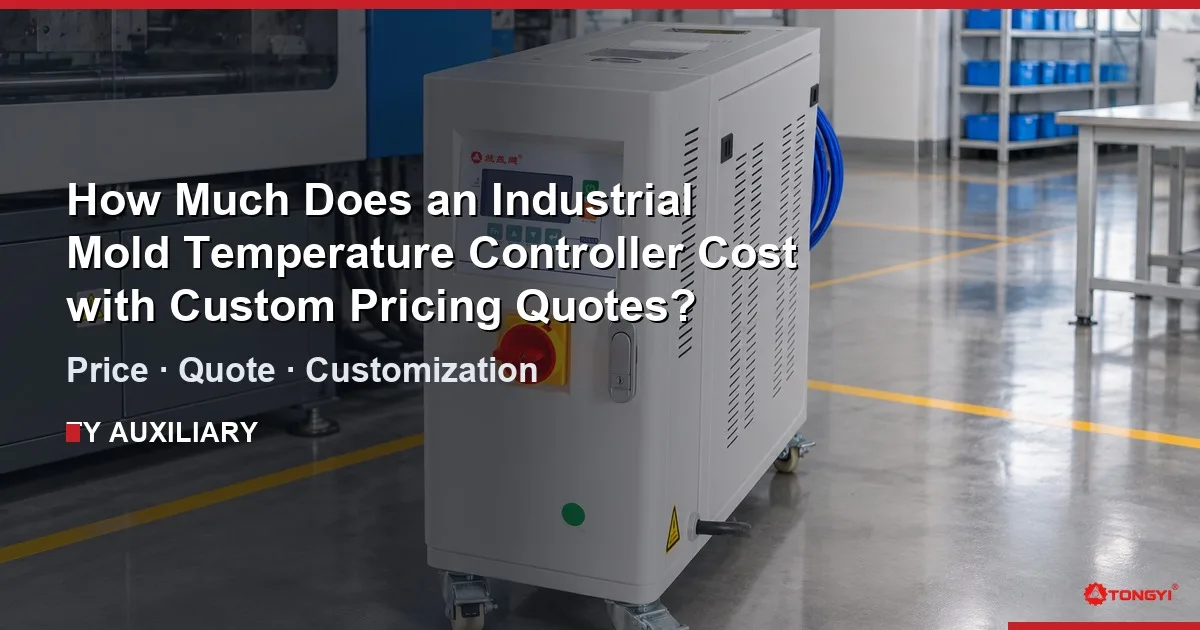
Short answer: no published list price applies to an industrial mold temperature controller, and any honest quote is custom. Your final cost depends on the heating capacity, pump size, control scope, and configuration you specify. This guide walks through what actually drives mold temperature controller pricing, which specifications determine the model you need, and what to include in a quote request so suppliers respond with comparable, like-for-like numbers.
Why Industrial Mold Temperature Controller Pricing Is Always Quoted Custom
Buyers searching for price information often expect a catalog number. In practice, water-type mold temperature controllers are configured per application: heater power, pump capacity, manifold layout, and connection sizes all change with the mold and process. A controller sized for a small injection mold is not the same machine as one circulating coolant through a large multi-cavity tool, so suppliers quote against a specification sheet rather than a fixed SKU.
That is good news for buyers. When you control the specification, you control the price drivers — and you can compare quotes from different suppliers on an equal basis instead of comparing apples to oranges.
The Main Cost Drivers in a Mold Temperature Controller Quote
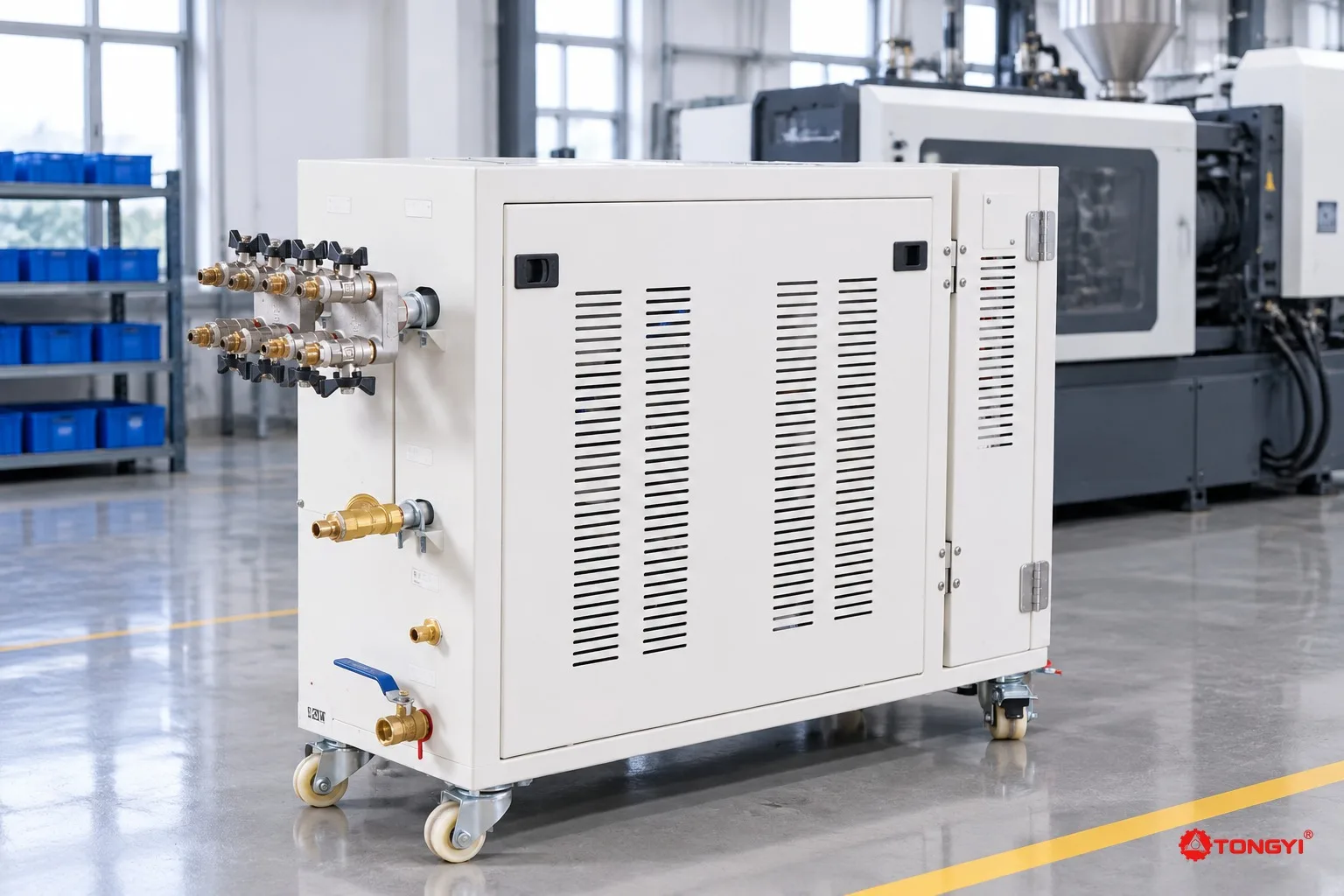
When you review custom pricing quotes, most of the variance comes from a handful of specification items:
- Electric heating power. Larger heaters cost more up front and may require higher supply voltage or amperage at your facility. Heating capacity should match the heat load of your mold, not just be “as big as possible.”
- Pump power and flow rate. The pump moves the heat-transfer medium through the mold channels. Higher flow supports faster, more uniform heat transfer but adds cost and affects maximum system pressure.
- Cooling method. Direct cooling keeps the design simpler; how the unit exchanges heat with your plant water affects plumbing and commissioning effort.
- Port and manifold configuration. The number of media in/out circuits and their diameters determine how the unit connects to your mold. More circuits or larger ports mean more material and more assembly work.
- Control and sensing hardware. The type of temperature sensing and the control arrangement are part of the specification and part of the price.
- Documentation and options. Voltage matching to your plant standard, special coatings, or additional instrumentation are legitimate line items — confirm them explicitly.
Which Specifications to Compare Before Accepting a Quote
A quote is only as useful as the specification behind it. Here is how the key parameters work, illustrated with a water-type (clean water medium) single-zone series that covers several common injection molding capacities.
Heater Power and Pump Capacity: The Core Sizing Pair
Heater power and pump flow must be evaluated together. Take two models from the same series as an example: the TMC 90W carries a 9 kW heater with a 0.75 kW pump delivering up to 60 L/min at a maximum pressure of 0.4 MPa. Stepping up, the TMC 360W uses a 36 kW heater with a 2.2 kW pump rated for 310 L/min at 0.3 MPa. Notice the trade-off: the larger unit moves far more water, but its maximum pressure rating is lower. If your mold circuit has high flow resistance, maximum flow alone will not tell you whether the pump can deliver it — you need both numbers, confirmed against your tool’s pressure drop.
On the smaller end, the TMC 60W pairs a 6 kW heater with a 0.37 kW pump and 42 L/min maximum flow at 0.35 MPa. This is the kind of unit that suits compact molds where a large pump would be wasted cost — which is exactly why oversizing is a pricing mistake, not a safety margin.
Operating Temperature Range and Its Limits
Every model in this water series shares the same operating envelope: a maximum temperature of 120 °C, with the minimum operating temperature defined as cooling water temperature plus 5–30 °C. The lower boundary matters more than buyers expect — it means the controller cannot hold a setpoint below roughly your incoming cooling water temperature plus a small offset. If your process needs to run near ambient, confirm this limit with the supplier before committing, because it affects whether a water-type unit is suitable at all.
Connection Layout: Why Ports and Manifolds Affect Price and Installation
The models differ meaningfully in how they connect to the mold. The TMC 60W and TMC 90W use a 2-in/2-out media manifold with 3/8-inch ports and a 15 mm return port. The TMC 120W expands to a 4-in/4-out manifold on the same 3/8-inch ports — useful when one controller feeds several independent mold circuits. At the high-flow end, the TMC 180W, TMC 240W, and TMC 360W switch to a 1-in/1-out layout with larger 1-inch (TMC 180W, TMC 240W) or 1.2-inch (TMC 360W) ports, matching the higher flow rates. All models use K-type probe thermocouples for media temperature sensing and direct cooling.
Match this layout to your mold’s channel design before requesting quotes: the wrong manifold configuration means rework at installation, and rework costs more than specifying correctly the first time.
Model Comparison Table: Water-Type Single-Zone Series
| Model | Heater Power | Pump Power | Max Flow | Max Pressure | Max Temp | Manifold | Media Ports |
|---|---|---|---|---|---|---|---|
| TMC 60W | 6 kW | 0.37 kW | 42 L/min | 0.35 MPa | 120 °C | 2 in / 2 out | 3/8 inch |
| TMC 90W | 9 kW | 0.75 kW | 60 L/min | 0.4 MPa | 120 °C | 2 in / 2 out | 3/8 inch |
| TMC 120W | 12 kW | 0.75 kW | 60 L/min | 0.4 MPa | 120 °C | 4 in / 4 out | 3/8 inch |
| TMC 180W | 18 kW | 1.5 kW | 165 L/min | 0.25 MPa | 120 °C | 1 in / 1 out | 1 inch |
| TMC 240W | 24 kW | 1.5 kW | 165 L/min | 0.25 MPa | 120 °C | 1 in / 1 out | 1 inch |
| TMC 360W | 36 kW | 2.2 kW | 310 L/min | 0.3 MPa | 120 °C | 1 in / 1 out | 1.2 inch |
All models use clean water as the heat-transfer medium, direct cooling, and K-type probe thermocouples, with a 15 mm return port. Specifications may change without notice; confirm current values with the supplier when quoting.
What to Include in a Custom Quote Request
To get a price you can actually act on, your RFQ should state:
- Process type (injection molding, extrusion, die casting) and mold size or number of cavities.
- Required setpoint temperature and whether it stays within the water-type limit of 120 °C maximum.
- Estimated heat load, or at minimum the mold’s cooling channel layout and pressure drop if known.
- Number of independent circuits needed from one controller — this drives the manifold configuration.
- Plant power supply (voltage, phase, frequency) so the heater and pump can be matched.
- Available cooling water temperature, since the minimum operating temperature is tied to it.
- Installation constraints: floor space, connection distances, and any port-size requirements.
A complete request lets the supplier propose the correct model — say, a TMC 120W rather than an oversized TMC 360W — and gives you a specification-anchored price rather than a ballpark.
How to Compare Quotes on a Like-for-Like Basis
Once quotes arrive, normalize them before comparing numbers:
- Check that every quote specifies the same heater power, pump power, maximum flow, and maximum pressure.
- Confirm the manifold configuration and port sizes are identical or that any difference is priced transparently.
- Verify the medium, cooling method, and temperature sensing type match across quotes.
- Ask what is excluded: freight, installation supervision, spare thermocouples, commissioning support.
- Confirm the quoted model’s specification sheet is current — reputable manufacturers reserve the right to revise specifications.
Next Step
If your process runs on water at moderate temperatures, start by matching your mold’s heat load and circuit count to a series like the one above, then issue a specification-based RFQ to two or three suppliers. The more precisely you define the unit, the closer the first custom quote will be to the price you finally pay. For related equipment on the molding floor, see our mold temperature controller lineup and industrial water chillers, which often work alongside temperature controllers in the same cooling circuit.