
How Much Does a Water-Type Mold Temperature Controller Cost with Custom Quotes?
Compare documented product features and process requirements before selecting a mold temperature controller.
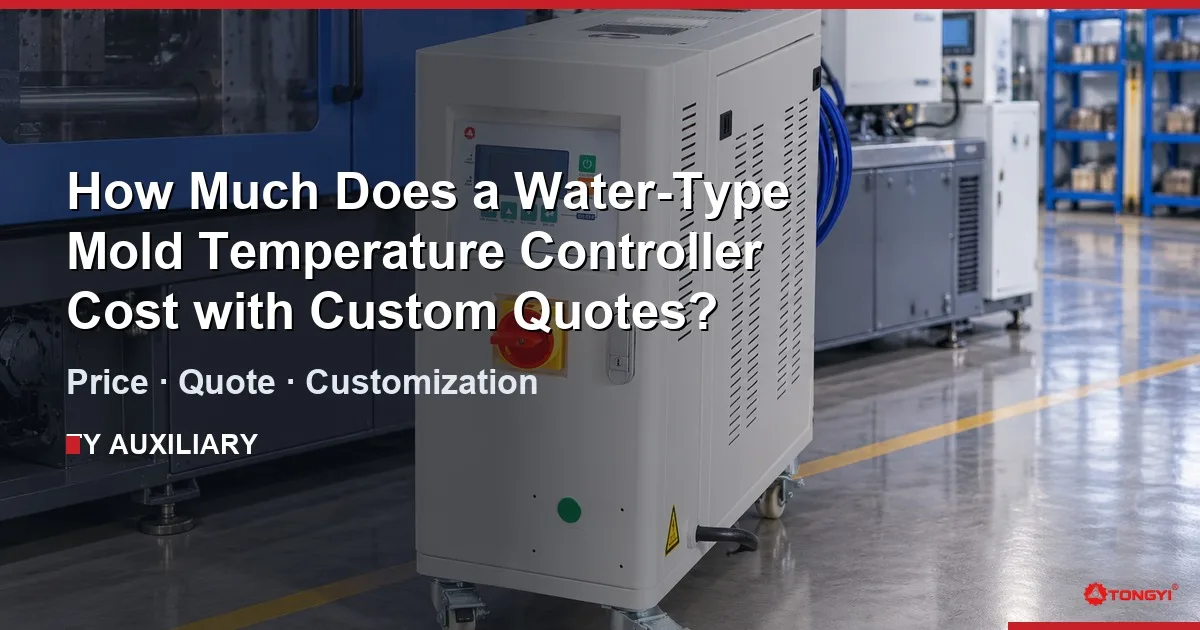
A water-type mold temperature controller is usually priced as a standard base unit plus customization, so the honest answer is that the final figure comes from a custom quote rather than a published list price. What you pay depends on heating capacity, pump size, connection configuration, and any modifications your molding process requires. This guide explains those cost drivers, shows how models in a typical water-type series differ, and tells you exactly what to include in a quote request so suppliers can price on a like-for-like basis.
What Actually Drives the Price of a Water-Type Mold Temperature Controller
Suppliers rarely publish fixed prices for this equipment category because the same series can be configured in very different ways. The main cost drivers are:
- Heating capacity. Larger heaters cost more and may require heavier wiring on your side.
- Pump power and flow. Bigger pumps that move more water through the mold cost more and affect your plant’s water supply and return plumbing.
- Connection configuration. The number of media in/out circuits and the port sizes change the manifold hardware and installation cost.
- Customization. Non-standard voltages, control options, or special fittings are quoted as extras.
- Freight and compliance requirements. Shipping weight, crating, and any documentation you need for importing into the US all affect landed cost.
How to Compare Models Before You Request a Custom Quote
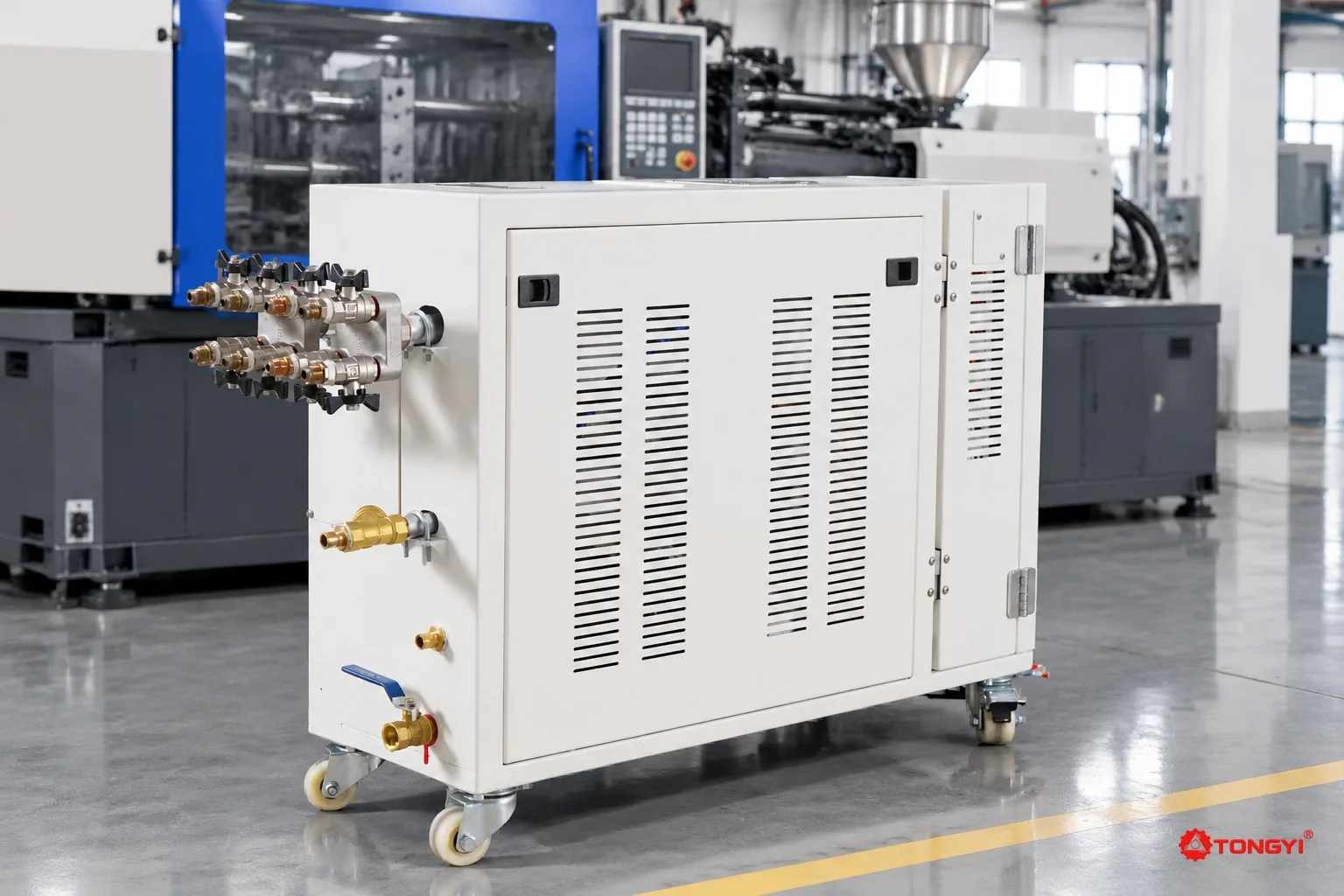
Because pricing tracks specification, the fastest way to control cost is to size the unit correctly first. Below is a like-for-like comparison of the TMC water-type series. All models in this series use clean water as the heat transfer medium, direct cooling, and a K-type probe thermocouple for the media inlet and outlet temperature sensing, with a maximum temperature of 120 °C.
| Model | Heater Power | Pump Power | Max Pump Flow | Max Pressure | Media Circuits | Media Port Size |
|---|---|---|---|---|---|---|
| TMC 60W | 6 KW | 0.37 KW | 42 L/min | 0.35 MPa | 2 in / 2 out | 3/8 inch |
| TMC 90W | 9 KW | 0.75 KW | 60 L/min | 0.4 MPa | 2 in / 2 out | 3/8 inch |
| TMC 120W | 12 KW | 0.75 KW | 60 L/min | 0.4 MPa | 4 in / 4 out | 3/8 inch |
| TMC 180W | 18 KW | 1.5 KW | 165 L/min | 0.25 MPa | 1 in / 1 out | 1 inch |
| TMC 240W | 24 KW | 1.5 KW | 165 L/min | 0.25 MPa | 1 in / 1 out | 1 inch |
| TMC 360W | 36 KW | 2.2 KW | 310 L/min | 0.3 MPa | 1 in / 1 out | 1.2 inch |
Reading the Numbers That Matter Most
Two specifications carry the most weight in both sizing and price. First, heater power: the TMC 90W carries a 9 KW heater while the TMC 360W carries 36 KW, so the heater alone roughly quadruples across the series. Heater power determines how quickly the unit can bring a mold up to setpoint, so undersizing it leads to slow startups and, at scale, real productivity cost. The TMC 180W, at 18 KW, sits in the middle for larger molds that still run below the 120 °C maximum temperature of the water-type series.
Second, pump flow: the TMC 90W delivers up to 60 L/min, while the TMC 360W delivers up to 310 L/min. Higher flow supports faster heat transfer through larger or more complex cooling channels, but the TMC 360W pairs that flow with a maximum pressure of 0.3 MPa, whereas the TMC 90W is rated to 0.4 MPa. These are separate ratings — maximum flow and maximum pressure describe different aspects of pump performance, and a quoted duty point should be confirmed with the supplier rather than assumed.
Accuracy: What Is and Is Not Claimed
The published product page for this water-type series states a temperature accuracy of ±0.1 °C at the series level. Note what this does and does not tell you: it is a controller accuracy claim for the series, not a per-model guarantee, and it is not the same as temperature uniformity throughout the mold cavity. Uniformity depends on mold design, channel layout, and flow balance. If your process requires verified accuracy at a specific measurement point, confirm the test conditions with the supplier in writing before you rely on the number.
Customization: What to Ask For and What It Adds to Cost
Customization is the second part of the price equation. Common custom requests on water-type units include non-standard supply voltages, modified circuit manifolds, and special fittings for existing mold connections. When you request a custom quote, specify:
- The exact model or heater/pump sizing you believe you need, and the mold tonnage or part you plan to run.
- Your plant voltage and frequency, since heater and pump ratings interact with the power supply you can provide.
- The minimum operating temperature you need at the mold, given that the minimum for these units is cooling water temperature plus 5–30 °C.
- Any required documentation, testing, or inspection before shipment.
- Destination port and any packaging constraints, which affect freight quoting.
The more complete the specification, the fewer assumptions the supplier bakes into the price — and the easier it is to compare quotes from different vendors.
How to Get Comparable Quotes
When you receive custom quotes, normalize them before comparing: confirm each quote is based on the same model, the same heater and pump ratings, the same circuit configuration, and the same scope of supply (spares, documentation, freight terms). Ask each supplier to confirm the maximum temperature, minimum temperature relative to your cooling water temperature, and pressure rating in writing. A quote that omits these details is harder to evaluate than one that states them explicitly.
The practical next step: identify your required heating capacity and flow from your mold’s cooling channel requirements, shortlist one or two models from the series table above, and send a single detailed specification sheet to each supplier so the custom quotes you get back are directly comparable.
Frequently Asked Questions
Why is the 120 °C maximum temperature a pricing boundary?
Water-type units such as this series top out at 120 °C. If your process needs to run hotter, you move to an oil-type controller, which is a different (and generally higher) cost category. Knowing this boundary early prevents requesting quotes for equipment that cannot meet your process temperature.
Do larger models always cost proportionally more?
Cost generally rises with heater power and pump size, but not linearly — the TMC 180W and TMC 240W share the same 1.5 KW pump and 165 L/min flow while differing in heater power (18 KW vs 24 KW). Getting the sizing right before quoting often saves more than negotiating on an oversized unit.
What should a complete quote request include?
At minimum: target model or sizing basis, plant voltage and frequency, required mold temperature range, number and size of mold connections, destination, and any documentation requirements. Including these items lets suppliers quote accurately and reduces back-and-forth delay.