
How Much Does an Industrial Mold Temperature Controller Cost? Custom Quotes and Price List
See what drives industrial mold temperature controller price, from heating capacity to pump size, plus how to request a comparable custom quote.
An industrial mold temperature controller can cost anywhere from a few thousand dollars for a compact water-type unit to considerably more for large-capacity multi-zone systems, and no responsible supplier publishes a single fixed number because the price depends on heating capacity, pump size, customization, and order terms. This guide explains what actually drives mold temperature controller price, how to build a quote request that gets accurate, comparable numbers, and which specifications in a supplier’s price list you should check line by line before committing.
Why a Published Price List Rarely Answers the Real Question
Buyers searching for a price list usually want a fast budget number, and that is a reasonable goal. The complication is that a mold temperature controller is a configured machine, not a commodity item. Two units with the same nominal model number can differ in heater power, pump specification, control features, and port configurations depending on the molding application they serve.
A credible price list therefore shows model families with their specifications and invites buyers to request a project-specific quote. Treat any supplier who quotes an exact figure without asking about your process — mold size, required temperature, water quality, and electrical supply — with caution. The figure will either be padded to cover unknowns or lowballed to win the order and revised later.
What Drives the Price of an Industrial Mold Temperature Controller
Understanding the cost drivers lets you judge whether a quote is proportionate before you compare it against others.
Heating capacity
Electric heater power is one of the largest single cost components. A small unit sized for a compact mold might carry a 6 KW heater, while a large unit serving a bigger mold or faster cycle can require 36 KW. More heating capacity means larger heaters, heavier contactors or solid-state switching, and bigger enclosures — all of which raise the unit cost.
Pump specification and flow rate
The circulation pump must deliver enough flow through the mold’s cooling channels at the required pressure. Higher-flow pumps cost more, and the trade-off between flow and pressure matters: a high-flow, lower-pressure pump suits large-channel molds, while a higher-pressure pump suits restrictive circuits. Selecting the wrong pump specification either inflates your cost unnecessarily or leaves the mold under-circulated.
Operating temperature range
Water-type controllers operating up to around 120 °C are simpler and generally more economical than oil-type or pressurized-water units designed for higher process temperatures. Match the temperature ceiling to your resin and mold requirements — paying for headroom you will never use wastes money, while underspecifying limits your process window.
Cooling method
Direct cooling, where plant cooling water exchanges heat directly with the circulating medium, is the simplest and least costly approach. Indirect cooling via a heat exchanger adds components and cost but isolates the circuit — a factor when plant water quality is poor.
Customization
Custom requests — non-standard voltage and frequency, special port configurations, altered manifold layouts, specific controller brands, or integration with your plant monitoring — each add engineering and component cost. Ask the supplier to itemize customization separately so you can see exactly what the special requirements are costing you.
Order terms and logistics
For buyers importing equipment, quoted prices typically vary with order quantity, Incoterms (EXW, FOB, CIF, DDP), and shipping arrangements. A unit-price comparison between an EXW quote and a DDP quote is meaningless unless you normalize the delivery scope first.
Compare Models Like-for-Like Before Comparing Prices
A sensible procurement sequence is to shortlist models on specifications first, then request quotes for those exact configurations. Below is a like-for-like comparison of two water-type models from one series to illustrate how specifications differ within a family — and why a single “price per unit” tells you little without this context.
| Specification | TMC 90W | TMC 360W |
|---|---|---|
| Heat transfer medium | Clean water | Clean water |
| Maximum temperature | 120 °C | 120 °C |
| Minimum temperature | Cooling water temperature +5~30 °C | Cooling water temperature +5~30 °C |
| Cooling method | Direct | Direct |
| Electric heating power | 9 KW | 36 KW |
| Pump power | 0.75 KW | 2.2 KW |
| Pump maximum flow | 60 L/MIN | 310 L/MIN |
| Maximum pressure | 0.4 MPA | 0.3 MPA |
| Medium inlet/outlet manifold | 2-in / 2-out | 1-in / 1-out |
| Medium inlet/outlet diameter | 3/8 inch | 1.2 inch |
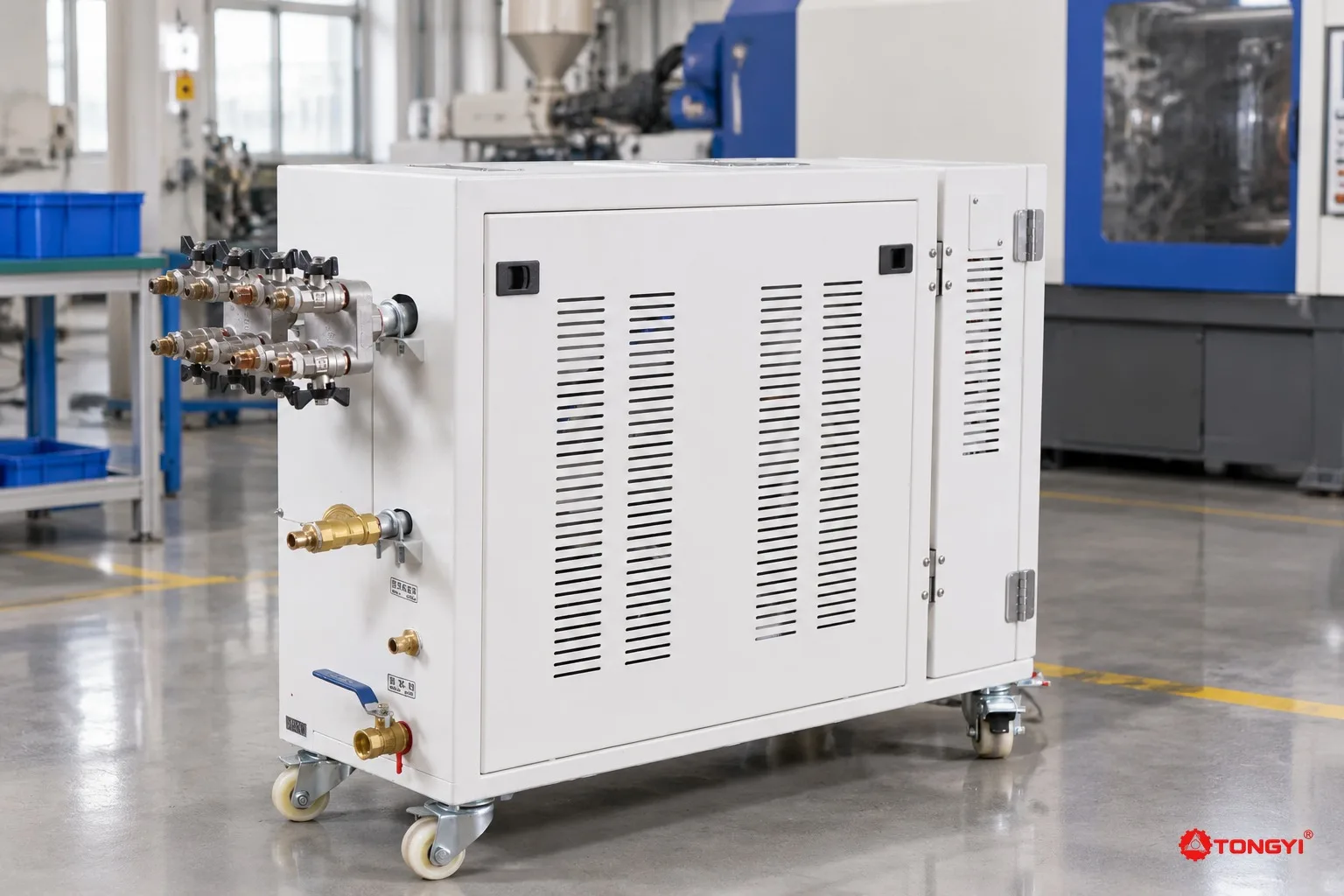
Two documented trade-offs in this comparison deserve attention. First, the TMC 360W trades maximum pressure for flow: its pump delivers 310 L/MIN against the TMC 90W’s 60 L/MIN, but its maximum pressure is 0.3 MPA versus 0.4 MPA on the smaller unit. Maximum flow and maximum pressure are separate ratings — the pump does not necessarily deliver both at once — so confirm the duty point for your mold’s circuit with the supplier. Second, the TMC 360W uses a single 1-in/1-out medium connection with a 1.2-inch diameter, while the TMC 90W splits flow across a 2-in/2-out manifold with 3/8-inch ports. The manifold arrangement affects how you plumb to the mold and how evenly flow distributes across multiple channels, which in turn affects mold temperature uniformity.
Beyond the pump, the heater step from 9 KW on the TMC 90W to 36 KW on the TMC 360W is the main driver of both capability and cost: it determines how quickly the unit can bring a large mold to setpoint and how well it holds temperature under heat load from the molding process. Both models share a 120 °C maximum water temperature, a floor of cooling water temperature +5~30 °C, and direct cooling — so if your process fits inside that window, there is no reason to pay for a higher-temperature machine. All models in this series use a K-type probe thermocouple for medium inlet and outlet temperature sensing; verify with the supplier what controller accuracy is achieved at the sensing point and, separately, how uniform temperature will be throughout the mold, since these are two different questions.
Also note the manufacturer’s standard caveat: specifications are subject to change without prior notice. Confirm the current specification sheet in writing as part of your quote request, so the price you receive corresponds to the machine you will actually get.
What to Include in a Quote Request for Accurate Pricing
To move from a vague budget range to firm, comparable quotes, send each supplier the same package of information:
- Process requirements: target mold temperature, resin family, and whether your application stays within a 120 °C water-type window or needs oil-type operation.
- Mold data: number and diameter of cooling channels, estimated flow demand, and connection sizes so the supplier can match the manifold and port configuration.
- Plant utilities: available voltage, frequency, and phase; cooling water supply temperature and pressure; water quality if it is marginal.
- Scope: quantity, required accessories, any customization, and preferred Incoterm and destination port.
- Documentation: electrical drawings, manuals, and warranty terms — ask whether they are included or priced separately.
Ask every supplier to quote against the same specification sheet. Then compare quotes line by line: heater power, pump power and flow, maximum pressure, manifold configuration, control features, and warranty. A quote that omits any of these should be treated as incomplete, not cheaper.
Reading a Price List Critically
When you do receive a price list, look past the unit prices. Check that each listed model states its heating power, pump flow, maximum temperature, and cooling method — a list that gives only model numbers and prices forces you to assume the configuration. Confirm whether the listed models are standard configurations or base units that require paid options. And confirm the validity period of the pricing, since component costs and exchange rates move; a quote valid for 30 days gives you a firm number to plan against.
Next Step
If your process requires mold temperatures up to 120 °C with clean water as the medium, request quotes for specific models — such as the TMC 90W for smaller molds or the TMC 360W for large, high-flow applications — with your mold’s channel data and plant utilities attached. You can review the mold temperature controller specifications to shortlist models, and if your molding line also needs material handling, the central feeding system and industrial chiller pages cover the surrounding equipment that often ships in the same procurement cycle.