
How Much Does a Water-Type Mold Temperature Controller Cost, and How Does a Custom TCU Work?
Compare documented product features and process requirements before selecting a mold temperature controller.
How much does a water-type mold temperature controller cost?
A water-type mold temperature controller is quoted as a configured system, not as a catalog line item, so there is no single list price that applies across plants. For a clean-water unit in the 120 °C class, the quoted number is built from heating capacity, pump size, cooling method, the number of mold circuits, and the control package you specify. Two buyers requesting the same frame can receive very different quotes because one asks for a 6 kW heater with a 0.37 kW pump and two mold circuits, while the other needs 36 kW of heating, a 2.2 kW pump, and a single large-bore circuit. The practical way to price a controller is to fix the process duty first, then let the supplier price the hardware that meets it.
This article breaks the cost into its real drivers, explains how a custom TCU is engineered, and shows how the verified TMC water-type series is specified so you can build a like-for-like request for quotation.
What actually drives the price of a water-type mold temperature controller
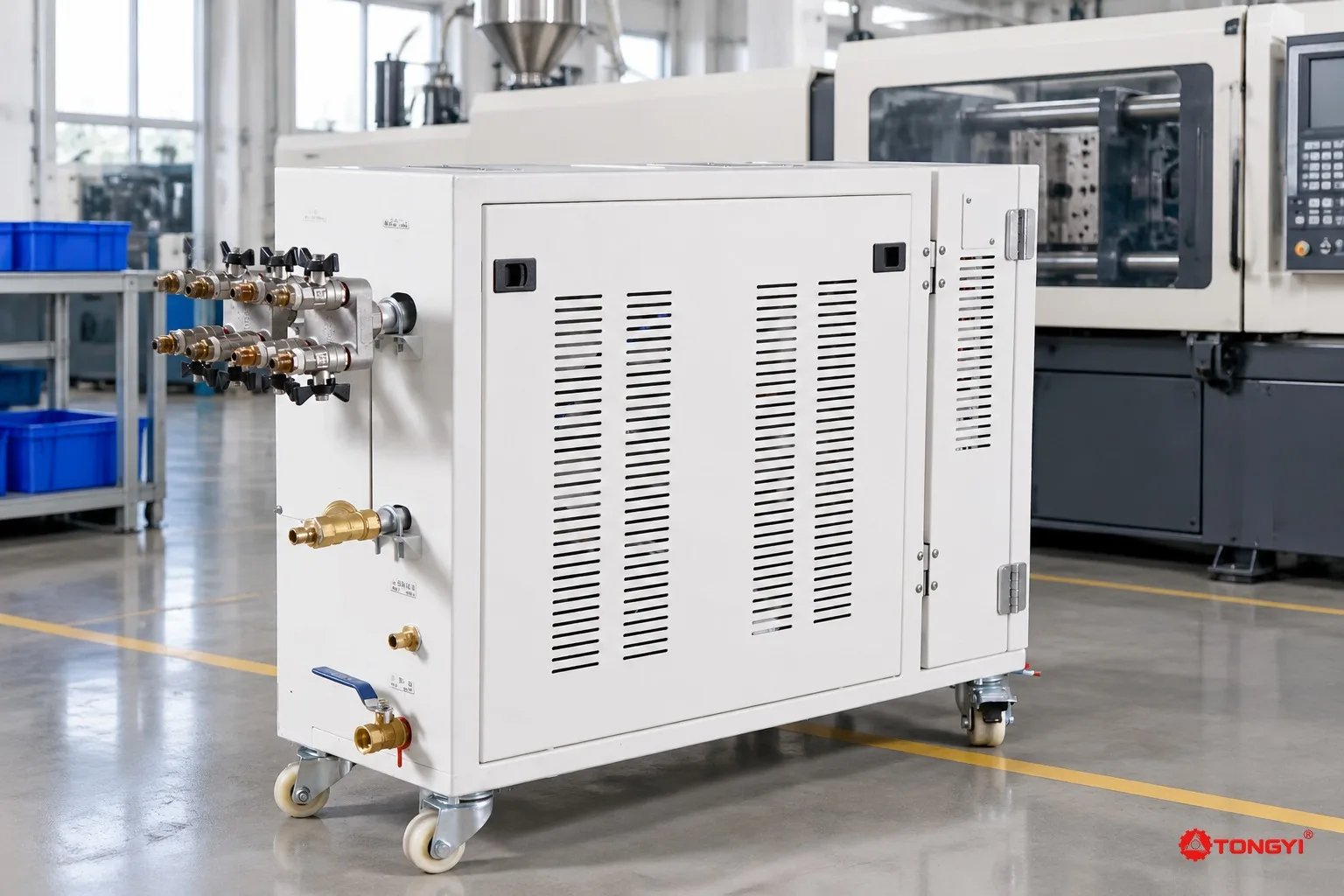
Water-type units are the least expensive class of temperature controller because clean water is the heat-transfer medium: there is no thermal oil circuit, no oil expansion tank, and no oil-to-water heat exchanger in the loop. Cost differences between two water units come from four engineering decisions.
- Heating capacity. Electric heating power sets the size of the heater bundle, the contactor or solid-state switching, and the branch-circuit wiring. It is usually the single largest cost line because it scales the electrical panel, not just the element.
- Pump power and flow. The pump must move enough water to carry the heat into and out of the mold without a large temperature drop across the circuit. Higher flow at a given pressure means a physically larger pump, a bigger motor, and a stronger manifold.
- Circuit count and bore size. A unit with a 2-in/2-out manifold and 3/8 inch ports serves small, closely spaced circuits. A 1-in/1-out manifold with 1 inch ports serves one large circuit and requires different valving and hose.
- Control and instrumentation. Sensor type, controller resolution, alarms, communications, and safety interlocks are priced separately from the hydraulic package.
Cooling method matters as well. Every model in the supplied TMC water series uses direct cooling, meaning the cooling water is admitted to the loop rather than through a separate heat exchanger. That is a simpler, lower-cost arrangement, but it ties the achievable low-end temperature to your plant cooling water temperature.
What specs to include in a quote request
Suppliers price what you describe. If the request omits duty information, the supplier either guesses or prices a generic unit, and neither is useful for comparison. A complete request for quotation should state the mold or platen mass, the target mold surface temperature, the required heat-up time from a cold start, the number of independent circuits, the distance and elevation from the controller to the mold, the available plant cooling water temperature and flow, and the supply voltage and phase. Add the ambient conditions in the molding area, the hose and fitting type you already use, and any requirement for alarm contacts or data output to the machine controller.
With those inputs, a supplier can recommend a specific model and quote it without hedging. Without them, you will receive ranges instead of a number.
How the TMC water-type series is specified
The supplied TMC series covers clean water as the heat-transfer medium across all models, with a maximum temperature of 120 °C and a minimum temperature expressed as cooling water temperature plus 5 to 30 °C. Every model uses direct cooling, a K type probe thermocouple for media inlet and outlet temperature, a 15 mm return water port, and a removable manifold. What changes across the range is heating power, pump power, flow, pressure, and manifold configuration.
Reading two values from the table shows how the specification changes the machine. The TMC 60W is rated at 6 kW of electric heating power with a 0.37 kW pump, which means it is intended for small molds or a single low-mass circuit where the heat load is modest. The TMC 360W is rated at 36 kW of heating power with a 2.2 kW pump, so it can hold temperature on a substantially larger mold or on multiple circuits drawing heat simultaneously. The gap between 6 kW and 36 kW is not a trim level; it changes the electrical service, the panel size, and the price class of the unit.
Like-for-like comparison of selected TMC models
The table below lists the supplied models exactly as published so you can compare on equal terms. A supplier quoting a different heating or pump rating against these figures is quoting a different machine.
| Model | Heating power | Pump power | Max flow | Max pressure | Manifold | Media port | Max temperature |
|---|---|---|---|---|---|---|---|
| TMC 60W | 6 KW | 0.37 KW | 42 L/MIN | 0.35 MPA | 2 in 2 out | 3/8 inch | 120 °C |
| TMC 90W | 9 KW | 0.75 KW | 60 L/MIN | 0.4 MPA | 2 in 2 out | 3/8 inch | 120 °C |
| TMC 120W | 12 KW | 0.75 KW | 60 L/MIN | 0.4 MPA | 4 in 4 out | 3/8 inch | 120 °C |
| TMC 180W | 18 KW | 1.5 KW | 165 L/MIN | 0.25 MPA | 1 in 1 out | 1 inch | 120 °C |
| TMC 240W | 24 KW | 1.5 KW | 165 L/MIN | 0.25 MPA | 1 in 1 out | 1 inch | 120 °C |
| TMC 360W | 36 KW | 2.2 KW | 310 L/MIN | 0.3 MPA | 1 in 1 out | 1.2 inch | 120 °C |
Note the trade-off visible between the mid-range and the largest models. The TMC 180W and TMC 240W move the same 165 L/MIN with the same 1.5 KW pump, and both are rated at 0.25 MPA maximum pressure, so choosing between them is a question of heating capacity rather than hydraulics. The TMC 90W and TMC 120W are identical in the same way, sharing a 0.75 KW pump and 60 L/MIN. In both pairs, the buyer pays for additional heater capacity without gaining additional flow, which is exactly the case where a plant should confirm the actual heat load instead of over-specifying heating.
The pressure ratings also deserve attention. Maximum flow and maximum pressure are separate ratings, not a single duty point. The TMC 60W reaches 0.35 MPA with a comparatively small 42 L/MIN flow, while the TMC 360W reaches 0.3 MPA while moving 310 L/MIN. A larger pump does not automatically mean higher discharge pressure; if your mold circuit has significant restriction, ask the supplier to confirm the flow delivered at the actual circuit pressure drop, because that is the number that controls heat transfer.
For controller precision, the supplier’s published material for the TMC water-type series states a temperature accuracy of ±0.1 °C. That figure is published at the series level, and the page does not specify which models it applies to, where the measurement is taken, or under what test conditions. It should be treated as a series-level claim about the controller rather than a guarantee of mold surface uniformity across the whole tool. Mold cavity temperature uniformity depends on circuit layout, flow balance, and tool design, so confirm the measurement point and test conditions with the supplier before you use that figure in a machine specification. You can review the published data on the water-type mold temperature controller page.
How a custom TCU is engineered
A custom TCU is normally a standard hydraulic and heating platform adapted to a specific process, not a clean-sheet design. The engineering follows five steps.
1. Fix the heat load
The mold or platen mass, the polymer being processed, the cycle time, and the required heat-up rate define how many kilowatts the heater must deliver. This step sets the model class before any other decision.
2. Balance flow against circuit restriction
Flow determines whether heat moves fast enough to hold the setpoint during injection. The pump rating and the manifold layout are selected together with the mold circuit geometry, because a high-flow unit feeding a restricted circuit will not deliver the calculated flow.
3. Match the cooling path to plant water
Because the TMC series uses direct cooling, the low-end temperature is defined as cooling water temperature plus 5 to 30 °C. A plant with warm cooling water in summer will have a higher achievable low-end temperature than the same machine in winter. Custom configurations address this through flow control and circuit design rather than through a chiller.
4. Specify the control interface
The controller, sensor, alarms, and any signal to the molding machine are selected here. The supplied series uses a K type probe thermocouple for media inlet and outlet temperature, which is a common and easily serviced choice.
5. Confirm the physical installation
Media port size and return port diameter determine the hose and fittings. The manifold configuration, whether 2 in 2 out, 4 in 4 out, or 1 in 1 out, decides how the unit connects to the tool and whether each circuit can be balanced independently.
Customization options that change the quote
- Heating power within the same frame, for example moving from 18 KW to 24 KW without changing the pump or manifold.
- Manifold configuration, including the 4 in 4 out arrangement on the TMC 120W for tools with several parallel circuits.
- Media port size, from 3/8 inch on the smaller models up to 1.2 inch on the TMC 360W.
- Control and alarm features layered on top of the base controller.
- Electrical configuration matched to the plant supply.
Each of these is priced, so the quote request should list them explicitly. A supplier cannot price an option that appears nowhere in the request.
How to compare supplier quotes
Because water-type mold temperature controllers are quoted to specification, comparing quotes only works when the underlying specifications match. Normalize every quote to the same eight fields: heating power in kW, pump power in kW, maximum flow in L/min, maximum pressure in MPa, manifold configuration, media port size, maximum temperature, and the stated low-end temperature condition. Then check whether the supplier states maximum flow and maximum pressure as separate ratings or as a single duty point, and whether any temperature accuracy claim specifies the model scope, measurement point, and test conditions.
If a quote states a price without listing those fields, it is not comparable to anything. Request the specification sheet before you compare cost.
Frequently asked questions
Why is there no fixed list price for a water-type mold temperature controller?
Because the unit is assembled to a process duty. Heating capacity, pump size, manifold configuration, port size, and control features are all selected per application, and each selection changes the hardware. Two plants ordering the same model frame for different molds can receive different quotes. A useful quote is always tied to a stated heat load and circuit arrangement.
Is a higher heating power always the more expensive choice?
Not automatically. The TMC 180W and TMC 240W share the same 1.5 KW pump, the same 165 L/MIN maximum flow, and the same 0.25 MPA maximum pressure, so the difference between them is heating capacity alone. The same pattern appears between the TMC 90W and TMC 120W, which share a 0.75 KW pump and 60 L/MIN. Confirm your actual heat load before paying for heating capacity you will not use.
Can I use one 120 °C water unit for several molds at once?
It depends on the manifold and total heat load. A 2 in 2 out manifold on the TMC 60W or TMC 90W suits a small number of circuits, while the TMC 120W provides a 4 in 4 out manifold for tools with several parallel circuits. Running multiple molds from one unit also means the circuits share flow, so balance and total heat demand both have to be checked before the model is chosen.
What does the ±0.1 °C temperature accuracy figure actually cover?
The supplier publishes a temperature accuracy of ±0.1 °C for the TMC water-type series, but the published page does not state which models it applies to, where the measurement is taken, or the test conditions. Treat it as a series-level controller claim, not as a guarantee of uniform mold cavity temperature. Ask the supplier to confirm the measurement point and conditions if that figure will appear in your specification.
Why is the minimum temperature stated as cooling water temperature plus 5 to 30 °C?
All TMC models use direct cooling, so the achievable low-end temperature follows the temperature of your plant cooling water rather than a fixed setpoint. A plant with colder cooling water can reach a lower mold temperature than one with warmer water on the same machine. If your process needs to run below that minimum, that requirement has to be raised with the supplier during selection.
What should I send a supplier to get a comparable quote?
Send the mold mass, target mold surface temperature, required heat-up time, number of circuits, distance to the mold, plant cooling water temperature and flow, and supply voltage and phase. Also state the hose and fitting type you use and any alarm or data output requirement. With those inputs a supplier can name a specific model and quote it; without them you will receive a range.
To move from a range to a number, start with the verified TMC specifications on the water-type mold temperature controller page, then send the heat load and circuit details described above. Our team can match your duty to a specific model and confirm the options that affect the final quote.