
How Much Does a Custom Water Mold Temperature Controller Cost?
Compare documented product features and process requirements before selecting a mold temperature controller.
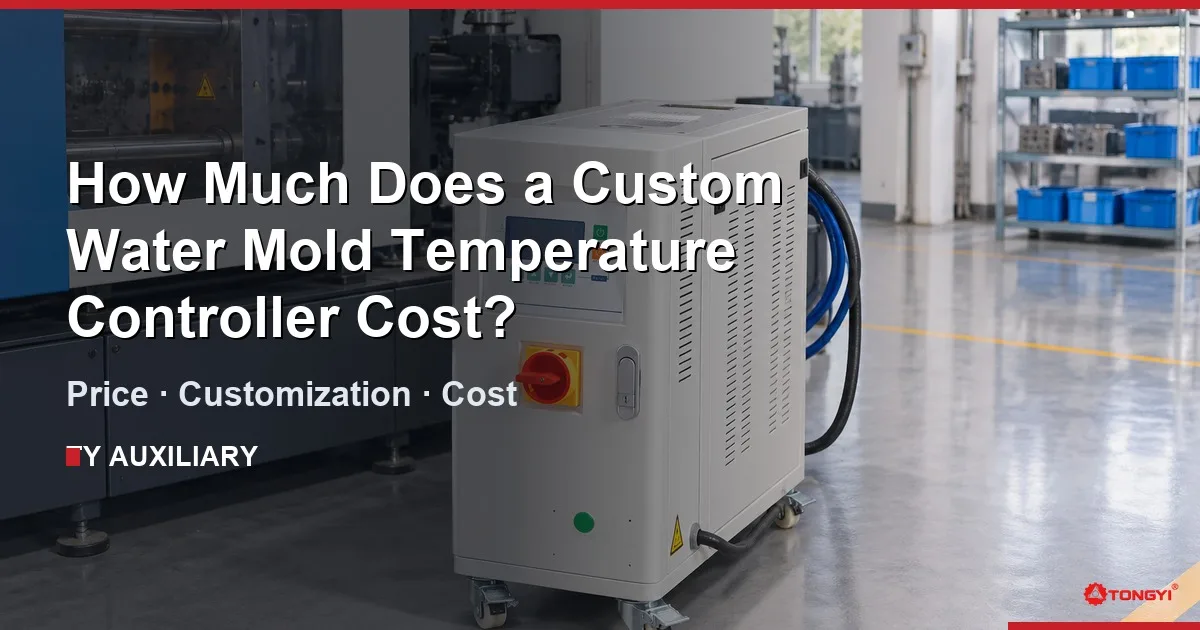
A custom water mold temperature controller has no fixed list price: what you pay depends on the heating and pumping capacity your mold actually needs, how the cooling circuit is configured, and any customization around controls, plumbing, or integration with your molding line. The most reliable way to get an accurate number is to size the unit first — heating power, pump flow, and pressure — and then request a like-for-like quote based on those specifications. This guide explains the cost drivers, shows how the verified specifications of a water-type series translate into different price points, and tells you exactly what to include in a quote request so suppliers can price the same machine, not three different ones.
Why a Water Mold Temperature Controller Price Is Always Quote-Based
Water mold temperature controllers are industrial process equipment, not catalog commodities. Even within a single water-type series, the models can differ by a factor of six in heating power and by more than seven times in pump flow. A 6 kW unit circulating water through a small injection mold and a 36 kW unit feeding a large, high-flow tool are related products, but they are not the same price — the heater bank, pump, piping, and control hardware all scale with capacity.
Customization adds another layer. Buyers routinely ask for non-standard plumbing arrangements, specific controller interfaces, special manifold configurations, or dimensional changes to fit an existing cell. Each of these changes material and labor content, so no supplier can honestly quote “a mold temperature controller” without knowing your specifications. That is why the price conversation starts with sizing, not with a catalog number.
What Actually Drives the Cost of a Mold Temperature Controller
Heating power
Heater capacity is usually the single largest cost driver. It determines the size of the heating elements, the contactor or SSR hardware, and often the cabinet and wiring gauge. If your process needs to bring a large mold to temperature quickly, or hold temperature under heavy thermal load, you need more heating power — and you pay for it.
Pump power and flow rate
The pump moves the heat-transfer water through the mold channels. Higher flow rates require a larger pump motor, bigger piping, and a different manifold arrangement. Flow also interacts with your mold design: a mold with many parallel cooling circuits needs enough flow to serve all of them, or the farthest circuits will run cooler than the ones nearest the supply.
Operating pressure rating
The maximum working pressure of the circulation loop affects the pump spec and the pressure-bearing components. When you compare quotes, confirm that the stated maximum pressure matches your process requirement rather than assuming all units in a series share one rating — they often do not.
Manifold configuration and port sizes
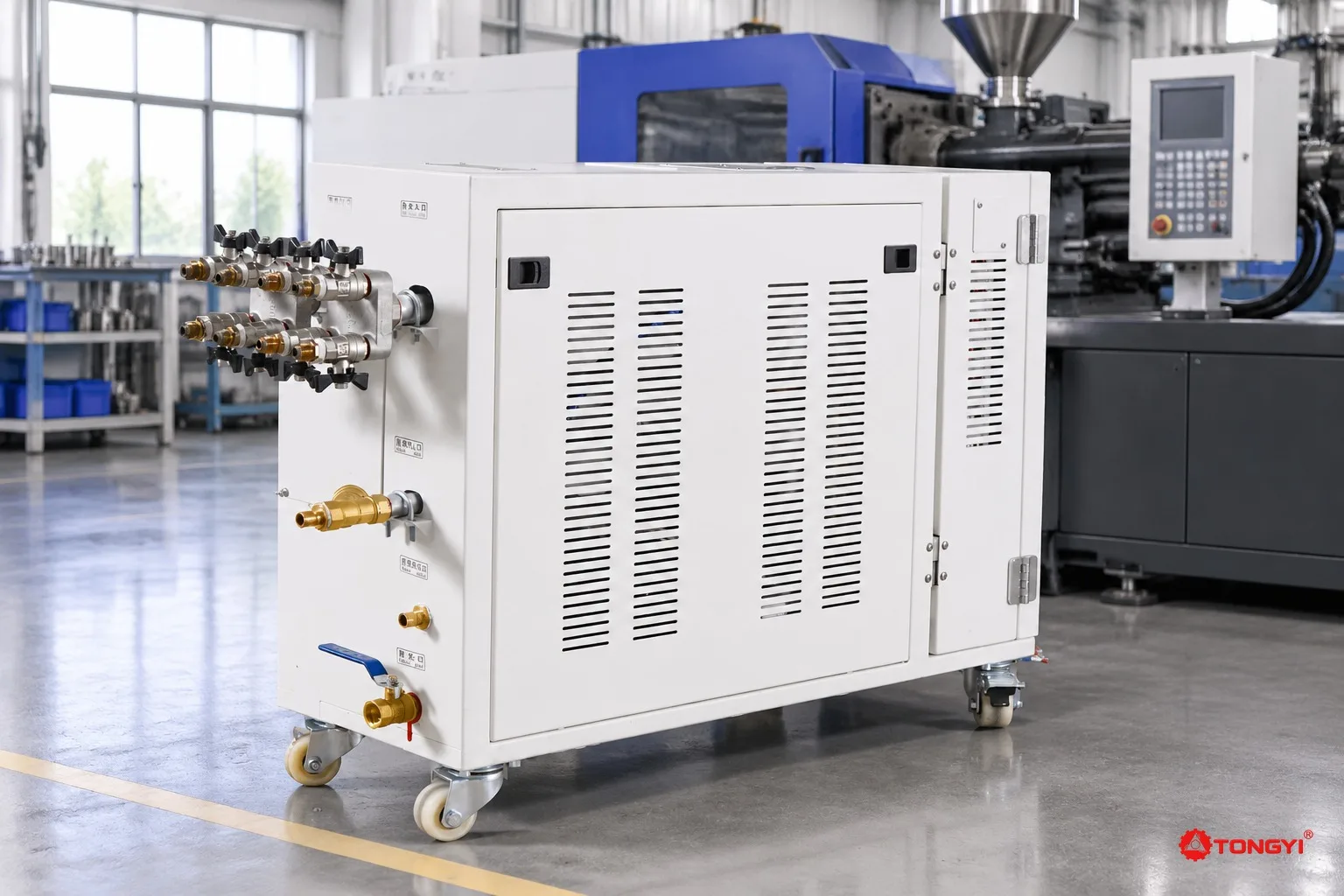
How many independent circuits the controller serves, and at what port diameter, changes the plumbing and the splitter hardware. A 2-in/2-out manifold and a 1-in/1-out connection are different builds with different costs.
Customization scope
The word “custom” covers everything from minor plumbing variations to modified dimensions, control interfaces, or integration requirements. Be explicit about what you actually need changed. Custom features that do not affect your process add cost without adding value, while omitted requirements discovered after delivery usually cost far more to fix.
How Verified Specifications Make Quotes Comparable: A Water-Type Series Example
One useful way to understand pricing tiers is to look at an actual water-type mold temperature controller series and see how the specifications step up. The table below compares four models from the same series — all use clean water as the heat-transfer medium, direct cooling, and K-type probe thermocouples, with a maximum operating temperature of 120 °C and a minimum usable temperature of cooling water temperature plus 5–30 °C.
| Model | Heating power | Pump power | Max pump flow | Max pressure | Return port | Manifold type | Circuit port |
|---|---|---|---|---|---|---|---|
| TMC 60W | 6 kW | 0.37 kW | 42 L/min | 0.35 MPa | 15 mm | 2-in/2-out | 3/8 inch |
| TMC 90W | 9 kW | 0.75 kW | 60 L/min | 0.4 MPa | 15 mm | 2-in/2-out | 3/8 inch |
| TMC 120W | 12 kW | 0.75 kW | 60 L/min | 0.4 MPa | 15 mm | 4-in/4-out | 3/8 inch |
| TMC 360W | 36 kW | 2.2 kW | 310 L/min | 0.3 MPa | 15 mm | 1-in/1-out | 1.2 inch |
Two values in this table deserve special attention when you compare prices. First, heating power: the TMC 60W carries 6 kW of heating while the TMC 360W carries 36 kW — a six-fold difference that reflects a genuinely different machine in heater capacity, wiring, and cabinet hardware. When two quotes arrive at noticeably different prices, check whether the heater ratings actually match; a “cheaper” quote is frequently a smaller unit. Second, maximum pump flow: the TMC 60W delivers up to 42 L/min while the TMC 360W reaches 310 L/min. Flow determines how many mold circuits you can serve effectively, so if your tool has multiple cooling channels, undersized flow is a false economy — you may save on the controller and lose cycle time on every shot.
Notice also that maximum pressure is a separate rating from maximum flow. The TMC 360W, despite being the largest unit, is rated at 0.3 MPa while the TMC 90W and TMC 120W are rated at 0.4 MPa. Do not assume the biggest model has the highest pressure rating; verify the rating against your loop requirements before ordering.
Series-level data for this water-type controller line, as published on the water-type mold temperature controller product page, states a temperature accuracy of ±0.1 °C. Because this figure is published at the series level without specifying the measurement point or test conditions, treat it as a nominal control accuracy rather than a per-model guarantee, and confirm the applicable conditions with the supplier in writing. Also keep in mind that control accuracy — how tightly the controller holds the medium temperature — is not the same as temperature uniformity throughout the mold cavity, which depends on mold design and flow balance as well.
What to Include in a Quote Request for a Custom Unit
Suppliers price accurately when you give them complete, specific inputs. Your quote request should state:
- Process type (injection molding, die casting, extrusion, or other) and mold size or weight, if known.
- Required operating temperature at the mold, and whether 120 °C with clean water is sufficient or you need higher-temperature capability.
- Number and configuration of mold cooling circuits, and required flow per circuit.
- Available cooling water supply temperature and pressure at the installation site.
- Target heat-up time from cold to operating temperature.
- Electrical supply available at your facility (voltage, frequency, phase).
- Any dimensional, plumbing, control-interface, or integration requirements you classify as custom.
- Delivery scope: documentation language, spare parts, and commissioning expectations.
With these items, two suppliers can quote the same machine and you can compare offers on identical specifications instead of guessing what each price includes.
How to Compare Custom Quotes on a Like-for-Like Basis
Once quotes arrive, line them up against the same checklist:
- Heating power and pump power, in kW, per unit.
- Maximum pump flow and maximum pressure, with units — a comparison that only cites one of the two is incomplete.
- Maximum operating temperature and the minimum usable temperature relative to your cooling water supply.
- Manifold configuration and connection sizes, so installation hardware matches your plan.
- Temperature sensor type and where it is measured.
- Which items are standard versus custom, and what each custom item adds to lead time.
If one quote is significantly lower, ask which specification has been reduced. Differences in heater capacity, pump size, or manifold hardware are the usual explanation, and they matter far more to your process than a headline price difference. Requesting the specifications for models such as the TMC 90W or TMC 180W from the full water-type controller series gives you reference points for mid-range sizing conversations.
A Practical Next Step
If you know your mold’s cooling-circuit count and target temperature, you are close to a quotable specification. Send those details — plus your facility power supply — to a supplier and ask for the smallest model in the series that meets the duty, not the largest. Right-sizing the heating power and pump flow is how you keep the price proportionate to the process, and it is the only way to make sure the number you receive reflects the machine you will actually install.
Frequently Asked Questions
Do higher-priced mold temperature controllers always mean better quality?
Not necessarily. Price usually tracks heating power, pump capacity, and customization scope. A larger model with more heater kW and higher flow will cost more, but that does not make it better for your mold — the right question is whether the specifications match your duty, not which unit is most expensive.
What specifications affect the price of a custom water mold temperature controller the most?
Heating power and pump flow rate are the biggest drivers, followed by the maximum pressure rating, manifold configuration, and any custom plumbing or control requirements. State each of these explicitly in your quote request so suppliers price identical machines.
Is a temperature accuracy claim of ±0.1 °C enough to choose a controller?
It is a useful starting point, but series-level accuracy claims do not specify the measurement point or test conditions, and control accuracy is not the same as temperature uniformity inside the mold. Ask the supplier to confirm the applicable conditions in writing for the specific model you order.
Can one water-type controller serve multiple molds or several cooling circuits?
It depends on flow and the manifold configuration. Models with a 4-in/4-out splitter are built to serve more circuits than 1-in/1-out units, but the pump’s maximum flow must still cover all circuits. Count your circuits and the flow each needs before selecting a model.
How do I know which model size my process needs?
Start with three inputs: target mold temperature, the number and configuration of cooling circuits, and your acceptable heat-up time. Give these to the supplier and ask them to recommend the smallest model whose heating power, flow, and pressure rating meet the duty — that keeps the cost proportionate.