
How Much Does a Water-Type Mold Temperature Controller Cost, and Can I Get a Custom Solution?
Water-type mold temperature controller pricing depends on heater power, pump capacity, and circuit configuration rather than a fixed list price.
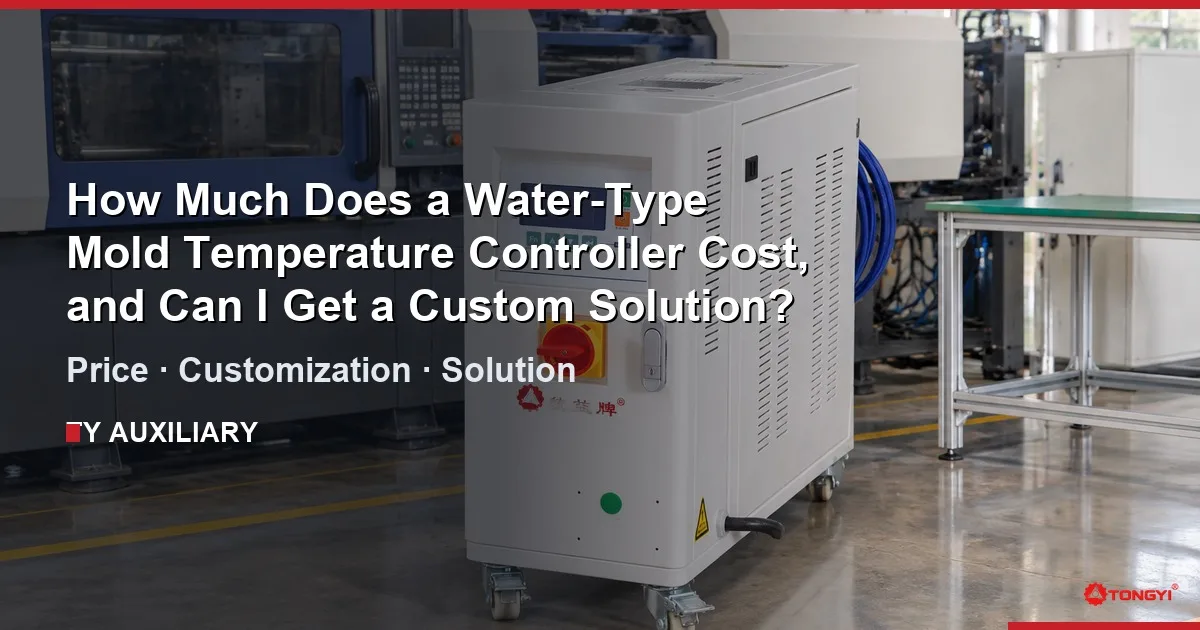
Short answer: a water-type mold temperature controller is priced per unit against heater power, pump capacity, and the scale of the circulation loop you need—so there is no single published price. Suppliers quote based on the model selected, options required, and destination market. A US buyer can control cost only by specifying exactly what the process needs and requesting a like-for-like quote from each vendor. Custom configurations are common: this equipment class is routinely adapted to specific molding setups, plumbing interfaces, and control requirements.
What drives the price of a water-type mold temperature controller
Water-type units circulate clean water as the heat-transfer medium, typically serving processes that run below oil-type controller temperatures. Because all models in a given series share the same medium, cooling method, and temperature ceiling, the main cost differentiators are electrical and hydraulic capacity:
- Heater power. Higher electric heating output costs more and also affects your facility’s electrical planning—a 36 KW heater needs different supply and breaker sizing than a 6 KW unit.
- Pump power and flow. A larger pump motor and higher maximum flow support bigger molds or longer circulation runs, and they add to unit cost.
- Number of media inlets and outlets. A multi-circuit splitter (for example, 4-in/4-out) versus a single large circuit changes the plumbing assembly and fittings.
- Pipe sizes and interface fittings. Different return-water and media connection diameters affect installation cost on your side.
- Controls and options. Accuracy, communication interfaces, and any customization you request are quoted case by case.
- Shipping and import. For US buyers, freight class, crating, and duty handling are part of total landed cost even though they are not part of the unit price.
Because these variables change from buyer to buyer, a responsible supplier will not publish one fixed number. Instead, prepare a short technical brief and ask for a written quote per model.
Match the model to your process before comparing quotes
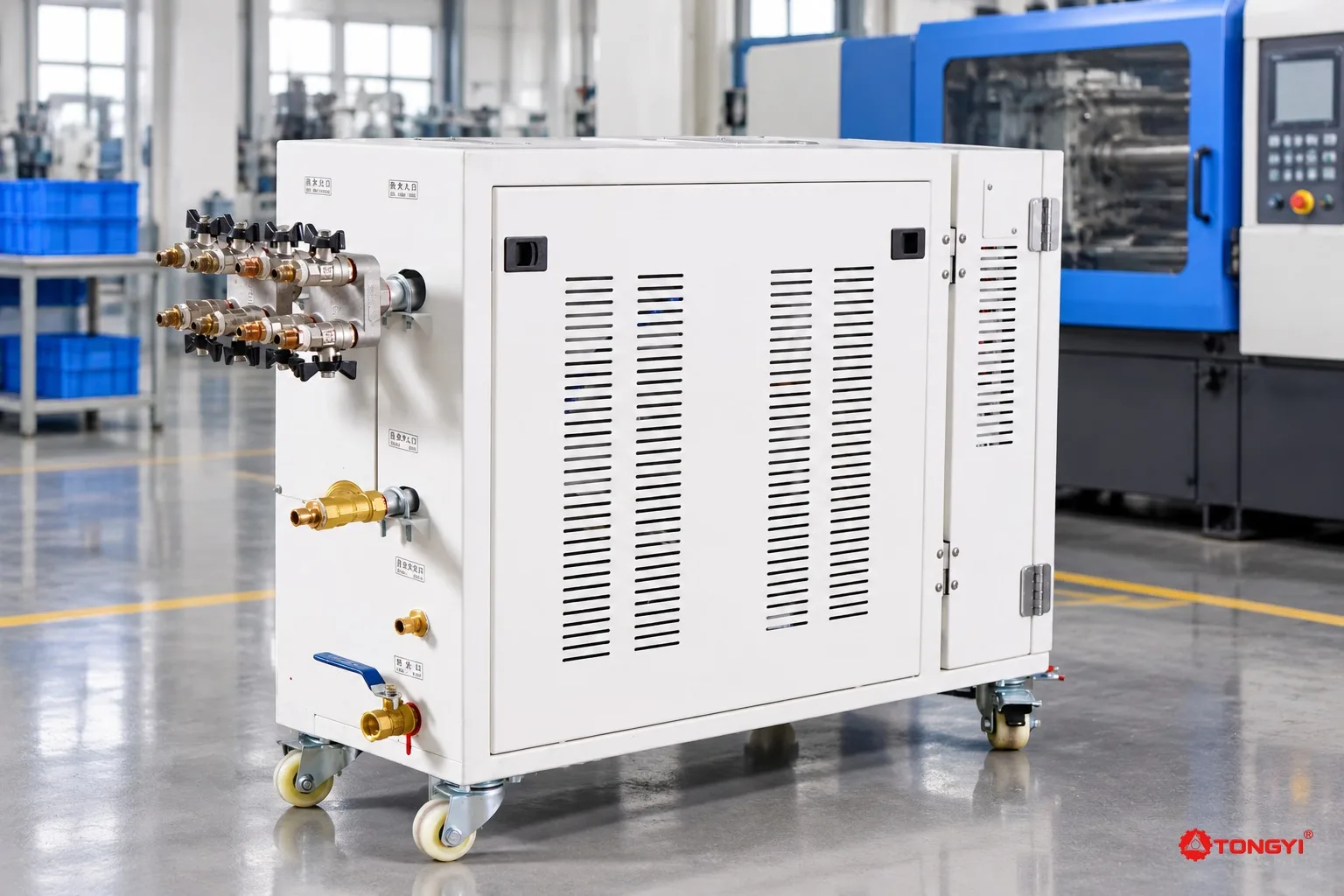
Price comparisons only mean something when the models are functionally equivalent. The practical way to get there is to define your duty requirements first: the process temperature you need, the total volume of water you must circulate, and the number of independent mold circuits. Then compare suppliers quoting the same capacity class.
One verified series example: the published water-type series uses clean water as the medium, direct cooling, and a maximum operating temperature of 120 °C, with K-type probe thermocouples for media inlet and outlet temperature measurement. The manufacturer publishes a temperature accuracy of ±0.1 °C as a series-level claim for this water-type line; the published page does not state how it applies to each model, where it is measured, or under what test conditions, so confirm the applicable scope in writing with any supplier before you treat it as a purchasing guarantee. Note that controller accuracy is not the same as temperature uniformity throughout the mold—cavity uniformity depends on mold design and channel layout as well.
A like-for-like comparison of three representative models
| Model | Heater Power | Pump Power | Max Flow | Max Pressure | Circuit Splitter | Media Pipe Dia. |
|---|---|---|---|---|---|---|
| TMC 60W | 6 KW | 0.37 KW | 42 L/MIN | 0.35 MPA | 2-in/2-out | 3/8 inch |
| TMC 120W | 12 KW | 0.75 KW | 60 L/MIN | 0.4 MPA | 4-in/4-out | 3/8 inch |
| TMC 360W | 36 KW | 2.2 KW | 310 L/MIN | 0.3 MPA | 1-in/1-out | 1.2 inch |
These three models illustrate the documented trade-offs you will encounter across the full series. The TMC 60W, at 6 KW of heating with a 0.37 KW pump moving up to 42 L/MIN, suits smaller tooling with modest heat demand; the heater rating tells you whether the unit can recover to setpoint quickly, while the pump rating tells you whether it can push water through your mold channels at the required rate. The TMC 120W doubles heater power to 12 KW and raises pump capacity to 0.75 KW with a maximum flow of 60 L/MIN and 0.4 MPA maximum pressure, and its 4-in/4-out splitter supports molds with more independent circuits—a frequent choice for multi-cavity tooling. At the top of this selection, the TMC 360W is built around 36 KW of heating and a 2.2 KW pump delivering up to 310 L/MIN, but note the trade-off: its maximum pressure is 0.3 MPA, lower than the TMC 120W’s 0.4 MPA, and it uses a single 1-in/1-out circuit with 1.2 inch media piping—high volume through one large loop rather than several small circuits. Choosing between these patterns is exactly where a custom-solution discussion with the supplier starts.
Other series models fill the intermediate ranges: the TMC 90W (9 KW heater, 0.75 KW pump, 60 L/MIN, 0.4 MPA, 2-in/2-out), the TMC 180W (18 KW heater, 1.5 KW pump, 165 L/MIN, 0.25 MPA, 1-in/1-out, 1 inch piping), and the TMC 240W (24 KW heater, 1.5 KW pump, 165 L/MIN, 0.25 MPA, 1-in/1-out, 1 inch piping). All share the 120 °C maximum temperature, direct cooling, and a minimum operating temperature of cooling water temperature plus 5–30 °C, with a 15 MM return-water port and 3/8 inch media connections except where noted above.
How custom configurations work
Customization in this equipment category usually falls into a few practical buckets:
- Electrical adaptation. Confirm the voltage and frequency your plant runs on, and whether the control panel and heater elements must be configured for your supply. This is a standard, low-risk request.
- Plumbing and interface changes. Different splitter arrangements, connection diameters, or manifold layouts to match your mold’s circuit pattern.
- Control options. The way temperature is measured and controlled (the series uses K-type probe thermocouples at the media inlet and outlet) can be discussed against your process requirements.
- Certification or compliance requirements. If your facility requires specific electrical standards, state them in the request so the supplier confirms feasibility before quoting.
Expect customization to affect lead time and price. A supplier who can explain exactly which changes are standard, which are optional, and which are not feasible is generally easier to work with than one offering a vague “yes, we can customize everything.”
What to include in your quote request
To get comparable pricing—rather than quotes for technically different machines—include these items:
- Target process temperature and required control stability.
- Mold description: number of circuits, tool size, and approximate water volume or required flow.
- Chosen model or capacity class (for example, heater power range and number of splitter circuits), or ask the supplier to recommend one and state the reasoning.
- Facility electrical supply (voltage, phase, frequency) and available breaker capacity.
- Plant cooling-water conditions, since the minimum operating temperature depends on your cooling water temperature.
- Destination, freight preference, and any compliance requirements.
- Required documentation: wiring diagrams, dimensioned drawings, and, if the ±0.1 °C accuracy claim matters to your process, a written statement of its applicable scope and test conditions.
When you receive quotes, compare the same model designation (or equivalent heater/pump ratings) from each supplier, and ask each one to itemize options separately so you can see what customization actually costs.
Where this equipment fits in your broader auxiliaries plan
A water-type mold temperature controller is usually one element of a temperature-control strategy alongside other auxiliaries. If you are also evaluating cooling for the mold or chiller support, see the site’s cooling chiller range; for material handling alongside molding, the central feeding system and hopper dryer pages cover adjacent equipment. Specifying the whole auxiliary lineup with one supplier often simplifies integration and freight.
Frequently asked questions
Why is there no published price for a water-type mold temperature controller?
Because the final cost depends on the model’s heater and pump ratings, the circuit configuration, any customization, and freight to your destination. Reputable suppliers quote per model against a written specification rather than publishing one number that cannot fit every application.
How do I know which model size I need?
Work from your process temperature (within the 120 °C ceiling of this water-type series), the number of independent mold circuits, and the flow you need. Then compare heater power, pump power, maximum flow, and maximum pressure across models—for example, the TMC 120W offers 12 KW heating and a 4-in/4-out splitter, while the TMC 360W offers 36 KW heating with a single large circuit at 310 L/MIN.
Can a supplier customize the controller for my plant’s electrical supply?
Yes—electrical configuration for your voltage and frequency is one of the most common customization requests. State your plant supply and breaker capacity in the quote request and have the supplier confirm the configuration in writing before ordering.
What does the ±0.1 °C accuracy claim actually cover?
It is published as a series-level claim for the water-type line. The published page does not specify applicability per model, the measurement point, or test conditions, so ask the supplier to confirm the scope in writing. Also remember that controller accuracy is not the same as temperature uniformity across the mold cavity.
Why do maximum flow and maximum pressure not rise together across the series?
They are separate ratings set by different pump and circuit designs. In this series the TMC 120W reaches 0.4 MPA at 60 L/MIN, while the larger-flow TMC 360W is rated at 0.3 MPA—high flow through a single large loop comes with lower maximum pressure. Check both against your mold’s flow-resistance requirements.
What information should I prepare before requesting a quote?
Process temperature, mold circuit count, required flow, facility electrical supply, plant cooling-water conditions, destination, and any compliance or documentation requirements. The more complete your brief, the more comparable the quotes you will receive.