
How Much Does a Custom Water-Type Mold Temperature Controller Cost, and Where Can I Get the Principle Diagram?
Compare documented product features and process requirements before selecting a mold temperature controller.
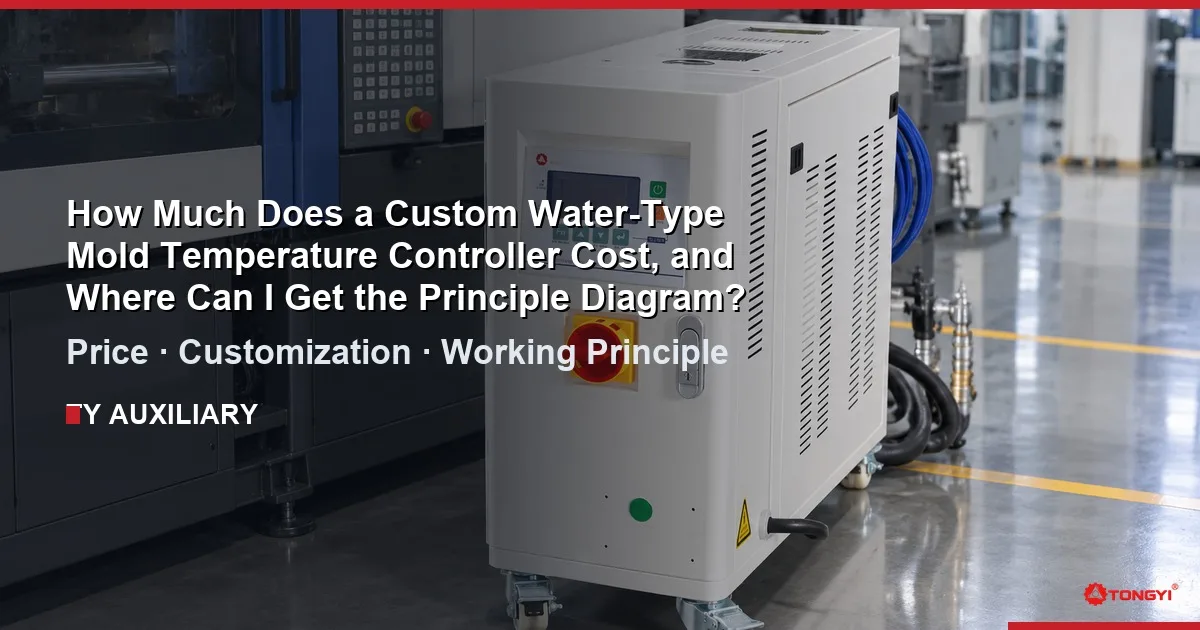
A custom water-type mold temperature controller is priced by how far it is built away from a standard catalog unit, not by a single market rate. In most quoted projects, the cost is driven by heating capacity, pump flow and pressure, the number and size of the media manifolds, the control package, and the volume of engineering documentation the supplier has to produce. Published list values for Chinese-made water-type units in this class normally sit well below comparable European or Japanese machines, but the spread inside that band is wide enough that a like-for-like specification comparison matters more than any headline number.
If your question is really about how the machine works before you price it, the principle diagram you want is the one your supplier draws for your loop: pump, heater, mold circuit, direct cooling water valve, temperature sensor, and controller. That diagram is normally issued with the quotation or with the manufacturing drawing package rather than published on a public page.
What actually drives the price of a custom mold temperature controller
Custom pricing is a build cost, and build cost follows the same specification chain in almost every project. Buyers who want a defensible quote should expect the supplier to quote against these items rather than a model number alone.
- Heating capacity and voltage. Electric heating power is the single largest hardware variable. A larger heater also forces larger contactors, wiring, and enclosure, so the cost steps up faster than the kilowatt count.
- Pump and flow class. Pump power, maximum flow, and maximum pressure are separate ratings. Going from a small circulating pump to a high-flow pump changes the pump cost, the piping size, and the pressure rating of every downstream component.
- Manifold count and port size. A machine built with a small number of outlets at a narrow media port diameter is a different cost structure from one with multiple outlets at a one-inch port, because the manifold block, valves, and hose fittings all change.
- Control package. Standard relay or PID control versus a controller with data logging, communications, and alarms changes the control cabinet cost substantially and is usually the easiest item to scope down.
- Materials and wetted parts. Stamped steel, stainless panel work, and specific cooling-water valve materials are separate line items in a custom build.
- Documentation and inspection scope. If you require a principle diagram, wiring diagram, or a specific inspection package, that engineering time is part of the price and should be listed in the quotation.
- Quantity and tooling. A single custom unit carries the full engineering load; a repeated order spreads it.
Why the principle diagram belongs in the quotation
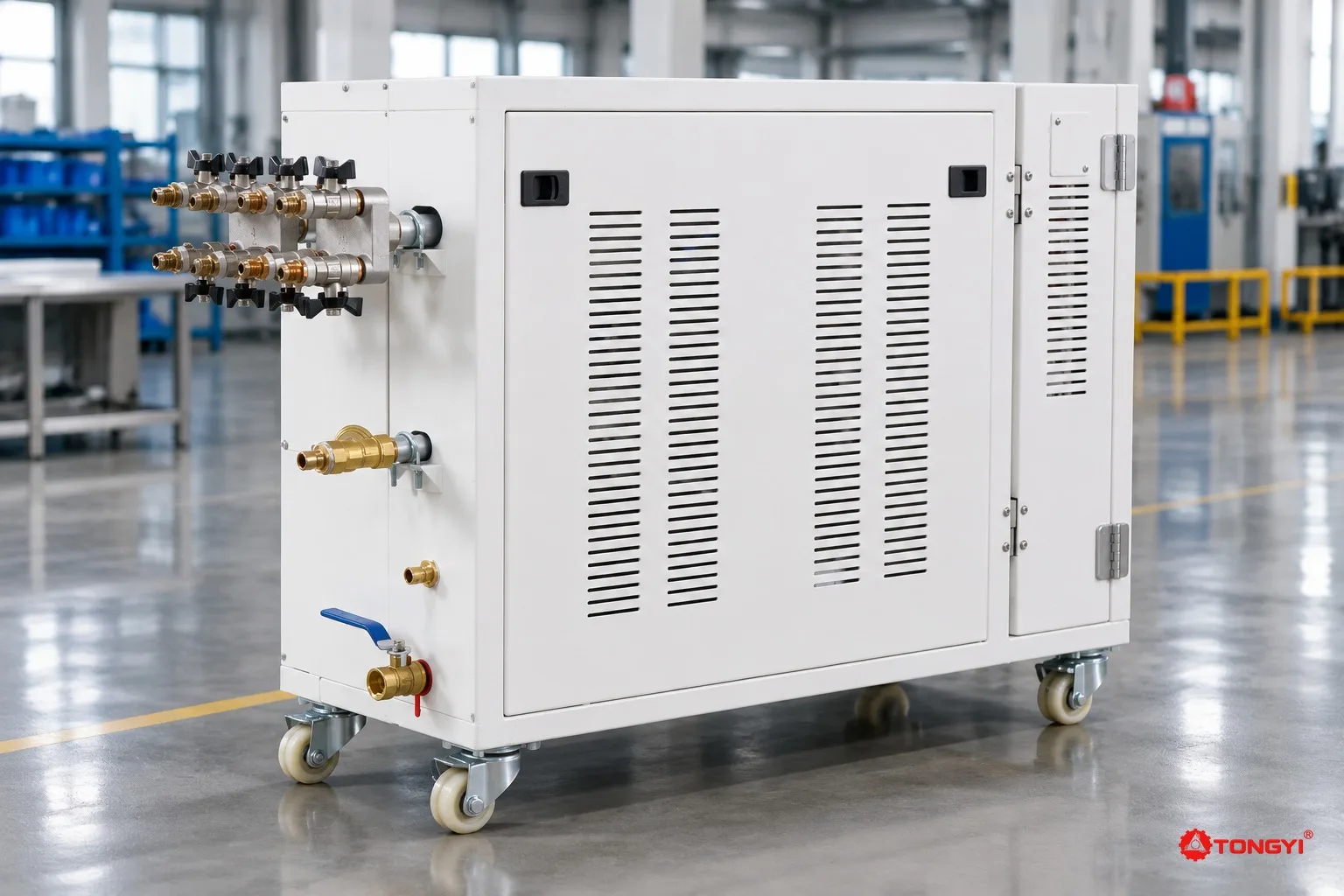
The principle diagram is the drawing that shows how your specific loop is wired: where the pump draws, where the heater sits, how cooling water is injected or valved, where the temperature sensor reads, and which safety devices are in the circuit. Because a custom controller is built around your mold and your plant water supply, the diagram is only correct once those inputs are fixed.
For a water-type unit the diagram is short and worth reading before you approve the order, because it reveals three things a specification table does not: whether cooling is direct or indirect, whether the temperature probe sits on the media inlet/outlet or on the mold return, and whether a bypass or mixing loop is used to hold temperature during low-load periods. Ask for the diagram as a controlled document with a drawing number. That single request makes later maintenance and spare-parts ordering far easier.
Example specification ranges in a standard water-type series
The published specifications for this water-type series show how far a single series can stretch, which is also why custom pricing has such a wide band. Every model in the series uses clean water as the heat-transfer medium and reaches a maximum temperature of 120 °C. The minimum controllable temperature is stated as cooling water temperature plus 5 to 30 °C, and cooling is direct on every listed model. The media inlet/outlet temperature probe is a K-type probe thermocouple across the series, and the return water port is 15 mm on all listed models.
On the small end, the TMC 60W uses 6 kW of electric heating power with a 0.37 kW pump, a maximum flow of 42 L/min, and a maximum pressure of 0.35 MPa, plumbed as 2-in/2-out with 3/8 inch media ports. On the large end, the TMC 360W uses 36 kW of heating with a 2.2 kW pump, a maximum flow of 310 L/min, and a maximum pressure of 0.3 MPa, plumbed as 1-in/1-out with 1.2 inch media ports. Reading those two rows together is instructive: maximum flow and maximum pressure are separate ratings and do not move in the same direction, so a buyer who needs both high flow and high pressure is asking for a configuration that may not exist in the standard series.
Two values deserve particular attention when you write a quote request. First, the minimum temperature is not an absolute figure. It is defined relative to your cooling water temperature plus 5 to 30 °C, so a plant with warm cooling water cannot reach the same low setpoint as a plant with cold cooling water, and no supplier can quote around that limit without knowing your water supply temperature. Second, the return water port diameter is 15 mm across the listed series while the media inlet/outlet port size changes from 3/8 inch on the small models to 1.2 inch on the largest, which means the piping you install between the controller and the mold must be sized against the media port, not the return port.
Temperature accuracy for this water-type series is published as ±0.1 °C at the series level. That figure is a controller and sensor accuracy statement for the series, not a per-model guarantee, and it does not describe temperature uniformity across a mold cavity. Mold surface uniformity depends on your cooling channel layout, flow distribution, and manifold balance. State your uniformity requirement explicitly in the quotation request if the part tolerance depends on it, and ask the supplier to confirm the applicable measurement point and test conditions in writing.
Comparing two models in the same water-type series
The table below compares four exact models from the supplied series data on a like-for-like basis. All values are as published for those model codes, using clean water as the medium and the stated maximum temperature, minimum temperature condition, and direct cooling method.
| Model | Heating power | Pump power | Max flow | Max pressure | Manifold | Media port |
|---|---|---|---|---|---|---|
| TMC 60W | 6 kW | 0.37 kW | 42 L/min | 0.35 MPa | 2 in / 2 out | 3/8 inch |
| TMC 120W | 12 kW | 0.75 kW | 60 L/min | 0.4 MPa | 4 in / 4 out | 3/8 inch |
| TMC 240W | 24 kW | 1.5 kW | 165 L/min | 0.25 MPa | 1 in / 1 out | 1 inch |
| TMC 360W | 36 kW | 2.2 kW | 310 L/min | 0.3 MPa | 1 in / 1 out | 1.2 inch |
The trade-off visible in the table is manifold architecture. The TMC 120W delivers four separate inlet/outlet pairs at a maximum pressure of 0.4 MPa, which suits a multi-cavity tool that needs balanced parallel circuits. The TMC 360W delivers a single inlet/outlet pair at a much higher flow of 310 L/min but a lower maximum pressure of 0.3 MPa, which suits one large circuit carrying a high heat load. A buyer with several small cavities and a high pressure drop should not simply scale up to the largest model; the correct move is either parallel machines or a custom manifold, and both of those paths are quoted as custom work.
How to structure a custom quotation request
A quote request that produces a usable number within a day or two lists the following, in writing. This is also the checklist to use when comparing two suppliers, because it forces both to answer the same question.
- Required setpoint range, in °C, and your cooling water supply temperature range. The minimum achievable temperature is defined against the cooling water temperature, so this is not optional.
- Heat load of the process, or the shot weight and cycle time of the molds being served, so the supplier can size heating power rather than guess.
- Number of circuits, and the flow and pressure drop of the mold circuit. Maximum pressure and maximum flow are separate ratings; state which one your process actually limits on.
- Media port size you can accept, and the hose or pipe diameter already installed on the press.
- Control requirements: setpoint accuracy needed at the controller, alarms, communications protocol, and whether data logging is required.
- Electrical supply available at the machine, including voltage, phase, and frequency.
- Documentation package required, specifically whether a principle diagram and wiring diagram are needed as controlled drawings.
- Quantity for the first order and expected annual repeat volume.
Where to get the principle diagram
Three sources are realistic. The first and best is the supplier’s engineering department, requested as part of the quotation; a serious manufacturer will issue a principle diagram for the specific configuration rather than hand over a generic schematic. The second is the operation and maintenance manual shipped with the machine, which normally contains the same diagram in a simpler form. The third is the drawing package issued after the order is placed, which is where the drawing number, revision, and component list live.
Be specific when you ask. Request the principle diagram for your exact configuration, list the components you want labeled (pump, heater, cooling valve, temperature probe, safety devices, and manifolds), and ask for the media flow direction to be marked. A diagram without flow direction and probe location is not useful for troubleshooting.
Getting from specification to a firm number
Custom pricing is much less opaque than it first appears once the specification is fixed, because the cost is the sum of heating power, pump class, manifold architecture, control package, and engineering documentation. Fix those five items, ask for a principle diagram with the quotation, and state a single setpoint and cooling water condition, and every supplier’s number becomes comparable. If you are still scoping the machine class, review the water-type mold temperature controller specifications first, then confirm piping and control scope, and where the process also needs higher-temperature media review the oil-type mold temperature controller range before finalizing the loop, along with the process temperature control equipment range for auxiliary options.