
How Much Does a Water-Type Mold Temperature Controller Cost with Custom Drawings?
Learn which specifications drive water-type mold temperature controller cost and how to request a quote with custom drawings that suppliers can price.
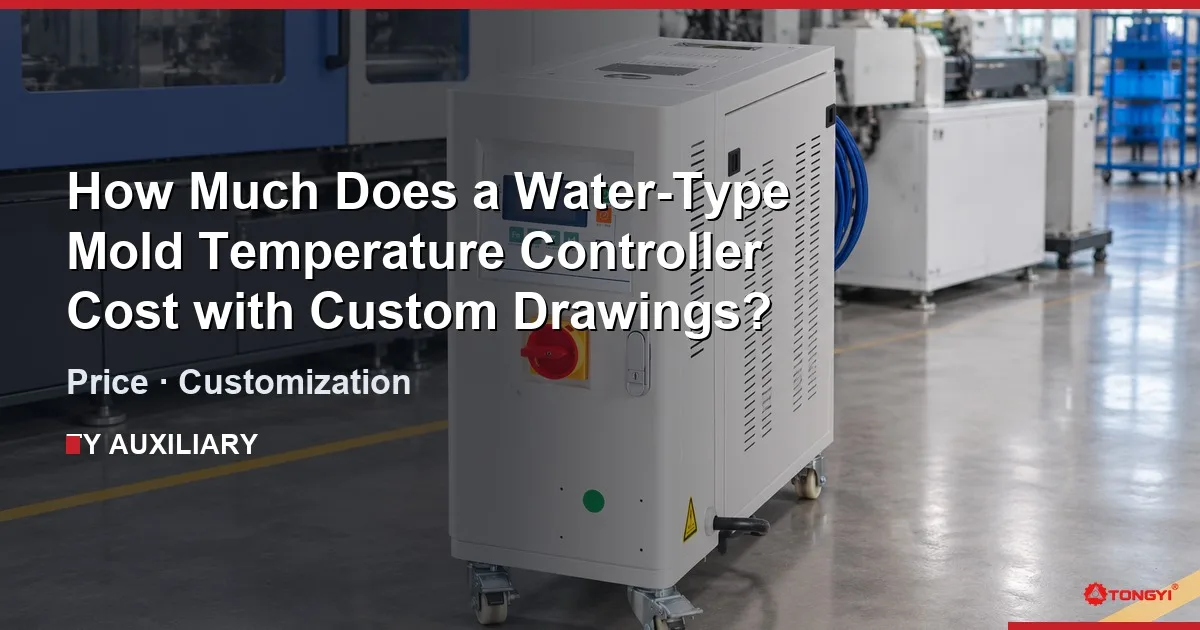
A water-type mold temperature controller is priced by the configuration you specify, not by a single list figure. The heating capacity, pump size, flow rate, piping connections, and the amount of engineering work behind a custom drawing all move the quote, and no supplier can give a firm number without knowing which of those you need. In practice, a standard catalog model with a clean water loop and a straightforward 2-in 2-out manifold sits at the low end, while a unit rebuilt around your plant’s layout, voltage, and manifold routing costs more because more design and fabrication time goes into it.
The practical answer for a US buyer is to request a quote against a defined configuration: name the model class you are considering, state the process temperature and cooling water conditions, attach a drawing if the piping layout is fixed, and ask the supplier to quote the controller plus the panel modifications separately. That structure lets you compare suppliers on equal terms instead of comparing a bare unit with a fully engineered package.
What drives the price of a water-type mold temperature controller
Cost in this category tracks four things: heating power, pump and flow capability, the manifold and connection arrangement, and the engineering content of the order. Everything else — the controller, the sensor, the cabinet — sits on top of those.
Heating capacity sets the electrical package
The heater is usually the largest single cost block. A water-type unit with 6 kW of heating power needs a smaller contactor set, smaller wiring, and smaller branch protection than one rated at 36 kW, so both the parts and the labor in the electrical panel scale with the rating. Heating capacity also determines what your facility must supply: a 36 kW heater draws a substantially larger circuit than a 6 kW unit, and that difference can force a panel upgrade or a dedicated feed at the installation site. When you ask for pricing, quote the heating power you actually need for the mold and cycle time, because oversizing the heater raises cost without improving temperature control.
Pump power and flow rate move together
Pump power and maximum flow are separate ratings that behave differently, and buyers should not treat them as interchangeable. In the water-type single-circuit series, the TMC 90W and TMC 120W both carry a 0.75 kW pump rated at a maximum flow of 60 L/min, with a maximum pressure of 0.4 MPa. The TMC 180W and TMC 240W step up to a 1.5 kW pump rated at a maximum flow of 165 L/min, with a maximum pressure of 0.25 MPa. The larger pump moves considerably more water, but its maximum pressure rating is lower, so the two numbers have to be read as separate ratings rather than as one combined performance figure. For the pump selection, what matters is that the circuit can deliver the flow your mold’s cooling channels need at the pressure drop they impose — maximum flow and maximum pressure are ratings, not a guaranteed duty point, and the supplier should confirm the operating point for your tool.
Manifold configuration and connection sizes
The manifold is where configuration starts to diverge. Smaller models in the series are supplied with a 2-in 2-out manifold and 3/8 inch media inlet and outlet connections, while the larger TMC 180W, TMC 240W, and TMC 360W units use a 1-in 1-out manifold, with the TMC 360W moving to a 1.2 inch connection. Each extra circuit, hose barb, or valve adds cost, and a manifold built to a specific drawing adds fabrication time. If your mold has multiple cooling circuits, the manifold design is a real cost line, not an accessory.
Engineering content: custom drawings and documentation
A custom drawing package is the clearest example of engineering content in the price. When a buyer supplies a plant layout, a fixed connection schedule, a specific voltage and phase, or a requirement that the controller fit an existing skid, the supplier has to produce drawings, revise them through review cycles, and fabricate to the approved revision. That work is real and should be quoted as a defined scope, not buried in a unit price. A clear drawing also reduces risk on both sides: it makes the acceptance criteria explicit and avoids site rework after delivery.
Comparing verified water-type models on a like-for-like basis
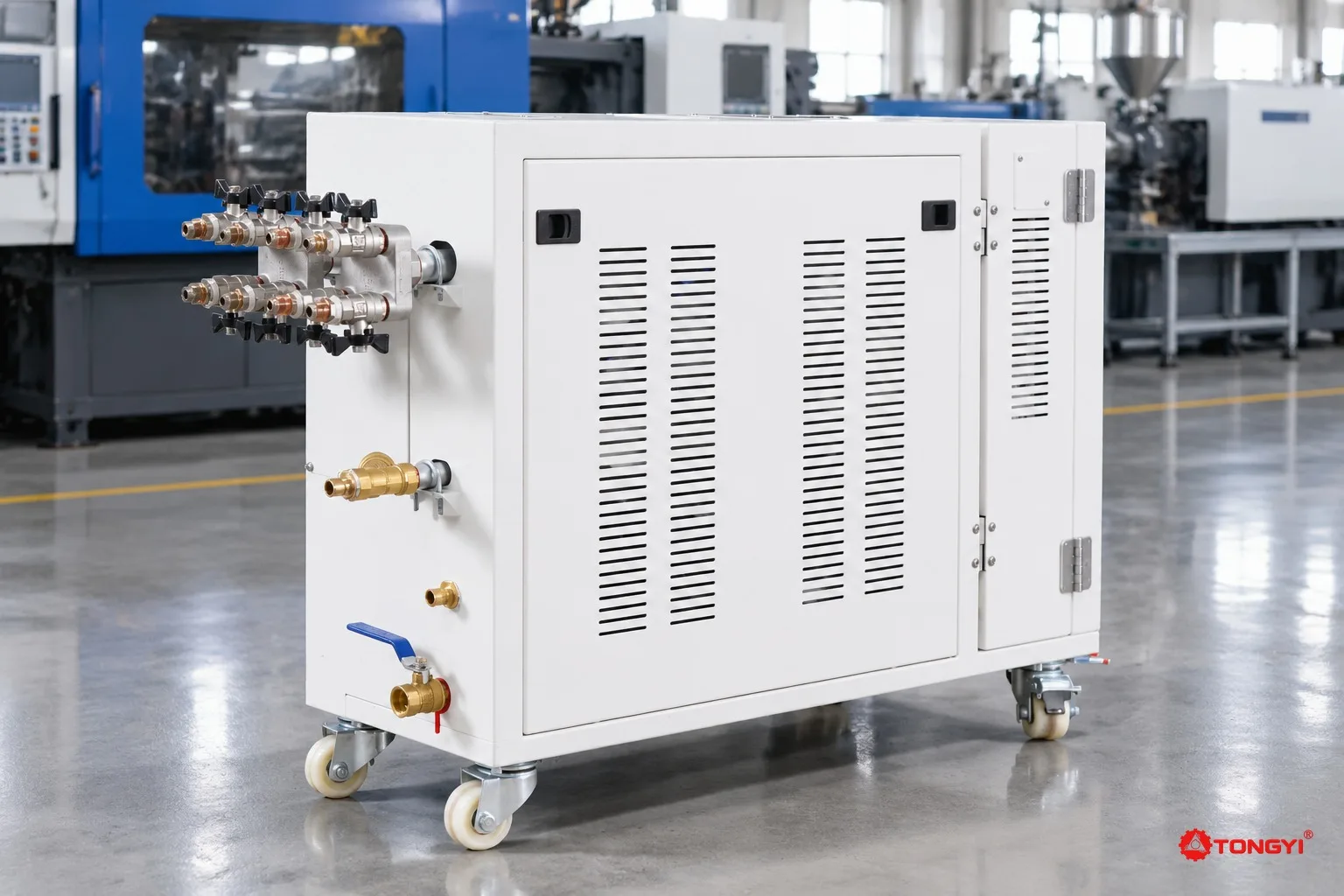
The table below shows the verified specifications for the single-circuit water-type series, so buyers can see exactly where the configuration changes. Every value is model-specific and should be read as belonging to that model only.
| Model | Heating power | Pump power | Max. flow | Max. pressure | Manifold | Media connections |
|---|---|---|---|---|---|---|
| TMC 60W | 6 kW | 0.37 kW | 42 L/min | 0.35 MPa | 2 in 2 out | 3/8 inch |
| TMC 90W | 9 kW | 0.75 kW | 60 L/min | 0.4 MPa | 2 in 2 out | 3/8 inch |
| TMC 120W | 12 kW | 0.75 kW | 60 L/min | 0.4 MPa | 4 in 4 out | 3/8 inch |
| TMC 180W | 18 kW | 1.5 kW | 165 L/min | 0.25 MPa | 1 in 1 out | 1 inch |
| TMC 240W | 24 kW | 1.5 kW | 165 L/min | 0.25 MPa | 1 in 1 out | 1 inch |
| TMC 360W | 36 kW | 2.2 kW | 310 L/min | 0.3 MPa | 1 in 1 out | 1.2 inch |
Two comparisons are worth calling out. First, the TMC 90W and TMC 120W share the same 0.75 kW pump, 60 L/min maximum flow, and 0.4 MPa maximum pressure, yet the TMC 120W carries a 12 kW heater against the TMC 90W’s 9 kW and uses a 4-in 4-out manifold instead of 2-in 2-out. The trade-off is straightforward: the TMC 120W gives you more heating capacity and more manifold circuits for the same hydraulic performance, which matters when the mold has several cooling circuits and a heavier thermal load, but it also draws a larger electrical supply. Second, moving from the TMC 240W to the TMC 360W raises the maximum flow from 165 L/min to 310 L/min and the connection size from 1 inch to 1.2 inch, while the maximum pressure rating changes from 0.25 MPa to 0.3 MPa. Those are different ratings on a different pump and connection arrangement, not a smooth progression, so specify the model you intend to buy rather than an assumed range.
All models in this series run on clean water as the heat transfer medium, with a maximum temperature of 120 °C and a minimum temperature of cooling water temperature plus 5 to 30 °C, and all use direct cooling. Temperature sensing is by K type probe thermocouple. The published series-level temperature accuracy is ±0.1 °C, stated for the TMC water-type series as a whole; the product page does not specify the measurement point, test conditions, or model-by-model applicability, so treat it as a series-level figure and confirm with the supplier how it applies to the exact model and measurement location you are ordering. It is controller accuracy, not a guarantee of temperature uniformity across a mold cavity.
How to structure a quote request with drawings
A quote request that produces comparable numbers across suppliers has five blocks. State the process requirement first: target mold temperature, cooling water supply temperature, and the cycle you are running. Then state the heating capacity you need, in kW, and explain how you arrived at it. Then describe the hydraulic side: how many cooling circuits the mold has, the connection size you want, and whether the manifold should follow an existing layout. Then attach the drawing — a dimensioned sketch of the unit envelope, the connection positions, and the power feed location is enough to price a custom build, and the more complete the drawing the fewer revision cycles. Finally, list the commercial and site conditions: supply voltage and phase, ambient conditions in the plant, whether the controller is standalone or integrated into a skid, and the documentation you expect.
Ask each supplier to break the quote into three parts: the base model, the custom drawing and fabrication scope, and any site-specific options. That breakdown is what makes two quotes comparable. A quote that lumps everything into one number cannot be compared with anything.
What to verify with any supplier before ordering
Because pricing depends on the configuration, the verification list below also protects you from buying the wrong unit. Work through it before you sign anything.
- Confirm the heating capacity in kW against your actual thermal load. It matters because the heater rating drives both cost and the electrical supply you must provide. Check it by comparing the quoted kW against your calculated requirement for the mold and cycle time, and ask what happens to price if the rating changes.
- Confirm the pump’s operating point, not just its maximum ratings. Maximum flow and maximum pressure are separate ratings, and the actual flow depends on your mold’s pressure drop. Check it by asking the supplier for the expected flow at your system’s pressure drop, and confirm which model achieves it.
- Confirm the manifold configuration and connection sizes in writing. The number of circuits and the connection diameter are both cost lines and fit-critical dimensions. Check them against your mold’s cooling circuit count and your hose or pipe standard.
- Confirm the temperature range and cooling water conditions. The stated minimum depends on the cooling water temperature available at your plant. Check it by measuring your cooling water supply temperature and confirming the controller’s stated minimum is at least 5 °C above it.
- Confirm the temperature accuracy claim and its measurement point. The series-level figure of ±0.1 °C describes controller accuracy; it does not describe temperature uniformity across the mold. Check it by asking the supplier to state the measurement point, test conditions, and whether the figure applies to the specific model you are ordering, and by asking how mold temperature is maintained across the cavity.
- Confirm the electrical supply and panel requirements. The heater rating determines the circuit size, and a mismatch can force a site upgrade. Check it by sending your plant’s voltage, phase, and available circuit capacity with the quote request.
- Confirm the drawing revision and approval process. Custom drawings only control cost and fit if the approved revision is the one built. Check it by asking for a drawing approval step in writing, with a named revision number, before fabrication starts.
- Confirm the connection media and water quality requirements. The series uses clean water, and water quality affects component life. Check it by asking what water treatment or filtration is recommended and whether contamination affects warranty terms.
Where custom drawings change the selection, not just the price
Custom drawings are not only a pricing exercise. They often decide which model you should buy. If your mold sits on a skid with a fixed footprint, the controller’s overall dimensions may force a smaller model than your thermal load suggests, which pushes you toward a higher-power unit in a compact configuration or toward a different manifold arrangement. If your plant’s cooling water runs warm in summer, the stated minimum temperature of cooling water plus 5 to 30 °C becomes the binding constraint, and a larger cooling margin may be worth paying for. If your mold uses many small circuits rather than a few large ones, the manifold choice between a 2-in 2-out, 4-in 4-out, or 1-in 1-out arrangement matters more than raw flow.
This is why the drawing and the specification should be quoted together. A supplier who sees the drawing can tell you whether the model you named will actually fit and control the mold, and can price any change before it becomes a change order. Buyers who send a drawing with the initial inquiry generally get a firmer number and fewer surprises than buyers who send only a model number.
Frequently asked questions
How much does a water-type mold temperature controller cost?
There is no single figure, because the price is set by the configuration rather than the category. Heating capacity, pump size and flow rating, manifold arrangement, connection sizes, and the engineering work behind a custom drawing each change the quote. The productive approach is to define your process temperature, cooling water conditions, required heating power, and manifold layout, then request a quote against that defined configuration so suppliers can be compared on the same scope.
Why does a custom drawing raise the price of a mold temperature controller?
A custom drawing adds engineering time to the order: the supplier has to produce drawings, revise them through review cycles, and fabricate to the approved revision. It can also change the base configuration, for example a different manifold layout or a different connection size than the standard model. Ask for the drawing and fabrication scope to be quoted as its own line item, so you can see what the customization actually costs and compare it against the value of fitting your existing plant layout.
How do I compare quotes from different mold temperature controller suppliers?
Ask every supplier to split the quote into the base model, the custom drawing and fabrication scope, and site-specific options, then check that each quote names the same model, the same heating capacity in kW, the same pump rating, and the same manifold and connection sizes. A quote that combines everything into one figure cannot be compared. Confirm as well that the maximum flow and maximum pressure ratings are quoted separately, since they describe different aspects of pump performance.
What specifications should I include in a quote request?
Include the target mold temperature, the cooling water supply temperature available at your plant, the process cycle, the required heating capacity in kW, the number of cooling circuits in the mold, the connection size and standard you use, the supply voltage and phase, and the expected documentation. Attach a dimensioned drawing of the unit envelope, connection positions, and power feed location. Also state whether the controller will stand alone or be integrated into an existing skid.
Does a higher maximum flow rating mean the controller will cool my mold faster?
Not necessarily on its own. Maximum flow and maximum pressure are separate ratings, and the flow your mold actually receives depends on the pressure drop through its cooling channels. A model with a higher maximum flow rating but a lower maximum pressure rating may deliver less flow through a restrictive mold than expected. Give the supplier your mold’s cooling circuit details and ask which model achieves the required flow at your system’s pressure drop.
What does the ±0.1 °C temperature accuracy figure cover?
It is a published series-level figure for the water-type series and describes controller temperature accuracy, not temperature uniformity across a mold cavity. The published scope does not specify the measurement point, test conditions, or applicability by model, so confirm with the supplier before relying on it for a specific unit. If your process depends on consistent cavity temperature, ask separately how mold temperature is maintained across the tool and where the sensor is located.