
How Much Does a Water-Type Mold Temperature Controller Cost, and How Do I Choose and Customize the Right TCU?
Water-type mold temperature controller pricing depends on heating power, pump flow and manifold configuration, so this guide explains the cost drivers.
What Actually Drives the Price of a Water-Type Mold Temperature Controller
Because water-type units in this class share a common architecture — clean water as the heat-transfer medium, direct cooling, and a maximum temperature of 120 °C — the main variables that separate a small unit from a large one are electrical and hydraulic:
- Heating power (electric kW). Larger heaters cost more in components and wiring, and may require higher-capacity facility power.
- Pump power and flow rate. A bigger pump moves more water through the mold circuit, which matters for large or multi-cavity molds, but adds cost.
- Number of media circuits at the manifold. A 2-in/2-out splitter serves fewer zones than a 4-in/4-out arrangement; more circuits mean more plumbing and controls.
- Port size. Larger return and media ports (for example 1 inch versus 3/8 inch) support higher flow but change the plumbing package.
- Options and customization. Non-standard port arrangements, special control requirements, or integration with your plant’s monitoring system all add engineering time and cost.
Because these variables differ from buyer to buyer, reputable suppliers quote per configuration rather than publishing a single list price. That is not a pricing tactic — it is the only way to make the quote match the machine you actually need.
Water-Type TCU Model Range: A Like-for-Like Comparison
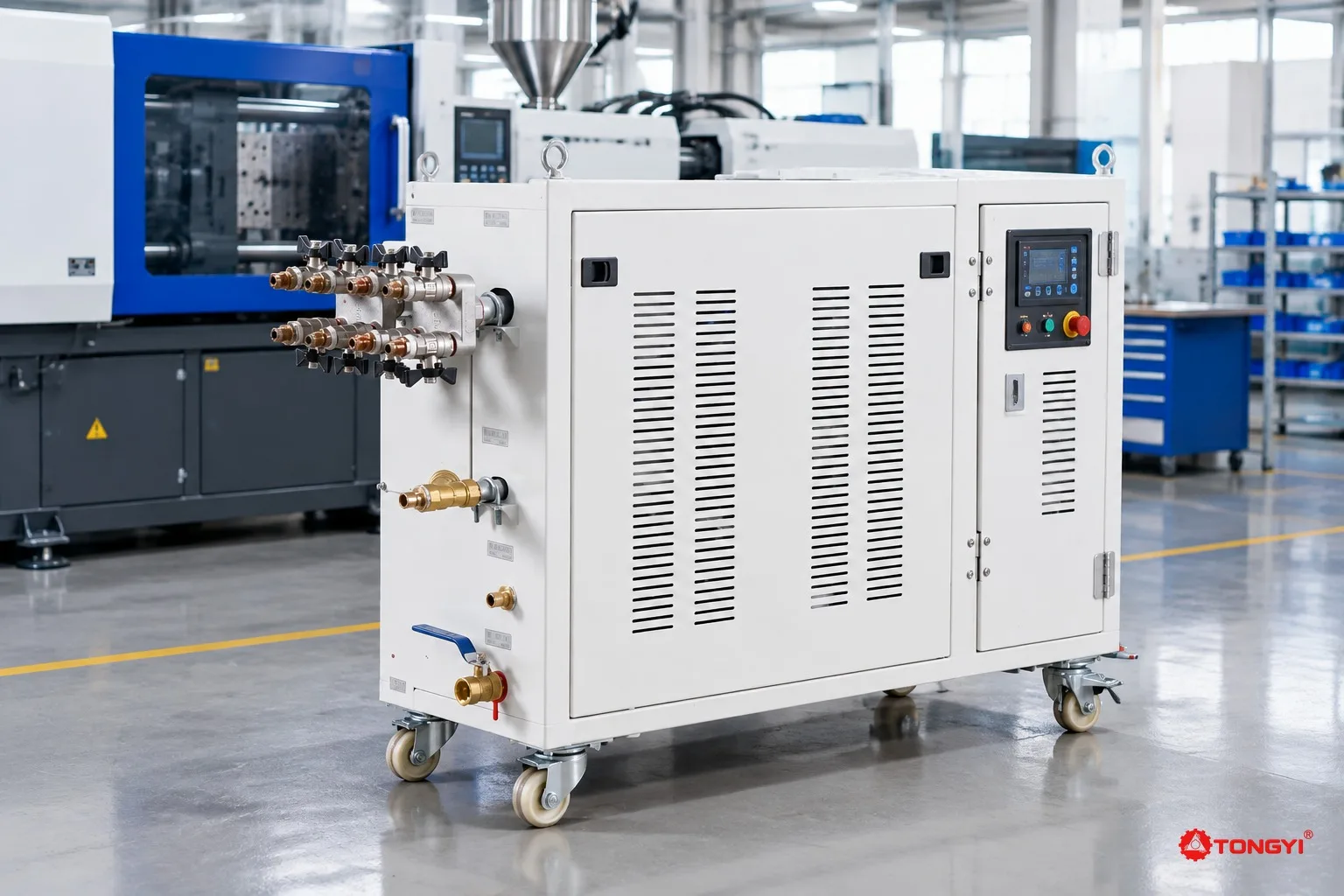
The table below compares published models in a water-type series so you can see exactly which specification changes drive cost and capacity. All models use clean water as the medium, direct cooling, a K-type probe thermocouple, and a 15 mm return port.
| Model | Heating power | Pump power | Max flow | Max pressure | Manifold | Media ports |
|---|---|---|---|---|---|---|
| TMC 60W | 6 kW | 0.37 kW | 42 L/min | 0.35 MPa | 2 in / 2 out | 3/8 inch |
| TMC 90W | 9 kW | 0.75 kW | 60 L/min | 0.4 MPa | 2 in / 2 out | 3/8 inch |
| TMC 120W | 12 kW | 0.75 kW | 60 L/min | 0.4 MPa | 4 in / 4 out | 3/8 inch |
| TMC 180W | 18 kW | 1.5 kW | 165 L/min | 0.25 MPa | 1 in / 1 out | 1 inch |
| TMC 240W | 24 kW | 1.5 kW | 165 L/min | 0.25 MPa | 1 in / 1 out | 1 inch |
| TMC 360W | 36 kW | 2.2 kW | 310 L/min | 0.3 MPa | 1 in / 1 out | 1.2 inch |
Two specifications in this table deserve closer attention because they most directly shape both price and process capability.
Heating power. The series spans 6 kW on the TMC 60W up to 36 kW on the TMC 360W. Heating power determines how quickly the unit can bring the mold up to setpoint and how well it holds temperature under heat load from the process. A 6 kW unit suits small molds and modest heat loads; a 36 kW unit is for molds that pull a lot of heat or need fast recovery between cycles. Undersizing the heater is one of the most common and expensive selection mistakes — the controller runs at full output and never stabilizes, and you end up buying a second unit later.
Maximum flow. Flow ranges from 42 L/min on the TMC 60W to 310 L/min on the TMC 360W. Flow capacity decides how much water you can push through mold channels, which affects heat-transfer rate and how many circuits you can feed. Note that the larger-flow models (TMC 180W, 240W, 360W) use 1 in / 1 out manifolds with 1 inch or 1.2 inch ports, while the smaller models use 2 in / 2 out or 4 in / 4 out arrangements with 3/8 inch ports — the plumbing layout and the flow rating go together, so you cannot mix them freely when customizing.
Also note the trade-off between pump size and pressure: the TMC 180W and 240W have a 0.25 MPa maximum pressure, lower than the 0.4 MPa on the TMC 90W and 120W, because their pumps are optimized for volume rather than head. If your mold circuit has high flow resistance (long, narrow channels), confirm pressure margin with the supplier rather than assuming a bigger model automatically gives you more of everything.
All models in the series share a 120 °C maximum temperature with direct cooling, a minimum operating temperature of cooling water temperature plus 5–30 °C, and the manufacturer publishes a temperature accuracy of ±0.1 °C for the water-type series. That accuracy figure is a series-level published claim; the product page does not specify how it was measured or at what conditions, so treat it as a baseline to verify with the supplier for your specific application rather than a per-model guarantee of uniformity across the mold cavity.
How to Choose the Right TCU for Your Application
Start from your mold and process, not from the model list:
- Heat load. Estimate how much heat the molding process puts into the mold and how fast you need recovery. That sets the minimum heating power.
- Circuit count. Count the independent water zones in the mold. A 4 in / 4 out manifold (TMC 120W) suits multi-zone molds; single large-circuit molds match the 1 in / 1 out models.
- Flow resistance. Long or narrow cooling channels need pressure head, not just volume — check the maximum pressure rating against your circuit.
- Target temperature. Water-type units in this class top out at 120 °C. If your process needs more, you need an oil-type unit instead, which is a different product with a different price structure.
- Plant water and power. Confirm your facility can supply the pump’s electrical load and adequate cooling water at the required temperature.
Customization: What You Can Specify and What It Adds to Cost
Suppliers of this equipment class commonly accommodate customization requests, but each change is engineering work. Typical customizeable points include:
- Non-standard manifold configurations or port sizes beyond the published 3/8, 1, or 1.2 inch options.
- Control upgrades — additional sensors, remote monitoring, or integration with plant data systems.
- Special mounting, footprint, or enclosure requirements.
- Controls calibrated for unusual start-up or cooling-water conditions.
When you request customization, ask the supplier to quote the standard equivalent configuration alongside the modified one. That gives you a clear view of what the customization itself costs and makes the quotes comparable across vendors. Also confirm in writing that modified specifications carry the same published ratings — the manufacturer notes that specifications are subject to change without notice, so a written confirmation of the as-built spec sheet protects you.
How to Request a Quote That You Can Actually Compare
To get comparable quotes for a water-type mold temperature controller, give every supplier the same inputs:
- Required heating power in kW (or your heat-load estimate so they can size it).
- Required flow rate and number of mold circuits.
- Target operating temperature and your available cooling water temperature.
- Mold port sizes and connection layout.
- Any customization requirements, stated as functional needs rather than part numbers.
- Delivery scope: does the quote include freight, installation support, commissioning, and spare parts?
A quote that omits any of these items is not comparable — ask for the missing line before comparing prices, or you will be comparing machines that are not actually the same machine.
Next Step
If your process fits within a 120 °C water-type envelope, shortlist one or two models from the table above based on heating power and circuit configuration, then send suppliers a quote request with the specification list in the previous section. If your team also runs drying or material handling alongside molding, the same spec-driven approach applies when sizing an industrial hopper dryer or planning a central feeding system for the full cell.
Get a specification-matched quote
Send the mold size, required working temperature, cooling channels per circuit and your electrical supply. We reply with a like-for-like configuration and the documented specifications for each model in the offer.
Every figure in this guide comes from our published specification sheets. Confirm model scope and test conditions before ordering.