
How Much Does a Water-Type Mold Temperature Controller Cost from a Custom Manufacturer?
Compare documented product features and process requirements before selecting a mold temperature controller.
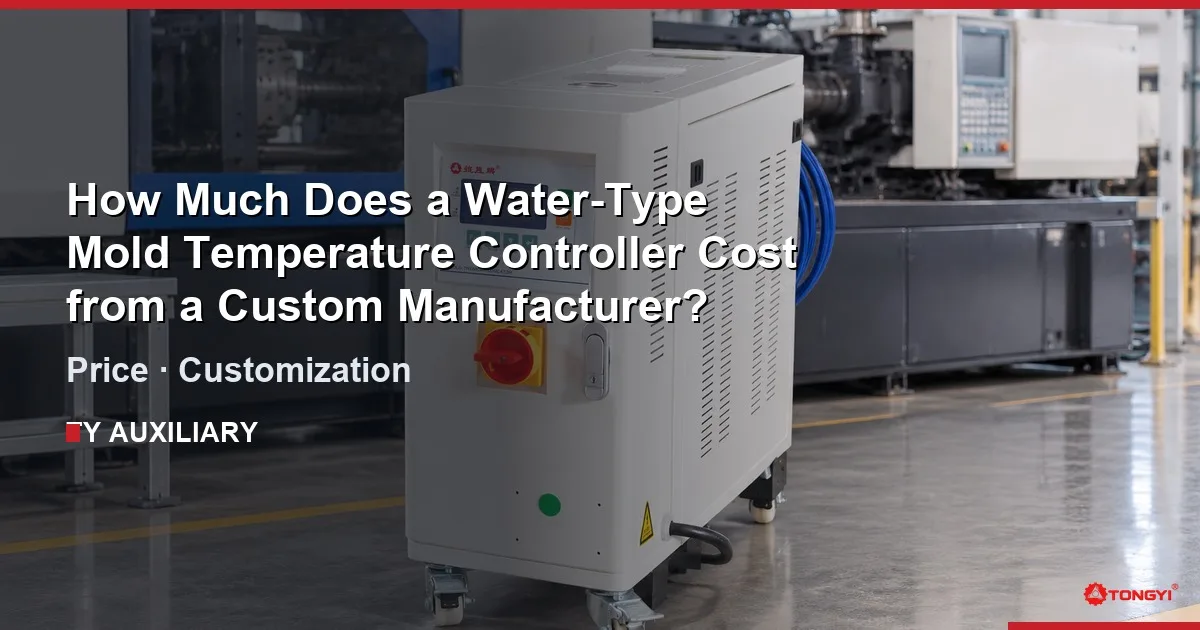
A water-type mold temperature controller sourced from a custom manufacturer typically costs more than a catalog standard unit, but the exact figure depends on heating capacity, pump size, customization scope, and order quantity. Because pricing varies widely by configuration and market, this guide does not quote currency amounts. Instead, it explains what actually drives the price, which specifications to lock down before requesting a quote, and how to compare custom-manufacturer offers on a like-for-like basis so you can evaluate whether the number you receive is justified.
Why Pricing a Water-Type Mold Temperature Controller Is Configuration-Driven
Water-type units circulate clean water as the heat-transfer medium, usually up to around 120 °C in standard designs, and their cost scales directly with the electrical and hydraulic components inside the cabinet. A custom manufacturer adjusts heater kilowatts, pump power, flow capacity, and plumbing configurations to match your molding process, so two quotes for nominally similar machines can differ substantially once these variables change.
The main cost drivers you should expect a supplier to itemize are:
- Heating capacity (electric heater power). Larger heaters cost more and may require higher-amperage electrical service at your plant, which affects total installed cost.
- Pump power and maximum flow. Higher flow supports larger molds and longer runner circuits but increases pump cost and piping size.
- Cooling method. Direct cooling is the simpler, lower-cost approach; indirect designs add a heat exchanger.
- Manifold and port configuration. The number of media inlet/outlet circuits and pipe diameters change machining and assembly time.
- Control features. Temperature sensor type, controller sophistication, and safety interlocks influence both price and long-term reliability.
- Customization depth. Non-standard voltages, footprint constraints, special materials, or integration with your existing PLC environment all add engineering hours.
- Order quantity and freight terms. Unit pricing improves with volume, and shipping, crating, and destination duties belong in any honest cost comparison.
What the Verified Model Range Tells You About Cost Drivers
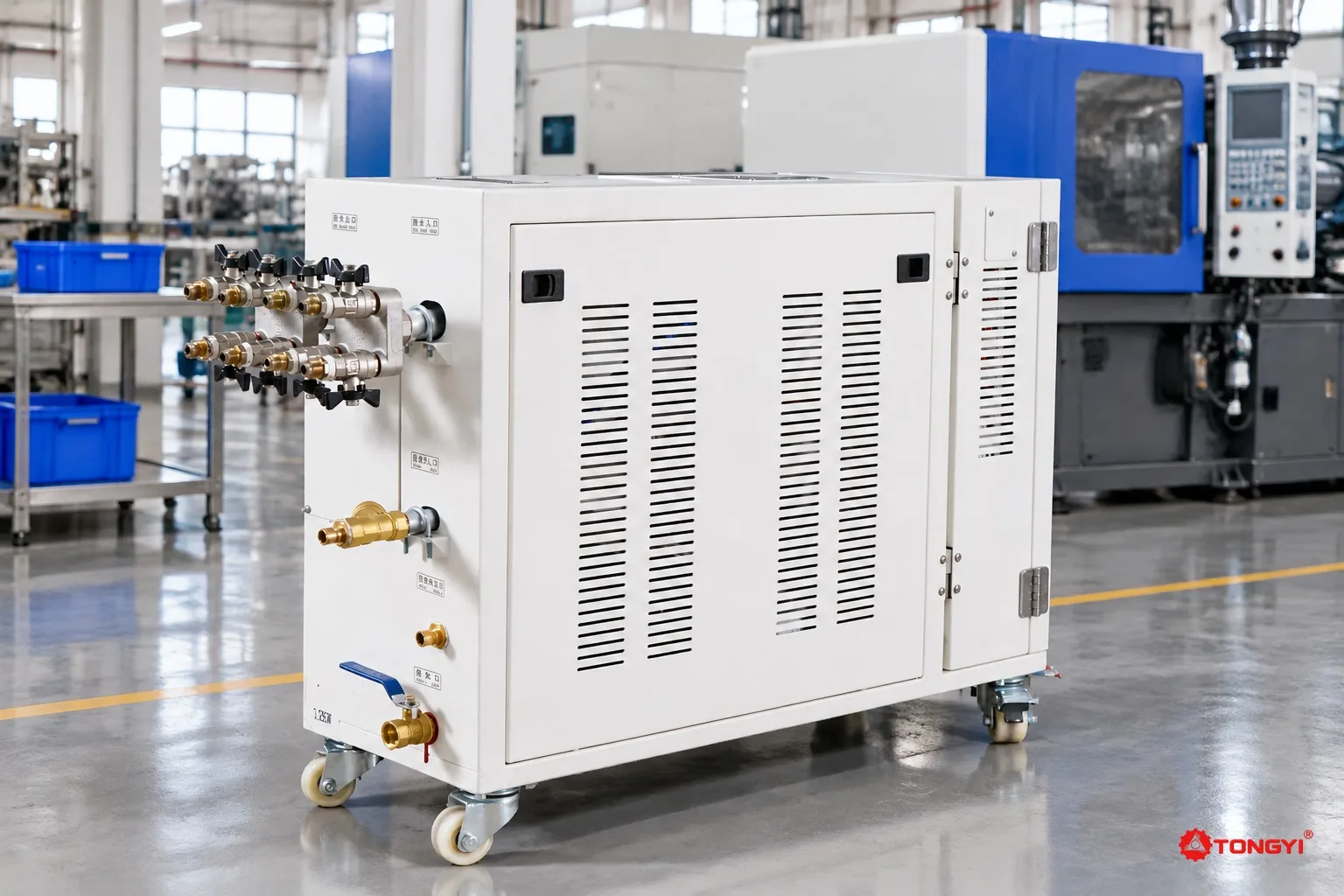
Looking at a real product series makes the price logic concrete. The models below are all water-type units using clean water as the medium with direct cooling and a 120 °C maximum temperature, but they span very different capacities — and therefore very different component costs.
| Model | Heater Power | Pump Power | Max Flow | Max Pressure | Manifold | Port Size |
|---|---|---|---|---|---|---|
| TMC 60W | 6 kW | 0.37 kW | 42 L/min | 0.35 MPa | 2-in / 2-out | 3/8 inch |
| TMC 90W | 9 kW | 0.75 kW | 60 L/min | 0.4 MPa | 2-in / 2-out | 3/8 inch |
| TMC 120W | 12 kW | 0.75 kW | 60 L/min | 0.4 MPa | 4-in / 4-out | 3/8 inch |
| TMC 180W | 18 kW | 1.5 kW | 165 L/min | 0.25 MPa | 1-in / 1-out | 1 inch |
| TMC 240W | 24 kW | 1.5 kW | 165 L/min | 0.25 MPa | 1-in / 1-out | 1 inch |
| TMC 360W | 36 kW | 2.2 kW | 310 L/min | 0.3 MPa | 1-in / 1-out | 1.2 inch |
Two values in this table are especially useful for judging quotes. First, heater power: the TMC 60W carries a 6 kW heater while the TMC 360W carries 36 kW — a six-fold difference that translates directly into heater, contactor, and wiring costs, plus higher electrical service requirements at your facility. A supplier quoting one price for “a 6 kW class machine” and another for “36 kW” should not be compared line-by-line without acknowledging this gap. Second, pump maximum flow: the TMC 60W delivers 42 L/min, whereas the TMC 360W reaches 310 L/min. Flow determines how many mold circuits you can serve and how quickly heat moves through long channels, so under-sizing it to save money is a common false economy. Note that maximum flow and maximum pressure are separate ratings — for example, the TMC 180W offers 165 L/min at a 0.25 MPa maximum pressure, which is a different operating envelope than the smaller 3/8-inch-port models. Confirm both figures against your mold’s circuit count and pressure-drop requirements.
All models in the series use a K-type probe thermocouple for media inlet and outlet temperature sensing and a 15 mm return port. The published series-level specification also cites a temperature accuracy of ±0.1 °C for the water-type TMC series; because the product page does not define the measurement point or test conditions for that figure, treat it as a series-level claim and ask the manufacturer to confirm the applicable conditions for your model before relying on it in a process qualification.
How Sizing Choices Shape What You Pay
Match heater power to your heat-up requirement
Oversizing the heater inflates both purchase price and running cost, while undersizing stretches startup times and destabilizes cycle-to-cycle temperatures. Estimate the mold mass and the temperature you need to reach, then let the manufacturer propose a heater rating — the 6 kW to 36 kW span above covers small single-cavity tools up to larger multi-circuit molds.
Match flow and port configuration to your mold’s cooling channels
A 2-in/2-out manifold with 3/8-inch ports (as on the TMC 60W, 90W, and 120W) suits molds with multiple parallel small-diameter circuits, while 1-in/1-out arrangements with 1-inch or 1.2-inch ports (TMC 180W, 240W, 360W) favor high-flow single-circuit designs. Custom manufacturers will reconfigure manifolds, but every deviation from standard adds cost — so know your mold before you negotiate.
Custom Manufacturing: Where the Extra Cost Goes and When It’s Worth It
Buying from a custom manufacturer rather than a distributor typically means you can specify the exact combination of heater power, pump, manifold, sensor type, and control interface your molding plant needs. That flexibility shows up in the quote as engineering and assembly labor. It is worth paying for when:
- Your plant power standard differs from the supplier’s default voltage and frequency.
- Your mold requires an unusual circuit count or port arrangement that standard units cannot serve efficiently.
- You need the controller integrated with an existing central temperature-control or plant monitoring system.
- Spare-part commonality with your existing fleet matters for maintenance planning.
If none of these apply, a standard configuration will almost always be cheaper and faster to deliver.
What to Include in a Quote Request to a Custom Manufacturer
To get comparable pricing rather than a vague ballpark, send each supplier the same technical package:
- Required operating temperature range and the medium (confirm clean water is acceptable at your maximum temperature).
- Heater power or the mold data needed to calculate it.
- Required flow rate, number of circuits, and port sizes.
- Cooling method preference and available cooling-water supply conditions (the minimum operating temperature is typically tied to cooling-water temperature plus 5–30 °C, so your plant water matters).
- Electrical supply specification (voltage, frequency, phase).
- Temperature sensor type and controller interface requirements.
- Delivery destination, Incoterms, and target quantity.
Suppliers who respond with itemized line items for each of these can be compared directly; suppliers who quote a single lump number cannot.
Comparing Custom-Manufacturer Quotes on a Like-for-Like Basis
Once quotes arrive, normalize them before judging the price:
- Confirm every quote is for the same heater power, pump power, flow rating, and pressure rating.
- Confirm the same manifold configuration and port sizes are included.
- Check whether temperature accuracy is stated, and at what scope and conditions — a series-level claim such as ±0.1 °C should be confirmed for the specific model being quoted.
- Ask what is excluded: spare parts, commissioning support, documentation, freight, and duties are frequent add-ons.
- Verify lead time and warranty terms are stated in writing.
If you are also evaluating oil-type units for higher-temperature applications, compare them against the oil-type mold temperature controller range, or review the full water-type mold temperature controller series before finalizing a specification. For plants consolidating temperature control across multiple machines, a central temperature control system may change the unit-count and cost picture entirely.
Frequently Asked Questions
What is the maximum operating temperature of a water-type mold temperature controller?
Standard water-type units in the TMC series reach 120 °C with clean water as the medium, and the minimum operating temperature depends on your cooling-water supply, typically cooling-water temperature plus 5 to 30 °C. If your process needs higher temperatures, discuss an oil-type unit or a pressurized water design with the manufacturer.
How do I choose between the different heater power ratings?
Base the choice on your mold mass, target temperature, and required heat-up time. The series spans 6 kW on the TMC 60W up to 36 kW on the TMC 360W, so a custom manufacturer can match the rating to your thermal load instead of forcing you into an oversized standard unit.
Does higher flow always cost more?
Generally yes, because higher flow requires a larger pump and bigger piping. The series ranges from 42 L/min on the TMC 60W to 310 L/min on the TMC 360W, so specifying only the flow your mold circuits actually need keeps the quote lean.
What does ±0.1 °C temperature accuracy actually mean for my process?
It is a published series-level specification for the water-type TMC line, meaning the controller’s regulation accuracy at the media temperature sensor. It is not a guarantee of temperature uniformity throughout the mold cavity, and the measurement point and test conditions are not defined on the product page, so confirm applicability to your specific model with the supplier.
Why do I need to tell the supplier my cooling-water conditions?
Because the minimum controllable temperature is defined as cooling-water temperature plus 5 to 30 °C in this series, your plant’s supply water temperature directly determines the lowest stable operating point the unit can hold — a key input for sizing the right model.
Can a custom manufacturer modify the manifold and port configuration?
Yes — that is the core advantage of custom manufacturing. Standard models ship with configurations from 2-in/2-out with 3/8-inch ports up to 1-in/1-out with 1.2-inch ports, and manufacturers can adapt manifolds to your mold’s circuit layout, though non-standard configurations add cost and lead time.