
How Much Does a Water-Type Mold Temperature Controller Cost, and What’s the Difference Between Standard and Custom Units?
Learn how heating power, pump flow and pressure, manifold configuration, and customization scope drive the cost of a water-type mold temperature.
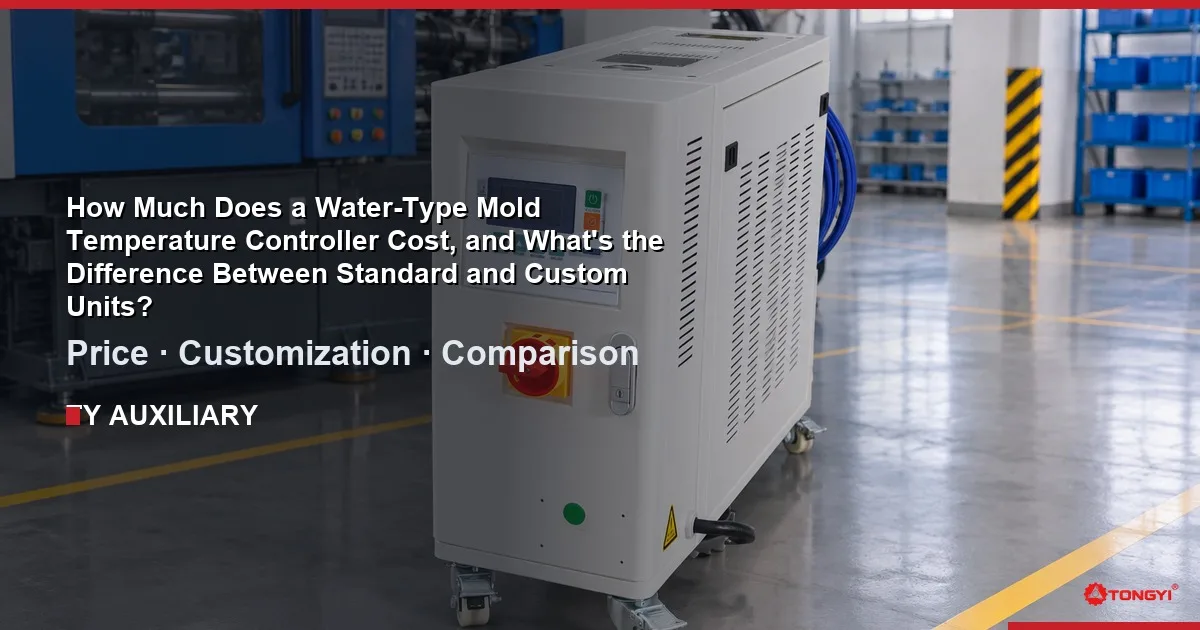
A water-type mold temperature controller is usually quoted as a configured package rather than a fixed catalog item, so two buyers asking about the same model can receive materially different numbers. Expect five cost drivers to dominate the quote: heating capacity, pump flow and pressure, the manifold and piping configuration, the temperature-control electronics, and the scope of any customization. Because published list prices are rare in this category, the practical way to price a unit is to specify the process duty first and ask for a line-item quotation against those numbers.
Why water-type mold temperature controllers are quoted per application
Water units sit at the low-temperature end of mold temperature control. They circulate clean water through the mold circuit, heat it with an electric element, and shed heat through direct cooling when the mold runs hot. Because the same control cabinet can be built with different heaters, pumps, and manifolds, manufacturers price against the process rather than against a single stock SKU. That is also why a buyer who asks “what does one cost” without specifying the mold will usually get a request for more information instead of a number.
For overseas buyers, that dynamic has a second effect: the fastest way to compare suppliers is to send an identical specification sheet to each one, so that every quote is answering the same question.
What actually drives the price of a water-type mold temperature controller
Heating capacity sets the largest single cost step
Heating power is the dominant hardware cost, because it determines the element bank, the contactors, and the main power wiring. In the TMC water-type series, heating power spans 6 KW on the TMC 60W up to 36 KW on the TMC 360W. The significance for purchasing is straightforward: if the mold’s heat load is modest and the cycle is slow, a smaller heater does the same job for less money, while an oversized heater raises unit cost and electrical service requirements without improving cycle time. The boundary condition to respect is that heating capacity is sized against the heat the mold actually has to absorb, not against the machine’s clamp force.
Pump flow and pressure usually move together, but not always in the same direction
Pump power, maximum flow, and maximum pressure are quoted separately because they are separate ratings. Two examples from the same series make the trade-off visible. The TMC 180W uses a 1.5 KW pump rated at a maximum flow of 165 L/MIN and a maximum pressure of 0.25 MPA, while the TMC 360W uses a 2.2 KW pump rated at a maximum flow of 310 L/MIN and a maximum pressure of 0.3 MPA. Both are maximum ratings, not simultaneous operating points: a circuit that demands high pressure may not see the full rated flow, and vice versa. For a buyer, this is the single most common source of mismatched quotes — one supplier quotes the flow figure the mold needs, the other quotes a pressure figure that sounds higher but does not describe the same duty.
High flow matters when the mold has many parallel cooling circuits and the goal is an even temperature profile across the tool. High pressure matters when the circuit is long, restrictive, or narrow. When you request pricing, state which of the two your circuit actually needs, and include the mold’s internal channel layout so the supplier can size the pump against it.
Manifold configuration and connection sizing are quiet cost factors
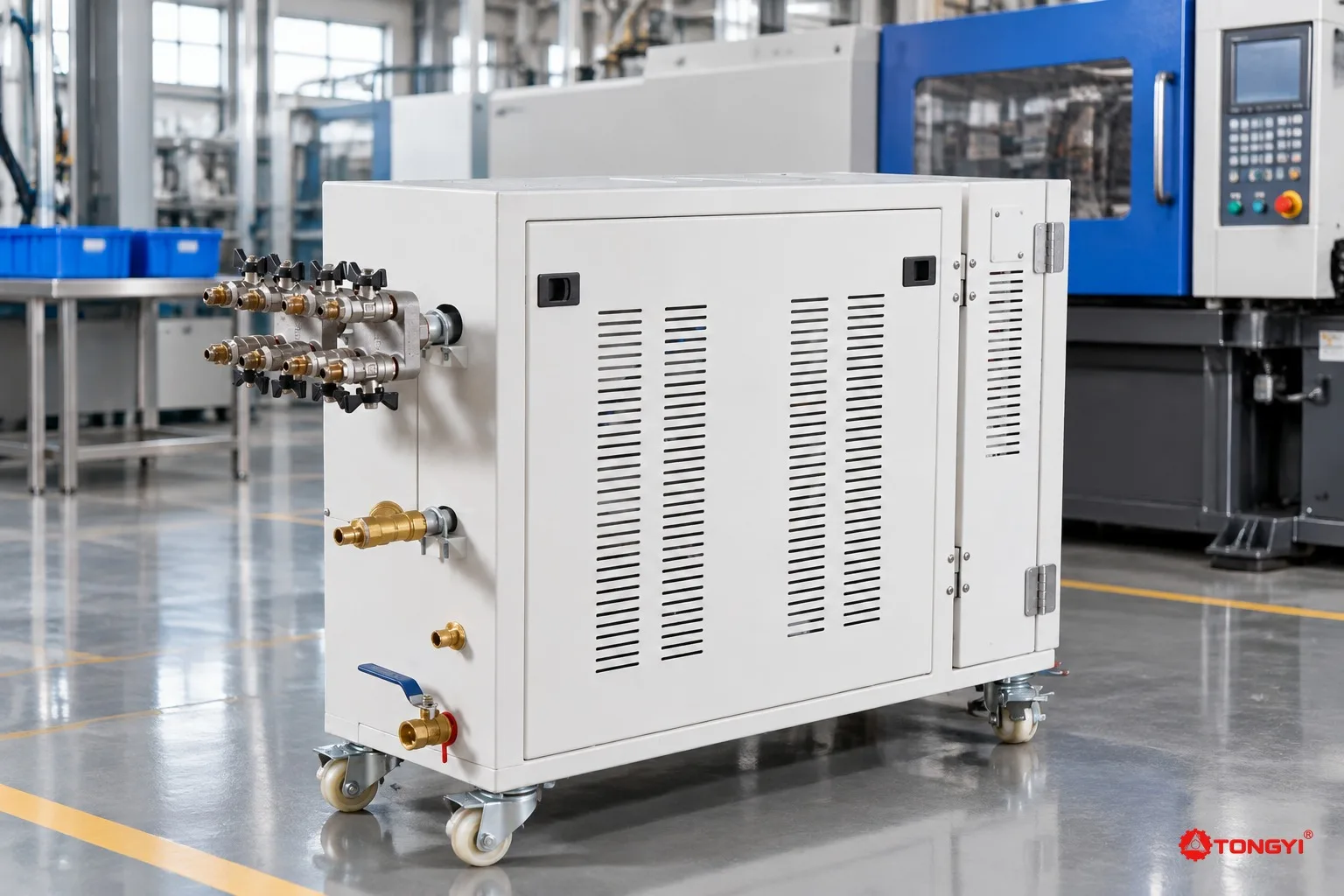
The number of media inlet and outlet ports changes the manifold assembly, the fittings, and the labor content of the build. The TMC 60W, TMC 90W, and TMC 120W are supplied with a 2-in/2-out manifold and 3/8 inch media ports, while the TMC 120W is supplied as a 4-in/4-out unit at the same 3/8 inch port size. The 180W, 240W, and 360W models move to a 1-in/1-out manifold, with the TMC 180W and TMC 240W at a 1 inch media port and the TMC 360W at 1.2 inch. A mold with four separate circuits needs the port count to match, so a buyer who specifies only temperature and flow can end up paying twice — once for the wrong manifold, and again to correct it.
Control electronics and accuracy claims
The published TMC water-type series specification states a temperature accuracy of ±0.1 °C. That figure is a series-level claim with a defined scope: the product page does not specify which models it applies to, at which measurement point it is measured, or under what test conditions, so it should be treated as requiring supplier confirmation for a specific model and application. It is also a controller accuracy figure, not a statement about temperature uniformity across a mold cavity — cavity uniformity depends on circuit layout, flow distribution, and manifold balance, which are mold-side variables. Buyers comparing brands should ask each supplier to state the measurement point and test conditions behind any accuracy claim.
Customization scope is the largest variable in the quote
The difference between a standard unit and a custom unit is rarely the control cabinet; it is everything attached to it. Standard configurations follow the published model set, with defined heating power, pump, manifold, and port sizes. Custom work changes one or more of those, and each change adds engineering review, non-standard parts, and often a separate production run.
Typical customization categories include:
- Port count and port size to match an existing mold or manifold that will not be modified
- Pump selection for a circuit with unusual flow or pressure demand
- Electrical configuration for the destination plant’s supply voltage and phase
- Interface and controls, such as a specific signal type, communication protocol, or alarm output
- Cabinet dimensions or layout to fit a constrained space beside the press
- Documentation, spare parts kit, and labeling requirements
Each of these should be listed explicitly in the quote request. A customization that is described in a sentence will be priced more loosely than one described as a dimension, a rating, or a part number.
Standard vs. custom water units: a like-for-like comparison
The table below compares four exact models from the published series. Only the supplied values appear; every figure stays attached to its own model and operating condition.
| Specification | TMC 60W | TMC 120W | TMC 180W | TMC 360W |
|---|---|---|---|---|
| Heating power | 6 KW | 12 KW | 18 KW | 36 KW |
| Pump power | 0.37 KW | 0.75 KW | 1.5 KW | 2.2 KW |
| Maximum flow | 42 L/MIN | 60 L/MIN | 165 L/MIN | 310 L/MIN |
| Maximum pressure | 0.35 MPA | 0.4 MPA | 0.25 MPA | 0.3 MPA |
| Manifold | 2-in/2-out | 4-in/4-out | 1-in/1-out | 1-in/1-out |
| Media port size | 3/8 inch | 3/8 inch | 1 inch | 1.2 inch |
| Maximum temperature | 120 °C | 120 °C | 120 °C | 120 °C |
| Minimum temperature | Cooling water temperature +5~30 °C | Cooling water temperature +5~30 °C | Cooling water temperature +5~30 °C | Cooling water temperature +5~30 °C |
| Cooling method | Direct | Direct | Direct | Direct |
Read across the pump rows and a documented trade-off appears: the TMC 180W and TMC 360W are the high-flow models in this set, but their maximum pressure ratings (0.25 MPA and 0.3 MPA) are lower than the TMC 120W’s 0.4 MPA. A buyer who needs to push water through a long, restrictive circuit cannot simply step up to the largest model and assume every rating rises with it. This is exactly the kind of detail that separates a correct standard selection from an unnecessary custom build.
What to include in a quote request
Because no supplier can price a configured unit without the duty, a complete request shortens the quoting cycle and makes quotes comparable. Include:
- Required mold surface temperature and the acceptable control band
- Number of independent cooling circuits in the mold and the port layout
- Estimated heat load the mold must absorb per cycle
- Available cooling water temperature at the plant
- Plant supply voltage, phase, and frequency
- Ambient conditions and whether the unit sits beside the press or in a utility area
- Any interface, alarm, or documentation requirements
Send the same list to every supplier. When quotes come back, compare them line by line against the specification rather than on total figure alone, and ask each supplier to state whether a claim applies to the specific model quoted or only to the series.
Where the money usually goes wrong
Two purchasing mistakes recur in this category. The first is buying heating capacity the process does not need, which raises both unit cost and the electrical service the plant has to provide. The second is buying on flow alone when the circuit is pressure-limited, or on pressure alone when the mold has many parallel circuits that need balanced flow. Both mistakes usually end in a custom rebuild, which costs more than specifying correctly the first time.
A practical step before requesting pricing is to review the water-type mold temperature controller series specifications against your mold’s circuit layout, and to look at how the unit will be integrated with the rest of the temperature control equipment on the press. If the mold will be served by more than one unit, confirm the balance between them before ordering rather than after installation.
Frequently asked questions
How much does a water-type mold temperature controller cost?
There is no single figure, because the unit is configured against the process. The quote is driven by heating power, pump flow and pressure, manifold and port configuration, control electronics, and any customization. In the TMC water-type series, heating power alone ranges from 6 KW on the TMC 60W to 36 KW on the TMC 360W, and that step change is the largest single cost driver. Request a line-item quote against your mold’s duty rather than a catalog price.
What is the difference between a standard and a custom water-type mold temperature controller?
A standard unit follows the published model set with defined heating power, pump, manifold, and port sizes. A custom unit changes one or more of those to match an existing mold, an unusual circuit, a specific plant voltage, or a required interface. The control cabinet itself is often the same; the difference is in the attached hardware and the engineering review it requires.
Which specifications should I send to get an accurate quote?
Send the required mold surface temperature and control band, the number of independent cooling circuits and their port layout, the estimated heat load per cycle, the plant’s cooling water temperature, the supply voltage and phase, and any interface or documentation requirements. Sending an identical list to each supplier is what makes the resulting quotes comparable.
Can I select a model on maximum flow alone?
No. Maximum flow and maximum pressure are separate ratings, and they do not always rise together. In the TMC series, the TMC 180W is rated at 165 L/MIN and 0.25 MPA while the TMC 120W is rated at 60 L/MIN and 0.4 MPA. A circuit that is long or restrictive may need the higher pressure figure, while a mold with many parallel circuits needs the higher flow.
Does the ±0.1 °C temperature accuracy apply to every model in the series?
The ±0.1 °C figure is published at the series level for the TMC water-type units. The product page does not specify which models it covers, at which measurement point it is measured, or under what test conditions, so buyers should ask the supplier to confirm it for the exact model and application being quoted. It is a controller accuracy figure, not a statement about temperature uniformity across a mold cavity.
What determines whether a custom build is necessary?
A custom build is usually necessary when the mold’s manifold or port layout cannot be changed to match a standard unit, when the circuit’s flow or pressure demand falls outside the standard pump options, or when the destination plant’s electrical supply or control interface differs from the standard configuration. If none of those apply, a standard model from the published series is normally the lower-cost path.