
How Much Does a Custom Water-Type Mold Temperature Controller Cost, and Can You Send a Custom Quote Sheet?
Custom water-type mold temperature controller prices depend on heating capacity and pump flow; request a line-by-line quote sheet to compare supplier.
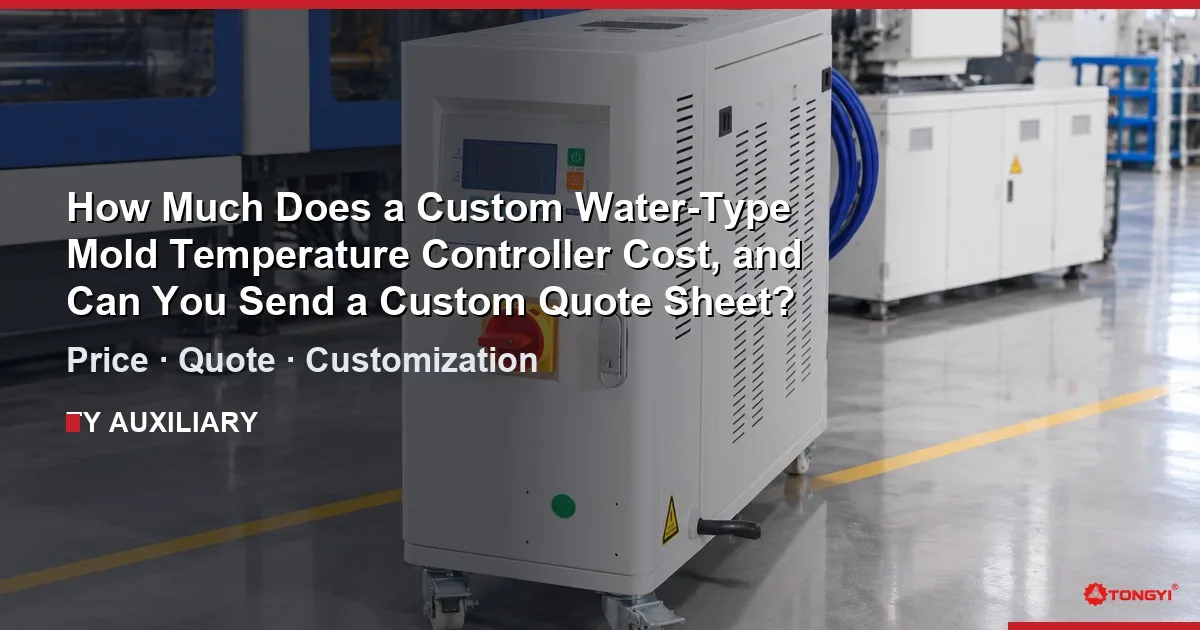
There is no list price for a custom water-type mold temperature controller, because the unit is built around your mold, your plant water and your process window. What you can get is a quote sheet: a line-by-line document that fixes the heating capacity, pump curve, manifold layout and connection sizes to a specific model, so that every supplier is quoting the same machine. In the TMC water-type series, the standard configurations run from 6 KW to 36 KW of heating capacity and from 42 L/MIN to 310 L/MIN of pump flow — and those two numbers, more than any cosmetic option, decide the price band you land in.
Why a custom mold temperature controller has no catalog price
A stock single-zone unit is quoted from a price list. A custom unit is quoted from a configuration. The moment you specify a different pump, a different manifold split, a non-standard inlet/outlet size or a control interface that has to talk to your molding machine, the machine stops being a catalog item and becomes a build. Suppliers cannot put a number on that until they know three things: the heat load you must remove or add, the flow you need to move through the mold, and the physical plumbing on the mold itself.
This is why two quotes for what sounds like “the same” controller can differ by a wide margin without either supplier being dishonest. They are quoting different machines. The remedy is not to negotiate harder; it is to make the specification identical on both quotes.
What actually drives the cost of a water-type unit
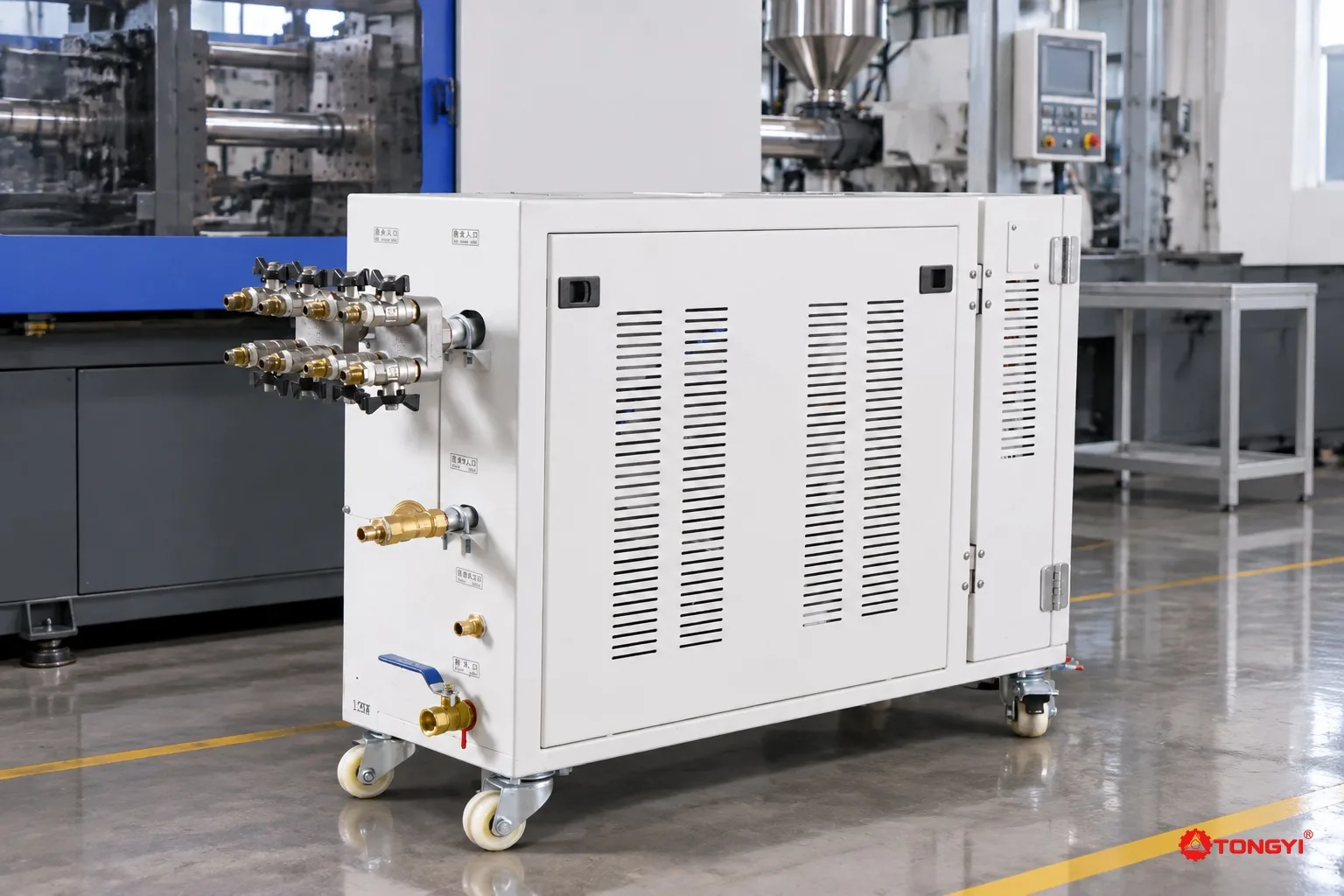
Cost in this category is driven by four engineering decisions rather than by brand markup.
- Heating capacity. More kilowatts means larger heating elements, heavier contactors and a bigger electrical enclosure. It also changes your facility requirement, not just the equipment line.
- Pump power, flow and pressure. A higher-flow pump is a larger motor, a larger impeller housing and a higher-current circuit. Flow and pressure are separate ratings — a pump rated for high flow is not automatically rated for high pressure, and the two are not interchangeable when you are pushing water through a long or restrictive circuit.
- Manifold split and connection size. A 2-in/2-out manifold is a different assembly from a 4-in/4-out, and a 1-inch process connection needs different fittings, hose and valves than a 3/8-inch connection. These are real bill-of-material differences.
- Custom scope beyond the base machine. This is where “custom” earns its name: matched manifolds, extended hose sets, alternate voltage or frequency, non-standard panel controls, communication protocols, documentation packages, spare-parts kits and acceptance-test requirements.
Cooling method also matters for the water circuit design. Every model in the TMC water-type series uses direct cooling, and every model lists a minimum achievable temperature of cooling water temperature plus 5 to 30 °C. That boundary is a cooling-water-dependent figure, not a fixed setpoint — if your plant water runs warm in summer, the coldest temperature your controller can hold moves with it. Buyers who ignore this spec end up with a unit that meets the datasheet on paper and misses the process on the floor.
Sizing before pricing: match the model to the mold
Heating capacity and pump flow should be selected together. A high-kilowatt unit paired with a low-flow pump can overshoot; a low-kilowatt unit with a high-flow pump can struggle to reach setpoint on a heavy mold. The table below shows the verified single-zone TMC water-type configurations side by side so you can see how the two values scale together across the series.
| Model | Heating capacity | Pump power | Max flow | Max pressure | Manifold | Process connection |
|---|---|---|---|---|---|---|
| TMC 60W | 6 KW | 0.37 KW | 42 L/MIN | 0.35 MPA | 2 in / 2 out | 3/8 inch |
| TMC 90W | 9 KW | 0.75 KW | 60 L/MIN | 0.4 MPA | 2 in / 2 out | 3/8 inch |
| TMC 120W | 12 KW | 0.75 KW | 60 L/MIN | 0.4 MPA | 4 in / 4 out | 3/8 inch |
| TMC 180W | 18 KW | 1.5 KW | 165 L/MIN | 0.25 MPA | 1 in / 1 out | 1 inch |
| TMC 240W | 24 KW | 1.5 KW | 165 L/MIN | 0.25 MPA | 1 in / 1 out | 1 inch |
| TMC 360W | 36 KW | 2.2 KW | 310 L/MIN | 0.3 MPA | 1 in / 1 out | 1.2 inch |
All models in the series use clean water as the heat-transfer medium and a K-type probe thermocouple for media inlet/outlet temperature sensing, with a 15 MM return water connection. Specifications may change without prior notice, so confirm the current sheet at the time of order.
Reading the flow and pressure ratings correctly
Two points deserve emphasis because they cause most of the confusion in sourcing discussions. First, maximum flow and maximum pressure are separate ratings, not a single operating point. The TMC 180W and TMC 240W, for example, both list 165 L/MIN maximum flow at 0.25 MPA maximum pressure, while the TMC 90W and TMC 120W list a lower 60 L/MIN but a higher 0.4 MPA. If your mold circuit is long, tight or has small internal channels, the higher-pressure configuration may hold flow better in practice than a nominally higher-flow unit — and that decision changes which model you should be pricing.
Second, manifold configuration tracks the application, not the price. The TMC 120W carries a 4-in/4-out manifold on the same 60 L/MIN pump and 0.4 MPA pressure as the TMC 90W, which uses 2-in/2-out. If you have four small circuits to feed, that manifold difference is the reason to quote the 120W; if you have one large circuit, it is the reason not to.
What the temperature accuracy claim does and does not cover
The TMC water-type series product page states a temperature accuracy of ±0.1 °C. This is a series-level claim from the published product page, not a per-model guarantee: the page does not specify whether it applies to every model in the series, where the measurement is taken, or under what test conditions. Treat it as a controller-level accuracy figure and confirm the details with the supplier before you write it into a purchase specification. Critically, controller accuracy is not the same as mold-cavity temperature uniformity — a controller can hold its own sensor within a fraction of a degree while the mold surface still varies, because uniformity depends on circuit layout, flow distribution, water quality and mold design. If your process requires a stated cavity uniformity, that must be quoted and tested as a separate requirement.
How to build a custom quote sheet that suppliers can price
A quote sheet is only useful if it is specific enough that two suppliers are answering the same question. Include the following blocks, and ask every supplier to respond in the same structure so you can compare line against line.
- Process requirement. Target mold temperature, required heating capacity, and the coldest temperature you must hold — remembering that on a water-type unit the lower limit is cooling water temperature plus 5 to 30 °C.
- Hydraulic requirement. Required flow at the mold, required pressure, number of circuits in and out, and process connection size.
- Facility requirement. Supply voltage, phase, frequency, available amperage, cooling water supply temperature and pressure, and ambient conditions at the installation point.
- Custom scope. Manifold arrangement, hose and fitting package, control interface and communication protocol, alarm and safety features, documentation, spare parts, and any factory acceptance test you require.
- Commercial terms. Incoterm, lead time, packaging, warranty period and spare-parts availability — these belong on the sheet even though they are not engineering data.
When the sheet is complete, the price differences you receive are traceable to real specification differences instead of to supplier guesswork.
What to confirm with any supplier before you order
Before a quote becomes a purchase order, verify these items in writing. Each one has a practical reason behind it.
- Cooling water conditions at your site. The minimum achievable temperature of a water-type unit is defined relative to cooling water temperature plus 5 to 30 °C. Ask the supplier to confirm the achievable setpoint against your actual summer water temperature, because a unit sized on winter water data may not reach setpoint in July.
- Whether flow and pressure are quoted at the same operating point. Ask for both ratings and, if a duty point is claimed, ask what conditions produce it. Maximum flow and maximum pressure are separate ratings unless a duty point is documented.
- Manifold configuration and connection size against your mold. Confirm the in/out count and the process connection diameter match your existing hose, fittings and valves. A mismatch becomes a site modification at your cost.
- Scope of the accuracy claim. Ask whether the stated accuracy applies to your specific model, where the sensor is located, and under what test conditions. Do not accept a series-level figure as a per-model guarantee.
- Voltage, phase and frequency for your plant. Confirm the electrical configuration matches your supply before shipment; changing it after the fact is not a field adjustment.
- Spare parts and consumables list. Ask which parts are wear items, their expected replacement basis, and whether they are standard catalog components available locally.
- Documentation package. Confirm whether you receive a wiring diagram, dimensional drawing, parts list and operating manual in English, and in what format.
- Current specification sheet. Since specifications may change without prior notice, ask the supplier to attach the dated specification sheet to the quotation so the machine you receive matches the machine you priced.
Getting the quote process moving
The fastest route to a usable number is to send your mold data first and let the model selection follow. If you can tell a supplier your target temperature, your cooling water temperature range, the number of circuits and your connection size, they can position the requirement inside a known configuration rather than guessing. Review the water-type mold temperature controller series to see the available heating and pump combinations, and if your process needs higher temperatures than a water circuit can reach, compare the oil-type mold temperature controller range before finalizing the specification. For multi-zone or plant-level requirements, the application solutions pages show how controllers are typically grouped with chillers and material handling equipment.
Frequently asked questions
Can you send a custom quote sheet for a water-type mold temperature controller?
Yes — a quote sheet can be built once the process requirement is defined: target mold temperature, required heating capacity, required flow and pressure, number of circuits in and out, process connection size, facility voltage and cooling water conditions. Suppliers can then price a specific configuration such as TMC 90W or TMC 180W rather than a generic unit.
Why is a custom mold temperature controller more expensive than a standard one?
The base machine is only part of the cost. Custom work adds matched manifolds, non-standard connection sizes, alternate electrical configurations, control interfaces, documentation and acceptance testing. Each of these changes the bill of materials and the engineering time behind the quotation, which is why custom pricing must be quoted rather than listed.
Which specifications change the price the most?
Heating capacity and pump configuration move the price most, because they change the heating elements, contactors, enclosure size and motor. In the TMC water-type series, heating capacity ranges from 6 KW on the TMC 60W to 36 KW on the TMC 360W, and pump flow ranges from 42 L/MIN to 310 L/MIN. Manifold split and process connection size are the next largest variables.
Does maximum flow mean the controller will deliver that flow through my mold?
No. Maximum flow and maximum pressure are separate ratings, and actual flow through a mold depends on the pressure drop of your circuit. For example, the TMC 90W and TMC 120W are rated at 60 L/MIN and 0.4 MPA, while the TMC 180W and TMC 240W are rated at 165 L/MIN and 0.25 MPA. Match the rating to your circuit’s resistance, and ask the supplier to confirm the expected duty point.
Does the ±0.1 °C temperature accuracy apply to every model in the series?
The ±0.1 °C figure is published at series level on the TMC water-type product page and does not specify applicability by model, measurement point or test conditions. Treat it as a controller accuracy claim and confirm the scope with the supplier. It is not the same as mold-cavity temperature uniformity, which depends on circuit layout, flow distribution and mold design.
What should I include in a quote request to get an accurate answer the first time?
Send target mold temperature, cooling water temperature range, required heating capacity, required flow and pressure, number of circuits in and out, process connection size, supply voltage and frequency, and the custom scope you need. Also state your Incoterm and required lead time. With those inputs a supplier can quote a defined model instead of estimating.