
How Much Does a Water-Type Mold Temperature Controller Cost? Pricing and Sales Quotes for TCUs
Compare documented product features and process requirements before selecting a mold temperature controller.
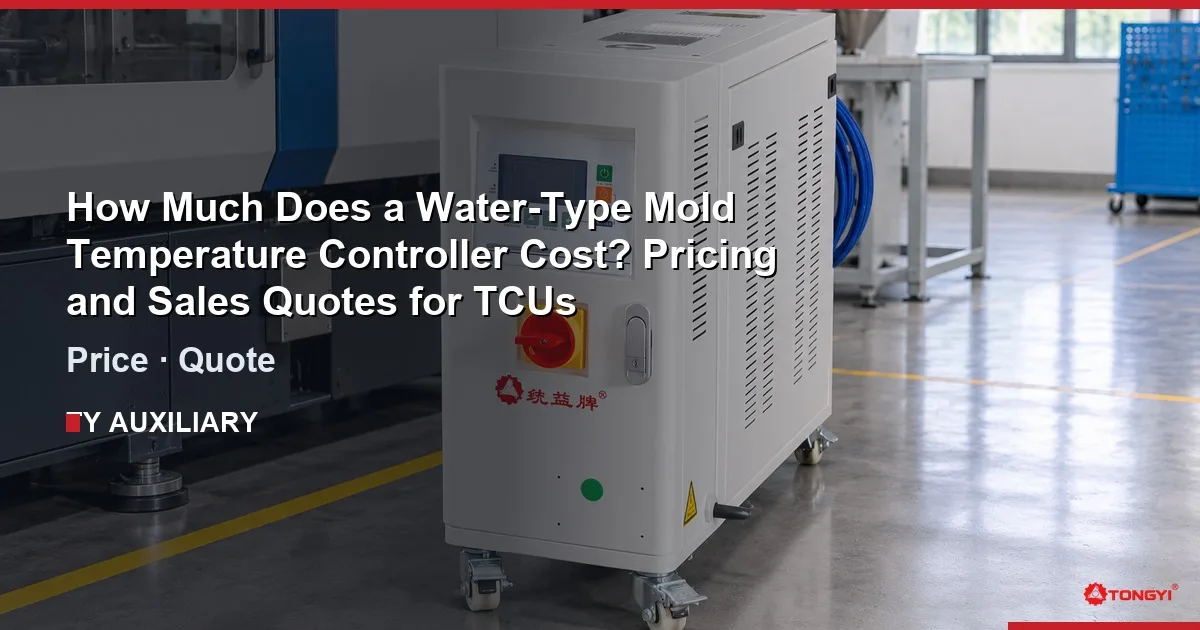
A water-type mold temperature controller (TCU) does not carry a fixed catalog price. Quotes vary with heating capacity, pump size, control features, and order terms, and most suppliers price these units per configuration rather than per model number. What a buyer can control is the specification: a clearly defined quote request is the single biggest lever on getting an accurate, comparable price. This guide explains what drives the price of a water-type mold temperature controller, which verified specifications to include in a request for quotation (RFQ), and how to compare sales quotes on a like-for-like basis.
Why water-type mold temperature controller pricing is configuration-driven
Water-type TCUs circulate clean water as the heat transfer medium and are typically used where mold temperatures stay within the range water can handle. Because a single product family usually spans several frame sizes with different heater and pump combinations, a supplier cannot quote meaningfully until it knows your process. Two buyers asking for “a water-type mold temperature controller” may need units that differ by a factor of six in heater power and several times in flow rate, and their prices will differ accordingly.
Pricing is also affected by order terms: quantity, destination port, voltage and frequency requirements, documentation needs, and any custom features such as special manifold configurations. Sales teams generally quote faster and more competitively when the RFQ removes these ambiguities up front.
What drives the price of a water-type mold temperature controller
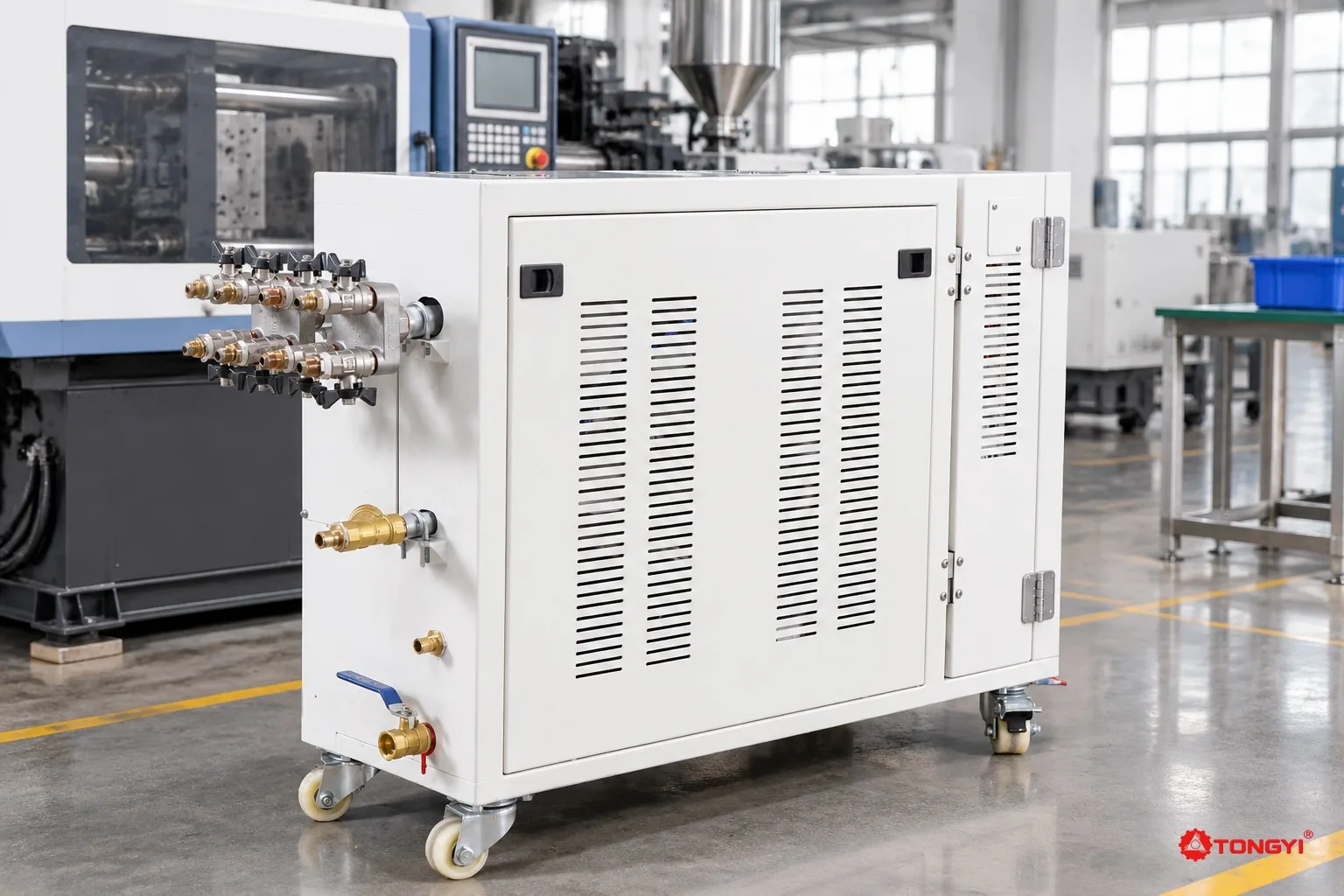
Most of the cost difference between two units in the same series comes from a handful of specifications. Knowing them helps you decide where to spend and where to save.
Heater power
Electric heating power is a primary cost driver. In one verified water-type series, heater ratings run from 6 kW on the smallest model (TMC 60W) up to 36 kW on the largest (TMC 360W), with intermediate models at 9, 12, 18, and 24 kW. Larger heaters require bigger contactors, heavier wiring, and often a larger cabinet, all of which add cost. Specifying more heater power than your heat-up time actually requires is a common way buyers overpay.
Pump power, flow, and pressure
The pump determines how much hot water reaches the mold and at what pressure. Pump specifications vary widely across a series: the TMC 60W uses a 0.37 kW pump delivering up to 42 L/min at a maximum pressure of 0.35 MPa, while the TMC 360W uses a 2.2 kW pump with a maximum flow of 310 L/min at 0.3 MPa. Note that maximum flow and maximum pressure are separate ratings; a unit does not necessarily deliver its maximum flow at its maximum pressure. If your mold has long or narrow cooling channels, flow capability matters more than heater size, and it should be stated explicitly in your RFQ.
Manifold configuration and connection sizes
The media inlet/outlet splitter arrangement and port sizes affect both plumbing cost on your side and the unit’s price. Verified configurations in this series range from 2-in/2-out and 4-in/4-out manifolds with 3/8-inch ports (TMC 60W, TMC 90W, TMC 120W) to 1-in/1-out arrangements with 1-inch or 1.2-inch ports on the larger TMC 180W, TMC 240W, and TMC 360W models. A unit with more circuits and larger ports generally costs more but may eliminate external manifold plumbing you would otherwise buy separately.
Control and sensing components
Temperature sensing hardware, such as the K-type probe thermocouples used at the media inlet and outlet in the verified series, and the quality of the temperature controller itself, contribute to cost. When comparing quotes, confirm that all suppliers are quoting equivalent control hardware; a lower price sometimes reflects a simpler controller or sensor package rather than a better deal.
Verified model range in the TMC water-type series
The following table compares the verified models side by side. All models in this series use clean water as the heat transfer medium, direct cooling, a K-type probe thermocouple for media inlet/outlet temperature sensing, a 15 mm return-water port, and a maximum operating temperature of 120 °C, with minimum operating temperature defined as cooling water temperature plus 5 to 30 °C.
| Model | Heater power | Pump power | Max flow | Max pressure | Splitter type | Port size |
|---|---|---|---|---|---|---|
| TMC 60W | 6 kW | 0.37 kW | 42 L/min | 0.35 MPa | 2-in/2-out | 3/8 inch |
| TMC 90W | 9 kW | 0.75 kW | 60 L/min | 0.4 MPa | 2-in/2-out | 3/8 inch |
| TMC 120W | 12 kW | 0.75 kW | 60 L/min | 0.4 MPa | 4-in/4-out | 3/8 inch |
| TMC 180W | 18 kW | 1.5 kW | 165 L/min | 0.25 MPa | 1-in/1-out | 1 inch |
| TMC 240W | 24 kW | 1.5 kW | 165 L/min | 0.25 MPa | 1-in/1-out | 1 inch |
| TMC 360W | 36 kW | 2.2 kW | 310 L/min | 0.3 MPa | 1-in/1-out | 1.2 inch |
Two values are worth reading closely because they show the trade-off you are buying. First, compare the TMC 120W with the TMC 180W: the 120W offers a 4-in/4-out manifold on 3/8-inch ports at 60 L/min, which suits molds with multiple smaller cooling circuits, while the 180W switches to a 1-in/1-out arrangement on 1-inch ports and delivers up to 165 L/min. If your mold has many parallel circuits, the 120W manifold saves external plumbing; if you need high volume through fewer, larger channels, the 180W is the better match even though it runs at a lower maximum pressure (0.25 MPa versus 0.4 MPa on the 120W).
Second, note the pump and heater combination on the mid-size models: the TMC 90W and TMC 120W share the same 0.75 kW pump and 60 L/min maximum flow, so the only meaningful difference is the 9 kW versus 12 kW heater and the manifold (2-in/2-out versus 4-in/4-out). If your heat-up time is comfortable at 9 kW, stepping up to the 120W solely for heating capacity is wasted spend; it only makes sense if you need the additional circuits.
The series product page publishes a temperature accuracy of ±0.1 °C for the water-type TMC series. This is a series-level published figure; the page does not specify which models, measurement points, or test conditions it applies to, so confirm the applicable accuracy scope and conditions with the supplier before treating it as a per-unit guarantee. Also remember that controller accuracy at the media probe is not the same as temperature uniformity throughout the mold cavity, which depends on mold design and flow balance.
What to include in a quote request
A complete RFQ shortens the sales cycle and makes quotes comparable. Include at minimum:
- Target mold temperature and required heat-up time from ambient.
- Mold cooling-channel layout: number of circuits, channel diameters, and total expected flow.
- Required heating capacity or the mold and machine data needed to calculate it.
- Facility power supply (voltage, frequency, phase) at the installation site.
- Available cooling water temperature and pressure, since minimum operating temperature depends on it.
- Preferred manifold configuration and connection sizes, or let the supplier propose them.
- Destination, order quantity, and any documentation or packaging requirements.
Specifying these items also determines whether a water-type unit is appropriate at all. All models in the verified series top out at 120 °C; if your process requires higher mold temperatures, you need an oil-type mold temperature controller instead, and our oil-type mold temperature controllers cover that range.
How to compare sales quotes on a like-for-like basis
When quotes arrive, normalize them before comparing numbers:
- Check that heater power, pump power, maximum flow, and maximum pressure match your RFQ exactly, model by model. A quote for a smaller pump is cheaper for a reason.
- Confirm the media is clean water, the cooling method is direct, and the maximum temperature is 120 °C if those are your requirements.
- Verify the temperature control hardware and sensor type (for example, K-type probe thermocouples at the media inlet and outlet) are equivalent across quotes.
- Confirm which Incoterms the price is based on, what is included in the price (spares, manuals, wiring diagrams), and the warranty scope.
- Ask whether the quoted accuracy figure applies to the specific model and under what measurement conditions.
Beyond TCUs, buyers often pair them with other auxiliary equipment; if your project also involves material handling, our central feeding systems and industrial chillers pages describe the specifications to gather for those quotes as well.
Practical next step
If you know your mold temperature requirement and cooling-circuit layout, request a quote against a specific model in the series rather than a generic “water-type TCU” inquiry. Suppliers can then confirm model selection, applicable accuracy scope, and delivery terms in a single response, which is the fastest route to a comparable, firm price. Note that manufacturers reserve the right to change specifications without prior notice, so confirm the current specification sheet at the time of quotation.