
How Much Does a Water-Type Mold Temperature Controller Cost from the Factory?
Factory pricing for a water-type mold temperature controller depends on heater power, pump size, and flow configuration, so this guide explains the cost.
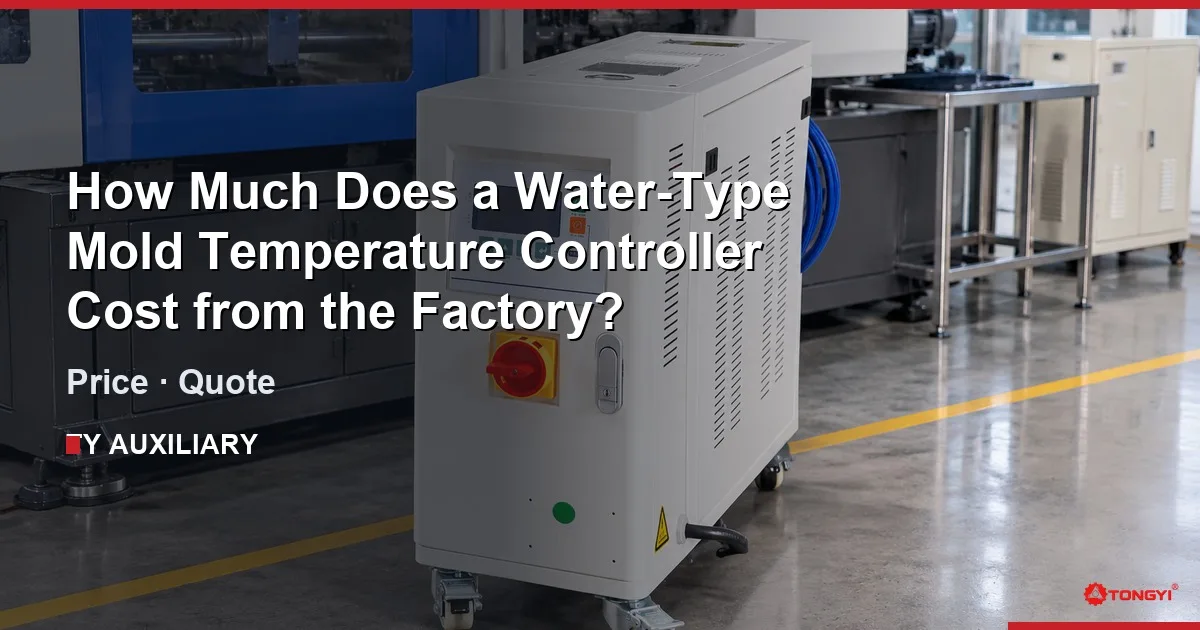
A water-type mold temperature controller purchased directly from a factory is priced against its heating capacity, pump size, and flow configuration rather than a single list number, so the honest answer is: the cost depends on which model size matches your mold’s heat-load and flow requirements. Because suppliers publish specifications rather than fixed pricing, the practical way to control cost is to know exactly which model class you need, request a factory quote on a like-for-like basis, and verify what is included before you compare offers.
What Drives the Price of a Water-Type Mold Temperature Controller
Factory pricing for this equipment category tracks a few concrete engineering inputs. Understanding them helps you see why two quotes for “the same” controller can differ significantly.
- Heating capacity. Electric heater power is one of the largest hardware cost drivers. In a water-type series, heater ratings commonly step up in defined increments across the model range, and moving to the next step changes the price materially.
- Pump power and flow rate. A larger pump motor and higher maximum flow require a bigger pump assembly, a heavier frame, and sometimes larger piping. Flow also determines how many mold circuits the unit can serve effectively.
- Port and manifold configuration. The number of medium inlet/outlet circuits and the connection size affect manifold machining and plumbing cost.
- Maximum operating pressure. Higher-pressure designs require more robust components.
- Controls and safety options. Controller features, sensing hardware, and any site-specific electrical requirements add to the base configuration.
- Order terms. Quantity, destination port, Incoterms, and lead time all shape the landed cost you ultimately pay.
How to Match a Model to Your Application Before Requesting a Price
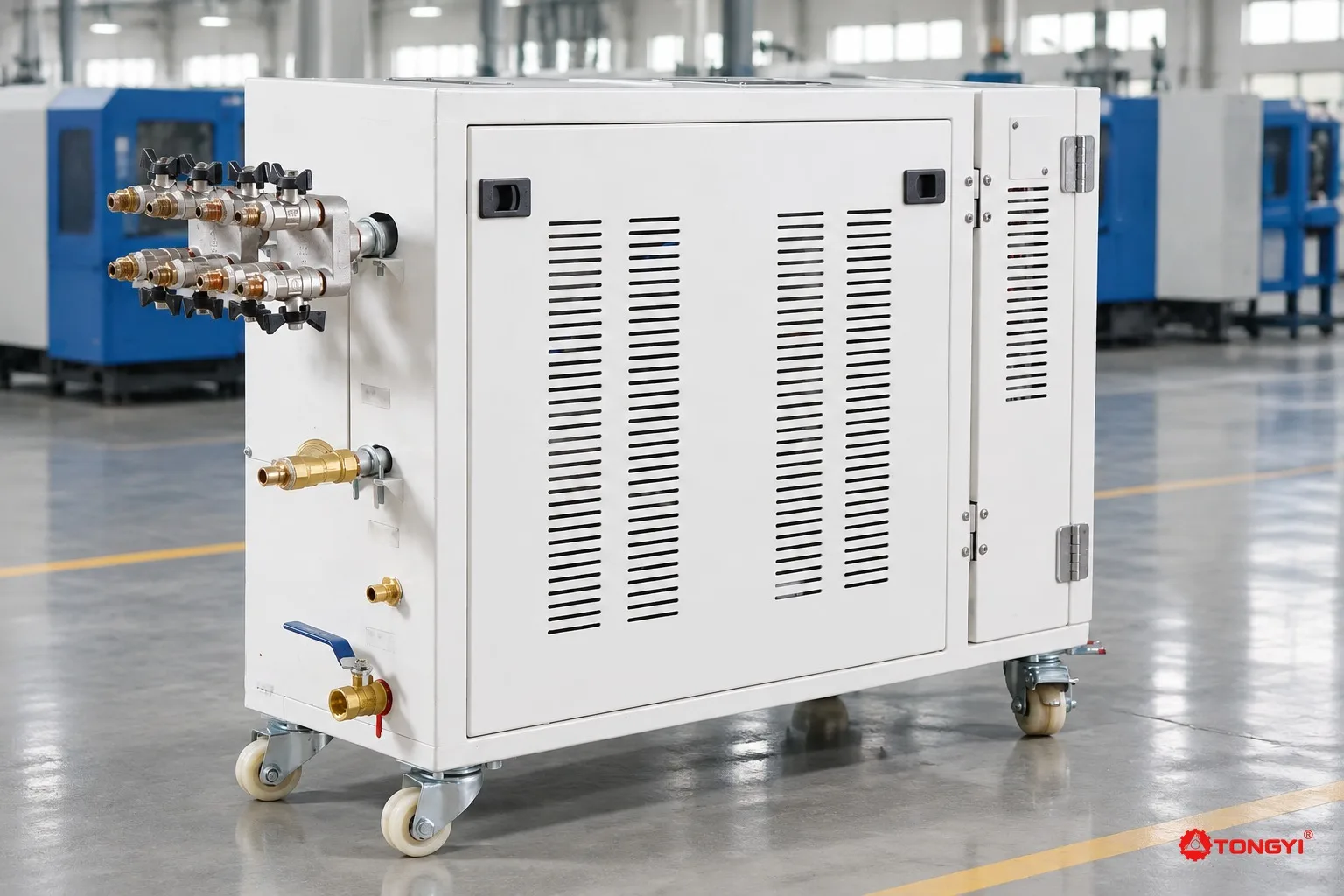
Requesting a quote for the wrong size wastes a buying cycle. A water-type mold temperature controller is sized by matching heater power to your mold’s heat demand and pump flow to the total coolant flow your mold circuits require. Work through these questions with your process engineer:
- What setpoint temperature does your process require? All models in a typical water-type series share one maximum temperature limit, so if your setpoint fits the water-type range, model selection comes down to capacity and flow.
- How much heating power does your mold need to reach setpoint in an acceptable time?
- What total flow do your mold channels require, and how many independent circuits will the controller serve?
- What supply voltage and frequency will the unit run on at your plant?
Comparing Models Side by Side
When you compare factory quotes, insist that each supplier quotes against the same model specification. The table below shows how a representative water-type series scales across its range, using the manufacturer’s published single-unit specifications.
| Model | Heating Power | Pump Power | Max Flow | Max Pressure | In/Out Configuration | Media Port Size |
|---|---|---|---|---|---|---|
| TMC 60W | 6 kW | 0.37 kW | 42 L/min | 0.35 MPa | 2-in/2-out | 3/8 inch |
| TMC 90W | 9 kW | 0.75 kW | 60 L/min | 0.4 MPa | 2-in/2-out | 3/8 inch |
| TMC 120W | 12 kW | 0.75 kW | 60 L/min | 0.4 MPa | 4-in/4-out | 3/8 inch |
| TMC 180W | 18 kW | 1.5 kW | 165 L/min | 0.25 MPa | 1-in/1-out | 1 inch |
| TMC 240W | 24 kW | 1.5 kW | 165 L/min | 0.25 MPa | 1-in/1-out | 1 inch |
| TMC 360W | 36 kW | 2.2 kW | 310 L/min | 0.3 MPa | 1-in/1-out | 1.2 inch |
All six models use clean water as the heat-transfer medium, direct cooling, a K-type probe thermocouple for the medium inlet and outlet temperature sensing, and a 15 mm return port. The published maximum temperature for the series is 120 °C, and the minimum operating temperature is defined as the cooling water temperature plus 5 to 30 °C — a boundary that matters if your plant’s chilled water runs cold, because the controller will not regulate below that floor.
Two Specifications That Explain Most of the Price Spread
Heating power vs. pump flow — the TMC 120W and TMC 180W comparison. The TMC 120W carries 12 kW of heating power with a 0.75 kW pump delivering up to 60 L/min through a 4-in/4-out manifold at a maximum pressure of 0.4 MPa. Step up to the TMC 180W and heating power rises to 18 kW, pump power doubles to 1.5 kW, and maximum flow jumps to 165 L/min — but the maximum pressure drops to 0.25 MPa and the configuration becomes a single 1-in/1-out circuit at a 1-inch port. This is a documented trade-off: the larger model moves far more water for molds with high flow demand or larger channels, yet it is not simply “better” — if your process needs higher circuit pressure or multiple small-diameter circuits, the smaller model’s 4-in/4-out manifold and higher 0.4 MPa rating may fit better despite its lower capacity. That is why quoting the wrong model produces misleading prices.
Maximum flow. Flow ratings range from 42 L/min on the entry-level TMC 60W up to 310 L/min on the TMC 360W. Maximum flow and maximum pressure are separate ratings — a model’s maximum flow is achieved at its own operating condition, not necessarily simultaneously with its maximum pressure. If your mold needs high flow through long or restricted channels, confirm the duty point with the supplier rather than assuming both peak values apply together.
One more published figure worth noting: the manufacturer states a temperature accuracy of ±0.1 °C for the water-type TMC series as a whole. This is a series-level claim — the published page does not specify which models, measurement points, or test conditions it covers, and controller accuracy is not the same thing as temperature uniformity throughout the mold cavity. Ask the supplier to confirm the accuracy figure for your specific model and how it was measured before treating it as a guarantee.
Why Buying Directly from the Factory Affects Price
Factory-direct sourcing removes distributor margin, which is why buyers researching water-type mold temperature controller pricing so often search for the manufacturer rather than a reseller. Direct sourcing also gives you something arguably more valuable than a lower number: specification authority. When you talk to the factory, you can confirm exactly which heater step, pump, and manifold configuration you are paying for, and request factory test data for your unit before shipment.
The trade-off is that factory-direct purchases are usually FOB or EXW transactions where you manage freight, import clearance, and any local service arrangements. Factor those items into your total cost of ownership — a slightly higher quote that includes crated delivery to your port may be cheaper landed than the lowest EXW figure.
What to Include in a Factory Quote Request
A precise RFQ gets an accurate price faster and prevents substitution of a smaller unit. Include:
- Target model or heater power class (for example, 12 kW or 18 kW), or your mold’s heat-load calculation so the factory can recommend one.
- Required setpoint and your plant’s cooling water temperature, so the minimum operating temperature boundary can be verified.
- Number of mold circuits and total flow demand.
- Supply voltage, frequency, and phase at your facility.
- Preferred Incoterm and destination port.
- Quantity and any required documentation for installation and commissioning.
Next Step
If your process runs on water below the series’ 120 °C maximum temperature, review the water-type mold temperature controller series specifications, then send the factory your mold’s heat load, circuit count, and electrical supply details for a model-specific quotation. For processes that exceed water-type limits, an oil-type mold temperature controller is the appropriate category to compare instead. If you are building out a complete temperature-control loop, the matching industrial chiller supplies the cooling water that defines the controller’s minimum operating temperature.