
How Much Does a Water-Type Mold Temperature Controller Cost, What Goes Into a Quote, and Who Handles Commissioning?
Learn what drives water-type mold temperature controller cost, which specifications to put in a quote request, and how commissioning is normally split.
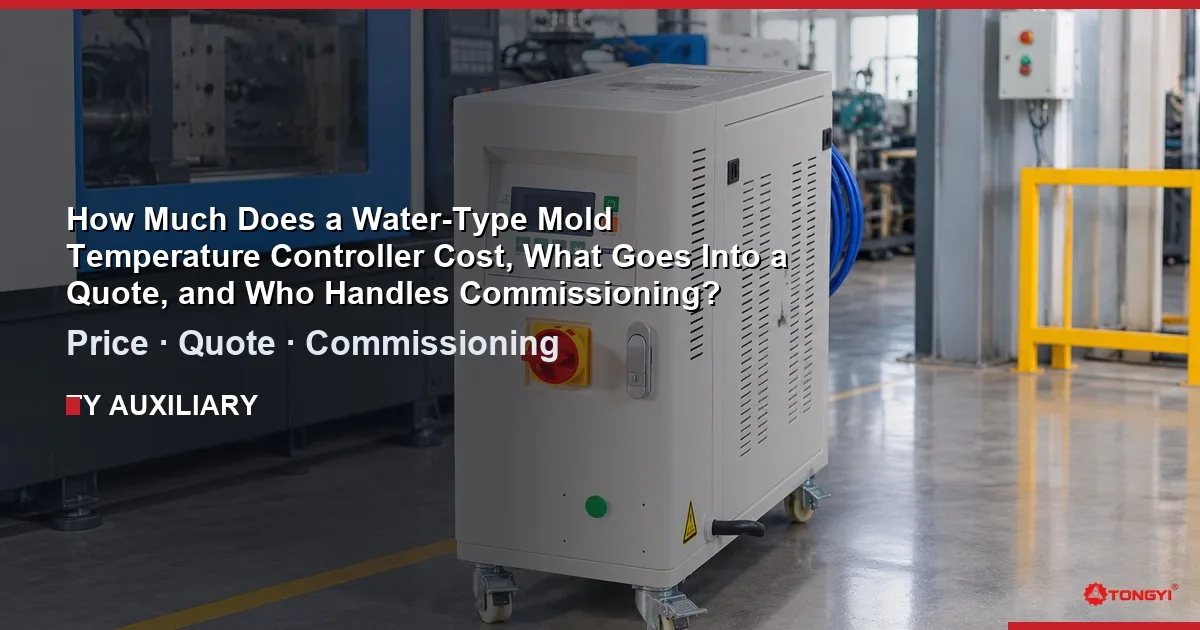
A water-type mold temperature controller cost is not a list price you can look up — it is built from heating capacity, pump duty, cooling method, manifold configuration, and the control accuracy you actually need on the press. A 6 kW single-zone unit and a 36 kW unit with a 310 L/min pump are different machines at different price points, and the quote should show which specification each line of the price reflects. Commissioning — the other half of what buyers ask about — is normally split between the machine builder’s own startup team and the supplier’s controls documentation, so the split needs to be agreed before the purchase order, not after the crates arrive.
What determines the price of a water-type mold temperature controller?
Price tracks five physical cost drivers. Heating power sets the size of the contactor, solid-state relay, safety circuit and wiring gauge. Pump power and flow set the pump body, motor, seal class and the bore of the internal piping. Cooling method determines whether you are paying for a direct-cooling valve body or an indirect heat exchanger. The manifold — how many inlets and outlets are machined into the distribution block — is a machining and fitting cost that scales with circuit count. Finally, the control package: the temperature sensor type, controller resolution, and whether the unit needs a communications port for the press or the plant network.
Because these variables move independently, two controllers with the same nominal heating power can differ substantially in price if one carries a larger pump and a four-circuit manifold. Ask for the quote to be itemized against the specification table rather than quoted as a single lump figure, so you can see which line item changed when you revise the brief.
How heating capacity and pump duty translate into price and process fit
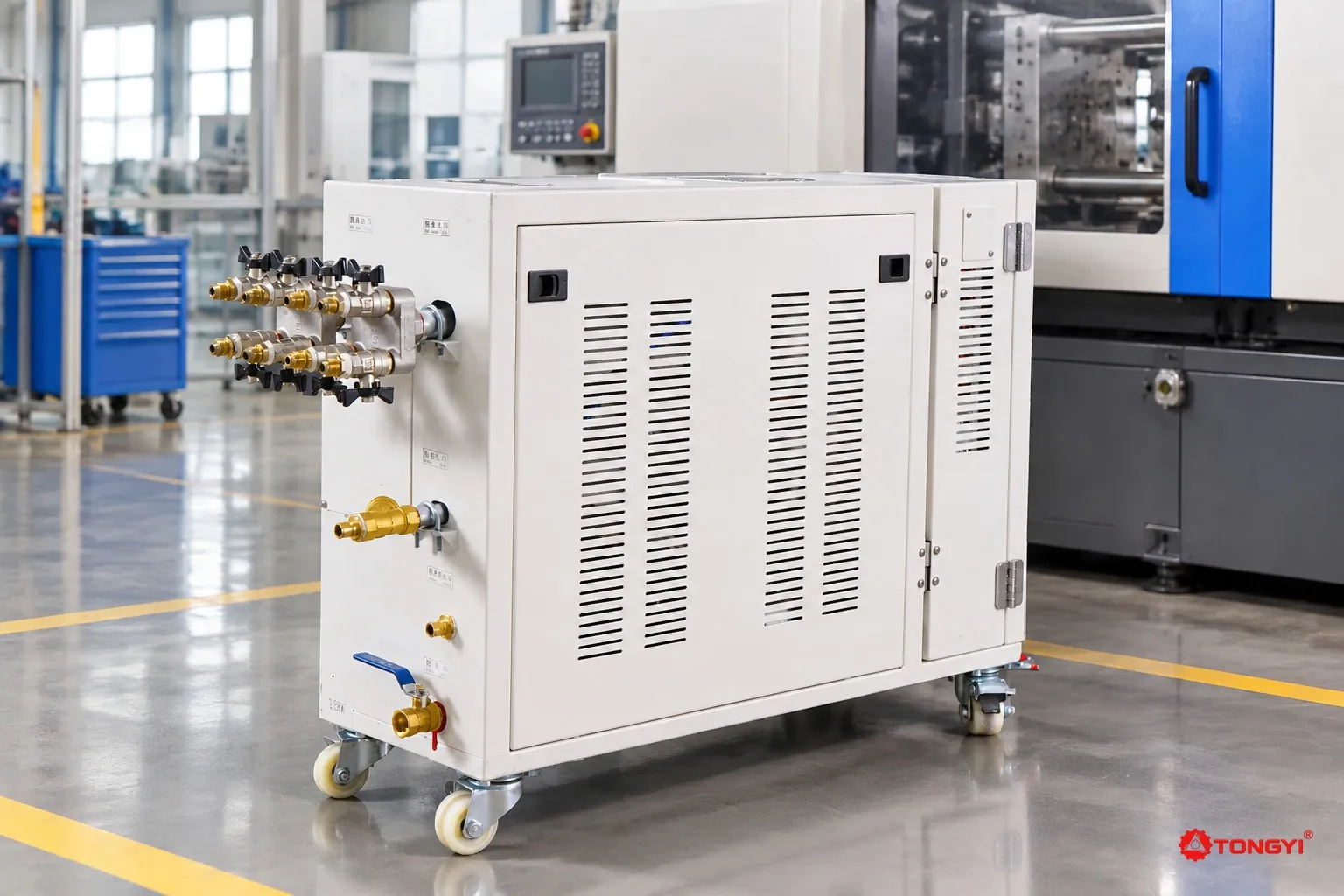
Heating capacity is the first thing a supplier will price, and it should be the first thing you calculate. The verified single-temperature TMC water series shows how widely this scales: the TMC 60W carries 6 KW of electric heating power, while the TMC 360W carries 36 KW — six times the heating power, and a correspondingly larger electrical supply, contactor group and incoming cable. For a buyer, the significance is not the number itself but the circuit you must provide for it: the higher-heating models need a dedicated supply sized to the heating load plus the pump, and that electrical work is a cost that lands on your side of the project, not the supplier’s. Confirm the required supply voltage, phase and breaker size in writing for the exact model you select.
Pump duty is the second priced variable, and it is often the one buyers under-specify. In the same verified series, the TMC 60W is rated at 0.37 KW with a maximum flow of 42 L/MIN, while the TMC 360W is rated at 2.2 KW with a maximum flow of 310 L/MIN. Maximum flow and maximum pressure are separate ratings on these units — the TMC 360W is listed at 0.3 MPA maximum pressure against 310 L/MIN maximum flow, so a high-flow model is not automatically a high-pressure model. That matters for selection: long hose runs and narrow mold channels cost you pressure, while large manifolds and multiple parallel circuits consume flow. Tell the supplier your hose length, internal channel diameter and number of parallel circuits, and let them match a pump curve to it rather than assuming the largest pump is the safest choice — a larger pump carries a larger price and a larger electrical draw.
Comparing verified single-temperature water models like for like
The table below reproduces the manufacturer’s published figures for six models in the series. Every value is attached to its exact model; nothing here is averaged or interpolated. Models outside this range are not covered by this comparison.
| Model | Heating power | Pump power | Max flow | Max pressure | Manifold | Media port |
|---|---|---|---|---|---|---|
| TMC 60W | 6 KW | 0.37 KW | 42 L/MIN | 0.35 MPA | 2 in 2 out | 3/8 inch |
| TMC 90W | 9 KW | 0.75 KW | 60 L/MIN | 0.4 MPA | 2 in 2 out | 3/8 inch |
| TMC 120W | 12 KW | 0.75 KW | 60 L/MIN | 0.4 MPA | 4 in 4 out | 3/8 inch |
| TMC 180W | 18 KW | 1.5 KW | 165 L/MIN | 0.25 MPA | 1 in 1 out | 1 inch |
| TMC 240W | 24 KW | 1.5 KW | 165 L/MIN | 0.25 MPA | 1 in 1 out | 1 inch |
| TMC 360W | 36 KW | 2.2 KW | 310 L/MIN | 0.3 MPA | 1 in 1 out | 1.2 inch |
All six models use clean water as the heat transfer medium, share a maximum temperature of 120 °C, and specify a minimum temperature of cooling water temperature +5 to 30 °C, with direct cooling and a K type probe thermocouple for media inlet and outlet temperature sensing. The right-hand columns show a real trade-off rather than a simple ladder. The TMC 120W moves from a 2 in 2 out manifold to a 4 in 4 out manifold at the same 60 L/MIN flow as the TMC 90W, which suits a mold with more independent circuits but fewer demanding ones. From the TMC 180W upward, the manifold reverts to 1 in 1 out with a 1 inch port and a much larger pump — that configuration favors a single high-volume loop, such as a large mold or a manifold feeding several presses, and it is the wrong choice if your tooling is built around four small parallel circuits. Model selection, not model size, drives the quote.
What belongs in a quote request
A quote is only comparable to another quote if both were built on the same inputs. Send the supplier the following, and ask them to confirm each item back to you in writing:
- Required mold surface temperature and the process window, not just a single setpoint.
- Available cooling water temperature at your plant and the flow rate you can supply to the unit.
- Number of independent temperature circuits, and whether each needs its own control loop.
- Hose or pipe length from the controller to the mold, and the internal channel diameter in the tool.
- Electrical supply available: voltage, phase, and the breaker you intend to dedicate to the unit.
- Ambient conditions in the molding area, including whether the unit sits near a hot press.
- Any requirement to log or transmit temperature data to the press or plant network.
Without these, a supplier can only quote a generic unit, and the price you receive will not survive contact with your floor. If the request is missing the circuit count and the hose length in particular, expect the pump to be specified either too small or larger than necessary — both are expensive, one in downtime and the other in capital.
How commissioning is normally handled
Commissioning a water-type mold temperature controller covers four things: verifying that the electrical supply matches the unit’s rating, pressure-testing the water circuit and confirming flow through every mold channel, tuning the controller to the process window, and training the operators who will run it. In practice this is a shared responsibility. The supplier typically provides the wiring diagram, the controller manual, the recommended startup sequence and, on request, remote support while your maintenance team performs the physical startup. Where a factory accepts a purchase order for multiple units, it is reasonable to ask for the startup procedure in writing in advance and to have one named contact on the supplier’s technical side for the commissioning window.
The published accuracy figure for this series is ±0.1 °C, stated at series level on the product page. It applies to the TMC water-type series as a whole; the published page does not specify which models it covers, where the measurement is taken, or the test conditions. Treat it as controller accuracy, not as mold-cavity temperature uniformity — the two are different quantities, and the second depends on your tool, your flow rates and your circuit layout. If your process depends on that accuracy figure, ask the supplier to confirm in writing how it was measured and whether it holds for the exact model you are buying. Also note that the manufacturer reserves the right to change specifications without prior notice, so the specification sheet attached to your order is the controlling document.
For units where mold temperature control is one part of a wider auxiliary equipment package, the same commissioning visit can usually cover the surrounding equipment, which reduces both the travel cost and the number of separate startup days. If you are still specifying the rest of the auxiliary set, review the range of water-type mold temperature controllers before finalizing circuit counts, and check how the controller integrates with auxiliary molding equipment on the same press.
A practical next step
Write a one-page specification brief using the seven checklist items above, attach the list of verified model figures you are willing to consider, and ask two or three suppliers to quote against that same document. Then compare the quotes line by line against the specification table rather than on total price alone. The supplier who explains which pump curve and which manifold configuration they chose, and why, is giving you a better quote than one who returns a single figure. For a full view of the available configurations, start from the single-temperature water series and confirm model availability, lead time, and commissioning arrangements directly in writing.
Frequently asked questions
How much does a water-type mold temperature controller cost?
There is no single list price, because the cost is built from heating capacity, pump duty, cooling method, manifold configuration and the control package. A unit with 6 KW of heating and a 42 L/MIN pump sits at a very different price point from one with 36 KW and a 310 L/MIN pump. Ask suppliers to itemize the quote against a specification table so you can see exactly what each price line covers.
What should I include in a quote request for a water-type mold temperature controller?
Include the required mold surface temperature and process window, your plant’s cooling water temperature and available flow, the number of independent temperature circuits, hose or pipe length and internal channel diameter, the electrical supply you can dedicate, ambient conditions, and any data logging requirements. A quote built without these inputs is not comparable to one built with them.
Why do two controllers with the same heating power have different prices?
Heating power is only one cost driver. Pump power and maximum flow, the number of manifold inlets and outlets, port size, and the controller and sensor package all move the price independently. In the TMC water series, the TMC 90W and TMC 120W share the same 9 KW and 12 KW heating range and the same 60 L/MIN pump, yet the TMC 120W uses a 4 in 4 out manifold instead of 2 in 2 out.
Does a higher maximum flow rating mean a higher maximum pressure?
No. Maximum flow and maximum pressure are separate ratings. In this series the TMC 360W is listed at 310 L/MIN maximum flow with 0.3 MPA maximum pressure, while the TMC 90W is listed at 60 L/MIN with 0.4 MPA. Match the pump to your hose length, channel diameter and circuit count rather than assuming the highest-flow model is always correct.
Who is responsible for commissioning the unit after delivery?
It is usually shared. The supplier provides the wiring diagram, controller manual, recommended startup sequence and often remote support, while the buyer’s maintenance team performs the physical installation, pressure test and flow verification. Agree the split in writing before the purchase order, and name a single technical contact on each side for the commissioning window.
Can I rely on the ±0.1 °C accuracy figure for my mold?
That figure is published at series level for the TMC water-type series and the page does not state per-model applicability, measurement point or test conditions. It describes controller temperature accuracy, not uniformity across the mold cavity, which depends on your tool and circuit design. Ask the supplier to confirm how it was measured for the exact model you are ordering.