
How Much Does a Water-Type Mold Temperature Controller Cost, and What Quote and Solution Can a Supplier Offer?
A water-type mold temperature controller's price depends mainly on heating power, pump capacity, and flow rate, so request a configuration-based quote.
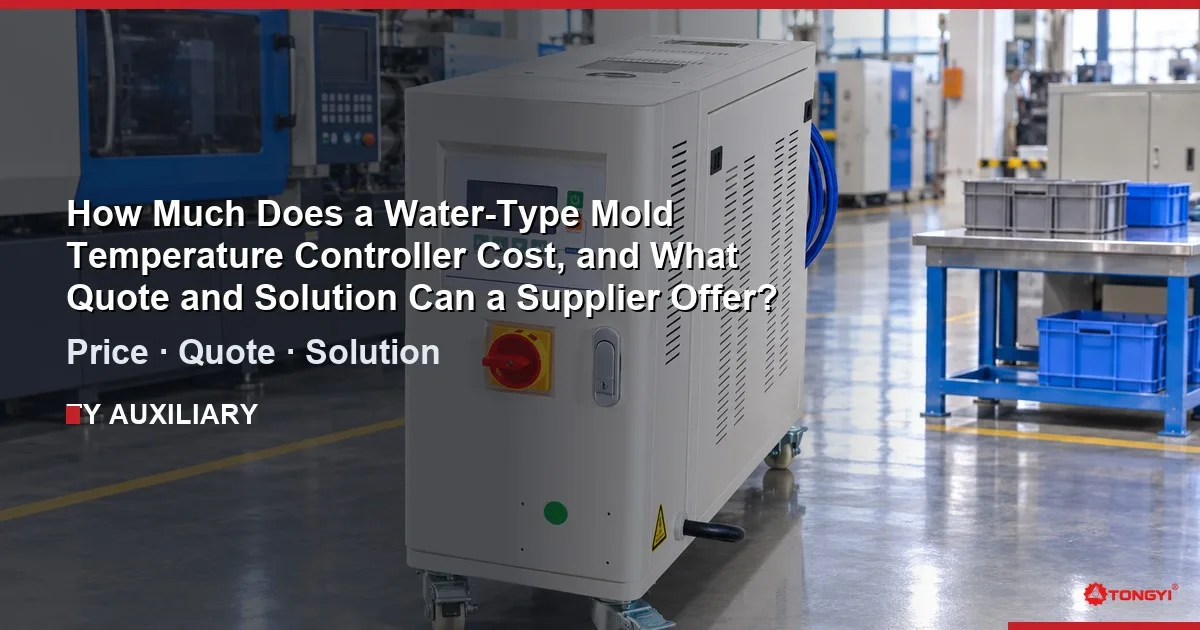
What drives the price of a water-type mold temperature controller
A water-type mold temperature controller is priced mainly by its electric heating capacity, pump size, flow rate, and internal construction — not by brand alone. Buyers searching for a water-type mold temperature controller price are usually comparing units that look similar in a photo but differ substantially in heating power, pump head, flow, and manifold configuration. Those differences determine the actual cost, and they also determine whether the unit will actually hold your process temperature on a real mold.
Because manufacturers quote configuration by configuration, there is no single list price. The practical approach is to define your process requirements first, then request a quote and a solution package that matches those requirements. That way every supplier is quoting the same scope.
Which specifications change the price the most
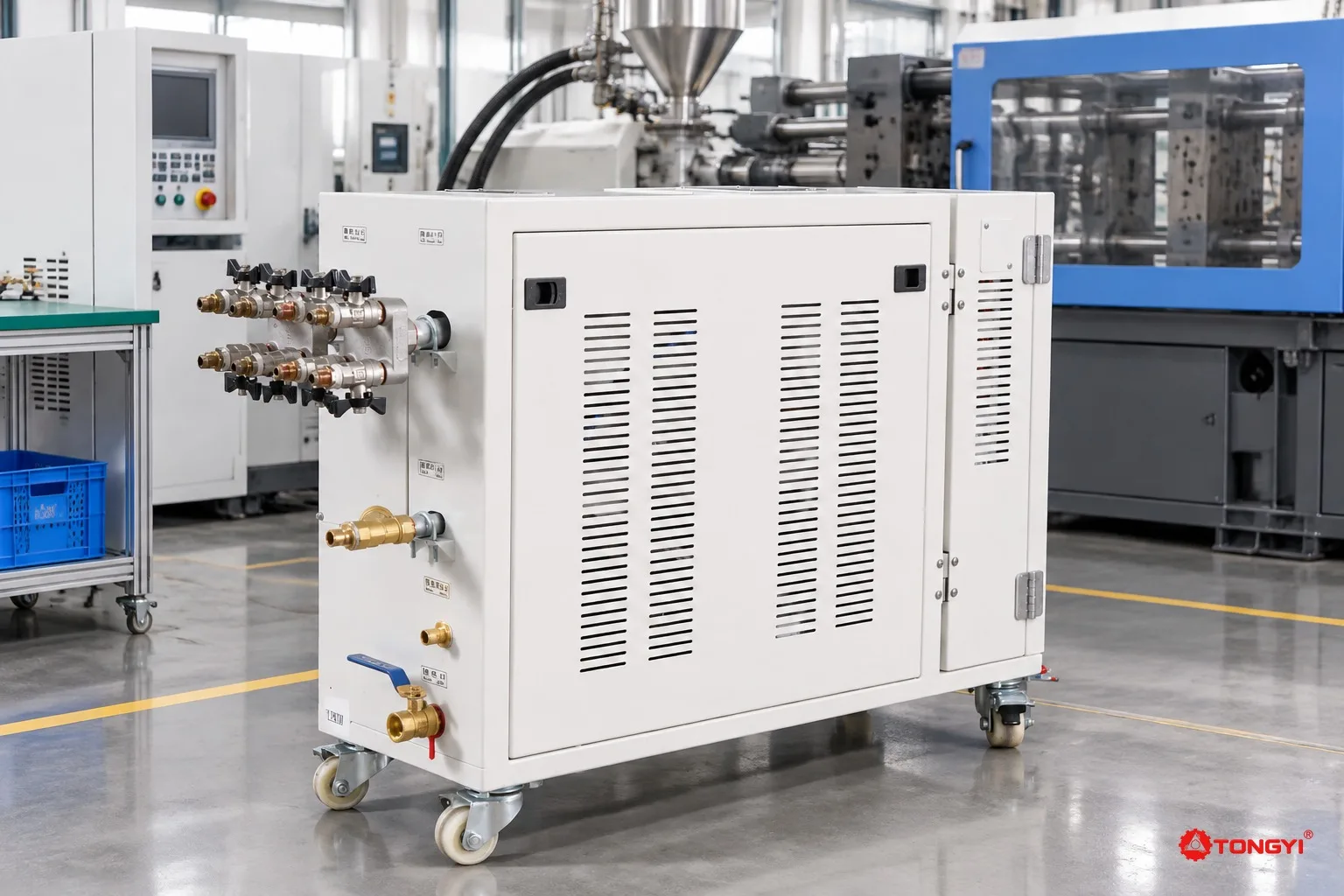
Four variables account for most of the cost difference between models in the same series.
- Electric heating power. Higher kW means larger heating elements, heavier contactors, and thicker wiring. This is the single largest cost step between units.
- Pump power and maximum flow. A bigger pump moves more water through the mold circuit, which is what actually controls cycle time. Pump and motor cost scales with flow and pressure.
- Maximum pressure. Pressure rating affects pump selection, sealing, and the mechanical strength of the circuit. It is a separate rating from flow, not a substitute for it.
- Manifold configuration. A unit built for one circuit is simpler and cheaper than one built to feed several mold lines at once.
Cooling method matters too. Every unit in this water-cooled series uses direct cooling, and the achievable low temperature is defined relative to the cooling water supply rather than as a fixed number.
How heating power, flow, and pressure scale across the series
The table below shows verified specifications for the water-type series, so you can see exactly where the cost steps fall. Readings should be compared model to model, never averaged across the range.
| Model | Heating power | Pump power | Max flow | Max pressure | Manifold | Media port size |
|---|---|---|---|---|---|---|
| TMC 60W | 6 KW | 0.37 KW | 42 L/MIN | 0.35 MPA | 2 in 2 out | 3/8 inch |
| TMC 90W | 9 KW | 0.75 KW | 60 L/MIN | 0.4 MPA | 2 in 2 out | 3/8 inch |
| TMC 120W | 12 KW | 0.75 KW | 60 L/MIN | 0.4 MPA | 4 in 4 out | 3/8 inch |
| TMC 180W | 18 KW | 1.5 KW | 165 L/MIN | 0.25 MPA | 1 in 1 out | 1 inch |
| TMC 240W | 24 KW | 1.5 KW | 165 L/MIN | 0.25 MPA | 1 in 1 out | 1 inch |
| TMC 360W | 36 KW | 2.2 KW | 310 L/MIN | 0.3 MPA | 1 in 1 out | 1.2 inch |
All models in this table use clean water as the heat transfer medium, reach a maximum temperature of 120 °C, and use direct cooling with a minimum temperature of cooling water temperature +5 to 30 °C. Temperature sensing is by K type probe thermocouple, and the return water port is 15 mm on every model listed. Specifications are subject to change without prior notice, so confirm the final configuration on the quotation.
Reading the flow and pressure numbers before you compare quotes
Two values in the table do most of the selection work, and they are frequently misread.
The first is pump maximum flow. Take TMC 180W and TMC 240W: both are rated at 165 L/MIN with a 1.5 KW pump, so an increase in heating power from 18 KW to 24 KW does not change the water the pump can move. What it changes is how fast the unit can recover temperature after a cold mold or a heavy shot. If your mold circuit is already adequately supplied at 165 L/MIN, paying for the higher-heating model buys heat-up speed and recovery, not more flow. Conversely, if your circuit is starved, moving to a higher-heating model at the same flow will not fix it.
The second is maximum pressure, which is rated separately from flow. Note that TMC 180W and TMC 240W are rated at 0.25 MPA while the smaller TMC 90W and TMC 120W are rated at 0.4 MPA — the higher-flow models do not simply carry a higher pressure rating. Pressure determines what the pump can push through a restrictive mold circuit, small-diameter channels, or long hose runs. A mold with narrow cooling channels may need the pressure figure checked before the flow figure, because flow collapses as restriction rises. Ask the supplier for the flow at your actual operating pressure, not the free-flow maximum, if your circuit is restrictive.
Manifold configuration is the other specification that shows up directly in price and in plumbing time. TMC 120W is built as a 4 in 4 out unit for feeding multiple circuits or multiple molds from one unit, while TMC 180W, 240W, and 360W step down to a 1 in 1 out arrangement with a larger 1 inch or 1.2 inch port. More ports and more circuits mean more fittings, valves, and assembly labor, which is why two models with similar heating power can still quote differently.
What a supplier quote should contain
A usable quote is not a single number. Ask for these items line by line so competing quotes can be compared on the same basis:
- Exact model designation and its heating power in kW, so you know which cost step you are buying.
- Pump power, maximum flow in L/MIN, and maximum pressure in MPA, quoted as separate ratings.
- Manifold configuration (for example 2 in 2 out or 1 in 1 out) and the media port size.
- Heat transfer medium and the temperature range, including how the minimum temperature is defined relative to your cooling water supply.
- Temperature sensing element type and how the controller is calibrated.
- Electrical supply and control voltage for your plant.
- What is included in the delivery scope — hoses, fittings, manifolds, spare parts, and documentation.
Quote everything in the same units. A price that omits the pump rating, the port size, or the manifold arrangement is not comparable to one that includes them, because those items are where the cost differences actually live.
What a supplier solution package should cover
The second half of the question is what the supplier delivers beyond the hardware. For water-type units, a useful solution package answers four things:
- Sizing. The supplier should size heating power and pump flow against your mold weight, shot weight, cycle time, and target mold temperature, and explain which model from the range covers it.
- Circuit design. Whether a single 1 in 1 out unit is appropriate or whether a 4 in 4 out manifold configuration is needed to feed several circuits from one machine.
- Cooling water interface. Because the minimum achievable temperature is cooling water temperature +5 to 30 °C, the supplier should confirm your plant water temperature and flow, since that determines the cold end of your process window.
- Commissioning and after-sales. Installation guidance, operator setup for the target temperature, spare parts availability, and response time for service.
Ask for the sizing calculation in writing. It is the fastest way to tell a genuine solution package from a price list.
A note on temperature accuracy claims
For this water-type series, temperature accuracy of ±0.1 °C is published at the series level. The published scope does not specify applicability by model, measurement point, or test conditions, so treat it as a controller-level figure rather than a guarantee for every unit or every installation, and note that it is not the same as temperature uniformity across a mold cavity — that depends on mold design, circuit layout, and flow. If mold temperature uniformity matters to your process, ask the supplier how it is verified rather than assuming the accuracy figure covers it.
How to get a comparable quote quickly
Send the supplier five items: the mold or part you are running, your target mold temperature, your available cooling water temperature, the number of cooling circuits you need to feed, and your plant electrical supply. With those five inputs, a supplier can select a specific model from the range, explain the flow and pressure it delivers, and quote a configuration that matches. Review the water-type mold temperature controller range, then compare the specification against the sizing calculation provided.
Frequently asked questions
Why is there no single price for a water-type mold temperature controller?
Because the unit is built to a configuration. Heating power ranges from 6 KW to 36 KW across the series, and pump flow, pressure rating, and manifold arrangement change with it, so each configuration has its own cost. Fixing your process requirements first is what makes quotes comparable.
Does higher heating power always mean more flow?
No. TMC 180W and TMC 240W both use a 1.5 KW pump rated at 165 L/MIN, so the jump from 18 KW to 24 KW adds heating capacity and recovery speed, not flow. Check the flow and pressure columns separately from the heating column.
What is the minimum temperature a water-type unit can hold?
For this series the minimum is cooling water temperature +5 to 30 °C. The achievable low end therefore depends on your plant cooling water, not on the controller alone, so tell the supplier your water temperature when requesting a quote.
Which models offer a multi-circuit manifold?
Within this series, TMC 60W, TMC 90W, and TMC 120W use 2 in 2 out or 4 in 4 out manifolds with a 3/8 inch media port. TMC 180W, TMC 240W, and TMC 360W use a 1 in 1 out arrangement with a larger port. More circuits mean more fittings and assembly, which affects cost.
What should I include in a quote request?
Include your target mold temperature, available cooling water temperature, number of cooling circuits, mold or shot weight and cycle time, and plant electrical supply. Ask for heating power, pump power, maximum flow, and maximum pressure to be itemized as separate ratings.
Is the published temperature accuracy a guarantee for my process?
The ±0.1 °C figure is published at series level and does not specify model, measurement point, or test conditions. Confirm with the supplier whether it applies to the configuration you are buying, and remember it addresses controller accuracy, not temperature uniformity across the mold.