
Dual PID Control in Water Mold Temperature Control
The TMC Series lists intelligent dual PID control for heating and cooling. See how to describe the feature without assuming application-specific results.

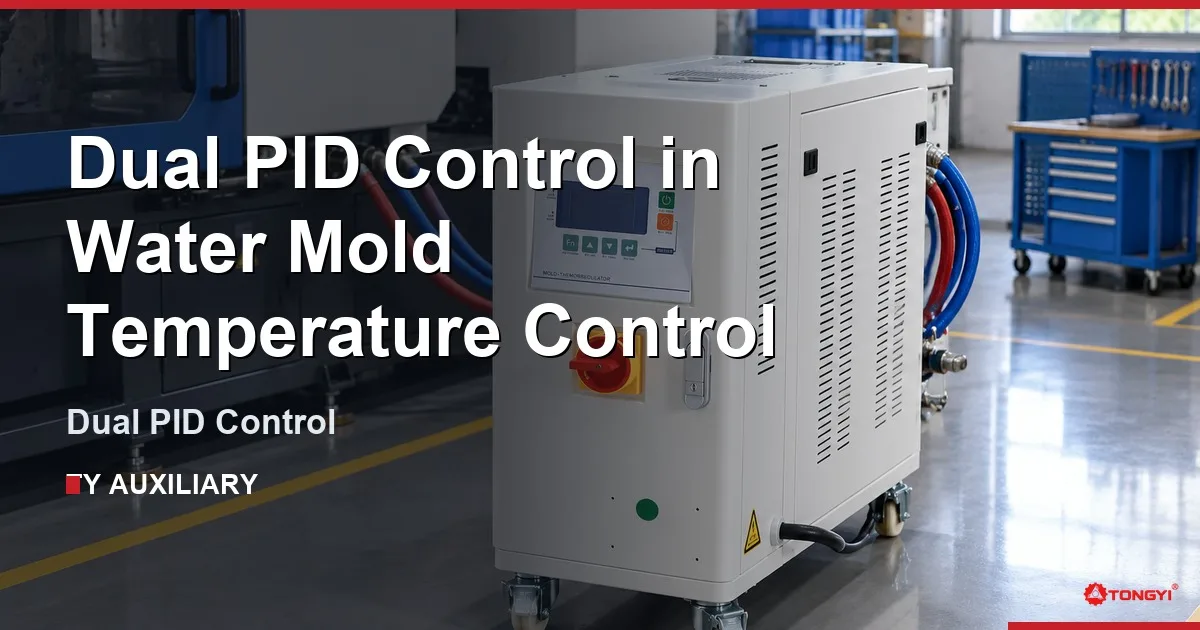
The TMC Series product page lists intelligent dual PID control that adjusts heating and cooling. The page does not describe the controller architecture or provide accuracy, stability, or cycle-time figures, so confirm implementation details with the supplier.
What is dual PID control and how does it work?
PID commonly refers to proportional-integral-derivative control. For this product, use the published description—intelligent dual PID control adjusting heating and cooling—and ask the supplier how the quoted model implements and configures that function.
Control behavior depends on the controller design, settings, sensor placement, and process load. Do not assume that a dual PID label guarantees a particular temperature band or response; validate performance against the requirements and measurement method for your application.
For the TMC Series, the product page lists intelligent dual PID control for heating and cooling. Confirm the available settings and operating behavior on the exact model and controller interface being quoted.
Why does dual PID control matter for molding processes?
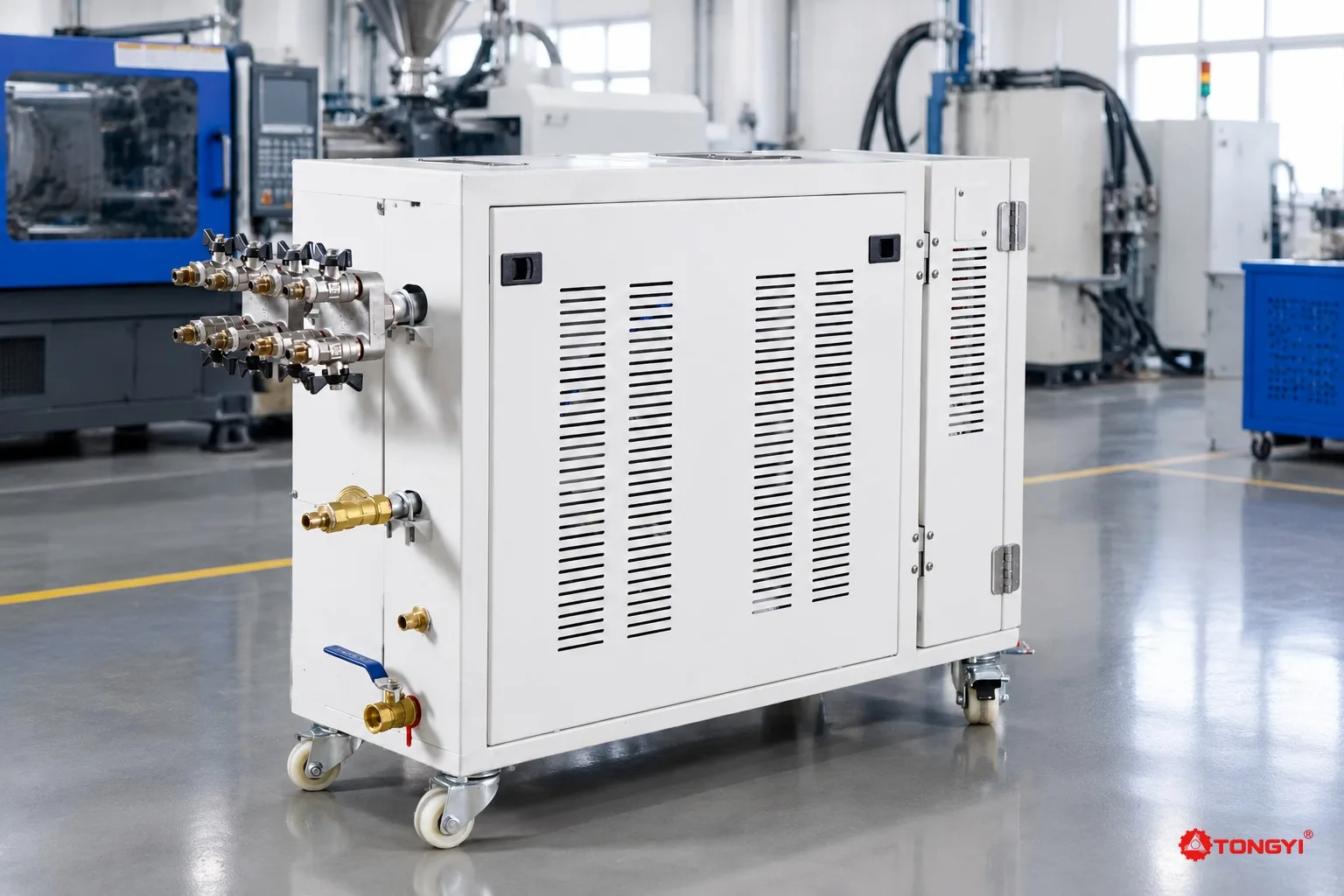
Mold temperature directly affects part quality: surface finish, dimensional consistency, sink marks, warpage, and cycle repeatability. When mold temperature swings, those effects show up as part-to-part variation that is hard to diagnose downstream.
Mold heat load can vary during a production cycle. Treat temperature repeatability and process adjustments as application-specific outcomes, then validate them during trials using the agreed sensor locations and acceptance criteria.
Single-loop versus dual PID control: what is the practical difference?
The clearest way to see the difference is to compare how each approach manages the transition between heating and cooling:
| Aspect | Single-loop control | Dual PID control |
|---|---|---|
| Heating and cooling | Managed sequentially; heating dominates, cooling is often on/off | Both loops calculated continuously and coordinated |
| Response to overshoot | Corrects after the temperature has exceeded the setpoint | Anticipates and applies cooling proportionally before or as drift begins |
| Temperature behavior | Oscillates around the setpoint as loads change | Holds a tighter band around the setpoint under varying loads |
| Fit for dynamic heat loads | Adequate for stable, low-fluctuation processes | Better suited to cyclic molding and processes with frequent load changes |
Whether dual PID control is useful depends on the process, control requirements, and available configuration. Compare the documented feature with the requirements for each mold and ask the supplier to explain any model-specific options.
When should you specify a dual PID water mold temperature controller?
If temperature control is important to a process, document the expected heat-load changes and acceptance criteria. Ask the supplier how the listed dual PID feature operates on the quoted model; do not assume it can adapt to every mold or material without configuration.
If your process is forgiving on temperature, or the mold runs in a narrow, stable condition around the clock, the added capability may not change outcomes noticeably. A frank conversation with your process team about where temperature variation actually causes scrap or downtime is the best starting point.
What else should buyers evaluate alongside the control algorithm?
Control architecture is only one selection criterion. When comparing water mold temperature controllers, evaluate:
- Pump and flow performance. The circulator must deliver adequate flow through the mold channels at your system pressure; a precise controller cannot compensate for starved flow.
- Temperature range. Confirm the unit’s rated operating range covers your process temperature, including any safety margin.
- Heating capacity. Match heater power to the heat load of the tool and process so recovery between shots is acceptable.
- Safety and protection features. Look for overheat protection, pump protection, and alarms appropriate to water-based systems.
- Interface and connectivity. Consider whether you need external communication, remote setpoint access, or integration with plant monitoring.
- Serviceability. Accessible components and clear diagnostics reduce downtime over the life of the unit.
Asking suppliers to document each of these points in a quote request makes it possible to compare offers on a like-for-like basis rather than on controller features alone.
How do you verify a supplier’s dual PID claims before purchasing?
Any manufacturer can list a control feature on a datasheet, so verification matters. Before committing, ask the supplier to describe how the heating and cooling loops are tuned and whether parameters can be adjusted on site for a specific mold. Request confirmation that the dual PID behavior is standard on the model you are quoting rather than an option, and ask how the controller behaves at a cold start, when the gap between ambient and setpoint is largest.
If possible, arrange a trial or visit an existing installation running a comparable application. Seeing the controller hold setpoint through actual molding cycles is far more informative than any brochure. The TMC Series, for example, lists intelligent dual PID control as a standard feature, and the next step is confirming — with the supplier and your own process data — how that capability performs on your specific tooling.
If you are evaluating a water mold temperature controller for an upcoming project, prepare a short specification sheet covering process temperature, mold heat load, flow requirements, and control expectations, and share it with prospective suppliers for an apples-to-apples comparison.
How should buyers interpret the published temperature-accuracy claim?
The TMC water-type series product page publishes a temperature-accuracy claim of ±0.1 °C. The page does not identify the applicable model, measurement point, or test conditions, so this figure should not be treated as a guarantee for every model or as mold-cavity temperature uniformity.
| Published item | Published scope | Details to confirm with the supplier |
|---|---|---|
| Temperature Accuracy ±0.1 °C | TMC water-type series-level product-page claim | Applicability to the quoted model, measurement point, and test conditions; this is not a mold-cavity temperature-uniformity specification. |
Source: TMC Series product page. Confirm the model-specific scope and agreed measurement method in writing.
Frequently asked questions
Does dual PID control improve temperature stability?
The product page lists dual PID control that adjusts heating and cooling. It does not state that both outputs are continuously modulated or specify a temperature band. Confirm the control behavior with the supplier and validate it against your process criteria.
Is dual PID the same as auto-tuning?
No. Auto-tuning is a function that calculates PID parameters automatically; dual PID refers to having two coordinated control loops, one for heating and one for cooling. A dual PID controller may include auto-tuning, but the two terms describe different capabilities and should not be used interchangeably in specifications.
Can dual PID control reduce cycle time?
Any effect on cycle time or part consistency is application-specific. The product page lists dual PID control for heating and cooling but does not quantify productivity results; evaluate those outcomes during process trials.
What information should I include in a quote request?
Provide your process temperature range, mold material and weight, required flow rate and pressure, heating power expectations, and the control features you require, including dual PID. The more complete the specification, the more accurately suppliers can quote and the easier the comparison.
See the Water Type Mold Temperature Controller TMC Series page for the published model specifications.
Last updated: October 30, 2026