
Sizing Pump Flow for a Mold Temperature Controller
Learn how flow and pressure affect a mold circuit, compare the TMC Series maximum pump ratings, and confirm actual operating conditions before ordering.

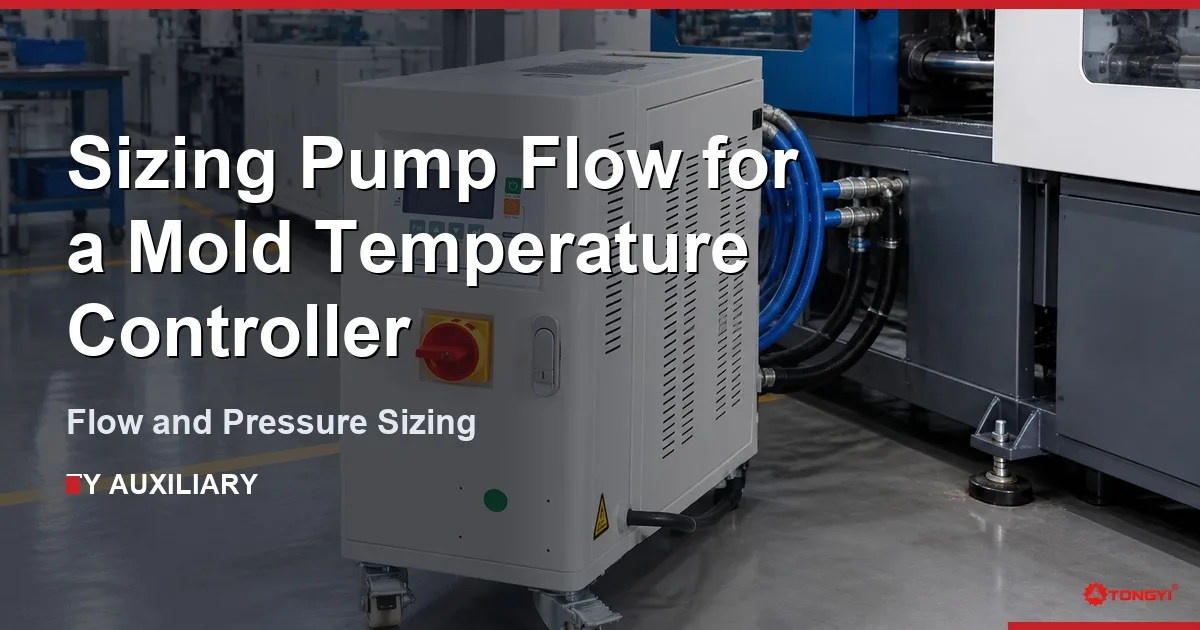
Pump selection should consider the flow and pressure required by the complete mold circuit. Ask the supplier for the pump curve or other model-specific data and have them confirm the expected operating point against your hoses, fittings, and mold channels.
Why do flow and pressure matter when selecting a mold temperature controller?
Flow determines how much heat energy you can carry into and out of the mold per unit of time; pressure determines whether the circulating pump can push that flow through the narrowest, most restrictive section of your circuit. A controller with generous heating capacity can still underperform if its pump cannot deliver adequate flow through your tool’s cooling channels at the required pressure.
Flow or pressure below an application requirement may affect circulation, but the product-page maximum ratings do not predict operating flow through a particular mold. Review the circuit layout, restrictions, and required operating point with the supplier.
How do you calculate the flow requirement for your mold?
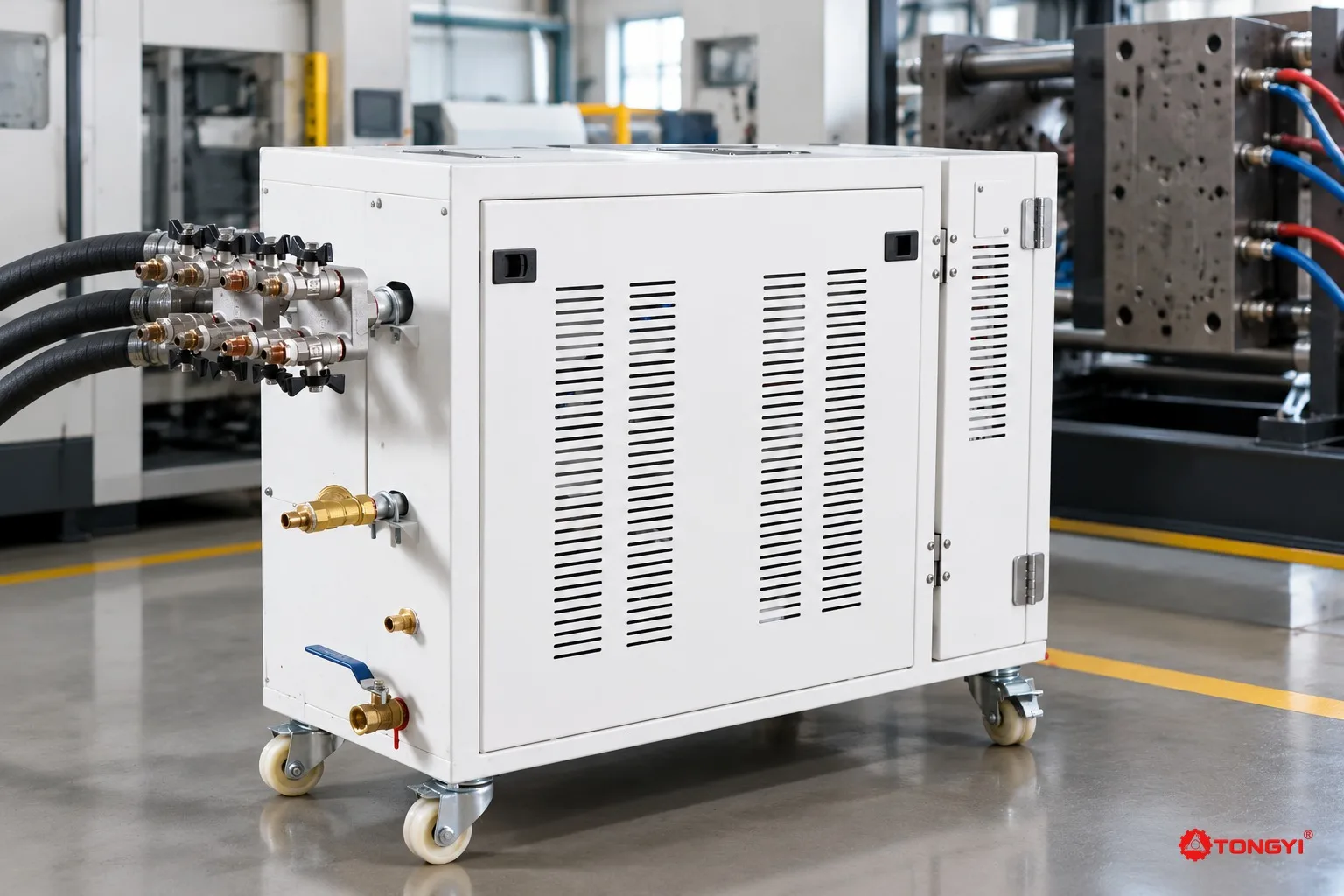
Start with the heat load of the process, then work backward to the circulating medium volume needed to carry that load at a reasonable temperature rise. In practice, plant engineers size flow using three inputs:
- The heat load to be removed or supplied, based on the resin, shot weight, and cycle time.
- The allowed temperature difference between supply and return water, which drives how much flow is needed for a given heat load.
- The geometry of the mold’s water circuits, because small channels and serial routing demand more flow at higher pressure to achieve the same surface temperature control.
Do not rely on a general higher-flow rule. Share the mold-channel layout, hose lengths, fittings, and available pump data with the supplier, and ask them to check the expected operating point against system resistance.
How much pump pressure does your loop actually need?
Total system pressure equals the resistance of every element in series: supply hose, quick connectors, mold channels, return hose, and any filters or heat exchangers. Restrictive fittings and long hose runs are frequently the largest contributors, so measure or estimate the full loop rather than the mold alone.
Pump pressure ratings are maximum values at the pump, not guaranteed delivery pressures at your operating flow. As flow demand rises, available pressure falls along the pump curve. Confirm the system resistance at the expected operating flow with your supplier, and specify a pump whose curve sits comfortably above that point. If your plant water supply varies in pressure across seasons or shifts, add margin accordingly.
Which pump specifications match common controller models?
Pump ratings vary widely across controller sizes, and the right choice depends on whether your application prioritizes pressure for restrictive tools or flow for high heat loads. The TMC Series illustrates the trade-off clearly:
| Model | Pump power | Max flow | Max pressure |
|---|---|---|---|
| TMC-90W | 0.75 kW | 60 L/min | 0.4 MPa |
| TMC-180W | 1.5 kW | 165 L/min | 0.25 MPa |
| TMC-360W | 2.2 kW | 310 L/min | 0.3 MPa |
The TMC-90W and TMC-180W list different maximum pressure and maximum flow values. Those maxima do not establish which model will perform better on a specific mold; request the pump data and confirm the operating point for your circuit.
Should you choose a high-pressure or high-flow pump configuration?
When a single controller family cannot optimize both variables, decide which one constrains your loop first:
- Choose higher pressure when the mold has small-diameter channels, serial circuit routing, long hose runs, or elevated mounting that resists circulation. A model such as the TMC-90W, with 0.4 MPa maximum pressure, maintains flow through restrictive geometry.
- Choose higher flow when the process moves large amounts of heat per cycle and the circuit geometry is relatively open. A model such as the TMC-180W, with 165 L/min maximum flow, delivers the volume needed for rapid temperature response.
- When both demands are high, step up to a larger unit such as the TMC-360W rather than pushing a smaller pump past its curve.
Reviewing the full family helps: the TMC-60W (0.37 kW, 42 L/min, 0.35 MPa) covers compact tools, the TMC-120W mirrors the TMC-90W’s pump ratings at a higher heating tier, and the TMC-240W parallels the TMC-180W’s pump with greater heating capacity.
What should you confirm with the supplier before ordering?
Pump and heater ratings are only half the picture. Before placing a purchase order, put the following in your quote request so the supplier can verify the match:
- Mold water-circuit drawings or channel diameters, lengths, and routing.
- Required supply and return water temperatures at the mold.
- Estimated total system resistance at the design flow, including hoses and fittings.
- Facility water quality and whether a closed-loop or direct circulating configuration is planned.
A supplier who reviews these details can confirm whether the pump curve intersects your system curve at a workable operating point, and can recommend the smallest controller that meets it, avoiding both underperformance and unnecessary spend.
Frequently asked questions
Can I oversize the pump on a mold temperature controller?
The listed flow figures are maximum values, not a guarantee of flow at a connected mold. Ask the supplier to confirm expected flow and pressure for your circuit; do not select a pump from maximum flow alone.
Why does maximum pump pressure drop as flow increases?
Maximum flow and maximum pressure are separate published limits and should not be treated as simultaneous operating values. Request the pump curve or supplier-confirmed operating data for the flow and resistance expected in your mold circuit.
What happens if the pump cannot overcome system resistance?
Flow through the mold channels drops, heat transfer degrades, and the controller struggles to hold setpoint. In severe cases, circulation nearly stops and the tool runs with uneven temperatures, causing cycle inconsistencies and part quality problems.
How do I verify system resistance before buying?
Calculate or measure the pressure drop of hoses, fittings, and mold channels at the design flow rate, then share the figure with your supplier. They can check the pump curve and confirm whether the controller delivers the required flow at that resistance.
See the Water Type Mold Temperature Controller TMC Series page for the published model specifications.
Last updated: October 30, 2026