
How Should Buyers Compare Supplier Quotes When Choosing a Water-Type Mold Temperature Controller?
Compare water-type mold temperature controller quotes by checking model ratings, connections, and accuracy conditions before reviewing supplier pricing.

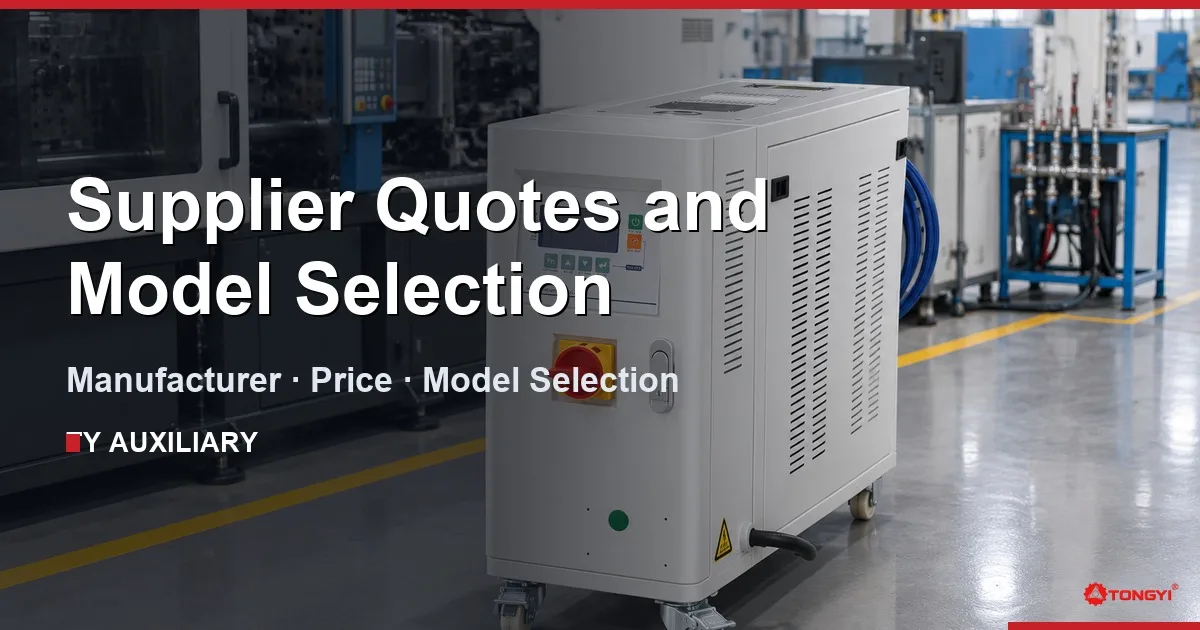
Compare water-type mold temperature controller suppliers by matching each quotation to the same process brief and exact model row, then review heater power, pump ratings, connections, and documented control claims. The TMC series lists six water-type models; its published ±0.1 °C accuracy is series-level only, so buyers should confirm model scope and test conditions before treating it as a requirement.
What should a supplier quote identify before prices are compared?
A comparable quote identifies the exact controller model and the conditions under which it will operate. Before requesting prices, describe the mold circuit, the required process temperature, the heat-transfer medium, the number and size of connections, the electrical supply, and whether the controller will serve one circuit or several. These details let each supplier quote the same scope instead of pricing different assumptions.
Ask the manufacturer to state which items are included and which are optional. That may cover the controller, pump and heater configuration, connection hardware, control functions, documentation, packing, and delivery. If a certification or a particular control interface is needed, name it in the request and ask for the relevant evidence; do not assume it is included because another quotation lists it.
What evidence helps distinguish one manufacturer from another?
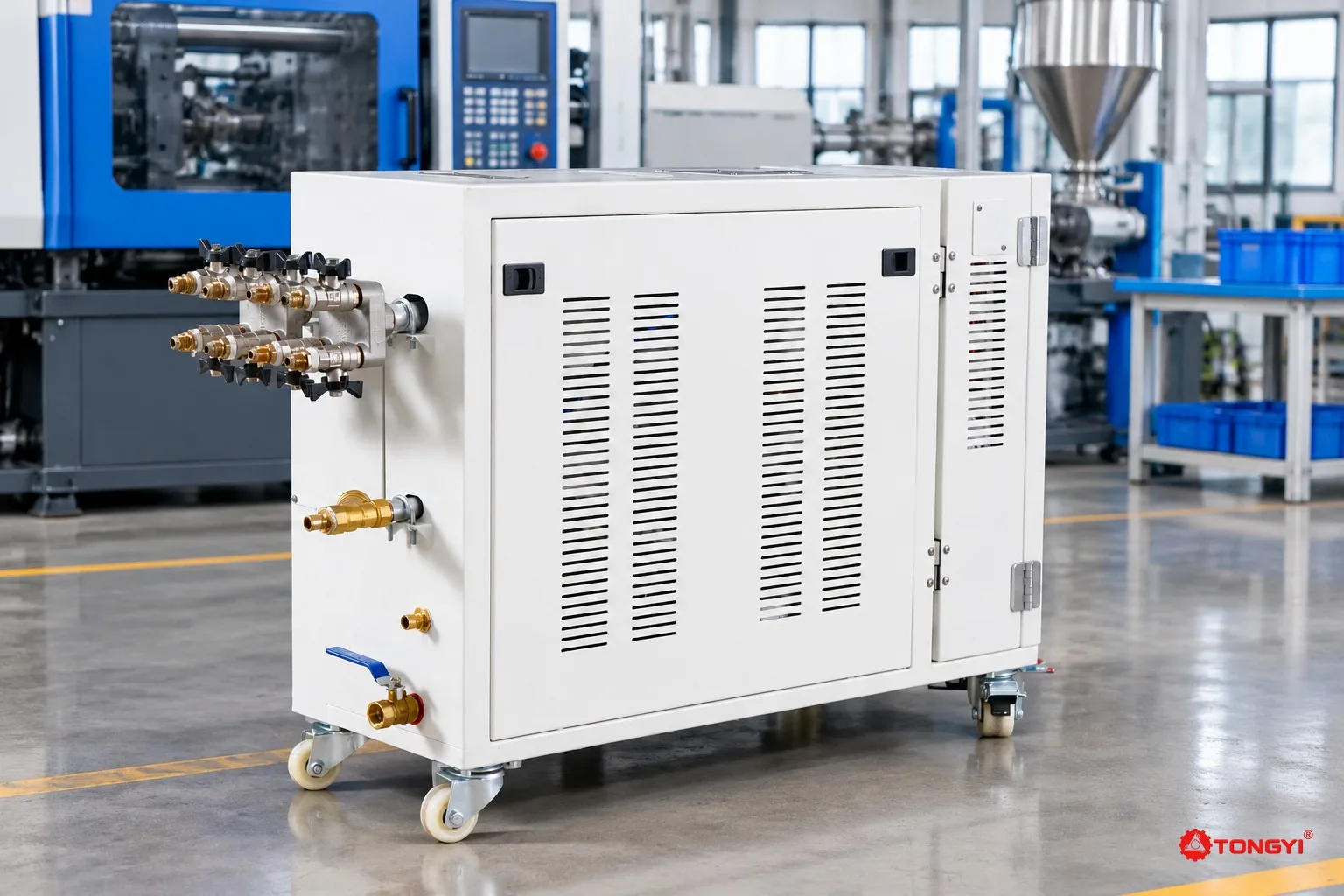
Compare manufacturers using evidence tied to the quoted model: a current specification sheet, connection drawing, operating manual, and pump curve when flow under load matters. For any missing requirement, ask the supplier to state the model, operating conditions, and verification method in writing; do not compare a broad series claim with model-specific evidence.
Give every supplier the same process brief, including temperature target, circuit layout, heat-transfer medium, electrical supply, and required interfaces. Mark each item as required, preferred, or optional, then ask suppliers to list deviations separately. A clear response identifies the model and unresolved conditions instead of repeating a headline rating.
Which TMC model ratings can buyers compare directly?
The supplied TMC water-type specification set lists heater power, pump power, maximum water flow, and maximum pressure by model. Keep each value attached to its model when comparing offers; the ratings below are not interchangeable across rows.
| Model | Heater power | Pump power | Maximum water flow | Maximum pressure |
|---|---|---|---|---|
| TMC 60W | 6 kW | 0.37 kW | 42 L/min | 0.35 MPa |
| TMC 90W | 9 kW | 0.75 kW | 60 L/min | 0.4 MPa |
| TMC 120W | 12 kW | 0.75 kW | 60 L/min | 0.4 MPa |
| TMC 180W | 18 kW | 1.5 kW | 165 L/min | 0.25 MPa |
| TMC 240W | 24 kW | 1.5 kW | 165 L/min | 0.25 MPa |
| TMC 360W | 36 kW | 2.2 kW | 310 L/min | 0.3 MPa |
The specification set lists a maximum temperature of 120 °C for the TMC water-type models. Confirm current values and operating conditions with the supplier before ordering. Maximum flow and maximum pressure are separate published ratings; the supplied data does not establish that both occur at the same operating point.
How do model differences change the selection discussion?
The TMC 90W and TMC 120W are both listed with a 0.75 kW pump, 60 L/min maximum flow, and 0.4 MPa maximum pressure, while their heater ratings differ: 9 kW and 12 kW. That is a documented distinction buyers can use to ask whether the available heating rating fits the mold’s thermal load and production cycle. It does not, by itself, establish heat-up time, temperature recovery, or performance on a particular mold.
The same comparison discipline helps with the TMC 180W and TMC 240W: both rows list 1.5 kW pump power, 165 L/min maximum flow, and 0.25 MPa maximum pressure, while heater power differs at 18 kW and 24 kW. The right choice depends on the actual circuit and required temperature behavior, not on assuming that a higher model number improves every part of the system.
For a real installation, request the pump curve or a stated flow point at the expected circuit resistance. A maximum-flow figure without a corresponding pressure point cannot show how much flow will remain through the connected mold, hoses, valves, and manifold. Confirm connection sizes and circuit layout from the model drawing as well.
How should suppliers explain price differences?
No verified selling prices are included in the supplied product information, so this article does not estimate an amount. Ask each supplier to itemize the exact model, heater and pump ratings, control scope, options, connection changes, documents, packing, and freight. Compare the same scope, not just the quoted totals.
Use one row per item and mark omissions as “not stated” rather than assuming they are included. If a supplier offers a performance value absent from the specification, ask whether it is rated, estimated, or guaranteed, which model it applies to, and how it will be measured. Record the answer and conditions with the order.
What does the published ±0.1 °C accuracy claim mean?
The TMC water-type product page publishes temperature accuracy of ±0.1 °C at the series level, but it does not identify model coverage, measurement point, or test conditions. Treat this as a published series claim, not a per-model guarantee.
Controller accuracy is not the same as temperature uniformity throughout a mold. The supplied data identifies a K-type probe thermocouple for the TMC models but provides no model-by-model accuracy table or test protocol. Ask the supplier to confirm the selected model’s scope and define the sensor location, load, stabilization method, and verification procedure before using the figure as an acceptance criterion.
What should procurement confirm before placing an order?
- Exact model and revision: record the model designation and request the current specification sheet because the data notes that specifications may change without prior notice.
- Operating conditions: state the heat-transfer medium, required temperature, circuit arrangement, and expected resistance; have the supplier confirm suitability for those conditions.
- Performance definitions: distinguish heater rating, pump power, maximum flow, maximum pressure, and temperature-accuracy claims; request test points where performance depends on operating conditions.
- Interfaces and included scope: confirm inlet and outlet sizes, circuit count, electrical requirements, accessories, documentation, packing, and delivery in writing.
- Acceptance and support terms: agree on inspection records, the method for checking stated accuracy, warranty boundaries, and the contact path for technical questions.
Temperature-control equipment can involve hot water and pressurized circuits. Installation and service should follow the manual and site safety procedures, with qualified personnel responsible for isolation and verification.
How can the agreed performance be checked at commissioning?
Agree on the test setup before delivery: selected model and revision, instruments and sensor locations, process load, stabilization period, and the records to be provided. The TMC information does not set acceptance thresholds for a particular mold, so the purchase specification must define them if they matter.
Record measured temperatures and circulation conditions at the agreed points. If flow or pressure is an acceptance item, specify its measurement location and operating point; a maximum-flow label alone is not evidence of performance in the installed loop.
Frequently asked questions about water-type mold temperature controllers
Can I choose a model from heater power alone?
No. Heater power is one selection input, but it does not show the circulation available through the actual mold circuit. Compare it with pump ratings, connection layout, the mold’s thermal load, and a supplier-confirmed operating point.
Does the ±0.1 °C figure apply to every TMC model?
The product page presents the figure as a series-level claim and does not identify model coverage or test conditions. Ask the supplier to confirm the scope in writing before using it as a model-level guarantee or acceptance criterion.
Does maximum flow mean the controller will deliver that flow on my mold?
Not necessarily. A maximum-flow rating alone does not describe flow at the pressure loss of a connected circuit. Request a pump curve or a confirmed duty point for the expected loop resistance.
Choose a water-type mold temperature controller only after the supplier has matched an exact model to the process brief and clarified its ratings, accuracy scope, interfaces, and quotation boundaries. If those items are not documented, ask for the missing evidence before comparing price or approving the order.
Product reference: TY Auxiliary water-type mold temperature controller. Model-specific ratings above are reproduced from the supplied TMC specification set; confirm its current revision with the supplier.
Last updated: October 30, 2026