Cabinet Dryer vs Inline Dryer: Batch or Continuous Drying?
Cabinet dryers suit small batches and frequent colour changes; inline dryers suit continuous production. Here is how to choose without buying both.

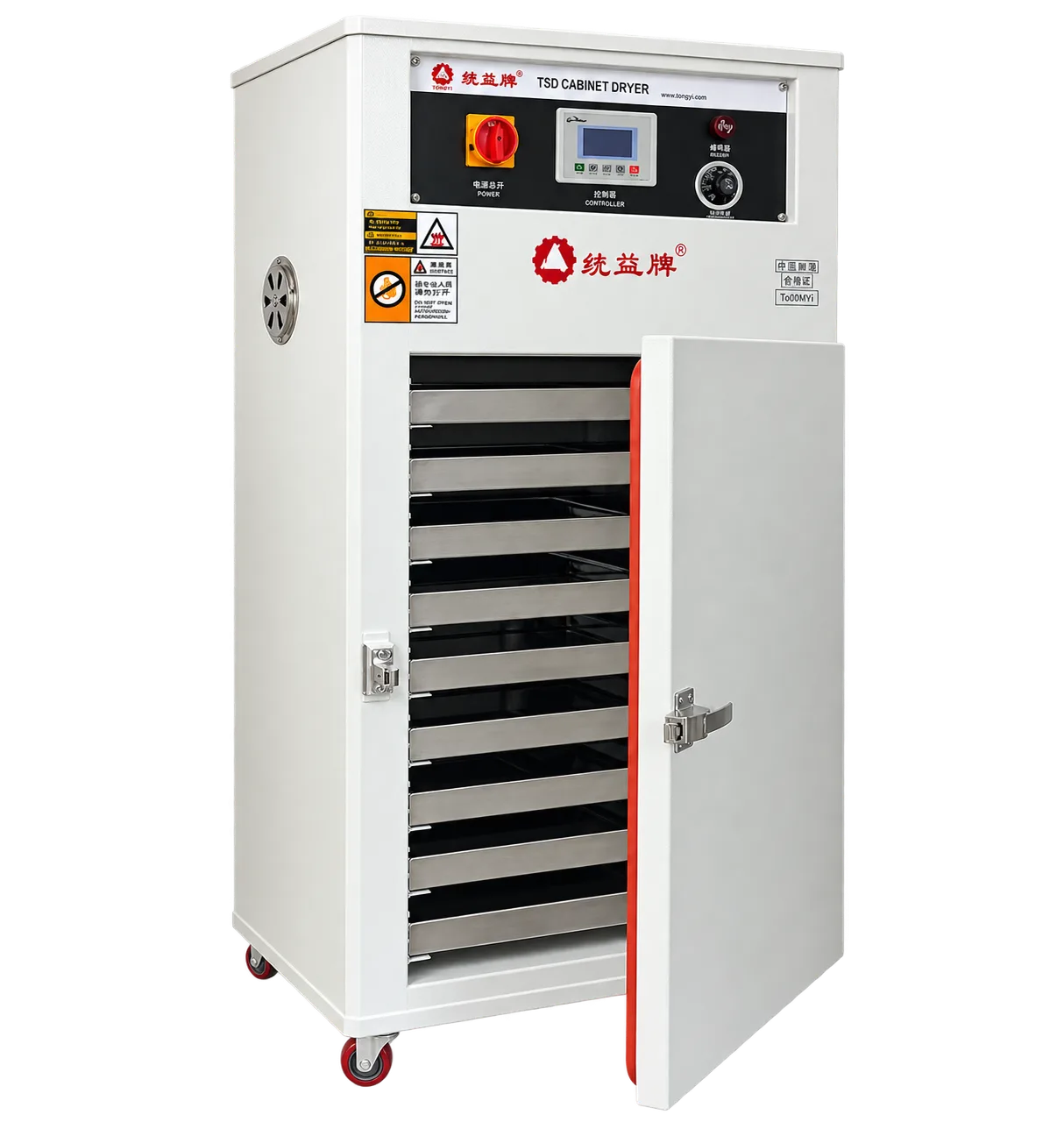
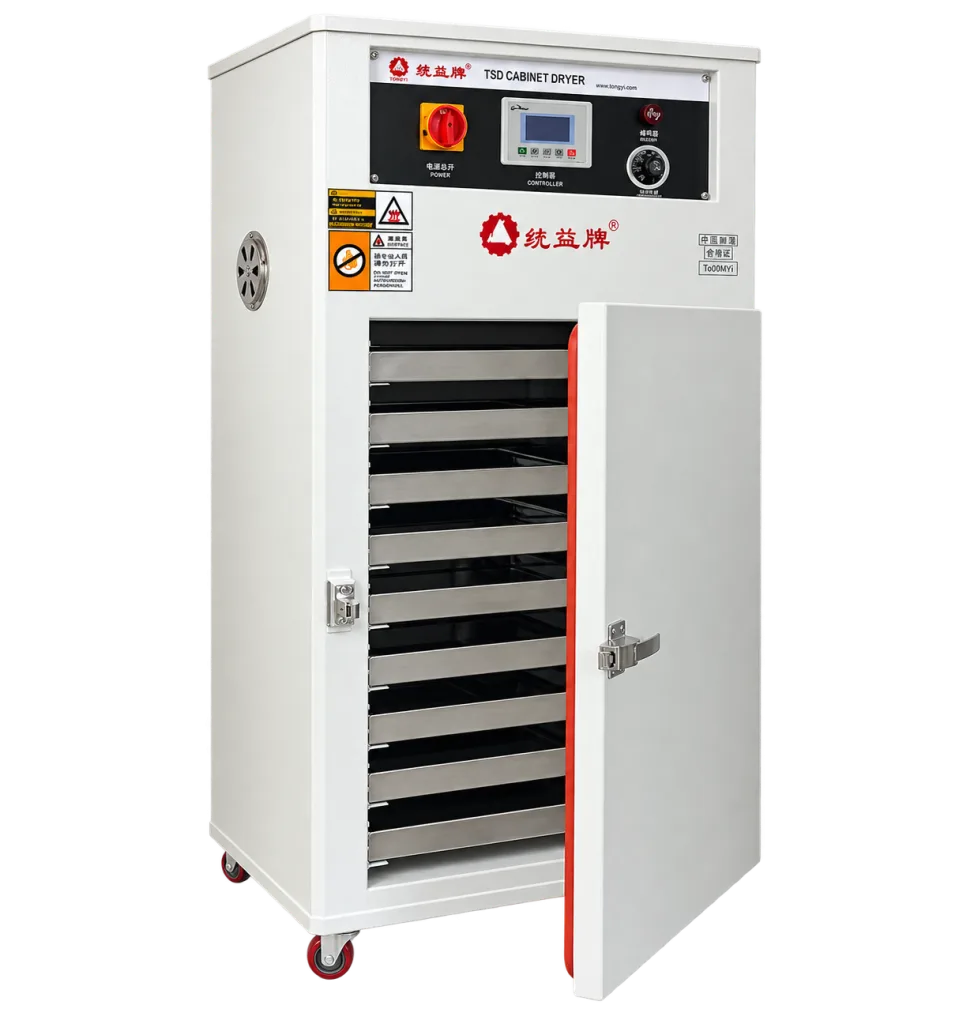
A cabinet dryer dries a batch of material in a chamber; an inline dryer dries material as it flows to the machine. The choice is decided by how often your material changes, not by how much you dry. Plants running one resin for weeks want inline drying; plants running twenty colours a month usually need a cabinet.
Buying the wrong one produces a predictable set of problems: an inline hopper that is emptied and refilled four times a day never reaches steady state, while a cabinet dryer feeding a high-volume line becomes the throughput bottleneck.
What actually separates the two types?
The difference is residence time stability. Inline drying depends on material spending the required hours in the hopper before it reaches the screw; that only works when consumption is steady. Batch drying separates the drying step from the machine entirely, so a batch can sit for exactly as long as it needs regardless of what the machine is doing.
| Factor | Cabinet dryer | Inline hopper dryer |
|---|---|---|
| Best for | small batches, many colours, trials | continuous production, one resin |
| Typical capacity | 25–300 kg per batch | 25–400 kg hopper |
| Residence control | exact, by batch | depends on consumption rate |
| Material change | minutes, no purge | requires emptying and purging |
| Dew point control | optional, on better models | standard on desiccant units |
| Labour | manual loading/unloading | automatic |
When does an inline dryer fail to dry properly?
When consumption drops below the rate the hopper was sized for. A hopper holding four hours of material at design throughput holds far more than four hours when the machine runs at half rate — which is fine — but holds less than four hours when a second machine is fed from the same hopper, which is not.
The failure is quiet: the temperature reads correct, the dryer is running, and the resin is under-dried because it did not stay long enough. This is why inline dryers need to be sized on the maximum consumption rate, not the average.
When is a cabinet dryer the better investment?
Three situations point clearly to batch drying:
- Frequent colour or resin changes — a cabinet can be emptied and reloaded in minutes, while an inline hopper needs purging and re-stabilising.
- Small total volume — under roughly 20 kg/h per material, a central desiccant system is over-specified.
- Trials and sampling — small batches that must be dried to a specification before a production run.
Cabinet dryers can also be specified with desiccant dehumidification, which makes them viable for PA and PC in small batches. A plain hot-air cabinet is limited to ABS, PMMA and similar.
Can the two work together?
Yes, and mixed plants are common. A cabinet dryer handles colour batches and trials while an inline or central system handles the high-volume resin. The split is usually drawn at the point where a material’s monthly volume justifies dedicated drying capacity.
The mistake to avoid is using a cabinet dryer as a buffer for a high-volume line: batches get pulled before the residence time completes, and the resulting splay is blamed on the resin.
What should you specify on either type?
Four items decide whether the machine works in practice:
- Temperature uniformity — a cabinet with hot and cold zones dries unevenly; ask for the measured spread.
- Dew point capability — if any hygroscopic resin will ever run, specify desiccant rather than hot air.
- Batch timing and alarm — a timer that stops the cycle and alarms prevents both under- and over-drying.
- Loading height and access — a 300 kg batch that must be lifted by hand will not be used as intended.
Where to go next
The cabinet dryer covers batch work and colour changes, while the hopper dryer handles continuous single-resin production. Where the line also needs conveying, the three-in-one unit combines drying and transport in one machine.
Send us your monthly material list and change frequency and our engineers will recommend which combination fits.